
An angel love interest is a romantic figure who is literally divine, semi-divine, or so luminously good that they read as something other than human. They get paired with a partner who is usually mortal, usually flawed, and usually the one who falls first.
The angel love interests at the center of these books are not decorative. They carry wings, duties, vows, and a moral weight that makes wanting them feel like a crime. That friction is the whole engine of the story.
If you have ever finished a romance and thought the love interest was too perfect to be believable, this trope is the inverse: the perfection is the point, and the plot is about what happens when something holy wants something back.
What Angel Love Interest Actually Means
The term covers a wide spectrum, and the edges are blurrier than most readers expect. At the strict end, you have a genuine celestial being: a guardian angel assigned to watch over a specific human, an archangel with a sword and a temper, an angel of death who collects souls and has never once been touched.
At the loose end, you have a human character written with angelic coding, someone whose goodness, patience, or beauty is described in explicitly sacred language until the metaphor stops being a metaphor. Both count. The trope is defined by the dynamic, not by whether the wings are physical.
What does not count is a character who is merely nice. Kindness alone is not angelic.
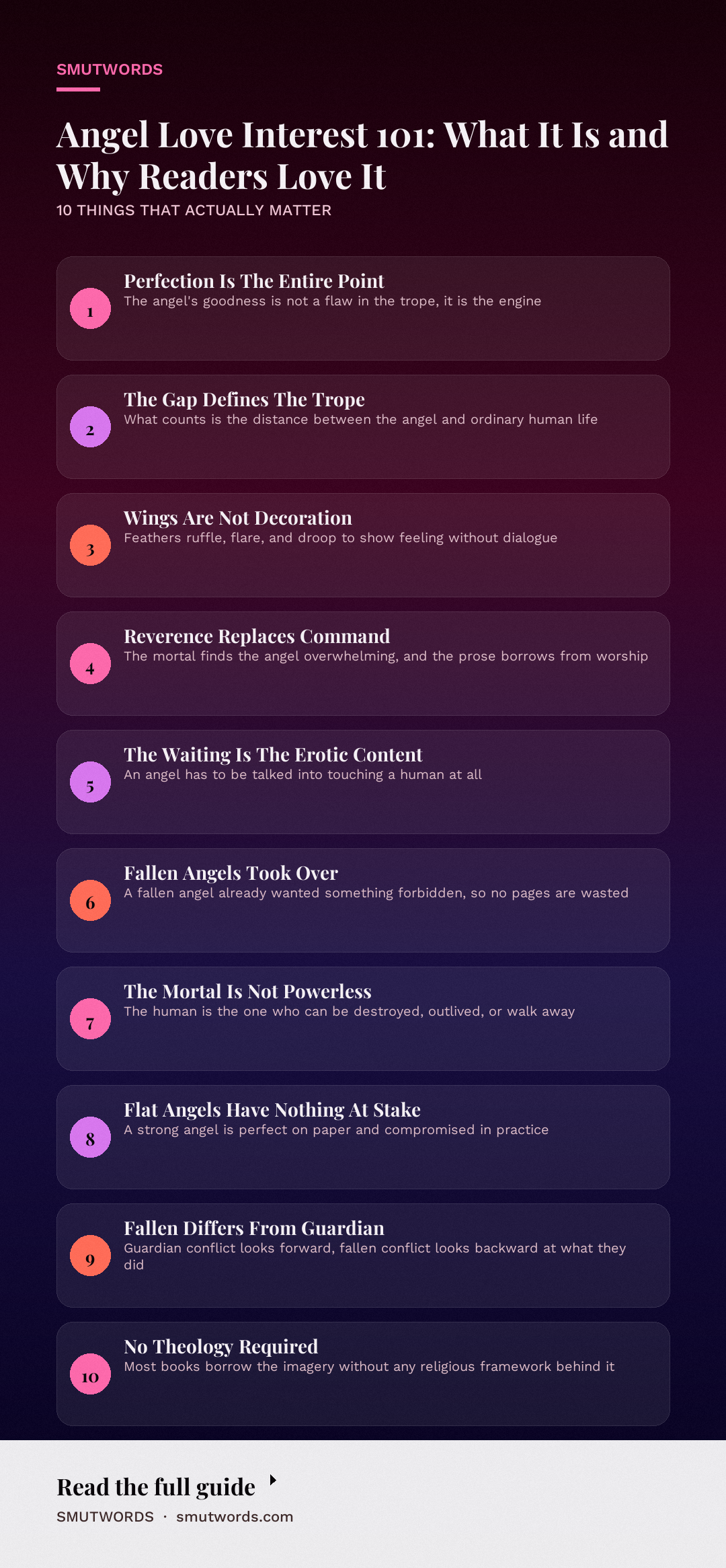
The trope requires a gap between the love interest and ordinary human experience, whether that gap is metaphysical (they have existed for millennia), moral (they have never sinned and cannot conceive of wanting to), or occupational (their job is literally to protect a soul rather than to love a person). That gap is what the mortal partner has to cross, and what the angel has to choose to abandon.
Misconceptions run thick here. A common one: that angel love interests are always soft, gentle, and sexless. Plenty of them are warriors, enforcers, or executioners who happen to be on the side of heaven.
Another: that the trope requires a religious framework. It often borrows the imagery without any theology behind it, which is why you will find angel love interests in urban fantasy, sci-fi, and straight contemporary romance where the "angel" is a paramedic who has never made a selfish choice in his life.
The most persistent misconception is that the human partner is the one with all the power in the relationship because they are the one being worshipped. The reverse is usually true. The mortal is the one who can be destroyed, discarded, or outlived, and the angel's love is the thing that keeps them safe.
That asymmetry is where the tension lives. If you want the version where power gets traded back and forth on purpose, the SmutWords guide to class difference romance runs the same machinery with money instead of divinity.
Where Angel Love Interests Come From
Angels have been romantic figures for a very long time, but the modern angel love interest as a recognizable romance archetype is a publishing phenomenon with a fairly traceable arc. The groundwork was laid in the 1990s, when paranormal romance was consolidating as a genre and authors started working through the available supernatural love interests one by one.
Vampires came first and dominated. Werewolves followed. Witches, demons, and fae each got their turn.
Angels arrived late to that party and arrived with a problem the others did not have: they were, in the source material, explicitly good. That problem turned out to be the selling point.
The 2000s saw a wave of young adult and adult romance built around guardian angels and fallen angels, and the fallen angel variant quickly became the dominant form. A fallen angel gives you everything the trope needs in one package: divine origin, a history of transgression, a punishment, and a built-in reason to be interested in a human.
It also solves the purity problem. If your angel has already fallen, they have already wanted something they should not have wanted, which means the reader does not have to spend three hundred pages convincing them to want again.
The genre shifted again in the 2010s as self-publishing and indie romance expanded what could be sold. Angel love interests moved out of the young adult aisle and into adult romance proper, which meant the sacred-versus-carnal tension stopped being subtext and became the plot. Wings became a body part the narrative lingered on. Celestial hierarchy became worldbuilding.
The "angel's charge" setup, where a guardian is assigned to one specific human and the assignment becomes a relationship, became a reliable structure because it generates forced proximity without any contrivance.
Today the trope has splintered into something wider than its origins suggest. You will find fallen angels paired with demons, guardian angels paired with mortals who do not believe in anything, and "angels" who are really just people written with sacred imagery because the author wanted the reverence without the theology.
If you are new to the broader paranormal side of this, the SmutWords guide to monster romance for beginners covers the adjacent territory well, and a lot of the craft overlap is real.
How Angel Love Interests Show Up in Erotica
On the page, the trope does very specific things, and the good versions all share certain mechanics.
The first is the description of the wings. This is not decoration, and any editor will tell you the same. Wings are the body part the reader is here for.
Enjoyed this? Get a free book.
Join the list and we will send a complete free story straight to your inbox, plus new releases every week after that. No credit card, no catch.
They are also the most useful tool in the book for showing emotional state without dialogue, because feathers can ruffle, flare, droop, or spread in ways that are readable at a glance. A strong scene uses wing movement the way a weaker scene uses a clenched jaw.
The second is the vocabulary of reverence. The mortal partner in a well-written angel romance does not just find the angel attractive. They find them overwhelming, and the prose reflects that with language borrowed from worship. This is where the trope overlaps with the way alphahole dynamics handle power on the page, though the mechanism is inverted: an alphahole commands, an angel is revered.
The third is the delay. Angel love interests almost always require the mortal to wait, and the waiting is the erotic content. A vampire can bite someone in chapter two. An angel has to be talked into touching a human at all, and each step down that ladder is a scene.
Common variants you will run into:
- Fallen angel: divine being who transgressed, usually over a previous human or a previous rebellion, and who carries the guilt into the new relationship.
- Guardian angel: assigned specifically to the mortal partner, which creates forced proximity and a duty-versus-desire conflict built into the premise.
- Angel of death: collects souls, has never interfered before, interferes for the mortal partner. Usually darker, often shorter on redemption and longer on inevitability.
- Demon and angel pairing: opposites in the celestial hierarchy who find each other, which doubles the transgression and usually doubles the heat.
- Angel's charge: heavily weighted toward caretaking, where the angel has been watching the mortal for years and the mortal has no idea.
- Wings and wing kink: focused on the physical angelic body, with the wings as an erogenous and emotional center rather than a plot device.
- Divine being love interest: the loosest variant, where the character is angelic in effect rather than in origin.
What separates a strong version from a flat one comes down to a single question: does the angel want something they should not want, and do we feel the cost of it? A flat angel love interest is perfect and therefore has nothing at stake. A strong one is perfect on paper and compromised in practice, and every scene where they choose the mortal partner over their duty should cost them something the reader can name.
The flat versions also tend to make the mortal passive. If the angel is doing all the choosing and the human is just being chosen, the book loses its engine. The best examples give the mortal partner their own transgression, their own reason to feel unworthy, and their own moment of deciding to reach for something holy anyway.
If the dynamic you want is specifically about a character earning their way back into grace, that is a slightly different mechanism, and the SmutWords glossary entry on redemption arc romance covers it directly. Angel love interests can carry a redemption arc, but the trope does not require one.
Angel Love Interest vs Fallen Angel
These two get used interchangeably and they should not be, because the difference changes what the book is about.
An angel love interest is any divine or angelic-coded partner, regardless of their current standing. A fallen angel is a specific subtype: one who has already transgressed, already been cast out or stepped down, and who is therefore starting the story from a position of loss rather than a position of purity.
The practical difference is where the conflict sits. In a guardian angel story, the conflict is forward-looking: will this angel break a rule they have never broken? In a fallen angel story, the conflict is backward-looking: can this angel be trusted, forgiven, or loved by someone who knows what they did?
Both are worth reading. If you like the version where the mortal partner has to talk someone down from their own goodness, you want the guardian variant. If you like the version where the mortal partner has to decide whether to trust someone who has already failed once, you want the fallen variant.
Many books blend the two. The blend usually works best when the fallen angel has been fallen long enough to have a reputation and short enough to still care what heaven thinks.
Frequently Asked Questions
What is an angel love interest in romance?
It is a romantic partner who is literally a celestial being, a guardian spirit, or a human written with such radiant goodness that they read as otherworldly. The pairing usually involves a mortal who falls first and has to reckon with loving something not entirely human. The trope thrives on the gap between sacred duty and earthly desire.
Why do readers like angel love interests so much?
The appeal is the clash between reverence and hunger. Wanting something holy, or being the one fallen creature an angel chooses anyway, gives the reader a fantasy of being singled out by something that has seen every soul and picked theirs. There is also the built-in tension of a being who is not supposed to want anything wanting exactly one person.
Is a fallen angel the same as an angel love interest?
No, though they overlap heavily. Fallen angel is a subtype. An angel love interest can be a guardian, an archangel, an angel of death, or a divine-coded mortal. A fallen angel has specifically transgressed and been cast out, which means they start the story already compromised.
Do angel love interest books have to be religious?
Most of them borrow the imagery without the theology. You will find guardian angels in urban fantasy settings with no church in sight, and you will find "angels" in contemporary romance who are just extraordinarily good people described in sacred language. The trope runs on the feeling of the divine, not on doctrine.
What is wing kink and how does it relate to this trope?
Wing kink is an interest in wings as an erotic and emotional focus, and it shows up constantly in angel romance because wings are the most visible sign of the love interest's otherness. In practice, wings function as a body part the narrative can linger on, a mood indicator, and a site of vulnerability. Some books treat them as deeply intimate, touched only by someone the angel trusts.
Can the mortal partner be the more powerful one?
Rarely, but it happens, and it is one of the more interesting variations. The mortal usually holds the power to hurt or refuse the angel, even if they hold no power in any other sense. Some books lean into this by making the mortal the one who can end the relationship, walk away, or die, which reframes the whole dynamic.
How do I find good angel love interest books?
Start with the ranked list on this page, which orders titles from this catalog by reader response. If you want to understand the wider paranormal space the trope sits inside, the SmutWords guide to monster romance books for beginners is a solid orientation, and the author guide will help you find which pen names write which flavor.
Final Thoughts
Angel love interests work because they turn the standard romance question into something stranger. Not "will they choose me." "Should something like that be allowed to choose anyone at all."
Who exactly gets to decide? The best books in this vein let the answer cost the angel something real, and let the mortal partner do more than wait to be saved. Start with the ranked list below, and if you want to understand the broader genre the trope lives inside, the monster romance guide is the right next click.






Loading comments…