
A class difference romance is a love story built on the gap between two people's bank accounts, zip codes, and family names. One is rich, one isn't, or one has access and pedigree while the other has grit and a paycheck that barely covers rent. The couple's attraction runs straight into that gap, and the book's real work is watching them figure out whether the gap is a wall, a bridge, or something they can bulldoze together.
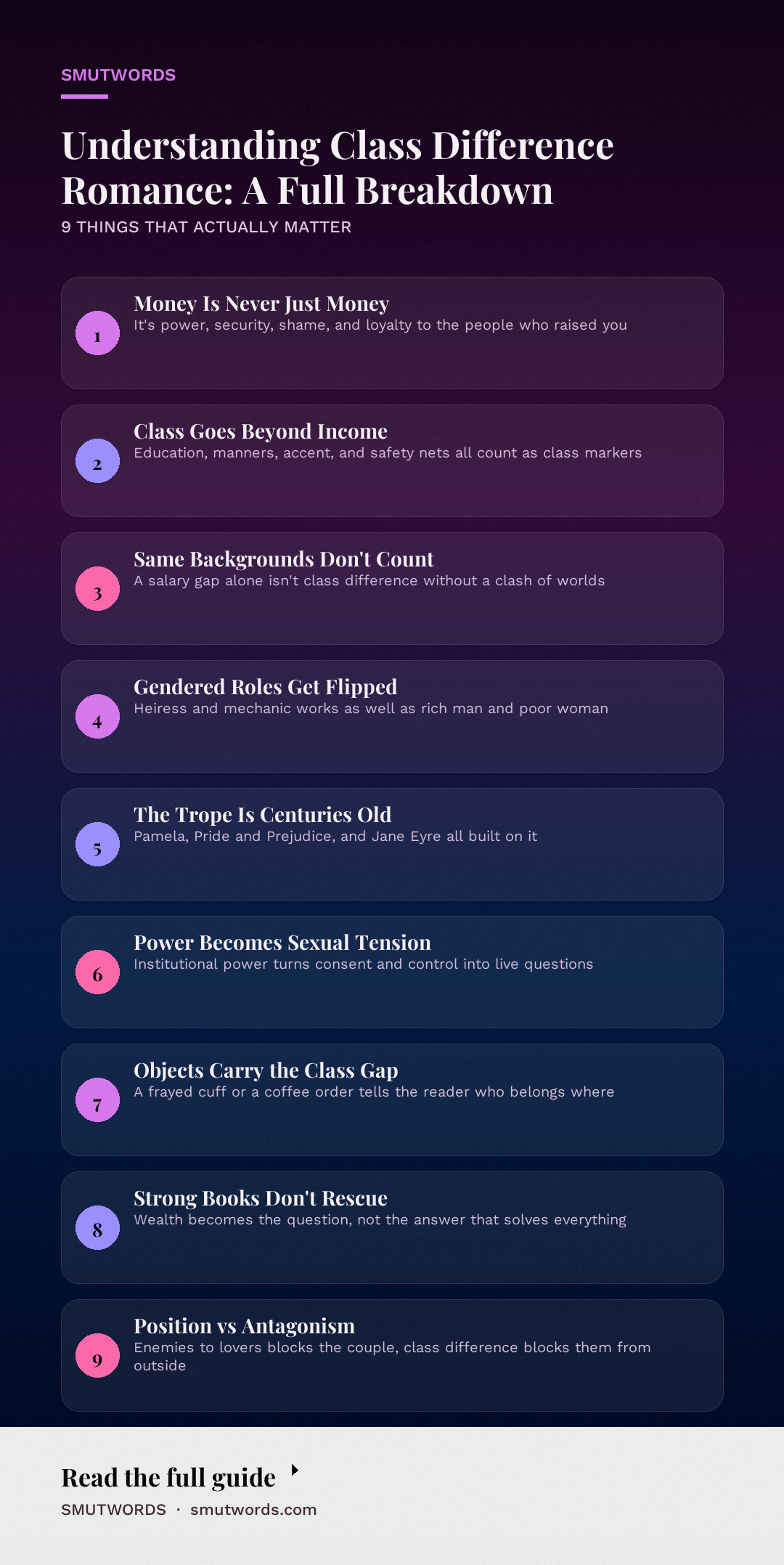
The class difference romance is one of the oldest engines in the genre, and it stays popular because money is never just money. It's power, security, shame, loyalty to the people who raised you, and the terrifying question of whether you're being loved or purchased.
Readers come to these books for the friction. Two people who shouldn't fit, fitting anyway. The fantasy is not that money stops mattering. It's that two people get honest about it and build something that survives the truth.
What Class Difference Romance Actually Means
The term describes a romance where the central couple's socioeconomic positions are meaningfully different, and that difference drives the plot, the conflict, and the character growth. The wealth gap can be extreme (a billionaire and a diner waitress) or subtle (a tenured professor and a contractor with a union job). What matters is that the gap is real and visible on the page.
"Class" here means more than income. It covers education, manners, accent, the restaurants you know how to order in, the vacations you took as a kid, whether your family owns property, whether you have a safety net, and how much shame you carry about any of it. A nurse with a master's degree and a hedge fund heir can be a class difference romance even though both are comfortable. The distance is cultural as much as financial.
What doesn't count: a couple with similar backgrounds where one is simply richer this year. A startup founder and a teacher who grew up in the same suburb, went to the same state school, and share the same references are not a class difference romance even if their salaries diverge. The trope needs a genuine clash of worlds, habits, and assumptions.
Common misconceptions, quickly:
- It's just about money. Money is the visible symptom. The actual conflict is about belonging, worth, and whose life gets treated as the default.
- It's always rich man, poor woman. Plenty of these books flip it. Heiress and mechanic, wealthy older woman and younger tradesman, rich girl and broke artist are all live variants.
- It requires a happy ending where the poor partner gets rich. Strong versions resist this. The couple negotiates a shared life that neither one's original world fully contains.
- It's the same as enemies to lovers. Often they overlap, but they aren't the same axis. See the comparison section below.
The label "class difference romance" is genre-critic shorthand rather than an in-world term. Publishers shelve these books under contemporary romance, historical romance, or billionaire romance. Readers searching for the dynamic use it because it names the thing they actually want: the vertigo of crossing a line that other people drew for you.
Where Class Difference Romance Comes From
The trope is as old as the novel. Samuel Richardson's Pamela (1740) is the founding text: a servant girl resists her wealthy employer's advances until he marries her. That book was a sensation and a scandal in equal measure, and its DNA is in every rich-boss-poor-employee romance published since.
Jane Austen spent a career on it. Pride and Prejudice is a class difference romance with a hate to love engine bolted on, and the Bingley sisters exist almost entirely to enforce the social line Darcy considers crossing.
Jane Eyre raised the stakes with a governess and a landed gentleman, plus a mad wife in the attic. By the Victorian era, the governess romance was a full subgenre, because the governess sat in a unique and agonizing position: educated like a lady, employed like a servant, welcome at the table but never quite at the family.
Twentieth-century category romance industrialized the trope. Harlequin and Mills & Boon churned out doctor-and-nurse, boss-and-secretary, and prince-and-commoner plots for decades, with a strong mid-century run of "poor girl, titled man" stories. The economics of the genre shaped the fantasy. These were books sold to women who worked, and the promise of being chosen by someone with power over your material life was part of the appeal.
The modern billionaire boom arrived with the 2010s and erotic romance's mainstream moment. Fifty Shades made wealth and dominance a package deal in the public imagination, and the market followed with a flood of CEO, tycoon, and royal titles.
What shifted in this era was the honesty about sex and about power. Earlier category romance softened the class gap into a misunderstanding. Contemporary versions put the gap on the table and make the couple argue about it.
The most recent shift is a correction. Readers and authors got tired of the fantasy where wealth simply rescues the working-class partner. Newer books foreground the working-class character's pride, community, and competence, and they make the rich partner do the adapting. The bestseller lists in contemporary romance over the past several years increasingly reward stories where money is treated as an obstacle to intimacy rather than a gift that solves everything.
How It Shows Up in Erotica
On the page, class difference does structural work. It gives the couple a reason to be in the same room (the job, the contract, the wedding they're both attending) and a reason to stay in conflict (family pressure, professional reputation, the fear of being seen as a gold digger or a predator). That double engine is why the trope carries so many plots.
Here is what strong versions actually do with it.
The power dynamic is sexual, not just social
The wealthier partner usually holds institutional power. They sign the checks, own the building, control the schedule. In erotica, that institutional power translates directly into sexual tension, because consent and control become live questions the characters have to answer out loud. A good scene makes that negotiation erotic. A weak scene pretends the power isn't there and just stages a sex scene in an expensive apartment.
The physical details do the class work
Watch the objects. A frayed cuff. The way one character knows which fork to use and the other watches to learn. A car that costs more than the other's student debt.
An apartment with staff who know the rich partner's coffee order. The best authors load scenes with these signals and let them carry the class gap without a single line of exposition.
Enjoyed this? Get a free book.
Join the list and we will send a complete free story straight to your inbox, plus new releases every week after that. No credit card, no catch.
Common variants authors use
- Rich boy, poor girl. The default. Often built on a workplace or small-town frame where the wealth gap is public knowledge.
- Poor boy, heiress. Flips the power and adds a family-approval plot, since her relatives see him as a threat to the estate.
- Workplace class divide. Boss and employee, executive and service staff, founding team and contract worker. High proximity, high stakes, HR policies that may or may not exist in this fictional company.
- Royalty and commoner. The class gap becomes a constitutional crisis. Protocol, security, and public scrutiny replace the usual family dinner tension.
- Billionaire and waitress. The most explicit version, and the one that most often stumbles into rescue fantasy if the author isn't careful.
- Academic and tradesperson. A subtler build. The gap is cultural and intellectual as much as financial, and the book is usually about mutual respect rather than money.
The tradesperson side of that last one has real kinship with the lumberjack romance, which trades institutional wealth for physical competence and rural independence. Both tropes put a self-made, hands-on character across from someone who lives on credentials and inherited access.
For a wider look at characters who bring their work to bed, musician romance runs on the same collision between self-made grit and institutional power, just with a record contract in place of a family estate. The musician romance breakdown covers how that subgenre handles money and fame.
What makes a version flat versus strong
Flat versions treat the rich partner as a fantasy delivery system. The wealth exists to buy the poor partner nice things, and the plot resolves when she accepts them. The working-class character has no community, no ambition of her own, and no reason to exist outside the romance. Class is a coat of paint.
Strong versions give the poorer partner a full life that the rich partner has to earn entry into. They let the wealth be genuinely attractive and genuinely corrosive. They stage at least one fight about money that is actually about love, and they resolve it by changing the couple's arrangement, not by changing one person's tax bracket.
The best versions also let the rich partner be vulnerable about what money cost them. Isolation, distrust, a family that treats affection as a transaction. When both characters carry class wounds, the romance becomes mutual repair instead of a rescue.
Where the trope overlaps with others
Class difference frequently rides on top of a hate to love arc, since the couple's mutual assumptions give them excellent reasons to dislike each other before they get close. It also pairs naturally with secret baby plots, where a pregnancy forces a reckoning about child support, name, and inheritance that the couple can no longer postpone.
Historical versions lean hard into the marriage in trouble machinery once the wedding happens, because a mismatched marriage in a society that treats it as a contract has its own built-in conflict. The trope also works as pure backstory, where the class gap explains why a character is the way they are rather than driving the plot forward.
Class Difference Romance vs Enemies to Lovers
These two get confused constantly, and the confusion costs readers good recommendations.
Enemies to lovers is about antagonism. The couple starts in opposition, often with real history, and the arc is about hostility turning into trust. The obstacle is each other.
Class difference romance is about position. The couple may like each other from page one and still be blocked by the gap. The obstacle is the world around them: families, employers, immigration status, professional reputation, the assumptions strangers make when they see the two of them together.
Plenty of books are both, and the strongest ones are. The distinction matters because it tells you where the tension lives. If the couple's problem is that they can't stand each other, you want enemies to lovers. If the problem is that everyone else can't stand them together, you want class difference.
Frequently Asked Questions
What is a class difference romance?
It's a romance where the central couple comes from different socioeconomic backgrounds, and that gap shapes the conflict. The book tracks how they handle money, family expectations, social circles, and the assumptions each brings about the other's world. The arc usually ends with them building a life that neither one's original class fully contains.
Is class difference romance the same as billionaire romance?
Billionaire romance is one delivery system for the trope. Class difference romance is the broader category and includes royalty and commoner, academic and tradesperson, and any pairing where social position separates the couple. A billionaire romance with two trust fund characters isn't a class difference romance at all.
Why do readers like class difference romance so much?
The friction is built in. Two people with incompatible worlds have to earn each other, and the payoff feels larger than a standard meet-cute. It also lets readers play with a real fantasy about being chosen across a line that other people enforce, without pretending the line doesn't exist.
Does class difference romance always end with the poor character getting rich?
No, and the best ones don't. Some couples land in the middle, some live mostly in the working-class partner's world, and some keep separate finances entirely. What they share is a negotiated arrangement that both characters actively chose. Books where wealth simply absorbs the poorer partner tend to read as weaker because the conflict evaporates instead of resolving.
Can class difference romance work in a historical setting?
It's arguably the native form. Governess and gentleman, servant and heir, and country doctor and titled lady are staples of historical romance for good reason. The stricter social rules of the period make the gap more punishing and the rebellion more satisfying. Contemporary versions trade legal barriers for cultural ones and often hit just as hard.
What's the difference between class difference romance and a redemption arc romance?
Class difference is about position, redemption arc romance is about a character atoning for past harm. A rich partner can have both arcs, but they resolve on different terms. The class conflict resolves when the couple finds a workable arrangement. The redemption arc resolves when the character is forgiven, which is a separate emotional beat.
Final Thoughts
Class difference romance works because money is the most honest mirror a couple can hold up to each other. It exposes what they value, what they're afraid of, and what they'll give up to belong somewhere new. The best books in this trope refuse to let wealth be the answer. They make it the question.
If you want a place to start, the SmutWords catalog has a ranked list of class difference and adjacent titles below. Pair it with the Penny Pepper free use series reading guide if you want to see how the same couple keeps negotiating power across multiple books, since that series makes class and control an ongoing conversation rather than a single arc.








Loading comments…