
An au pair romance is a love story built around a live-in childcare arrangement: your protagonist takes a job caring for someone else's kids, moves into their house, often into their country, and falls for the person who hired them, a relative, or another adult in the household orbit.
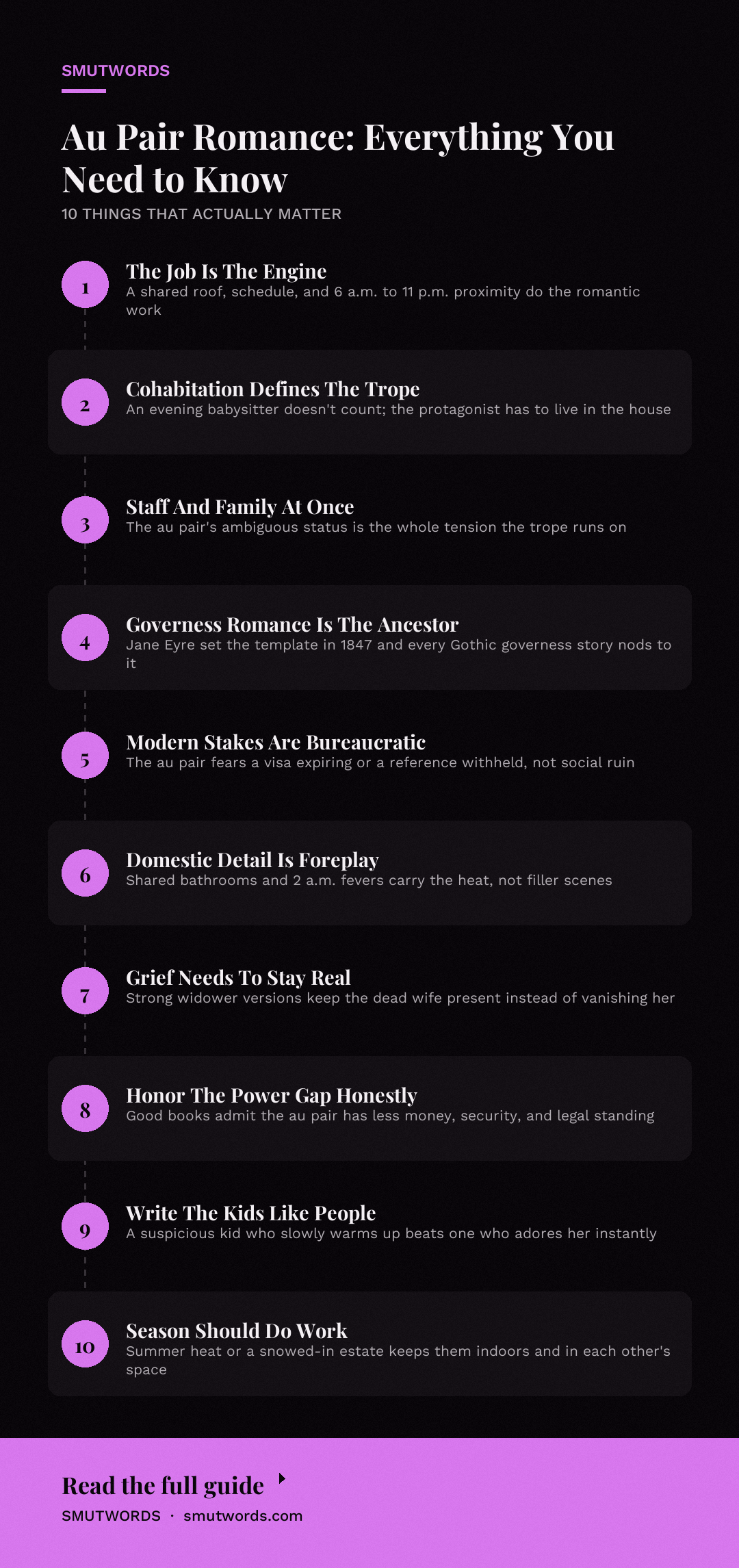
The job is the engine. It puts two people under one roof with a shared schedule, shared meals, and a built-in reason to be in each other's space at 6 a.m. and 11 p.m.
The au pair romance trope runs on that forced closeness, then adds the voltage of a paycheck, a work visa, and a guest bedroom that is not quite a guest bedroom. It is cozy and combustible at once, and it has quietly become one of the most reliable setups in contemporary romance.
What Au Pair Romance Actually Means
The name comes straight from the real-world au pair program, a cultural exchange arrangement where a young adult lives with a host family abroad, provides childcare, and gets room, board, and a stipend. The "au pair" phrasing (French for "on par" or "equal") carries an implied peer relationship, which is exactly the tension the trope exploits. The protagonist is staff and family at the same time. That ambiguity is the whole point.
In fiction, the term has stretched well past the literal au pair program. A nanny romance set in the same city counts. A governess romance in a Gothic manor counts. A live-in caregiver romance for an elderly parent or a sick child counts.
The category is defined by the living arrangement and the caregiving labor, not by the passport.
What does not count: a one-night stand with a hot single dad who happens to have kids. A babysitter who comes by for an evening does not an au pair romance make, because the proximity is temporary and the stakes are low. The trope needs cohabitation. It needs the protagonist waking up in the family's house, eating their food, learning their rhythms, and being unable to clock out at the end of the day.
A few common misconceptions worth clearing up. First, au pair romance is not automatically a power-imbalance kink, though it often plays with one. Many versions deliberately neutralize the employer/employee gap (the widower who treats her as an equal, the family that folds her into Sunday dinners).
Second, it is not the same as a boss/employee office romance. The domestic setting changes everything because the intimacy is constant and non-negotiable. You cannot avoid your boss in the hallway when the hallway is also your kitchen.
Third, the "foreign" element is flavor, not requirement. The classic version sends the protagonist to a windswept coastal town, a Paris apartment, a Scottish estate. But plenty of strong au pair romances keep the protagonist in her own country and simply move her into a stranger's home. The travel wish-fulfillment is a bonus, not the load-bearing wall.
Where Au Pair Romance Comes From
The governess romance is the ancestor, and it is old. Jane Eyre set the template in 1847: a plain, poor, principled young woman takes a position in a grand house, cares for a child, and falls for the brooding master whose secrets could ruin her. Charlotte Brontë did not invent the arrangement, but she made it permanent furniture in the genre. Every Gothic romance with a governess at its center is nodding at her.
For a century, the governess was the respectable way to put an unmarried heroine in a rich man's house without scandal. She had to be educated, modest, and dependent enough that the job mattered. The class gap did the work that a modern au pair's visa status does now: it made her vulnerable, made the relationship dangerous, and made a happy ending feel hard-won.
The contemporary au pair romance is a fairly recent publishing phenomenon, and its rise tracks two real-world shifts. The first is the explosion of the live-in childcare arrangement as a genuinely global, middle-class practice from the 1980s onward, which gave readers a familiar, modern frame for the old governess setup.
The second is the single-dad and widower romance boom in indie and digital publishing, which found in the au pair a perfect heroine: young, mobile, emotionally available, and dropped directly into a grieving family's daily life.
How the portrayal has shifted is worth tracking. Older governess stories leaned on class, propriety, and the threat of dismissal. The modern au pair romance leans on consent culture, immigration paperwork, and emotional labor.
Where the governess feared ruin, the au pair fears a visa expiring, a reference withheld, or a child getting attached to someone who might have to leave. The stakes got bureaucratic and tender at the same time.
There has also been a tonal drift toward warmth. The Gothic version is all secrets and shadowed corridors. The au pair version is sunlit kitchens, school runs, and a slow thaw. Both descend from the same root, and readers routinely love both.
How It Shows Up in Erotica
On the page, the au pair romance is a proximity machine. A good author milks the mundane logistics for all the heat they are worth: the shared bathroom schedule, the child's fever at 2 a.m. that puts the two adults in a dark hallway together, the employer watching from the doorway as the au pair reads bedtime stories in a soft voice.
The domestic detail is not filler. It is foreplay.
The strongest versions treat the slow burn as the main event. The employer and the au pair circle each other across weeks of small, charged moments. He makes her coffee. She notices the wedding ring he still wears.
A hand brushes a hand over a car seat. The heat comes from restraint and from the reader knowing exactly how close the two of them are living.
Here is how the trope most often breaks down on the page, and what separates a strong version from a flat one:
Enjoyed this? Get a free book.
Join the list and we will send a complete free story straight to your inbox, plus new releases every week after that. No credit card, no catch.
- The widower thaw. The employer is grieving, the au pair brings warmth back into the house, and the emotional arc is about permission to feel again. Strong versions let the dead wife stay a real presence rather than a convenient obstacle. Flat versions use grief as a plot device that vanishes the moment the hero gets hard.
- The forbidden-tension version. Strict house rules, a contract clause against fraternization, a professional distance that keeps collapsing. Works best when the rule is real and the consequences are concrete. Weak versions invent a rule nobody would actually enforce.
- The travel-escape version. The protagonist is abroad, lonely, reinventing herself, and the romance is tangled up with the new country. Strong versions make the setting a character. Flat versions slap a Paris postcard on a story that could happen anywhere.
- The wrong-household-member version. She falls for the brother, the uncle, the ex-husband who keeps showing up, or the other staff member. The best of these play with the reader's assumption that the employer is the hero.
- The rival-employed version. Two au pairs, or an au pair and a housekeeper, competing for the same attention. Rarer, and delicious when the rivalry is charged rather than petty.
- The secret-identity version. She is not who her paperwork says, or he is not the simple father he pretends to be. This is where the trope can borrow a little of the suspense of a stalker romance without going dark, and it can borrow a little of the family-secret architecture of a Gothic romance while staying in the sun.
What makes a strong version work is that it honors the imbalance honestly. The au pair has less money, less security, and fewer options than her employer. The good books do not pretend otherwise.
They let the employer use his power to protect her, and they let her use her position to reach the children he cannot reach. The relationship becomes a genuine exchange rather than a rescue.
The flat version skips all that. It makes the au pair a naïf, the employer a billionaire with a jaw, and the children props who disappear into a playroom for 200 pages. It resolves the power imbalance by simply not mentioning money. It treats the forbidden element as a rule to break rather than a real cost to weigh.
Craft-wise, the best au pair romances also write the children like people. A kid who is suspicious of the new au pair and slowly warms up is one of the most satisfying subplots in the whole genre. A kid who immediately adores her is a missed opportunity.
One craft note that applies to any version with a power gap and a slow burn: the check-in matters. The heat in these stories comes from two adults who want each other and are choosing, moment to moment, to be careful. If you are writing or reading a scene where the employer finally crosses the line, the scripts for checking in during a scene without killing the mood are worth keeping in mind.
Consent and tension are not opposites. The tension comes from the care. If you write power gaps for a living, a look at how domspace works in practice will sharpen the same instincts.
Setting and Season as Heat Sources
Au pair romances love a season. A summer placement in a coastal town is sweat and bare shoulders and doors left open for air. A winter placement on a snowy estate is firelight, shared blankets, and being snowed in. Whichever you pick, the season should do work: keep them indoors, keep them close, keep them in each other's clothes and schedules.
The Kids as Emotional Engine
Readers return to this trope for the family warmth as much as the sex. A scene where the employer watches the au pair teach his daughter to swim hits harder than a scene of the employer and au pair alone, because it shows him what he has been missing. The children are the proof that she belongs. That is the specific pleasure the trope delivers that no other setup quite does.
Au Pair Romance vs Governess Romance
The closest genuine comparison is between au pair romance and governess romance, because one keeps turning into the other in readers' search bars. The governess romance is the historical version: an educated, dependent young woman in a grand house, often in the 18th or 19th century, bound by propriety and class. The au pair romance is the contemporary version of the same setup, with a passport instead of a class barrier and a childcare contract instead of a recommendation letter.
The mechanics are nearly identical, which is why readers hop between them. If you love one, you will love the other. The main difference is the flavor of the danger.
The governess fears social ruin. The au pair fears losing her visa, her reference, or her place in a family she has come to love. Both are about a woman with something to lose falling for the man who holds the power to take it away.
The two tropes are so intertwined that many authors write both and market them together. If you are building a reading list around au pair romance, keep a governess romance on it too. The contrast teaches you what each version is actually doing.
Frequently Asked Questions
What is an au pair romance?
An au pair romance is a love story where the protagonist works as a live-in childcare provider, often in a foreign country, and falls for their employer or another adult in the household. The employer might be a single dad, a widower, or a couple navigating a divorce, and the romance builds out of the forced proximity of sharing a home.
What is the difference between a nanny romance and an au pair romance?
In practice, very little. Nanny romance is the more common American term, and au pair romance usually implies an international placement and a cultural-exchange frame. Readers use the labels almost interchangeably, and publishers often pick whichever keyword is trending. The living arrangement and the caregiving labor are the same in both.
Is au pair romance the same as boss-employee romance?
It overlaps, but the domestic setting makes it distinct. An office romance keeps the couple apart for most of the day, and the tension comes from the gap between professional and personal. An au pair romance keeps them together constantly, and the tension comes from being unable to leave the house to escape it. The intimacy is a 24/7 condition.
Why do readers love au pair romances?
The proximity is the main draw. Two people living under one roof, sharing meals and childcare and quiet late-night moments, build intimacy fast. Readers also love the family warmth, the travel wish-fulfillment, and the forbidden charge of a relationship that breaks a contract clause or a professional line.
Are au pair romances always slow burn?
Mostly, yes. The trope rewards a long buildup because the setting itself is a slow burn. Some authors do write faster, steamier versions, but the reader expectation is for weeks of charged small moments before anything happens. If you write one, give the build room.
What about the power imbalance in an au pair romance?
The imbalance is real and the good books treat it as real. The au pair has less money, less legal standing, and less security than her employer. The best versions either resolve that imbalance honestly by giving her genuine leverage, or use it deliberately as part of a redemption arc romance where the employer has to earn her trust. Readers are comfortable with the imbalance when the author is.
Where does the au pair romance come from?
The line runs back to the governess romance of the 19th century, with Jane Eyre as the template. The contemporary au pair version emerged as the global live-in childcare arrangement became common and as single-dad and widower romances got popular in digital publishing. The trope modernized the old class-imbalance story with a passport and a contract.
Final Thoughts
Au pair romance is one of the genre's great natural engines: a stranger dropped into a family's most ordinary and intimate moments, with a paycheck and a visa on the line. It rewards patience, domestic detail, and a writer who takes both the warmth and the power gap seriously.
If you want the version that best shows what the trope can do, start with a strong contemporary single-dad au pair romance in a setting that feels lived-in. Let the coffee get made. Let the kids get attached. Let the slow burn do the heavy lifting.




Loading comments…