Shibari is the Japanese practice of tying a partner with rope, built on precise patterns, deliberate tension, and a deep exchange of trust between the person tying and the person bound. In romance and erotica, it supplies something few other kinks can match: a visual language of restraint that is also, unmistakably, a form of care.
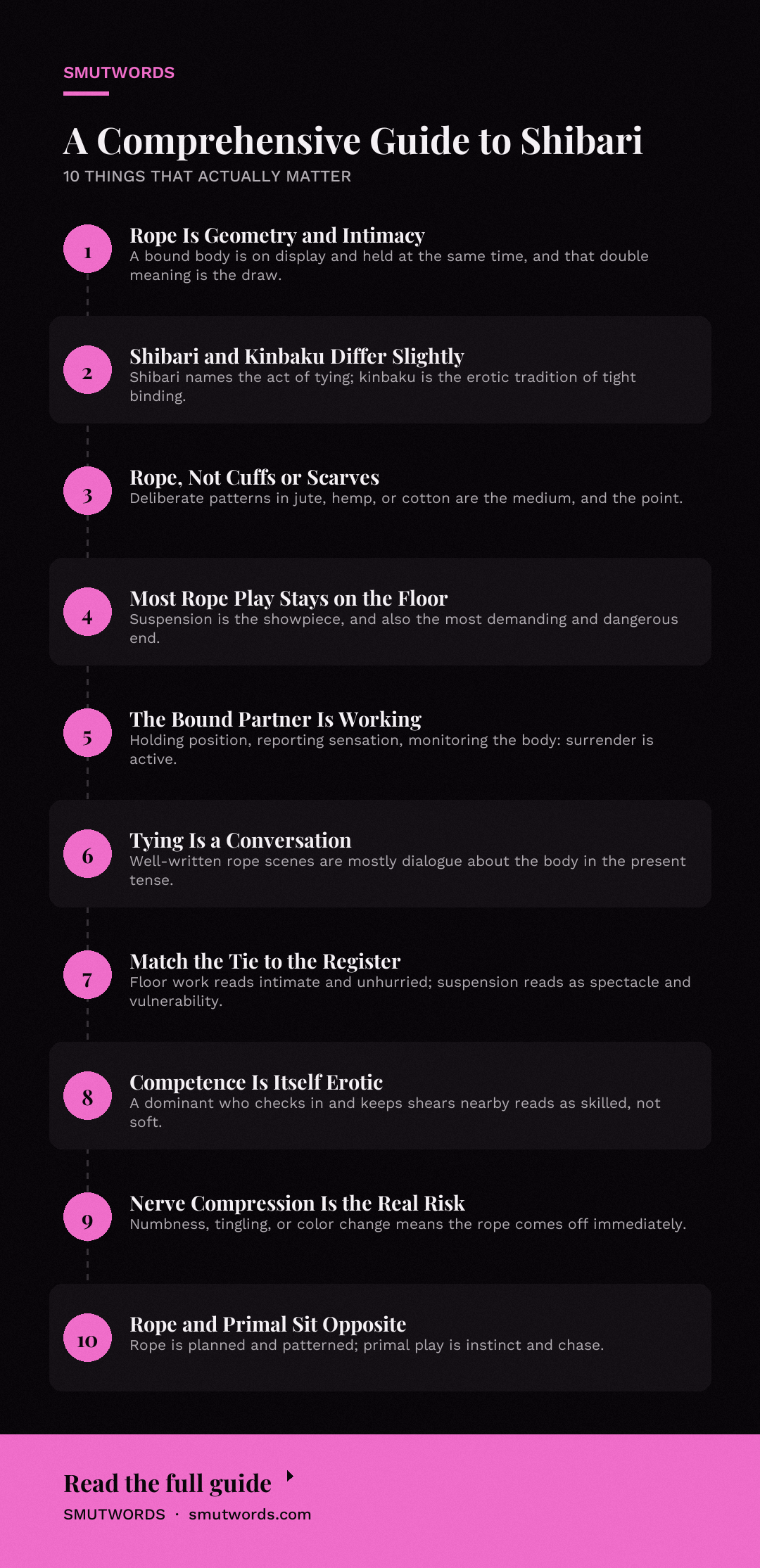
The rope is geometry and intimacy at once. A body wrapped in a chest harness or suspended from a beam is on display and held at the same time, and that double meaning is exactly what makes the practice so durable on the page.
If you landed here from a scene in a book that stopped you cold, or you're trying to write one that lands, this guide covers the definition, the history, the craft, and the practical realities. Shibari rewards readers who want more than a handcuff and a growl. It rewards authors who take the trouble to get it right.
What Shibari Actually Means
The word translates roughly to "to tie" or "to bind" in Japanese, and that plainness is part of its character. Shibari names the act of tying. The more specific term for the erotic and aesthetic tradition is kinbaku, which carries the sense of tight binding, and purists will tell you the two are not identical. In English-language romance and kink writing, the words are used almost interchangeably, and readers will not blink at either.
What counts as shibari: rope, deliberately placed, forming patterns rather than just restraints. A chest harness with symmetrical lines. A limb tied with attention to how the rope crosses and where it lands.
The categories worth knowing are floor work, where the body is bound on the ground in a shape the rigger chose, and suspension, where part or all of the body hangs from an anchor point.
What does not count: metal cuffs, leather straps, silk scarves knotted in a hurry. Those are bondage, and they are perfectly good bondage, but they are not this. The rope is the medium and the point. Natural fiber, usually jute or hemp, sometimes cotton for beginners, is the standard, chosen because it holds a knot and feels right against skin.
Common misconceptions
The first is that shibari is purely decorative. It is aesthetic, and photographs of rope work are their own genre, but the appeal in fiction is the tension between the pattern and the person inside it. The rope does something to the body and the mind.
The second is that it's always about suspension. Most rope play happens on the floor. Suspension is the showpiece, the thing that gets photographed and written about, and it is also the most technically demanding and dangerous end of the practice.
The third is that the person in the rope is passive. Anyone who has spent time around rope will tell you the bound partner is working constantly: holding position, communicating sensation, monitoring their own body. The surrender is active. That distinction separates a flat scene from one that hums.
Where Shibari Comes From
The lineage runs back through Japanese martial arts and the historical use of rope to restrain prisoners, a practice called hōjōjutsu, which developed elaborate and non-injurious tying methods as a mark of respect for the captive's status. The aesthetic and the restraint were never fully separable.
The erotic tradition proper took shape in the twentieth century. The photographer Itō Seiu is often credited with pushing rope work into an art form in the mid-century, and the magazine Kitan Club, published from the late 1940s, put bound bodies in front of a mass readership. Artists and photographers built a visual vocabulary from there: symmetry, tension, the bound body arranged like calligraphy.
Its arrival in English-language erotica and romance came much later, largely through photography and internet culture in the 1990s and 2000s. Western kink communities adopted the term, learned the patterns, and adapted the aesthetic. The publishing shift is recent enough to be traceable: what was once a niche curiosity in fetish photography is now a fixture of dark romance, BDSM romance, and contemporary erotic fiction.
That recent adoption matters for readers. Shibari in English-language fiction often arrives less as a Japanese cultural practice and more as shorthand for a particular flavor of intensity: the careful, exacting dominant, the partner undone by patience. Some books honor the tradition's origins; many borrow the look without the context. Both are common, and knowing which one you are reading helps.
How It Shows Up in Erotica
On the page, shibari does a specific kind of work other restraint kinks cannot replicate. It is slow. It takes time to tie a harness, longer to build a suspension, and that built-in slowness gives an author room to write anticipation, conversation, and the quiet focus of one person's hands on another's body. A writer looking for heat without hurry has a gift in the rope.
The strongest scenes treat the tying as a conversation. The dominant asks about sensation, adjusts tension, watches the partner's breathing. The bound partner reports what they feel, and that reporting is itself intimate. Read a well-written rope scene and you will notice how much of it is dialogue, and how much of the dialogue is about the body in the present tense.
Common variations authors use
- Floor work. The body bound in a shape on the ground: knees folded, arms patterned against the torso, rope connecting the two. The most accessible version and the easiest to write credibly.
- Chest harness. A symmetrical pattern across the torso, often the first thing a beginner learns. Visually striking, adaptable, and a favorite for scenes that want the bound body displayed while leaving the legs free.
- Suspension. The body lifted partly or fully off the ground from a single anchor. The showpiece variation, and the one that requires the most technical knowledge on both sides of the rope.
- Partial restraint. One limb, one wrist to one thigh, a harness with no intent to suspend. Useful for authors who want the visual without a full scene.
The variation an author picks should match the emotional register of the scene. Floor work reads as intimate and unhurried. Suspension reads as spectacle and vulnerability, and it deserves a scene that acknowledges what it asks of both people.
What separates a strong rope scene from a flat one
A strong scene makes the rope active. The tension changes as the partner shifts. The dominant notices a hand going numb and adjusts immediately. The rope is a living element in the room, and the scene acknowledges it.
A flat scene uses rope as a prop. The binding happens off the page or in a sentence, and then the scene proceeds as though the partner were in cuffs. The specific texture of rope, its slowness and attention, gets lost. Readers who know the practice notice instantly.
There is also the matter of the dominant's competence. Shibari scenes in fiction live and die on whether the person tying seems to know what they are doing. A dominant who checks in, who has safety shears within reach, who watches for color change in the fingers, reads as skilled in a way that a dominant who simply loops rope and smirks never will. That competence is itself erotic to a great many readers.
Enjoyed this? Get a free book.
Join the list and we will send a complete free story straight to your inbox, plus new releases every week after that. No credit card, no catch.
And the surrender works best when the bound partner is not merely compliant but engaged. The emotional pitch of rope scenes comes from the exchange: one person choosing to be held, the other choosing to hold. Scenes that flatten that into simple domination miss what readers come for. For a related dynamic where the surrender is more overtly negotiated and rule-bound, the SmutWords guide to free use kink explained for couples covers the consent scaffolding that underlies both practices.
Rope scenes also pair well with other kinks. A degradation kink can sharpen the vulnerability of a bound body, and authors often braid the two together. The care in a rope scene sits in interesting tension with a mouth that will not stop running. For a darker, more predatory register, feral play offers a useful contrast: rope is patience and pattern, feral play is instinct and chase.
Where the scene tips into the darker traditions of the genre, the SmutWords guide to dark romance covers how authors balance intensity with the reader's need to trust the dominant. Rope is a frequent tool in that balance, because the visual of a careful tie is reassurance as much as threat.
The safety details that make a scene credible
Nerve compression is the real risk, and fiction that ignores it reads as careless to informed readers. Numbness, tingling, cold fingers, or color changes in the skin mean the rope comes off immediately. Safety shears stay within arm's reach of anyone doing the tying. A tied partner is never left alone in a room.
These details are not mood-killers. They are the proof of care that makes the surrender legible. A dominant who keeps shears on the nightstand and asks about sensation is a dominant a reader can trust with a character they love. Trust is what makes the scene land.
Shibari vs Primal Play
These two get compared because both deal in intense physical control, but they sit at opposite ends of a spectrum. Shibari is planned, patterned, and precise. The rope is arranged with intention, the scene is negotiated in advance, and the dominant's attention is on geometry and sensation. Primal play is the reverse: instinct-driven, often unstructured, more about pursuit and reaction than pattern.
Readers who love rope scenes for the careful dominant will often find primal play too uncontrolled. Readers who love primal play for the raw physicality may find rope too deliberate. Both are valid.
Some authors use the contrast between the two as the engine of a scene: a character who expects one and gets the other. If your scene needs a dominant who plans, write the rope. If it needs one who reacts, write the primal.
Rope can also appear alongside rough sex, and the pairing works because the two play off each other: the rope holds the body in place while the sex is anything but gentle. The contrast between a thing done carefully and a thing done hard is one of the more reliable emotional levers in the genre.
Frequently Asked Questions
Is shibari the same thing as kinbaku?
In common English usage, yes, and most romance authors treat them as synonyms. Strictly speaking, kinbaku refers to the erotic and aesthetic tradition of tight binding, while shibari names the act of tying. For fiction, either word is correct; pick one and stay consistent.
Do you need a partner to practice shibari?
Solo practice exists and is how many riggers learn. You can tie your own legs or build a harness on yourself with a mirror and safety shears nearby. Anything involving suspension should never be done alone. In fiction, a character who practices tying alone makes for a compelling detail of obsession or discipline.
What kind of rope is used for shibari?
Jute and hemp are the traditional choices, often treated with oil or wax to soften them. Cotton and synthetic ropes are common for beginners because they are gentler on skin and cheaper to replace. The rope should be roughly 6 to 8 millimeters in diameter and long enough to tie the pattern comfortably, usually 8 meters or more for larger harnesses.
Why does shibari turn people on?
The appeal is a mix of visual beauty, the trust required to be tied, and the surrender of control that rope makes physical and visible. Some people experience a meditative calm under rope, a state often called rope space. Others are drawn to the aesthetic and the exchange of care. Most kinks are layered, and this one is no different.
Is suspension dangerous?
Yes. Suspension carries real risk of nerve damage, fainting, and falls, and it requires specific training in rope rigging, anchor points, and body mechanics. In fiction, authors who write suspension scenes should show the precautions: proper anchors, a spotter, safety shears, and a partner who knows the signs of a body in distress.
How do I know a rope scene is being done safely?
The signs are consistent: safety shears within reach, a conversation before the rope comes out about limits and sore spots, check-ins during tying, immediate adjustment when the bound partner reports numbness or tingling, and never leaving them alone. If any of those are missing, the scene is not safe, no matter how beautiful the rope looks.
Can shibari be part of a romance without being a full BDSM dynamic?
Absolutely. Many contemporary romances use rope as an occasional element within a relationship that is otherwise light on protocol. The exchange of trust and care that rope demands translates easily into a scene that is more about intimacy than about power. Look for authors who let the rope be a single thread rather than the whole dynamic.
Final Thoughts
Shibari earns its place in the genre because it does two things at once: it makes the body a picture, and it makes the relationship undeniable. The rope is a record of attention. Every line of it was placed by someone who wanted to place it, and every moment the bound partner spends in it is a moment of choosing to stay.
If you want to see the practice handled with the care it deserves, look for authors who let the slack out and the tension in one knot at a time, and who keep the shears on the table. A scene like that will stay with you well after the rope comes off.






Loading comments…