
A chef/restaurant romance is a love story built around professional food: one or both leads work in a kitchen, run a dining room, bake for a living, or fight their way through a culinary competition, and the relationship heats up alongside the stockpot.
The kitchen supplies the stakes (service, reviews, money, reputation), the sensory texture (heat, knife work, tasted spoons, late-night plates), and the power dynamics (executive chef and line cook, owner and employee, rival and rival). If a book puts you behind the pass during a Friday rush and then sends you home with someone whose hands still smell like garlic, you're reading a chef/restaurant romance.
What Chef/Restaurant Romance Actually Means
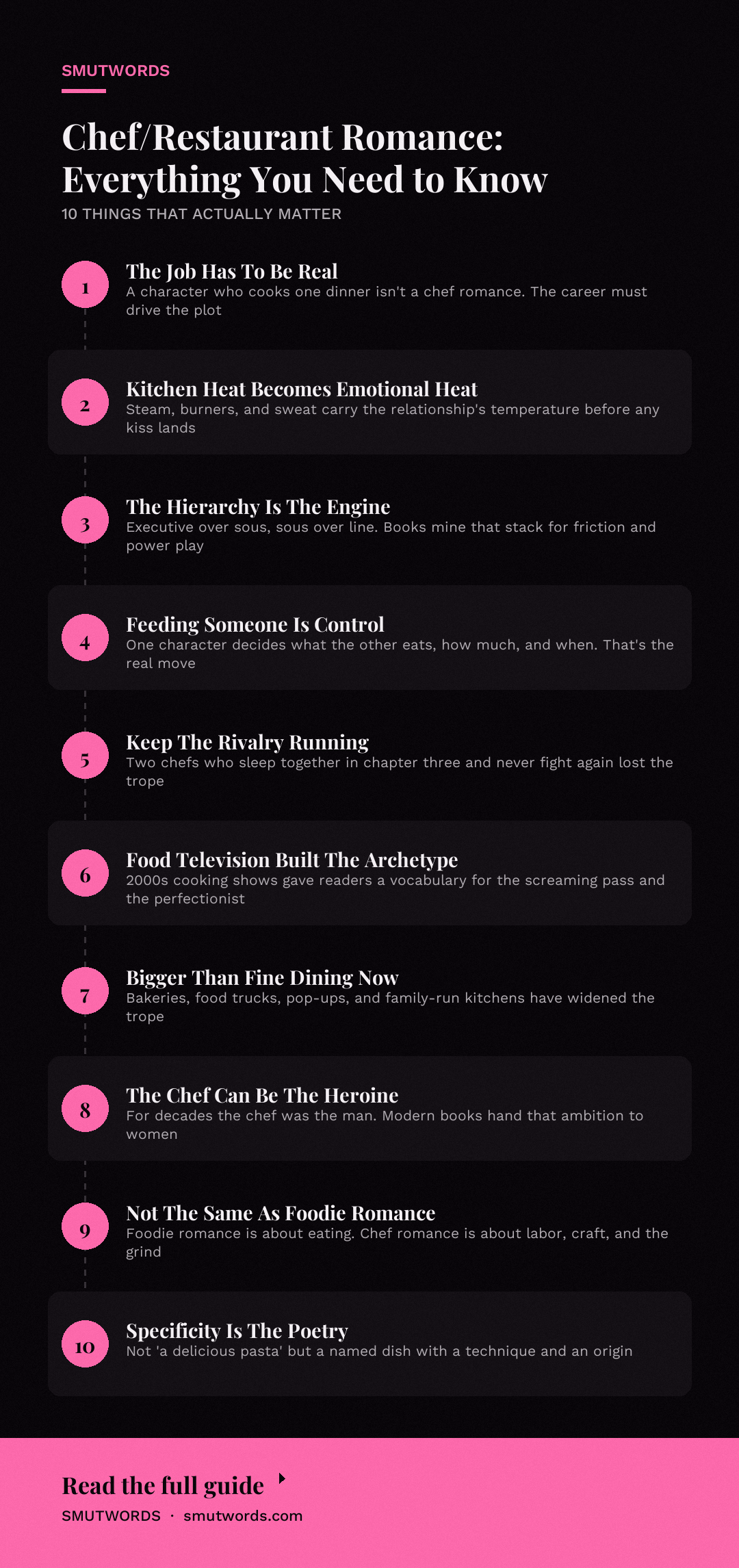
The label covers a wide spread of books, so it's worth being precise about the edges. The defining requirement is professional stakes tied to food. A character who cooks a great dinner once is not a chef romance. A protagonist whose livelihood, identity, and daily schedule revolve around feeding people is.
The name itself is a marketing convenience, a shelf label that publishers and readers settled on to cluster books that feel similar. There's no founding text and no formal definition. The trope describes a setting and a professional world more than a single plot shape.
What counts:
- A protagonist employed as a chef, sous chef, pastry chef, baker, restaurateur, sommelier, or food writer whose career drives the plot.
- Conflicts that come from the industry: a bad review, a failing lease, a menu launch, a Michelin bid, a staff shortage, a food festival, a televised competition.
- Food as a recurring intimacy device. Shared meals, cooking for someone, feeding someone, tasting off a fingertip.
What doesn't count, or only counts at the margins: a lead who owns a restaurant but is never in it, a single scene set in a nice restaurant that has nothing to do with anyone's job, or a book where cooking is a hobby mentioned twice. The professional kitchen has to be a place the story actually lives, not a backdrop it visits once.
Common misconceptions are worth clearing up. The first is that these books are all cozy and cute. Plenty are, especially the small-town bakery end of the shelf, but the restaurant world gives you just as much room for sharp-elbowed rivalry, exhaustion, burnout, and controlling personalities who handle a stove like a throne.
The second is that chef/restaurant romance is the same as foodie romance. Foodie romance is about eating, discovery, and pleasure. The chef version is about labor and craft, the grind behind the plate, and the specific arrogance of someone who is very good with a knife.
The third is that the heat is only about the food. The kitchen is a pressure chamber, and pressure chambers make people horny. A lot of the appeal sits in the closed door of a walk-in fridge and what happens when two people who have been shouting at each other over a ticket rail finally get thirty seconds alone.
Where Chef/Restaurant Romance Comes From
The honest history here is publishing history, not culinary history, so that's what this section covers. Food and romance have shared a page for as long as novels have had dinner scenes, but the professional-kitchen romance is a much more recent animal, shaped by two things: the rise of the celebrity chef and the rise of the food memoir as a genre people actually bought.
Through the 1980s and 90s, the chef in popular fiction was mostly a supporting character or a romantic shorthand for sophistication. A man who could cook was shorthand for a man who was good with his hands. Restaurants appeared as date locations, not workplaces.
The shift happened in the 2000s, when food television put the chef's temperament on prime-time display. Suddenly the public had a vocabulary for the red-faced executive chef, the mise-en-place perfectionist, the screaming pass. Romantic fiction absorbed that archetype fast, because it solved a problem the genre always has: how do you give a love interest a job that explains why they're intense, controlling, and unavailable until the plot forces them to soften?
The food memoir boom did the rest. When chefs started publishing confessionals about addiction, obsession, and kitchen brutality, readers got a template for a love interest with an actual dark side and an actual craft. Contemporary romance followed within a decade, and by the 2010s chef heroes and chef heroines were a reliable subcategory with their own cover conventions (flour on the apron, a hand at a collar, a moody bar shot).
The most recent evolution is diversification of the job itself. Older chef romances almost always centered a fine-dining restaurant. Newer ones have spread out into bakeries, food trucks, pop-ups, vegan kitchens, competitive cooking shows, and family-run ethnic restaurants where the cuisine carries cultural and familial weight. That widening is the healthiest thing that's happened to the trope.
One more shift worth naming: the chef as heroine. For a long time the culinary professional was the man and the woman was the critic, the heiress, or the customer. Modern books have corrected that.
Some of the strongest entries in the subgenre give the executive chef role to a woman whose ambition is the engine of the plot. If you like your romance with a driven, formidable professional at the center, this overlaps pleasantly with a redemption arc romance when the chef in question is rebuilding a career or a reputation.
How It Shows Up in Erotica
There's a lot of craft in this section. A chef/restaurant romance has more structural tools than most tropes, because the kitchen gives an author both a workplace and a set of props. Here's what the good ones do with it.
The Heat Transfer
The strongest versions use physical heat as emotional heat. Steam, burners, ovens, dish pits, the sweat at the small of a back in a hot kitchen. Authors who are thinking about the page will let the temperature of the room carry the temperature of the relationship, so the reader feels the rising flush before a single kiss.
This is the trope's greatest single advantage as erotica. You can build arousal for forty pages using nothing but a cramped service, a shared towel, and two people breathing hard near a stove. The payoff lands harder because it was earned by atmosphere instead of announced.
The Power Stack
There's a hierarchy in every professional kitchen, and writers mine it. Executive chef over sous, sous over line, everyone over the dishwasher. Books often push this into BDSM or dominance territory, and some do it beautifully by making the discipline of the kitchen the on-ramp to negotiated power play. Others handle it with more care, letting a fixed hierarchy create friction and the sex take place off the clock where it can be properly discussed.
If a book is heading toward the kinkier end of that stack, the good ones show the negotiations. Scene limits, safewords, the difference between a dom who commands a kitchen and a dom who respects a partner's limits. A lot of that chat belongs on the page, and there's a useful companion piece here on consent negotiation if you want to know what healthy negotiations actually look like in fiction.
Food as Foreplay
The cliché is the chocolate sauce. The craft version is subtler and much filthier when it works. A chef feeding someone something they've never tasted, a spoon held to lips, someone getting permission to lick a fingertip over a plate. The author's real move is control: one character deciding what the other eats, how much, and when.
That control dynamic is where chef romance can quietly become a power-proximity kink story without ever naming it. It's the same instinct that runs through a possessive kink vs jealousy kink discussion: the difference between a partner who's protective and one who owns. A great chef love interest is confident about the first and careful with the second.
Enjoyed this? Get a free book.
Join the list and we will send a complete free story straight to your inbox, plus new releases every week after that. No credit card, no catch.
The Rivalry Variation
Rival restaurants across a street. Two food-truck owners fighting for the same corner. One chef and one critic. One chef and one investor.
Rivalry gives you instant conflict, forced proximity via food festivals and competitions, and a delicious moment of respect that becomes desire. The strongest versions don't resolve the rivalry once the leads fall into bed; the work rivalry continues, because that's what makes them interesting to each other.
A weak version resolves it too fast. Two chefs who fall into bed in chapter three and never have another professional disagreement have lost the whole engine of the trope. Keep the fight going and let the bedsport complicate it.
The Small-Town Bakery Variation
Softer, slower, more cinnamon than chili. A city chef moves to a small town, or a returning local fires up the family bakery. The heat here is more domestic, and the sensory register shifts from adrenaline to comfort.
This version works best when the author makes the town's history and regulars matter, because the bakery is a community institution and the romance should intersect with it. There's a natural doorway from here into childhood friends to lovers territory whenever one lead is the hometown sweetheart the other left behind.
The Billionaire Chef Variation
Restaurant empire, private jet, name on the door, a chain of ten. This is a hybrid trope that borrows the billionaire romance scaffolding and stands it up in a professional kitchen.
The trick, when it's done well, is that the billionaire chef's money is a liability as much as a luxury. It makes him suspicious to the heroine, it separates him from the actual cooking he loves, it's a thing he has to set down in order to be a good partner. Skip that tension and you just get rich-guy romance with a truffle shaver.
The Competition Variation
Cooking-show romance is its own fast-paced strain. Two contestants, a televised deadline, cameras in the kitchen, a final challenge. The physical pressure is even more compressed than a restaurant service, and the format forces declarations fast. The good versions use the on-camera dynamic as a mask and let the off-camera dynamic run hotter, so the reader feels the difference between performance and private behavior.
What Separates a Strong Chef Romance from a Flat One
Four things, in my reading experience as an editor who's worked through a lot of these manuscripts.
- The work is real. The author has either spent time in a kitchen or researched it hard. Tickets, prep lists, service timing, quiet post-shift hours. Details that make the world feel worked in.
- The food is specific. Not "a delicious pasta" but a dish with a name, a technique, an origin. Specificity is the whole poetry of this trope.
- The heat has a source. Frustration, exhaustion, adrenaline, professional respect. If the sex arrives with no reason beyond proximity, the trope is underworked.
- The relationship survives the shift change. Strong versions show the couple after the service, after the hours, in the quiet of a closed kitchen, where the person has to be someone beyond their station.
One caution for authors reading this: if you're going to bring in stalker-ish obsession or aggression from a food-industry rival, treat it as the plot it is. Some of the sharper new books push toward stalker romance dynamics when a hostile competitor takes it too far. That's fine as long as the story knows what it's doing and the heroine's safety isn't treated as a garnish.
Chef/Restaurant Romance vs Lumberjack Romance
This comparison might seem odd on the surface, but it's real: both are workplace-adjacent tropes where the love interest has a manual, hands-on, physically demanding profession, and readers cross-shop the two constantly. The confusion is that both aesthetics trade in "strong, competent, slightly grumpy professional who works with his hands" and both promise competence as the primary erotic asset.
The differences matter when you're choosing your next read. A lumberjack romance leans into isolation, wilderness quiet, and slow, sensory, low-stakes solitude. Chef romance leans into pressure, urban density, noise, and the very modern stakes of reputation, money, and press. Lumberjack books give you air and pine; chef books give you steam and smoke.
The other difference is social density. A chef protagonist is surrounded by staff, critics, guests, and a full cast of secondary characters. A lumberjack protagonist is usually alone in a cabin with one love interest and maybe a dog.
If you want a busy, dialogue-heavy, ensemble-feeling romance, go kitchen. If you want the two leads boxed in together with nothing but weather and each other, go trees.
Frequently Asked Questions
What is chef/restaurant romance?
A chef/restaurant romance is a romance novel in which one or both protagonists work professionally in food (as a chef, baker, restaurateur, or critic) and the professional kitchen supplies the plot, the stakes, and the sensory texture of the relationship. The food career is essential to the story, not incidental.
Is chef romance always spicy?
No. The trope spans the full heat spectrum, from cozy closed-door small-town bakery books to explicit contemporary romances set in competitive fine dining. Readers who want heat should look at how a book is marketed and check heat ratings before buying; the "chef" label alone doesn't tell you how explicit it gets.
What are the most popular chef romance variants?
The main ones are billionaire chef, rival restaurants, small-town bakery, cooking competition, and food truck romance. Each puts the professional food world in a slightly different frame: luxury and power, head-to-head conflict, cozy community, high-pressure TV, or scrappy street-level hustle.
Which chef romance should I start with?
Pick based on the variant you're drawn to. If you want rivalry and heat, start with a rival-restaurant book. If you want something soft and domestic, a small-town bakery romance is the door in. Nearly every reader lands on one of these within a few pages and knows immediately which flavor they want next.
Do chef romances have to include food scenes?
Good ones do. If the characters are chefs and the book never puts you in a kitchen, never offers you a tasted dish, never lets you feel flour on a hand or garlic smoke in your hair, the trope has been undersold. Food scenes are the whole point of the setting.
Is a chef/restaurant romance the same as a foodie romance?
They overlap, but they're not the same. Foodie romance centers the pleasure of eating and discovering food, often with a critic or a traveler as the lead. Chef romance centers the labor of professional cooking, the identity of a chef, and the workplace itself.
Final Thoughts
The best chef/restaurant romance is dense with sweat, knife work, and the specific arrogance of somebody who can plate in eight seconds flat. Books that treat the kitchen as the relationship's fuel pull this off. Books that hang a stockpot in the background and call it a setting don't.
If you want a single recommendation to read next, pick one that puts the two leads on opposite sides of the same craft so the rivalry keeps producing sparks well past the first kiss. The ranked list below pairs well with a second glass of wine and a plate of something you cooked badly but proudly.




Loading comments…