Two readers can finish the same scene and disagree about what just happened, and the possessive kink vs jealousy kink divide is usually why. One reader closed the book turned on by the growl of "you're mine." The other skimmed past the growl entirely and got off on the moment the possessive one imagined someone else's hands and lost their composure over it.
Those are different engines running the same visible body language. Most of the sloppy writing in this corner of the genre comes from authors who think the growl is the whole product.
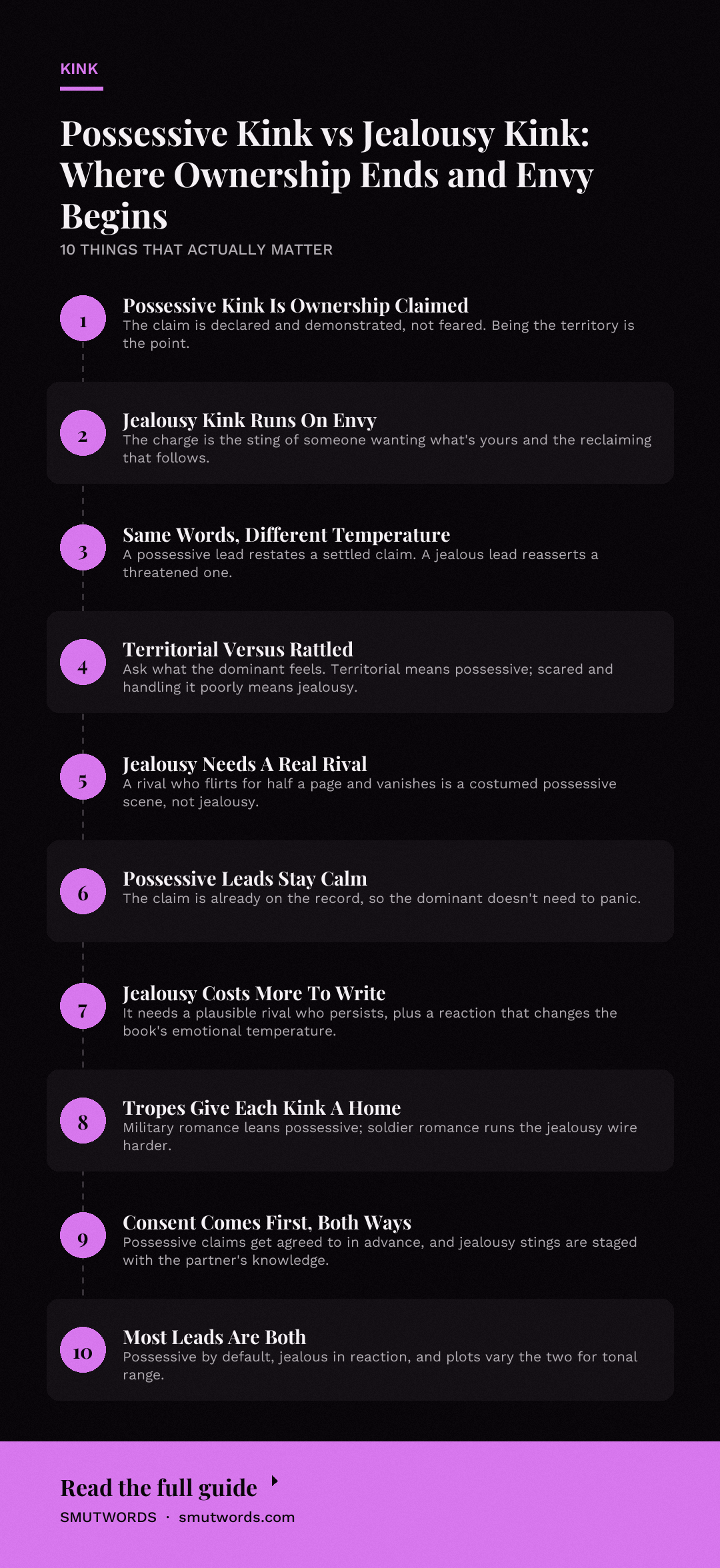
If you've been typing "possession kink" or "possessive kink" into a search bar trying to figure out which one you actually want, the misspellings are a clue about how blurry this gets. Possessive kink is about ownership claimed and enforced. Jealousy kink is about the proprietary horror of someone else getting what's yours, or what you want to be yours.
The first one hands you a collar. The second one hands you a gash of envy you're supposed to enjoy feeling.
They overlap, obviously. A possessive character licensing a public flirt that drives the jealousy spike is a legitimate structural move, and plenty of dominant leads run on both. But the fantasy each one delivers, and the kinks each one touches, are distinct enough to be worth splitting apart.
What possessive kink actually delivers
The ownership fantasy runs on possession declared and demonstrated. Think of the character who signs their name across a partner's shoulder blade, or the one who puts a hand on the back of a neck in public specifically so the room sees.
Possessive kink is about the comfort of being claimed so thoroughly that loss stops being a live question. It's not really about the fear of loss. The lead isn't worried. The lead is territorial, and being the territory is the point.
The beats are recognizable once you know them:
- Marking and public claiming. A jacket over shoulders, a hand on a waist at a party, a first name dropped possessively in front of an ex.
- Terms of endearment applied like a warning. "Mine," "pet," "little wife," "my girl," and every other phrase that turns a person into property the speaker is responsible for.
- Enforced exclusivity. A partner who won't tolerate the flirting, who issues a rule about it in the first act and enforces it in the third.
- The steady hand. Possessive dominants are usually calm, because the fantasy is a partner who doesn't need to panic. The claim is already on the record.
That calm trips a lot of people reading the same book. A dominant who has already claimed their partner can afford to be unbothered, and that unbothered quality reads as hot to one reader and flat to another.
The split maps closely onto how you relate to Financial Domination, another kink that runs on a fixed structure of ownership and obligation rather than a panic. In both, the charge is the arrangement being real and enforced, not the fear that it might end.
What jealousy kink actually delivers
Jealousy kink is the other side of the coin. It's the fantasy that someone could want your partner, and that the wanting is what makes the eventual outmaneuvering delicious. Some readers want the sting itself. They don't want a partner who's already committed; they want the ache of watching someone try to take what isn't theirs and knowing it's going to fail.
Others want the kink from the other side of the triangle, watching a dominant lose their composure over perceived competition. The lead who was unbothered through the whole first act gets one glimpse of the ex at the restaurant and cracks. That crack is the entire payoff.
The structure of a jealousy scene is basically a three-beat:
- An external party makes the claim visible. A stranger flirts. An ex reappears. A coworker gets handsy at the office party.
- The dominant notices, and the noticing is where the kink lives. The jaw. The knuckles going white on the glass. The hand curving a touch too firmly around the possessive partner's waist.
- The reclaiming, which has to be more intense than the claiming ever had to be, because something has to be proven. The partner gets pulled into a coat closet and reminded, verbally and otherwise, whose name is on the deed.
That third beat is where authors fumble the structure most often. Jealousy kink requires a real threat, even a small one.
A book that has the external party flirt for half a page and then vanish has no jealousy, just a costumed possessive scene. The reader who showed up for the sting wants to see the character wobble. Let them.
The actual difference, stated plainly
If possessive kink is the hand on the back of the neck, jealousy kink is the hand tightening. One is about the claim being present. The other is about the claim being personally threatened and then reasserted, and the fear of loss is the fuel.
A good way to check which one a scene is feeding is to ask what the dominant feels. If the answer is "territorial," you're in possessive territory. If the answer is "scared, and handling it poorly," that's jealousy.
Which is also why the two feel so different to write. Possessive authors can lean on physical description and dialogue and just let the claim stand. Jealousy authors need a whole external character (a plausible rival), a whole subplot beat (the rival has to be present for long enough to register), and a consequence (the dominant has to react in a way that changes the emotional temperature of the book). That's a heavier structural load for the same basic payoff.
Both, confusingly, can get mislabeled in query searches. People typing "possession kink" are usually looking for the first one. People typing "possessive kink" sometimes want the second and don't know it yet. The overlap is real, and the answer, for readers, is that you probably want both, in different books.
How the two kinks interact with other tropes
Some of this gets easier to feel when you stick each kink next to a trope that gives it a natural home. Military romance is possessive kink with the throttle down, because the lead has spent years in a chain of command and "you're mine" is a language they already speak fluently. The protagonist doesn't need to teach the dominant how to file a claim; the claim is the work they've been doing since page one.
Meanwhile, soldier romance tends to run the jealousy wire much harder. The separation, the letters, the fellow soldier who becomes a friend: all of it keeps the question of whose the partner is open for longer, so the reclaiming has something to reclaim. If you want to see what both of these look like rendered by authors who understand them structurally, that's the corner to read.
Lumberjack romance is the same mechanism with flannel. The cabin isolation is a natural possessive setting: the protagonist has been claimed by the land before the love interest shows up, and the trope runs on a character who is already territorial by default. Jealousy kink rarely gets to breathe in a cabin novel, because there's no rival within fifty miles.
Enjoyed this? Get a free book.
Join the list and we will send a complete free story straight to your inbox, plus new releases every week after that. No credit card, no catch.
Why the two get confused, and which one to read next
The main reason is that both kinks use the same vocabulary. "You're mine." "Mine." "My little wife." "No one else."
A possessive lead says those words because the claim is settled and being restated for comfort. A jealous lead says the same words because the claim is being tested and being reasserted out of fear. The sentences are identical on the page. The emotional temperature is not.
The second reason is that a lot of authors write the two as one scene. The lead makes a possessive claim (owning) because someone flirted with their partner (jealousy). Both fans get fed in the same paragraph.
That's an efficient way to write, but it should be flagged for what it is: two kinks braided together, not one kink. If you're drafting and you can't tell which one you're writing, check whether the dominant is relaxed (possessive) or rattled (jealousy). That single question sorts most drafts.
Third, and probably most usefully: the two kinks can be the same scene from opposite ends. A jealous dominant is a possessive dominant whose claim just got threatened. A possessive dominant at peace is a jealous dominant whose threat hasn't materialized. The distinction is structural, and the characters are basically the same person in different moods.
Reading list: both kinks, side by side
If you want to feel the possessive end of the spectrum first, His Last Name puts the claim on page one and doesn't lift it. The entire book runs on the protagonist handing over her autonomy and discovering the lead treats it like a legal document.
For the jealousy end, The Best Friend Strikes Back runs the sting through a plausible rival who persists for chapters instead of one scene. The reclaiming that closes it is the whole reason the book works. Side by side, those two render the difference better than any essay about it.
Read Bound by the Billionaire if you want a story that braids both: the lead is possessive by default and jealous by reaction, and the plot keeps staging plausible rivals specifically to set the second half off. Pair that with The Sheriff's Little Lamb, which runs the possessive wire through a small-town dynamic where the claim is public, the rival is local, and the jealousy has a physical address.
Two more worth naming: Marked: His to Keep does the claiming as body modification (a tattoo, a bite, a ring) and makes the visible ownership the whole point. One Night with the Enemy flips the mechanism so the jealousy is mutual, both leads spending a hundred pages quietly furious about each other's history. Reading those four in a row will sort out which one you're actually into faster than any internet quiz.
Consent, negotiation, and what the good versions do right
Both kinks share a safety structure, and the good books show it instead of skipping it. Possessive kink needs the claim to be consented to in advance. A dominant who announces "you're mine" to a partner who hasn't agreed is a horror story, not a romance.
The good versions put the negotiation on the page: the conversation where the partner says, explicitly, what they're willing to hand over, and what counts as too far. Consent negotiation isn't an interruption of the kink. In the better books it's the first scene of it, because the handing-over is the hot part.
Jealousy kink has a steeper ethic. The sting has to be manufactured with the partner's knowledge, or at minimum the partner's blanket consent to the game, because a jealousy scene staged without consent is just infidelity with a defense.
That's the structural difference between "the lead is jealous because the ex showed up unbidden" (the ex is the plot's problem, not the dominant's) and "the lead arranged for someone to flirt with their partner on purpose" (that's a game with rules, and the rules matter).
The latter is where most of the good jealousy writing lives. A partner who co-conspires in the sting is a partner with agency, and agency is what makes the reclaiming land as fantasy instead of bad behavior.
If you've read much of the degradation kink material, you'll recognize the structure. Both need the bottom of the scene to be a real participant with a real off-switch, and both fumble when an author treats roughness as a shortcut to intensity.
Frequently asked questions
Is possessive kink the same as a controlling partner? No. In fiction, possessive kink is a fantasy of being claimed by someone safe and consistent, whose claim is a comfort rather than a threat. A controlling partner in real life isn't the same thing, and good possessive romance makes the distinction by showing the claim being negotiated and the partner retaining agency.
How do I tell if a book is jealousy kink? Look for a rival who persists. If an external character flirts with the partner and vanishes within a scene, the book is running possessive spice, not jealousy. If the rival keeps showing up, the jealousy is real.
Can a character be both? Almost always, and many of the best-written dominant leads are. Possessive by default, jealous in reaction, and the plot varies the two for tonal range.
Does jealousy kink require cheating? No. The good versions keep the partner loyal and use the rival as a threat the dominant imagines, not one that's realized. A jealous scene happens in the lead's head more often than on the page.
Which is more common in romance as a whole? Possessive kink, by a wide margin, because it's structurally simpler and easier to make sympathetic. Jealousy takes more craft, so it shows up more in the darker corners of the genre, which is exactly where you'll find the readers who want it.
Final Thoughts
If you've read this far and still can't tell which side you're on, the answer is probably the same one I'd give about most kink arguments: you're on both sides, and the question is which scene you want first. Start with His Last Name if the comfort of the claim is what gets you there, and let it lead you into The Best Friend Strikes Back once you're ready for the sting.




Loading comments…