
Consent negotiation is the conversation where two or more people say out loud what they want to do, what they absolutely will not do, and how they'll signal the difference once things get going. In kink and BDSM contexts it's often a formal talk before a scene, complete with safewords and a yes/no/maybe list. In erotica it's the scene that makes the filthy scene possible. Characters lay out their terms, and everything that follows lands harder because of it.
The short glossary version covers the basics. What it leaves out is how much craft goes into a good one on the page, how the term got its shape, and why a well-written consent negotiation can be hotter than the sex it precedes. That's what this guide handles.
What Consent Negotiation Actually Means
"Negotiation" is the operative word. A negotiation has terms, offers, counteroffers, and agreement. It can end without a deal.
That structure is the point. Consent negotiation treats the question of what happens between bodies as something to be explicitly agreed, not assumed.
The practice covers several conversations that often blur together in fiction:
- Pre-scene negotiation. The talk before anything happens. What you want, what you don't, what's off the table entirely.
- Hard limits talk. The non-negotiables. These don't get debated or traded away.
- Soft limits and yes/no/maybe lists. The grey zone: things a person might try under the right conditions, things they'd consider later, things they're done with.
- Safeword discussion. What word or signal means stop, what means slow down, what means check in. The traffic-light system is common because it gives three distinct signals.
- Check-in protocol. How partners confirm each other's state mid-scene. A look, a question, a gesture.
- Aftercare planning. What happens after. Who needs water, a blanket, silence, a shower, company. Planned in advance so nobody has to improvise while wrecked.
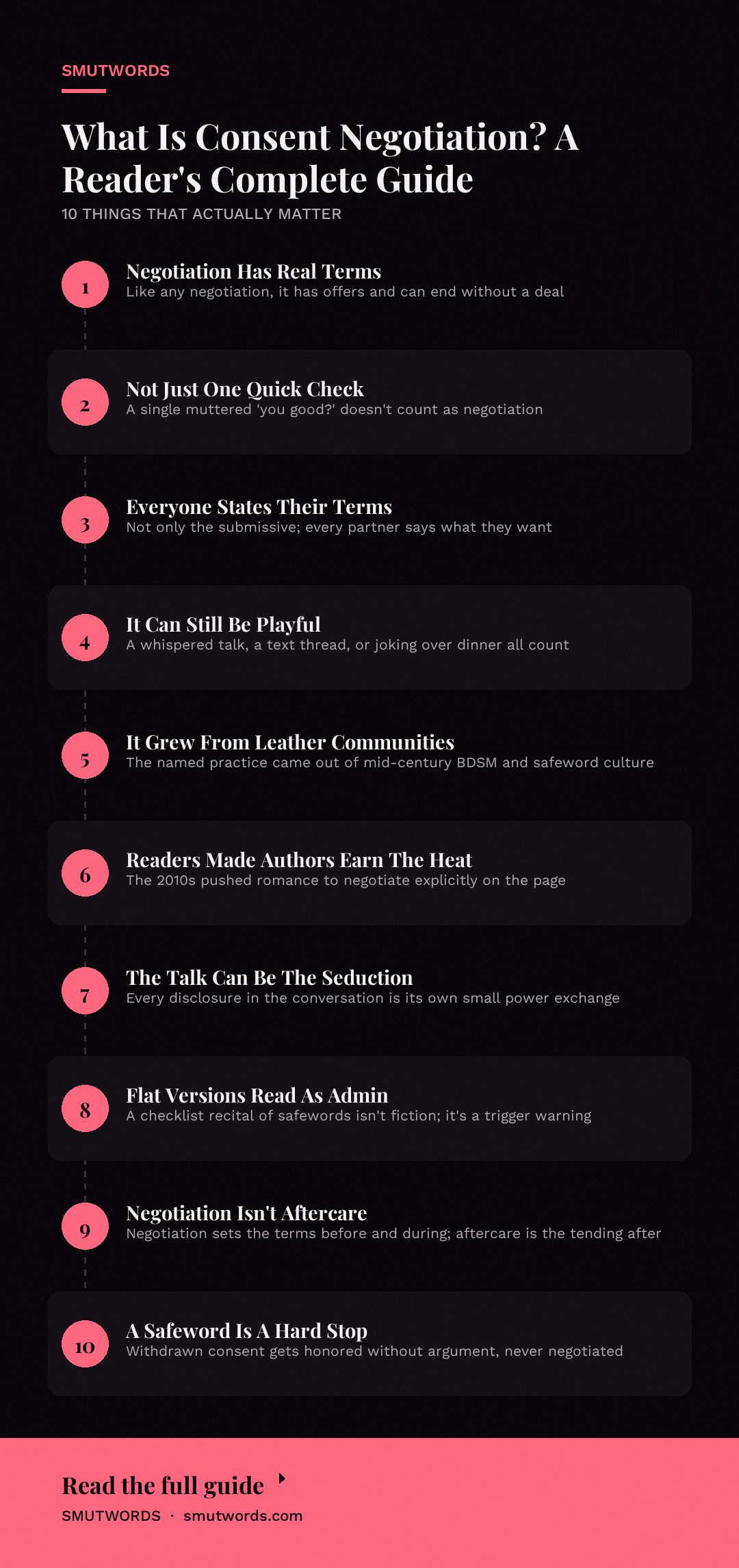
What doesn't count: a single "you good?" muttered once. Consent negotiation is an ongoing process, not a checkbox. The distinction matters in fiction because a scene that treats negotiation as a formality reads as shallow. One that treats it as genuinely open-ended reads charged.
Three misconceptions worth clearing up
First, negotiation doesn't kill spontaneity by design. Plenty of partners negotiate once and have a standing agreement for weeks. Second, negotiation isn't only for the submissive or the person being tied up. Everyone involved states their terms.
Third, negotiation doesn't have to be solemn. It can be a whispered conversation in bed, a text thread, a joking back-and-forth over dinner. The form varies. The explicitness is what makes it consent negotiation.
Where Consent Negotiation Comes From
Consent negotiation as a named practice grew out of the leather and BDSM communities in the mid-to-late twentieth century, alongside the safeword system and the idea that a scene should be built on agreed terms rather than improvisation.
The 1980s and 1990s brought it into the mainstream of kink writing through "safe, sane, consensual" rhetoric. The 2000s shifted the accent further toward "risk-aware consensual kink," which acknowledged that some practices carry real risk and that negotiation is how adults manage it. Consent workshops have been standard at play parties and kink conventions for decades. That's where most people first encounter the phrase performed out loud.
In erotica and romance specifically, the term's history is shorter and more interesting. For most of twentieth-century publishing, consent negotiation was mostly invisible on the page, handled by implication or by the "roguish hero who wouldn't really hurt her" convention.
The 2010s changed that. Readers started demanding that the spicy scenes earn their heat through explicit negotiation, and authors who wrote it well found the negotiation scenes were selling the book. Contemporary BDSM romance now routinely includes a sit-down conversation or a formal kink contract before the first scene. Plenty of readers report skipping ahead to the negotiation on a reread, because that's the emotional core.
What changed wasn't just the presence of negotiation. Earlier BDSM fiction sometimes treated it as a dry formality to get through. Contemporary romance treats it as a character scene, the place where both leads' vulnerabilities and kinks get revealed at once.
How It Shows Up in Erotica
The negotiation scene is one of the hardest scenes in the genre to write well, for a structural reason: it's mostly talking, it has to convey a lot of information, and it needs to be hot. The authors who succeed treat the conversation itself as a scene with its own tension, pacing, and disclosure beats.
Here's the craft breakdown, the way an editor looks at a draft.
The negotiation is a seduction scene wearing a practical face
The strongest versions let the negotiation become charged. Someone asks a question that's half business and half flirtation. A partner's answer reveals a kink they've never said aloud. The person writing the yes/no/maybe list pauses before admitting what they wrote down.
Every disclosure is a small power exchange of its own: information given, information received.
Weak versions treat the conversation as a checklist. The characters recite their safewords, confirm their limits, and the scene moves on. That works as a trigger warning on the page, not as fiction. If the reader isn't learning something about the characters through the negotiation, the scene is admin.
Common variations authors use
Pre-scene negotiation comes in several recognizable forms, and each delivers a different flavor of tension:
- The sit-down talk. Two characters have a real conversation before a scene. Usually calm, often at a kitchen table or in a hotel room. Tension comes from what's revealed. Aftercare planning often gets folded in here.
- The written contract. A kink contract, a yes/no/maybe list, sometimes a shared document the characters add to over time. Tension comes from reading each other's handwriting. Popular in office-set and formal-dom/sub dynamics.
- The mid-scene renegotiation. Someone calls a pause and asks for a change. This variant is a staple of darker BDSM romance because the renegotiation itself becomes a scene beat. Handled well, it's a power move. Handled badly, it reads as the book shirking the negotiation it should have had earlier.
- The check-in as recurring motif. Mid-scene check-ins woven through multiple chapters. The traffic-light system gets used, not just mentioned. Readers who love this variation come for the ongoing intimacy, not the one-off conversation.
- The text-thread negotiation. Contemporary romance loves this. The negotiation happens in DMs, screenshots, or voice memos. Tension comes from the medium's vulnerability and the delay between message and reply.
The variant that consistently produces the hottest scene is usually the first one, done well. The sit-down talk gives you two people choosing, out loud, to do something to each other. The choice is the erotics. The act is the follow-through.
What a strong version does
Strong consent negotiation scenes in erotica tend to do four things:
Enjoyed this? Get a free book.
Join the list and we will send a complete free story straight to your inbox, plus new releases every week after that. No credit card, no catch.
- Give both partners agency. Even in a power-exchange dynamic, both characters say what they want. The submission is chosen, not extracted.
- Reveal character through limits. What a character lists as a hard limit tells the reader more than a paragraph of backstory. A limit on a specific act often points at a history or a line they won't cross, and smart authors let that show without overexplaining.
- Show the negotiation as erotic in itself. The words do work. The pause before an answer is hot. An agreement sealed with a kiss reads as payoff, not exposition.
- Honor the ongoing part. The negotiation is set up as something that can be re-opened, and the story actually re-opens it. Safewords get used, not just named. Consent is withdrawn, acknowledged, and respected. The book proves it meant what it said during the talk.
What a flat version looks like
The flat version happens when the negotiation exists to check a box. It ticks through limits and safewords in a short paragraph, and the author moves on. The scene reads as a scene that knows it should be doing something but doesn't commit.
Another failure mode: the "perfect dominant" whose negotiation is entirely for the submissive's benefit, with no wants of his or her own. Real negotiation is mutual. When one partner states terms and the other only agrees, the reader gets a service-tier conversation. The kink reads thinner because the writing didn't let the person holding the whip need anything.
A third failure: the negotiation that gets contradicted in the scene. The characters agree to a boundary, and the dominant ignores it for drama. Some authors write this as a redemptive arc, and it can work if the book treats the violation as genuinely wrong and the scene as a turning point.
Most of the time it's a shortcut that breaks trust with the reader. The book needed the negotiation to matter later. Instead, it made the negotiation theater.
For the broader craft interest in scenes where characters agree to something risky, the SmutWords piece on what to expect at your first play party is a useful companion to how these scenes work off the page. So is our guide to blindfold play, which leans hard on negotiation before anything goes over the eyes.
Consent Negotiation vs Aftercare
These two terms show up side by side often enough that readers sometimes collapse them. They aren't the same stage of the scene, and the difference matters for what happens on the page.
Consent negotiation is what happens before and during the scene: negotiating terms, confirming limits, checking in mid-scene. Aftercare is what happens after: the tending, the check-ins once the scene ends, the blanket and the water and the conversation.
Both rely on communication, both get planned during the initial talk, and both belong to the same architecture of care. They serve different functions. Negotiation sets the terms of what happens. Aftercare is how partners come down and reconfirm that the terms held.
Authors who write both well often echo the planning language: the aftercare plan set during the negotiation gets paid off after the scene, and the reader feels the loop close. Authors who confuse the two end up with characters negotiating their way through aftercare, which reads as clinical and misses the point of the tending phase.
Impact play aftercare is another distinct term, worth knowing separately if a book includes that kind of scene, with its own specific tending needs. Consent negotiation covers the planning. Impact play aftercare covers the tending after impact specifically. The overlap is real; the labor is different.
Frequently Asked Questions
What is consent negotiation in BDSM?
Consent negotiation is the explicit conversation before and during a scene where partners discuss limits, desires, safewords, and what happens afterward. It turns unspoken assumptions into clear terms. The negotiation is ongoing: partners can renegotiate or withdraw consent at any point.
What's the difference between a hard limit and a soft limit?
A hard limit is something a person won't do, full stop, and shouldn't be pushed on. A soft limit is something they're cautious about, might try under the right conditions, or might warm to later. Soft limits get written into a yes/no/maybe list, and negotiating them is often where the conversation gets interesting.
Do you need a safeword if you're not doing anything kinky?
Safewords are most associated with kink because scenes can make "no" and "stop" ambiguous (especially in roleplay), so a distinctive word cuts through. Plenty of vanilla-adjacent partners use one too, and some prefer check-in phrases or the traffic-light system. The point is having a signal everyone recognizes and respects.
Can consent be withdrawn mid-scene?
Yes, and it should be honored without argument. Consent is ongoing, which is why mid-scene check-ins and safewords exist. A well-written scene in fiction shows the withdrawal being respected, not argued with. The safeword is a hard stop, not a negotiation prompt.
What's a yes/no/maybe list?
A written list of kinks and acts divided into three columns: things a person definitely wants (yes), things they won't do (no), and things they'd consider (maybe). Partners compare lists and find the overlap. It's a common tool for new partners because it takes the guesswork out and surfaces desires neither person might have raised on their own.
Is a kink contract legally binding?
No. A kink contract is a communication and trust document, not a legal one. It records what partners have agreed to do and not do, and it can be revised. Fiction sometimes treats the contract as more than that, but in practice it's a tool for explicitness, not enforcement.
Does negotiating kill the mood?
Not when it's written or performed well. Negotiation led with warmth, curiosity, and mutual disclosure can be its own kind of hot. The characters are still choosing each other. The negotiation is the choice made explicit.
Final Thoughts
Consent negotiation is the genre's favorite infrastructure. It's what lets the good stuff happen safely, and when it's written well, it's the scene that makes the book.
The best authors treat it as the first act of the relationship. Everything after lands harder because of it. If you want to read a book that gets this right, look for a BDSM romance where the negotiation comes with its own heat, its own reveals, and a payoff scene that proves the talk meant something.





Loading comments…