
What CNC Actually Means in Fiction
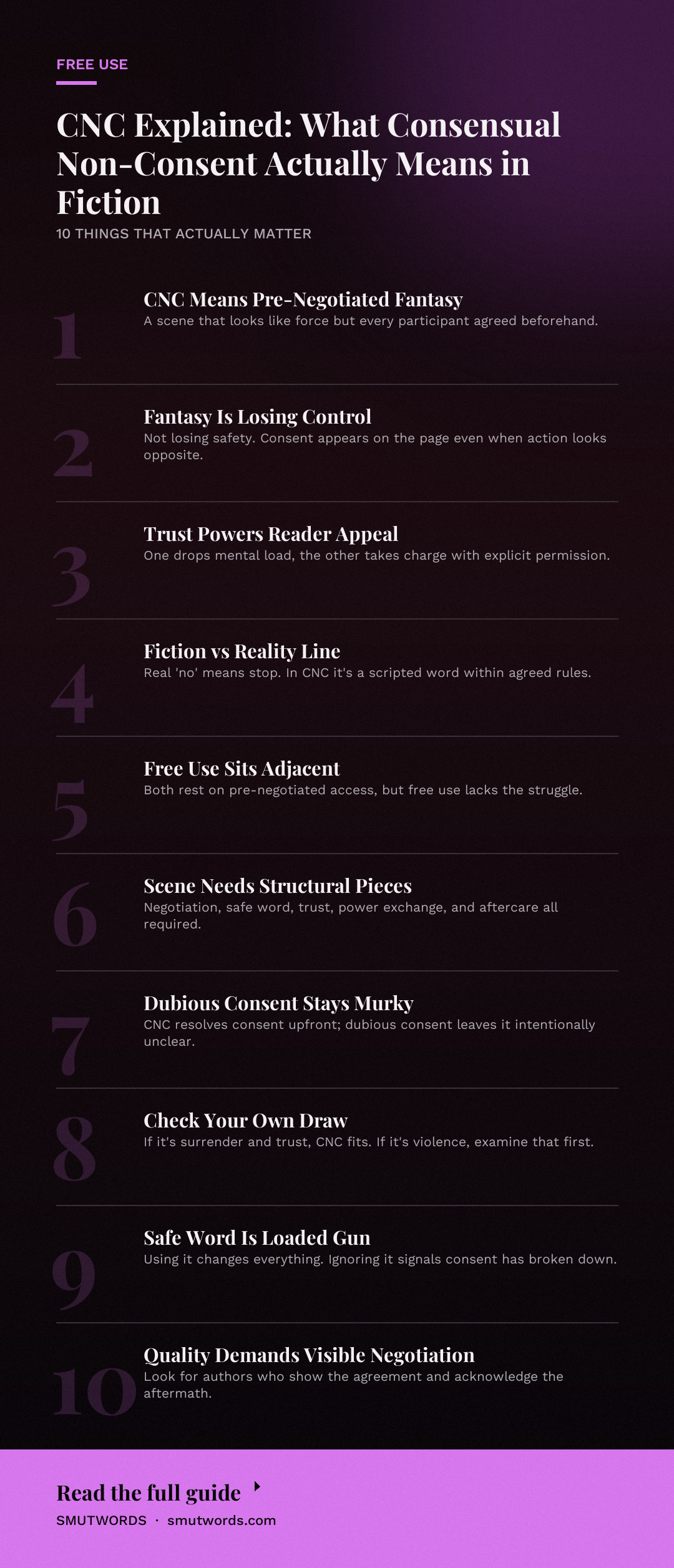
Consensual non-consent shows up in erotica more than most new readers expect, and it causes more confusion than almost any other trope on the shelf. The name sounds like a contradiction, which is the point. In plain terms: CNC is a scene where characters negotiate a scenario that looks like force, assault, or coercion, but every participant has agreed to it beforehand.
That agreement can come through a written contract, a safe word system, or just walking into a space with clear rules. The fiction part matters more than the non-consent part.
The fantasy being played out is the loss of control, not the loss of safety. That distinction is everything. A reader picking up a CNC story should see consent happening on the page, even when the surface action looks like its opposite.
The structure of the agreement separates this trope from something that glorifies actual harm, and authors writing this material know exactly how bright that line needs to stay.
Why Readers Are Drawn to CNC Scenarios
The appeal sits somewhere between trust and surrender. One partner gets to drop the constant mental load of making decisions, communicating needs, and managing the mood. The other gets to take charge with explicit permission to do what they want, knowing their partner wants it too. That exchange hits something primal that ordinary sex scenes often miss.
There's a reason so many romance subgenres brush against this territory without naming it. The possessive billionaire who negotiates a contract with the heroine is doing a version of this dance, just with legal documents standing in for a safe word.
Readers looking for CNC erotica explained by someone who actually reads it will hear the same thing again and again. The fantasy is about being wanted so completely that normal social rules bend. It's about trust so total that one person can say "no" and have it mean "yes, keep going" because of a conversation that happened before the scene started.
The taboo gives the exchange weight. Taking away the polite back-and-forth of typical seduction leaves the raw want underneath.
A scene where someone fights back but secretly loves it plays differently when you know the fight was choreographed. The struggle is performance. The desire is real. That gap between appearance and reality is the engine of the genre.
The Fiction vs. Reality Distinction
Here's where people outside the kink community get tripped up. They read a blurb about a woman pinned down, hear her say stop, and assume the book is endorsing sexual violence. That reading misses the entire framework the author set up.
In real life, someone saying "no" means stop, and any fiction that claims otherwise is unconscionable. In CNC fiction, the "no" is part of the negotiated script, and the author shows that agreement on the page, usually early, so the reader knows the rules of the game.
The difference comes down to agency. A real assault victim has no say in what happens, no warning, no control, no escape hatch. A CNC participant has already consented to the scenario, knows the boundaries they set, and can stop everything with a word or a gesture.
The fiction preserves the fantasy of helplessness without ever actually making the character helpless. The good authors walk that line with visible intention.
There's also a difference between reading about this and participating in it. Someone can consume CNC erotica without ever wanting to act it out. The page offers a safe container for exploring taboo impulses, the same way horror movies let people sit with fear without being in danger.
Some readers use these stories to process real experiences. Some just find the dynamic hot. Both reasons are legitimate, and neither requires trying anything in the bedroom.
How CNC Appears in Free Use Fiction
Free use erotica frequently overlaps with CNC territory because both tropes rest on the same foundation of pre-negotiated access. A free use scenario hands over ongoing consent for a set period or setting, and the partner takes what they want whenever they want it.
The difference usually comes down to objection. Free use characters tend to welcome the attention without protest once the agreement is in place. CNC characters often put up a verbal or physical struggle as part of the game, even while wanting what's happening.
Stories like Free Use Casino drop characters into an environment where the rules are announced upfront, and every encounter inside those walls carries implied consent. Nobody has to negotiate scene by scene because the setting did the work already.
That's a cleaner entry point for new readers than full CNC, since the compliance is enthusiastic rather than combative. The Free Use Airport Lounge takes the same approach in a transient space where travelers pass through and know what they're signing up for.
Dark free use stories push closer to the CNC edge. Free Use Doctor: A Dark Medical Free-Use Fantasy uses the clinical setting to strip away the usual courtship rituals, replacing them with directives and examinations that read as impersonal but remain consensual.
The power imbalance is baked into the scenario. The doctor has authority. The patient surrenders to it, but the patient chose to be there, and the story makes that choice visible.
Key Elements of a Well-Written CNC Scene
Not every story labeled CNC earns the label. Some authors write assault and call it kink, which poisons the well for everyone. A well-executed scene needs certain structural pieces in place to work ethically and effectively:
- Pre-scene negotiation: The characters talk about what will happen, what's off the table, and what the safe word is. This conversation might be brief, but it exists on the page.
- A clear safe word or signal: Something memorable and unambiguous. Traffic light systems, a specific word, or a physical gesture all work as reliable brakes.
- Established trust between characters: Partners who know each other's limits and history handle CNC scenes better than strangers. Some stories skip this for the thrill of danger, but the good ones build a foundation first.
- A visible power exchange: The reader should understand who holds the control and who surrenders it. That dynamic gets negotiated along with the physical acts.
- Aftercare or its emotional equivalent: Real CNC scenes end with care and reconnection. Fiction that skips this entirely often reads as hollow, while fiction that includes a tender aftermath lands the emotional stakes.
Check for these elements before recommending a book to someone new to the trope. A story missing the negotiation or the safe word isn't CNC. It's something else wearing the costume.
CNC vs. Dubious Consent: What's the Difference?
Readers new to this territory often confuse CNC with dubious consent, and the difference matters for what you're signing up to read. Dubious consent stories leave the consent itself murky. The heroine might be too drunk to meaningfully agree, asleep when things start, or emotionally manipulated into compliance.
The author intentionally clouds whether she actually wants what's happening. The tension comes from that uncertainty.
CNC stories resolve that uncertainty upfront. The consent exists, the reader knows it, and the drama comes from watching the agreed scenario play out. Neither approach is inherently better, but they deliver different experiences.
Enjoyed this? Get a free book.
Join the list and we will send a complete free story straight to your inbox, plus new releases every week after that. No credit card, no catch.
Dubious consent keeps the reader uncomfortable and questioning. CNC lets the reader relax into the fantasy of resistance without moral static. The best free use books list offers a useful map for figuring out which flavor you prefer.
There's also the question of when "no" means no in fiction versus when it's part of the agreed script. Authors signal this through context and character voice. A heroine who negotiated a scene and whispers protests through a smile is playing her role. A heroine who's genuinely terrified and trying to escape is in a horror story. Learning to read those signals comes with exposure to the genre.
How to Tell if CNC Erotica Is Right for You
New readers should approach this subgenre with curiosity and self-awareness. Start by asking what specifically appeals to you about the premise. If the draw is total surrender, trust, or the intensity of being so desired that someone bends rules for you, CNC will likely deliver.
If the draw is the violence itself, or if the idea of actual harm gets you going, that's worth examining before you go hunting for stories that validate it.
A sensible first step is reading free use material, which sits adjacent to CNC with less resistance play. Free Use Nurse: A Hospital Free-Use Fantasy offers a structured environment with clear rules and willing participation.
The guide to free use erotica explains how ongoing access fantasies work before you escalate to struggle-heavy CNC scenes. If those stories leave you wanting more friction, you've got your answer.
Pay attention to how a story makes you feel afterward. Erotica should never leave you feeling degraded or unsettled in a way that lingers unpleasantly. A good CNC story produces a satisfied, warm glow, the same as any other well-crafted smut.
If you finish feeling dirty in the wrong way, that author missed the mark, and you're allowed to put the book down without finishing it.
Dark Romance and Other Subgenres That Borrow From CNC
CNC dynamics bleed into mainstream romance more often than readers realize. Dark romance leans heavily on these tropes, dressing them up with brooding anti-heroes and high-stakes plots. The complete guide to anti-hero romance covers characters who take what they want while the heroine protests, only for the reader to learn she's complicit in the game.
That structure tracks directly from CNC fiction. The anti-hero's threat is real in the plot but negotiated in the relationship, and the tension comes from watching that line blur.
Certain romance subgenres use this dynamic so consistently they might as well have CNC baked into their formulas. Marriage in Trouble stories often feature one spouse demanding access the other resists, until the resistance becomes part of the reconnection ritual.
Soldier Romance and Billionaire Romance both rely on power imbalances where the dominant partner pushes boundaries and the submissive partner sets them. None of these subgenres announce themselves as CNC, but the skeleton is there.
Free use in public spaces adds another layer, where the risk of discovery substitutes for the struggle. The comparison between free use vs gangbang scenarios clarifies where group dynamics fit into the consent framework, and the public use fantasy piece explores how exposure changes the game. Each variation keeps the core agreement intact while changing the surface texture.
Safe Words and Their Role in Fiction
Most CNC fiction includes at least one explicit nod to safe words, even if it's a single line of dialogue. That mention serves double duty. It reminds the reader that consent structures exist within the story, and it gives the author a mechanism for plot tension.
A character who refuses to use their safe word when they should becomes a problem the other character notices. A character who uses it and gets ignored reveals the scene has turned genuinely dangerous.
The best writers treat the safe word like a loaded gun. It exists, it's powerful, and using it changes everything. Some stories build entire climaxes around a partner almost using the safe word but choosing not to, which dramatizes the trust at the heart of the fantasy.
Others have a character demand their partner prove their desire by refusing to safe out, which raises the stakes while keeping the safety valve visible.
When characters ignore a safe word in fiction, the author is telling you that what's happening has stopped being consensual non-consent and become something darker. The distinction matters for readers who want clean fantasies versus those who want to explore the ugly edge of the trope. Know which one you're signing up for before the scene goes sideways.
Finding Quality CNC Content
A quick search for CNC erotica explained will surface plenty of recommendations, but quality varies wildly. Look for authors who include negotiation scenes, who establish characters with interiority beyond their kinks, and who write aftermaths that acknowledge what just happened.
Praise from reviewers who specifically read kink fiction carries more weight than general romance reviews, since those readers can spot sloppy consent handling instantly.
Anthologies from established kink publishers tend to maintain higher standards than random self-published shorts, though exceptions exist everywhere. Free use collections like the Free Use County Fair and darker entries like Free Use Vampire Coven give you a sense of range within one trope family.
One thing to know going in: the free use model and the struggle-based model deliver different kinds of heat, and you might strongly prefer one over the other. That's not a defect in you or the genre, just a preference you'll refine as you read.
Final Thoughts
CNC fiction rewards readers who want their smut to carry weight. The negotiation, the trust, the boundary-pushing within a structure of care, all of it lands harder than a scene where two characters just fall into bed.
If you're new to this corner of erotica, start with free use stories to build your tolerance for the power exchange, then step into the resistance play once the dynamic feels comfortable. The audience for this material understands the fiction-reality boundary better than outsiders assume, and the best authors trust readers to hold that line with them.






Loading comments…