
Most people use "open relationship," "swinging," and "polyamory" like they're interchangeable, then get blindsided when a partner means something completely different by the same words. The gap between what you think you agreed to and what your partner thinks you agreed to is where most of the damage happens. So let's get the open relationship vs swinging vs polyamory distinction straight before anyone downloads an app or books a hotel.
Three different structures. Three different agreements, emotional loads, and failure modes. Knowing which one you're actually signing up for is the difference between a hot, honest arrangement and a slow-motion betrayal with extra steps.
What Is an Open Relationship, Exactly?
An open relationship is a committed couple that agrees to allow sexual (and sometimes romantic) experiences outside the relationship. The couple stays the primary unit. The openness is usually negotiated as a general permission rather than a scheduled activity.
It's the loosest umbrella of the three. Some open couples only play separately on work trips. Some have a standing rule that anything goes as long as nobody sleeps over.
Some treat openness as a background permission they rarely use, and others build a whole social life around it. The defining feature is that the couple relationship remains the anchor, and the outside connections happen independently.
That independence is the appeal and the risk. You don't need a matching couple, you don't need a calendar full of group events, and you don't need to introduce anyone to your partner. You also don't get the built-in guardrails that come from doing things together.
What Swinging Actually Involves
Swinging is the most social and the most structured of the three. It's typically couples who meet other couples (or singles, depending on the arrangement) for sex, often at parties, clubs, or planned dates, often in the same room or with some level of shared experience. The emphasis is recreational, time-bound, and usually has nothing to do with romance.
The classic version is "we only play together, or at least in the same building." That rule exists for a reason: it lets a couple process everything in real time and keeps outside connections casual by design. Swingers tend to have explicit rules about what's allowed, from condom use to how far a kiss can go to whether anyone exchanges phone numbers afterward.
Swinging draws people who like the shared event, the group energy, and the built-in social scene. If you've read erotica built on that specific thrill, like the group dynamic in Reverse Harem: Everything You Need to Know, you already know the fantasy version. The real version involves a lot more logistics and a lot less spontaneous perfection.
What Polyamory Means (and What It Doesn't)
Polyamory is multiple romantic relationships with the knowledge and consent of everyone involved. Sex is often part of it, but the defining element is romance, emotional intimacy, and often long-term commitment across more than one partner. Poly people have boyfriends, girlfriends, and partners in the full sense of those words.
This is where people most often misread the situation. A partner who says "I want to explore polyamory" is not offering you a hall pass. They're telling you they want the capacity to fall in love with someone else, and to have that relationship be real and acknowledged, not a fling you both pretend doesn't count.
Polyamory also tends to be the most time- and energy-intensive of the three. Multiple relationships mean multiple calendars, multiple sets of feelings, and honest conversations with every person involved about where they stand. Anyone who's read a Secret Baby storyline knows what happens when someone hides a whole second relationship. In polyamory, hiding is the cardinal sin.
The Key Differences at a Glance
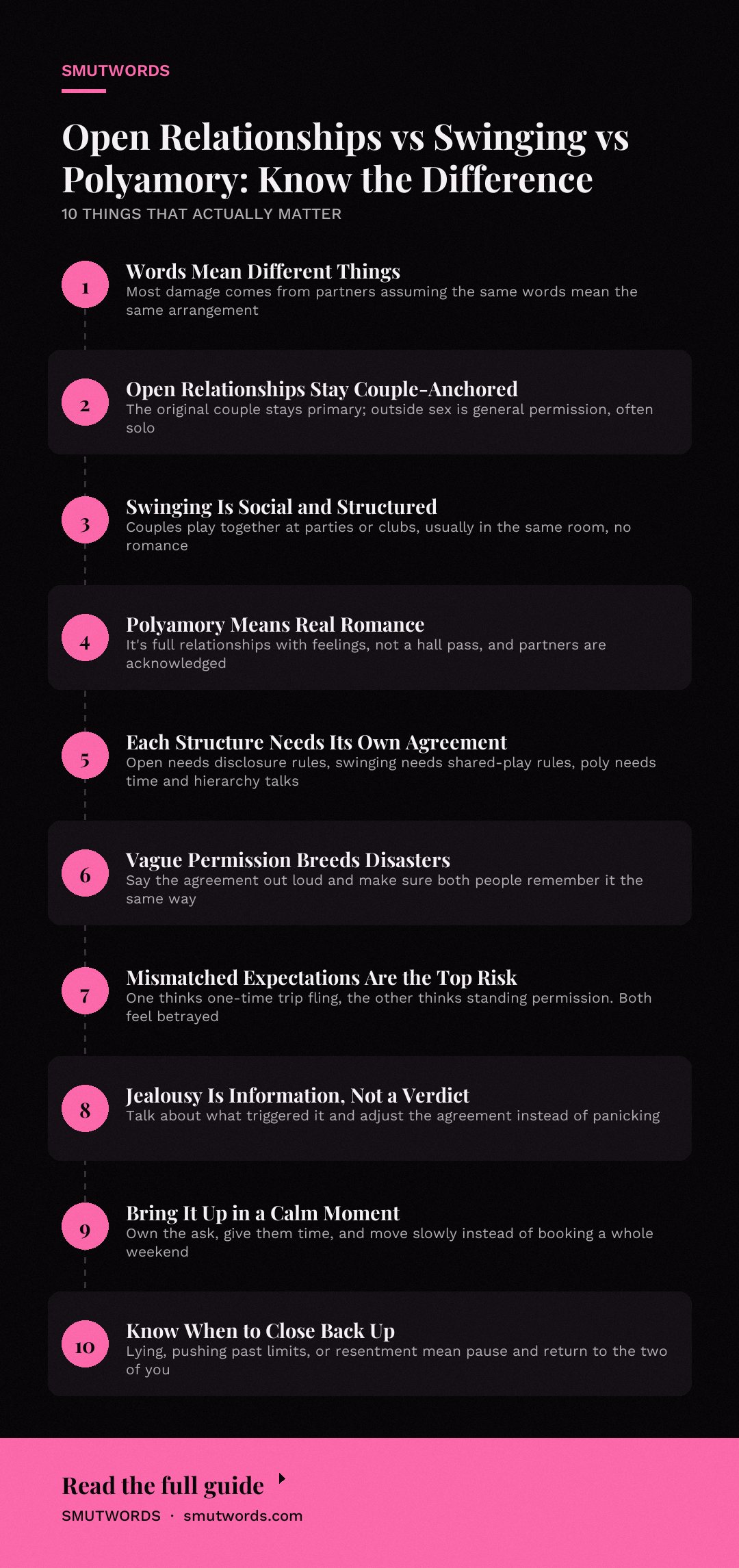
- Emotional scope: Open relationships usually allow sex outside the couple; polyamory allows full romantic relationships; swinging keeps outside contact recreational and short-term.
- Who's involved: Open relationships are often solo play; swinging is usually couples together; polyamory is individual dyads that all know about each other.
- Primary couple: Open and swinging arrangements almost always keep the original couple as the anchor. Polyamory may not have a "primary" at all.
- Time horizon: Swinging is event-based. Open relationships are permission-based. Polyamory is relationship-based and can last years.
- What you need to agree on: Open needs rules about disclosure; swinging needs rules about shared play; poly needs agreements about time, honesty, and hierarchy.
The Agreements Each Structure Requires
Nothing here works without a real agreement, written or at least said out loud and remembered the same way by both people. Vague permission is where disasters breed.
For an Open Relationship
You need to settle disclosure: do you tell each other before, after, or only if asked? Condom and STI rules are non-negotiable to nail down. So is whether outside partners can be regulars, whether overnights happen, and what counts as "too much" communication with someone else. And you need a policy for what happens if feelings develop, because they sometimes do, and "we didn't plan for that" is not a policy.
For Swinging
Most swinging agreements hinge on the together rule: same room, same event, same couple. Beyond that you need explicit rules about protection, about what acts are on or off the table with others, about how you check in during a night, and about a signal for "I need to leave now" that doesn't require a public conversation. Every experienced swinger has a story about the couple who didn't set that signal and had a miserable night.
For Polyamory
Poly agreements are the most detailed because they involve ongoing relationships. You'll need to talk about time allocation, how much you share about other partners, whether there's a hierarchy, how holidays and emergencies get handled, and how new partners get introduced. The most useful thing a poly couple can do is write the agreement down and revisit it every few months, because relationships change and the agreement has to change with them.
Questions to Ask Before You Try Any of It
Run through these honestly, separately and together, before anyone makes a profile. If a question makes one of you flinch, that flinch is the answer for now.
Enjoyed this? Get a free book.
Join the list and we will send a complete free story straight to your inbox, plus new releases every week after that. No credit card, no catch.
- What exactly do you want to do, and with whom? Get specific enough that you could describe it to a friend.
- What are you afraid of? Name the fear out loud. Jealousy about sex is a different fear than jealousy about intimacy.
- What would make you feel safe? Rules, check-ins, a veto, a particular reassurance after the fact.
- Are you doing this because you want it, or to keep the other person from leaving? The second one never ends well.
- What's your policy on feelings? If one of us catches them for someone else, what happens?
- How will we handle a bad night? Because there will be one, and the plan matters more than the fantasy.
How to Bring It Up With a Partner
Don't spring it during an argument or right after sex when everyone's feeling generous and agreeable. Pick a calm moment and own the ask.
"I've been reading about open relationships and I'm curious. I don't need an answer tonight. I want to know what comes up for you" is a far better opening than "so I was thinking we should see other people."
Give your partner time. A first reaction of "absolutely not" often softens into a real conversation once the surprise wears off. A first reaction of enthusiastic yes deserves the same scrutiny, because sometimes people agree to things they haven't actually thought through.
The couples who do this well tend to move slowly, talk for months, and start with something small rather than a fully booked weekend.
The Real Risks, and How to Lower Them
The biggest risk is not STIs, though those are real and condoms and regular testing handle a lot of it. The biggest risk is mismatched expectations.
One person thinks "open" means a one-time thing on a business trip. The other thinks it means a standing permission. Both are behaving in good faith and both feel betrayed.
Jealousy is the second risk, and it's normal. It doesn't mean the arrangement is wrong; it means something needs attention. The couples who survive it treat jealousy as information, not as a verdict. They talk about what triggered it and adjust the agreement instead of calling the whole thing off in a panic.
Time and energy are the third. Polyamory especially can quietly eat a relationship if one partner feels deprioritized. Scheduled check-ins, honest calendars, and the willingness to say "I need more of you right now" fix more of this than any rule ever will.
If jealousy runs hot, if one partner is going along to avoid a breakup, or if anyone starts lying about where they are, stop. Pause the whole arrangement and go back to the two of you. There is no shame in closing a relationship that opened too fast.
What Fiction Gets Right (and Glosses Over)
Erotica loves the charged version of these dynamics, and some of it gets the emotional texture right. Watched and Whispered nails the specific thrill of being seen, which is a big part of why people are drawn to swinging in the first place. First Timer: A Hotwife Cuckold First Time Erotica plays out the negotiation and nerves of a first outside experience in a way that's more emotionally accurate than most people expect.
What fiction tends to skip is the boring part: the calendar, the testing schedule, the check-in text at 11 p.m. That's the part that actually keeps a real arrangement working. Enjoy the fantasy for what it is, and treat the real thing like the practical project it is.
If a particular dynamic is what's pulling you toward this, follow that thread honestly. Someone drawn to the free-use fantasy in Free Use Wedding: A Free-Use Bride Fantasy is often chasing surrender and permission, not a group calendar. Knowing which itch you're actually scratching saves a lot of confused conversations.
When to Stop, Pause, or Close Back Up
Close the relationship back up, at least temporarily, if any of these show up: someone is lying about where they are, one partner is pushing past a stated limit, jealousy has turned into resentment, or either of you is using outside partners to avoid dealing with something inside the relationship. None of those are fixable by adding more people.
Also stop if you're doing it for the wrong reason. Opening a relationship to save it is like having a baby to fix a marriage. It adds pressure exactly where there's already too much.
Final Thoughts
If the fantasy of being watched or shared is what's pulling you in, start with Watched and Whispered and let it be fiction for a while. Talk about what it stirs up with your partner before you talk about rules, calendars, or anyone else's body. The conversation is the whole point.








Loading comments…