
Degradation kink is the erotic charge that comes from being called something ugly and liking it. A partner says worthless, pathetic, just a hole, and instead of shame, the submissive feels a hot, narrow focus: the world shrinks to the voice, the words, the person saying them. That is the whole engine.
A degradation kink is a consensual arrangement, built on trust and negotiation, where verbal or physical humiliation, objectification, or demeaning language produces arousal instead of harm.
The nastier the words get, the more carefully they have to be agreed on in advance.
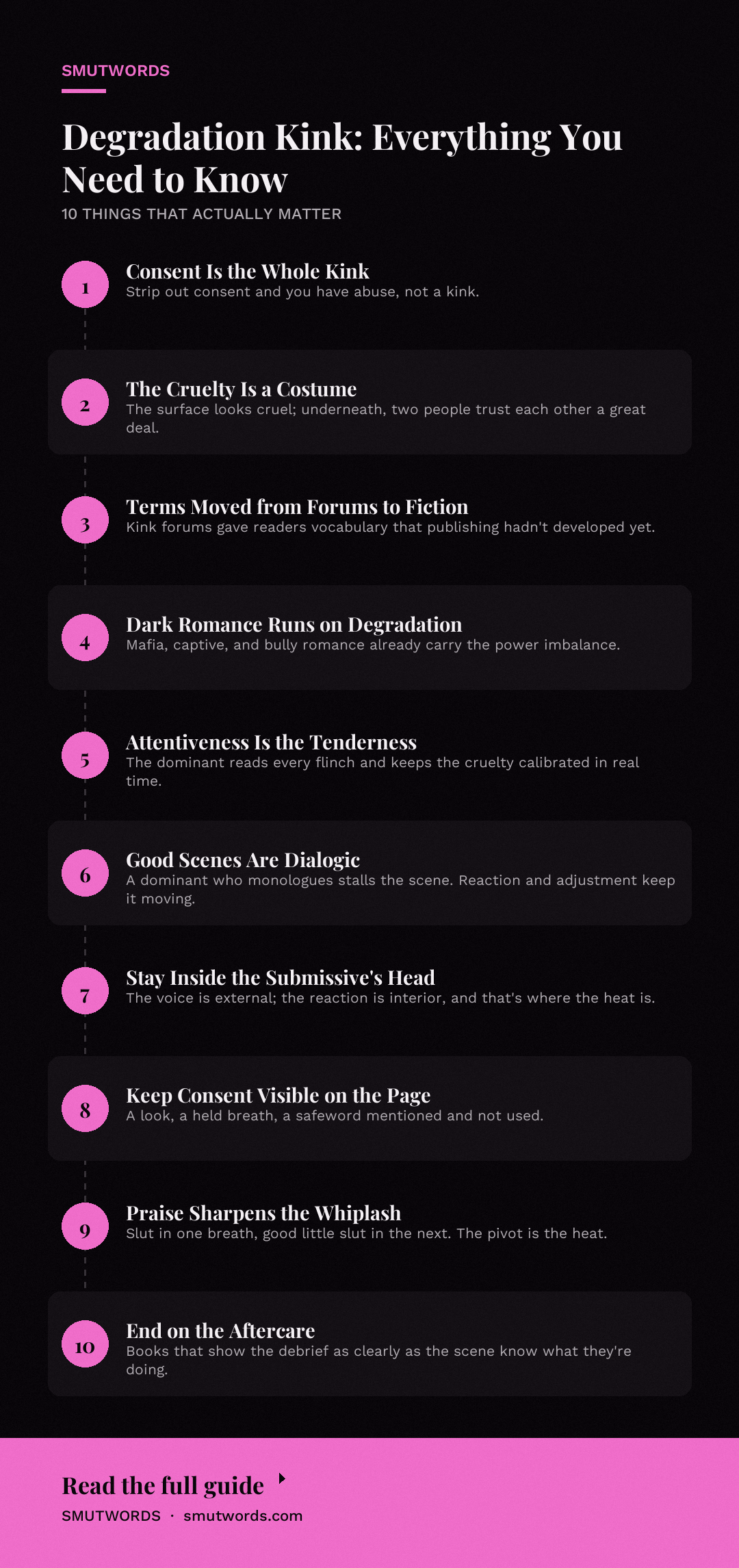
It is one of the most misunderstood kinks in erotica, partly because the surface looks cruel and the mechanism underneath is the opposite. Two people have to trust each other a great deal before one of them can call the other a stupid little slut and have it land as pleasure. The cruelty is the costume. The consent is the body underneath.
What Degradation Kink Actually Means
Degradation kink is arousal from being lowered, verbally or physically, inside a scene or relationship where both parties have already agreed that the lowering is wanted. The operative word is agreed. Strip out consent and you have abuse, not a kink. The kink is the frame around the words that makes them land as erotic.
Where Degradation Kink Comes From
Humiliation as a named kink has been documented in Western sexology since the mid-twentieth century, when researchers began cataloguing the wide range of consensual power-exchange practices people reported. The specific term degradation as a distinct flavor of humiliation play gained currency in kink communities in the 1990s and 2000s, as online forums let people compare notes across cities and countries for the first time.
In erotica and romance publishing, the trope has a longer and messier history. Classic BDSM literature from the mid-twentieth century often blurred degradation with punishment, treating verbal humiliation as a mild prelude to physical discipline. The dirty talk was rarely the point. It was seasoning on the way to something else.
That changed with the indie romance boom of the 2010s, when dark romance and BDSM romance authors started writing degradation as the main event. Heroines who wanted to be called names and heroes who delivered those names with unmistakable tenderness became a recognizable archetype. Reviewers started tagging books by the specific flavor of humiliation a reader could expect.
The most recent shift is toward precision.
Readers now want to know exactly what kind of degradation a book contains before they buy it: verbal only? physical? public? CNC?
The genre has gotten more honest about the fact that degradation covers a spectrum, and that a reader who loves being called a whore might hate being called stupid, and vice versa.
How the Term Moved from Forums into Fiction
Kink forums gave readers a vocabulary that publishing hadn't yet developed. Writers borrowed it, and authors' notes started listing triggers with the same care a content warning page would. The vocabulary traveled from community spaces into the books themselves, and now a romance novel can tag itself as verbal degradation, praise kink, CNC on the first page and readers know what they're getting.
That's a real change in how the genre treats its audience. A generation ago, a reader who wanted this had to hunt for it. Now it announces itself.
How It Shows Up in Erotica
On the page, degradation works through a specific set of craft moves. The dominant has to sound like they mean it, and the submissive has to sound like they're being taken apart in real time. Flat versions fail because the writer flinches: the insults come out too polite, the reactions too tidy, the whole thing reads like two people reading from a script they're embarrassed by.
Strong versions have cadence. The insult lands, the submissive's body reacts, and the dominant notices. That noticing is the erotic core of the scene. A dominant who calls someone a filthy little thing and then watches them fall apart is doing something tender with a sharp tool.
Here are the variations that show up most often in published erotica and romance:
- Verbal degradation: Name-calling, insults, and dirty talk that lowers the submissive's status ("slut," "whore," "pet," "toy"). The most common form by far, and the one most books mean when they tag "degradation."
- Objectification: Treating the submissive as a thing rather than a person, sometimes literally (positions, instructions, being used), sometimes in language ("just a warm body," "my fucktoy").
- Humiliation play: The broader category; includes verbal degradation but also physical humiliation, embarrassment, and scenarios where the submissive is made small in front of others.
- Consensual non-consent (CNC): Scenes where the parties have agreed in advance to act out a lack of consent, and the degradation is part of a fantasy of being taken without choice. Handled carefully in good fiction, since the consent framework is the whole safety structure.
- Physical degradation: Spitting, being used roughly, being positioned as beneath the dominant (literally on the floor, on the bed, held down). Less common in mainstream romance, more common in darker indie work.
- Public or semi-public degradation: Being demeaned in front of others, or in a scenario where exposure is part of the charge. The orgy setting is a common way to raise the stakes here. If that's the flavor you're chasing, our guide to your first play party covers how the public version works off the page.
The counterpoint most writers pair with degradation is the praise kink. A dominant who can pivot from you disgust me to you're being so good for me does more for a reader than a dominant who stays vicious throughout. The whiplash is where the heat lives.
The Craft Problem: Making It Land Without Breaking Trust
The hardest part of writing degradation is making the reader believe the dominant actually cares. If the dominant seems to enjoy the cruelty for its own sake, the scene stops being erotic and starts being upsetting. If the dominant seems to be performing cruelty they don't feel, the scene goes limp.
The version that works is the dominant who is highly attuned to the submissive's reactions, who reads every flinch, and who keeps the cruelty calibrated in real time. That attentiveness is the actual tenderness underneath. A reader can feel it even when the words on the page are ugly.
Good dirty talk helps. Bad degradation in fiction often has a monologue problem: the dominant gives a long, static speech about how worthless the submissive is, and the scene stalls.
Better versions are dialogic. The dominant says something vicious, the submissive reacts or fails to react, and the dominant adjusts. The scene moves.
Where Degradation Lives in Different Subgenres
Dark romance is the obvious home. The trope works well in mafia romance, captive romance, and bully romance, where the power imbalance is already built into the premise. The harem romance format can also carry it, with a single submissive and multiple dominants, each with their own flavor of degradation. The why choose romance structure pushes the dynamic further, since the submissive's attention is divided and the degradation can come from competing sources.
Contemporary romance has an interesting middle ground: the degradation is confined to the bedroom, and outside it the couple is properly polite. That contrast is part of the appeal. The same person who calls the heroine a filthy girl in bed holds her hair back when she's sick.
Enjoyed this? Get a free book.
Join the list and we will send a complete free story straight to your inbox, plus new releases every week after that. No credit card, no catch.
Friends-to-lovers and friends with benefits setups hit differently, because the degradation happens inside an established friendship. The reader already knows these two people care about each other. Watching them discover this together is where the tension goes. It's the same engine that drives sharing kink when it's written well: the taboo is loud, the affection underneath is louder.
What a Strong Degradation Scene Actually Does
It stays in the submissive's head. The reader needs to feel the moment the words land, the internal response, the way arousal and shame tangle together in a body that doesn't know yet whether it's allowed to want this. The dominant's voice is external; the submissive's reaction is interior, and that's where the heat is.
It keeps the consent visible on the page. Not as a legalistic interjection, not as a scene-killing pause, but as small signals: a look, a held breath, a safe word mentioned and not used. The best authors make consent feel like part of the erotic architecture rather than a disclaimer stapled to the top.
It shows the dominant's restraint. A dominant who goes all the way immediately has nowhere to escalate. A dominant who keeps something back, who is clearly in control of their own level of cruelty, reads as far more powerful than one who spills everything at once.
It ends with aftercare on the page. A scene that closes without care reads as incomplete to experienced readers, and rightly so. The come-down is half the story. A dominant who wraps the submissive in a blanket and tells them they did well is doing the work that makes the scene survivable, and the reader knows it.
Degradation Kink vs Humiliation Play vs Verbal Degradation
These three get used interchangeably, but readers draw lines.
- Verbal degradation is the narrowest: name-calling and insult-based dirty talk, usually one-on-one, usually in bed. The words do the work.
- Humiliation play is the broader category: verbal and physical, private and public, sometimes involving embarrassment scenarios that have nothing to do with names. Being made to do something ridiculous in front of a partner, being exposed, being laughed at. The arousal comes from embarrassment, not from being called something.
- Degradation kink is often used as the umbrella term in publishing, because it's the term that appears on trigger warnings. It covers both of the above, plus objectification and CNC, and it's the label readers search when they want the whole range.
The distinction matters when you're browsing for a specific book. A reader who wants the tight, sharp pleasure of being called names in bed may find a public humiliation scene too much. The reverse is also true: someone who wants the elaborate public scenario may find a two-person name-calling scene too small.
Degradation Kink vs Praise Kink
These are cousins, and many readers love both. The praise kink is arousal from being called good: such a good girl, so perfect for me, doing so well. The degradation kink is the inverse, and a lot of the heat in either one comes from the contrast with the other.
In practice, the two often run together. A dominant who calls the submissive a slut in one breath and such a good little slut in the next is doing both at once, and the whiplash is the point. Books that lean into the pairing tend to have a distinct rhythm: the submissive gets debased, then rewarded, then debased again.
The reader's preference varies. Some want the debasement to run unbroken. Some want the dominant to swing between degradation and praise and never quite land. The subgenre is wide enough to hold both.
Frequently Asked Questions
Is degradation kink the same thing as abuse?
No. The line between them is consent, negotiation, and care. In a degradation kink dynamic, the submissive has explicitly agreed to be spoken to that way, has named their limits in advance, and has a safeword that stops the scene.
Abuse is what happens when those things are absent. The kink is the practice of doing the same words inside a structure that makes them safe.
What are common limits in degradation scenes?
Most people draw lines around specific subjects, not the whole kink. Common limits include comments about body weight, intelligence, family, trauma, and any existing insecurity the submissive hasn't volunteered for the scene. A pre-scene conversation where each person names their hard limits and their soft limits (things that might be okay in some contexts) is standard practice. So is the rule that the dominant never invents a new limit mid-scene.
Why do people enjoy being degraded?
The mechanism varies. Some love the relief of letting go of performance: when someone calls you a mess, you don't have to keep pretending to be composed. Some love the vulnerability, the sense of being stripped down to something the partner is choosing to want anyway. Some come from the power exchange itself, where the dominant's control reads as care.
The strongest explanation most readers give is trust. Being degraded by someone you trust is a way of being seen at your worst and desired anyway.
What is aftercare and why does it matter in degradation play?
Aftercare is the period after a scene where both partners check in, physically and emotionally. In degradation scenes it matters more than in most kinks, because the words used can echo for hours afterward. A good aftercare routine includes reassurance, physical comfort, a debrief of what worked, and an explicit reframing: that was the scene, here's what I actually think of you. Skipping aftercare in a degradation scene is the fastest way to leave someone feeling genuinely small.
Can degradation kink work in a long-term relationship?
Yes, and many long-term couples treat it as one play style among several rather than a 24/7 dynamic. The vocabulary gets negotiated, revisited, and updated as the partners learn what lands. Couples who do it well tend to have regular check-ins outside of scenes, where they talk about limits and desires in plain language. The degradation stays inside the bedroom unless both partners have agreed otherwise.
How do I bring up degradation kink with a partner?
Outside of sex, in a neutral moment, using plain words. I've been reading about degradation and I think I'd like to try some verbal stuff, with a safeword, in a scene is a complete opener. The conversation afterward, where the partner says what they want and don't want, is part of the practice, not a preamble to it.
If a partner isn't interested, that's a full answer and the kink belongs on the shelf for that relationship. If a partner is curious, start small: one agreed-upon phrase, a short scene, a long aftercare.
Final Thoughts
Degradation kink is one of the rare kinks where the surface and the mechanism are almost opposites. The words are ugly; the trust required to make them land is rare and specific. When it's written well, it reads as a portrait of a relationship strong enough to hold cruelty inside it without breaking. That's why the best versions of the trope stay with readers longer than the average dark romance.
If you want to see it done with real care, look for the books that show the debrief as clearly as the scene. A book that ends on the aftercare, with the dominant checking in and the submissive reframing the words, is usually the one that knows what it's doing. Readers who've been in this dynamic tend to recognize the honest version immediately.





Loading comments…