
The sharing kink is the erotic charge a person gets from their partner being sexually intimate with someone else. That charge can come from watching, from arranging it, from hearing about it afterward, or from the sharp, complicated feeling of jealousy that turns into arousal.
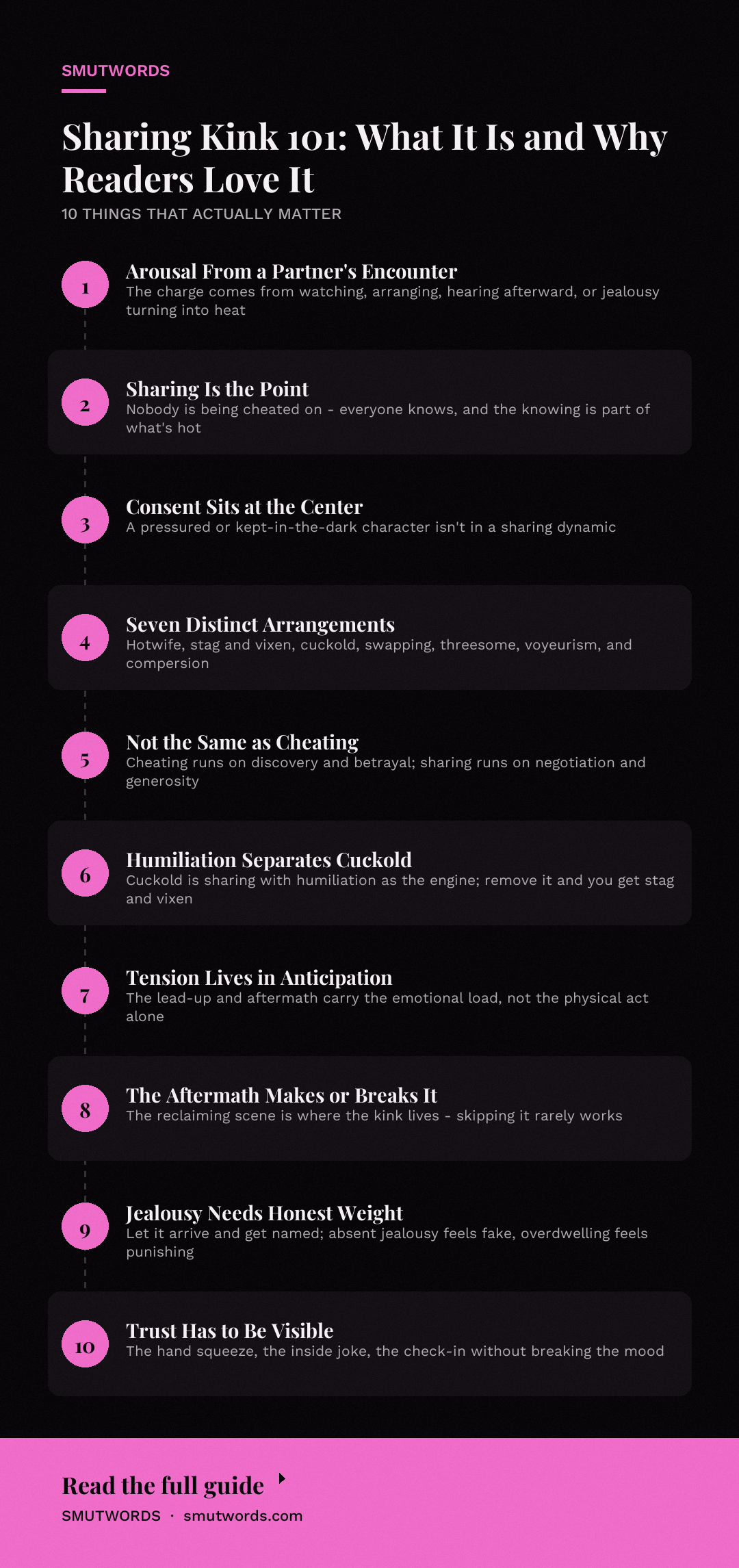
In erotica and romance, sharing kink covers a wide territory: hotwife arrangements, stag and vixen dynamics, cuckold scenarios, threesome initiations, and any story where a partner's desire for another person becomes fuel rather than threat. The throughline is that the sharing is the point. Nobody is being cheated on. Everyone involved knows what's happening, and the knowing is part of what makes it hot.
That distinction matters because sharing kink sits close to several other things readers search for and get confused about. It is not the same as a cheating trope, where the betrayal is the engine. Nor is it automatically cuckold kink, though cuckold is one expression of it. Plenty of readers come to this kink through a single scene in a book they picked up for other reasons and find themselves rereading it three times before they admit what's going on.
What Sharing Kink Actually Means
The term describes an erotic interest in a partner's sexual experiences with other people, where the person doing the sharing is aroused by the arrangement rather than hurt by it.
The arousal can run in several directions at once. Some people are turned on by the visual of watching. Some by the anticipation, the planning, the selection of the other person. Some by the aftermath: the reclaiming, the debrief, the way the partner comes back different and more desired.
The word "sharing" itself is doing a lot of work here. It implies ownership that's being offered rather than surrendered, and it implies the offer is voluntary.
Consent sits at the center of the definition. A character who is pressured, manipulated, or kept in the dark is not in a sharing dynamic. That's infidelity with extra steps. Erotica does write that, but it belongs to a different shelf.
What counts as sharing kink
Several distinct arrangements fall under the umbrella, and the differences between them are real. A quick taxonomy helps:
- Hotwife: A wife has sex with other men, typically with her husband's enthusiastic knowledge and encouragement. The husband often watches or hears about it. The arrangement is usually ongoing rather than a one-time event.
- Stag and vixen: Similar structure to hotwife, but the framing is more explicitly about the husband's pride and the wife's freedom. The stag participates, watches, or reclaims; he is not humiliated. The vixen pursues other partners openly.
- Cuckold: A wife takes other lovers while the husband watches or knows, and humiliation or submission is part of the dynamic for at least one participant. Not every cuckold story involves degradation, and not every one makes the husband submissive, but the humiliation element is what separates it from stag and vixen.
- Swinging and couple swapping: Two couples trade partners, usually in the same space. Less about one partner being shared than about mutual exchange. The guide to couple swapping is a useful companion if this variant specifically appeals.
- Threesome initiation: A couple invites a third person in, and the story tracks the negotiation, the nerves, and the shift in the couple's dynamic during and after. The sharing is often a first-time experience, which gives the scene its charge.
- Voyeurism: The reader or the character gets off on watching. Shading into the voyeur husband trope, where the husband's watching is the engine.
- Compersion: The emotional state of taking joy in a partner's pleasure with someone else. Not an act in itself, but the emotional core many sharing stories are aiming for.
What doesn't count
Sharing kink gets confused with cheating because the surface acts look identical. A wife has sex with another man. The difference is information and consent.
Cheating stories run on discovery, betrayal, and the reader's anxiety about whether the relationship survives. Sharing stories run on negotiation, generosity, and the strange, specific pleasure of seeing your partner want something you can't provide alone.
Sharing is also distinct from plain ethical non-monogamy in fiction. An open marriage where both partners date separately can be written without any erotic charge around the sharing itself. Sharing kink is about the charge. The mathematics of who is with whom matters less than the emotional temperature of the arrangement.
And it's not the same as a partner-sharing plot where one character is being pimped out or coerced. Dark romance can borrow the aesthetics of sharing, but the kink proper requires that the character doing the sharing is getting something out of it. If they aren't, you're reading a different book.
Where Sharing Kink Comes From
Hotwife and cuckold erotica has a longer publishing history than most readers assume. The terms themselves are older than the internet, circulating in swinger newsletters, personal ads, and specialty magazines from the 1970s onward. Victorian-era erotica had its share of wife-sharing scenarios too, written in coded language and usually framed as aristocratic decadence or moral cautionary tale, with the titillation doing most of the work.
The internet changed the distribution, not the appetite. Usenet groups, early web forums, and eventually dedicated erotica sites developed their own vocabulary: hotwife, cuckold, stag/vixen, compersion. Writers in these spaces were often anonymous, often unserious about craft, and occasionally very good. The tropes hardened around recognizable beats: the wife's first outing, the husband's combination of nerves and arousal, the debrief in the bedroom afterward.
Romance publishing came later to the party. Traditional imprints spent decades avoiding anything that looked like an endorsement of non-monogamy, and sharing plots showed up as scandals to be resolved rather than pleasures to be explored.
The self-publishing boom of the 2010s cracked that open. Readers with a specific kink and a Kindle account could find what they wanted without a gatekeeper deciding it was too transgressive. Tags, trope lists, and newsletter recommendation chains did the rest.
By the time mainstream romance started producing hotwife-adjacent stories under thin pseudonyms, the tropes were already fully formed. Authors were no longer inventing the beats; they were writing variations on them. That's not a problem. It's a sign that the kink has a working tradition, with conventions readers expect and riffs that feel fresh inside those conventions.
The word itself
"Sharing" as a fiction-genre label is newer than the practices it describes. The kink has been written under fan-fiction tags like "wife sharing" and community labels like "hotwife" for decades. The phrase "sharing kink" is a consolidation of those terms, mostly a reader-side label rather than a word the original writers would have used.
That's typical for kink terminology in romance. Practice comes first. Category labels come after, usually when a reading community needs to find each other.
How It Shows Up in Erotica
The craft question for a sharing scene is not "who does what to whom." It's where the tension lives. In a well-handled sharing story, the emotional load sits in the anticipation and the aftermath, with the physical scene as the pivot between them. Writers who put everything into the physical act tend to produce flat scenes. Readers show up for the emotional torque.
The pre-scene beats
Most strong sharing stories spend real estate on the lead-up. Some variation of these beats shows up in almost every book:
- The confession: One partner admits the fantasy. Sometimes directly, sometimes through a hint dropped in bed. This is often the first place the reader's own desire gets reflected back at them, and good writers let the confession be as hot as the act.
- The negotiation: What are the limits? Who is allowed? Is this a one-time thing or ongoing? Where does the couple's relationship live apart from the arrangement? Negotiation scenes are a chance for real intimacy to show up before the sex does.
- The selection: Often overlooked, and often the best scene in the book. Picking the other person, sizing them up, flirting on behalf of your partner. The prose can be as charged as any sex scene, and a writer who knows what they're doing will linger here.
- The nerves on the night: Both partners get the pre-outing jitters. The wife's dress, the husband's racing heart, the small talk that has to happen before anyone gets anywhere. This is where jealousy first surfaces, and it's more interesting when it does.
The scene itself
When the physical scene arrives, the writer has a craft choice: whose point of view carries it. The husband's? The sharing partner's? Both in alternating chapters? The other person's eyes entirely? Each choice changes what the scene is about. From the husband's POV, the scene is about possession and generosity tangled together. From the wife's, it's about appetite and performance and freedom. From the other person's, it's about being chosen, and stories told this way often make the third person more interesting than the couple. That's a risk as well as a strength.
The physical writing itself should treat the other person's body as an event, not a prop. Good sharing erotica describes the other man's hands, his voice, the body parts the couple has negotiated access to, with an attention that mirrors how the watching partner is watching. The prose should feel like it's been given permission to look.
The aftermath
This is where the kink usually lives or dies. The scene ends. The third person leaves (or doesn't, which is its own variation). The couple is alone. What happens in the next twenty-four hours is the emotional thesis of the whole story.
Enjoyed this? Get a free book.
Join the list and we will send a complete free story straight to your inbox, plus new releases every week after that. No credit card, no catch.
The debrief, the reclaiming, the questions about whether anyone is angry, the tears that come out of nowhere, the second round of sex that reasserts the relationship. Some books handle this in two pages. Some live inside it for a whole chapter. Either can work. Skipping it rarely does.
Writers in this space have to handle jealousy honestly. Pretending it doesn't exist makes the story feel like propaganda. Dwelling on it so heavily that the character seems broken makes it feel like a cautionary tale. The sweet spot is the middle: jealousy appears, is named, is handled.
What's the character actually afraid of? Being replaced? Being compared? Being revealed as not enough? Then what happens when the fear is looked at directly and the relationship holds?
Common variations
Once you know the beats, you start seeing the variations clearly. These are the most common:
- First time: The couple has never done this before. High nerves, high risk of miscommunication, high payoff when it works.
- Established arrangement: The couple has done this before, and the story is about a specific new partner, a specific milestone, or a specific escalation. Lower initiation friction, high room for character work.
- Stranger: The other person is unknown to the couple. Anonymous, safe, disposable. A one night stand that the couple orchestrates.
- Known third: The other person is a friend, colleague, ex. The interpersonal complications get pulled back into the couple's daily life, which is both a gift and a bomb. Friends with benefits arrangements are a natural fit here.
- Fantasy only: The couple talks about it during sex and never does it. The kink is entirely in the dirty talk. This is underrated and often the hottest version.
- Reverse: The wife arranges for the husband to be shared, or both partners are shared simultaneously. Less common in published romance, but a growing category.
- Group expansion: What begins as one shared experience becomes a larger arrangement, sometimes shading into harem romance territory or a group marriage structure that the story commits to.
What makes the strong version work
The strongest sharing scenes treat the couple's relationship as the central character. The other person matters, but as an event rather than a rival. When the husband watches his wife with someone else, the reader should feel three distinct things: the wife's pleasure, the husband's arousal, and the couple's bond being tested and reasserted in the same paragraph. Writers who hit all three make the scene work at the level of the kink and the level of the romance.
Trust has to be visible on the page. Characters who are comfortable with the arrangement should show it through small behaviors: the hand squeeze before the door opens, the inside joke that deflates the tension, the way one partner checks in without breaking the mood.
Writers often skip these because they seem unsexy. They're not. They're the page proof that the trust is real, and without them the scene reads as two strangers in the same room.
And the writer has to let the jealousy have weight. A scene where the sharing partner is uncomplicatedly fine the entire time tends to sag. Nobody in the reader's seat is uncomplicatedly fine about watching their person be wanted by someone else. Give the character a moment of sting, even a small one, then let them come back around. That arc is the whole point of the kink.
The flat versions go wrong in predictable ways. The other person is a prop with no interiority. The negotiation gets skipped entirely. The jealousy is either absent or overblown into melodrama. Readers notice all of it.
The reclaiming afterward gets rushed, too, usually into an immediate sex scene that never lets the couple actually talk. Or the writer treats the kink as a phase to be outgrown, with the story resolving in monogamy as if that's the maturity arc.
The real-world layer
Fiction is fiction, and the rules of fire play or a tantra session on the page don't need to match a safety manual. But sharing dynamics in real life depend on clear, ongoing consent, honest communication about limits, and aftercare for any jealousy or insecurity that surfaces. Stories that write those elements well tend to be the ones readers trust.
Sharing Kink vs Cuckold Kink
These two get used interchangeably, and they shouldn't be. Cuckold is a specific subset of sharing with humiliation as its erotic engine. The husband's submission to being displaced, his awareness that another man has satisfied his wife better, the ritual of his inferiority: that's the point. Remove the humiliation and you have stag and vixen, which is sharing without degradation.
Hotwife sits between them. Some hotwife stories lean toward cuckold, some lean toward stag/vixen, and some are simply about a wife's freedom with a husband's enthusiastic support and no humiliation element at all. If you're unsure which one a book is offering, read the blurb carefully. Authors know their audience and they tend to signal.
Cuckold itself has subdivisions worth knowing. Breeding and pregnancy themes, for instance, have their own conventions, and the difference matters enough to have its own breakdown in cuckold breeding vs cuckold pregnancy. If the humiliation element specifically appeals, look for cuckold tags. If it turns you off, look at stag and vixen, hotwife, or threesome initiation stories instead.
Frequently Asked Questions
Is sharing kink the same as being polyamorous?
No. Polyamory is a relationship structure involving multiple loving partnerships. Sharing kink is an erotic interest in a partner's experiences with others, and it can exist inside monogamously framed relationships (as fantasy or as an arranged one-off). Some people are both polyamorous and into sharing, but the two aren't the same thing.
Do you have to be in a couple to enjoy sharing kink?
No. Plenty of readers are single and enjoy the dynamic vicariously, the same way they might enjoy any kink they don't personally practice. The fiction does the work. You're not required to want the arrangement in your own life to find a well-written hotwife scene devastatingly hot.
What's the difference between sharing kink and cheating in romance?
Consent and information. In sharing, both partners know what's happening, agreed to it in advance, and are getting something out of it.
In cheating, at least one partner is deceived, and the story's emotional engine is usually discovery and betrayal. Both can be erotic to different readers for different reasons. They're not the same trope.
How do authors handle jealousy in these stories?
The good ones let jealousy arrive, name it clearly, and resolve it through communication rather than avoidance. The character gets to feel the sting, ask their questions, and hear reassurance. The scene that follows is usually a reclaiming scene where the couple reasserts their bond physically and emotionally. Skipping the jealousy makes the story feel dishonest; dwelling on it makes it feel punishing.
What's a reclaiming scene?
The sex scene (or conversation, or both) between the couple after the sharing event, in which they reassert their connection to each other. It often features one partner marking territory, expressing gratitude, or asking for reassurance. It's a genre convention, and readers expect it. Strong versions make it as emotionally specific as the sharing scene itself.
Where should a reader start if they're curious?
Start with a threesome initiation story rather than a full hotwife arrangement. The stakes are lower, the couple is on-screen together the whole time, and the emotional beats are easier to follow if you're new to the kink. From there, if the jealousy-and-reclaim dynamic is what grabbed you, move toward hotwife or stag and vixen. If the degradation angle grabbed you, cuckold is your shelf.
Final Thoughts
The sharing kink rewards a specific kind of reader: someone who wants the tension of possession and generosity in the same scene, who finds jealousy interesting rather than disqualifying, and who wants the couple to come out the other side more themselves.
If you're new to it, look for a book that commits fully to the aftermath. That's where you find out whether the author actually understands the kink or is just writing the mechanics. When a story gets the reclaiming scene right, you'll know within two pages. Then you'll be buying the next one before you've finished your coffee.





Loading comments…