
Somewhere in your city this Saturday, forty people are going to gather in a rented hall or somebody's finished basement, put their phones in a locked box, and spend the evening doing things to each other that most of them would never mention at work. You've been invited. You said maybe. Now it's 1am and you're reading this wondering what you've agreed to.
Here's the short version: a first play party is a social event with a dress code, a house rules briefing, and a lot of watching before anyone touches anything. The long version is what follows, and it covers what actually happens, what to wear, how consent gets negotiated in a room full of strangers, and how to walk out the door without making it weird if your nervous system decides it's had enough.
What a play party actually is
A play party is a private event, usually hosted by a community group or an established venue, where adults gather to socialize and, if they choose, to do kink scenes in a shared space. Think of it as a house party with a dungeon in the back room and a much stricter guest list.
They range wildly in scale. Some are fifteen people in a living room with a single spanking bench and a potluck table. Others are a hundred-plus in a converted warehouse with suspension rigs, a medical room, and volunteer dungeon monitors in colored vests.
The format scales. The etiquette barely changes.
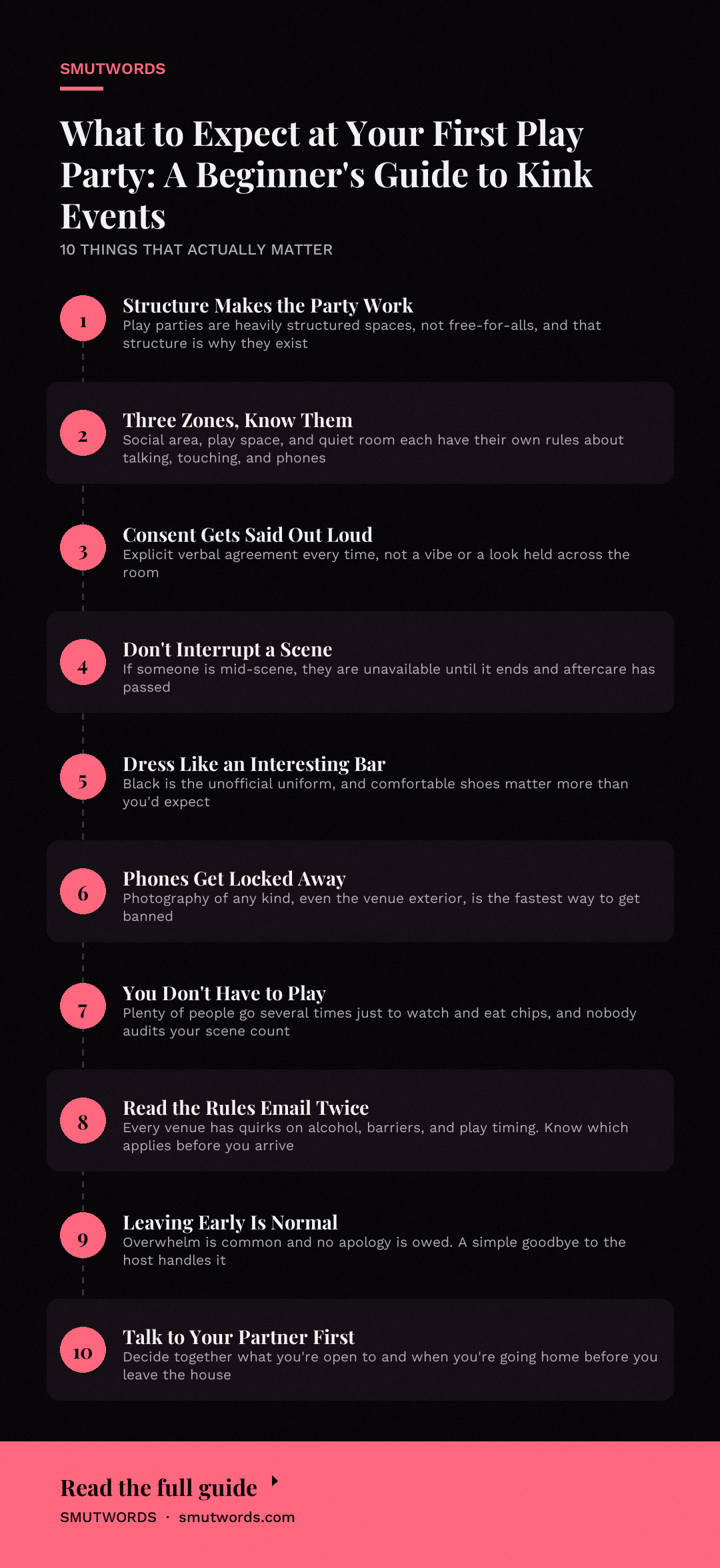
What you will not find, at any reputable event, is a free-for-all. Play parties are heavily structured spaces, and that structure is the entire reason they can exist.
The three spaces inside the space
Most parties divide the venue into zones, and knowing them ahead of time kills about half of the first-timer anxiety:
- The social area. Clothes on, talking allowed, snacks, usually the only place phones are permitted. You can spend the whole night here and nobody will comment.
- The play space. Where scenes happen. Conversation drops to a murmur, no interrupting scenes, no approaching a scene in progress.
- The aftercare or quiet room. Blankets, water, low light, sometimes a couch and a first-aid kit. Where people go when a scene ends or when they need to sit down and breathe.
Why people go, and why you might like it
The obvious answer is that people go to play. The more accurate answer is that people go for the room.
There's a specific atmosphere at a well-run party. The lights are low, the music is unobtrusive, and the noise level in the social area is just people talking about their jobs and their dogs. Then a door opens and someone leads their partner by the wrist into the play space, and the whole room registers it without anyone turning to stare.
That gap between ordinary conversation and what's happening twenty feet away is the thing regulars are chasing. It's hard to recreate anywhere else.
For people who've only ever read about this stuff, the appeal is simpler. Fiction does a good job of the fantasy and skips the logistics, which is exactly why so many readers of sharing kink stories get curious about the real-world version. Watching an experienced rigger work through a chest harness slowly, checking circulation between every rope, is a genuinely absorbing thing to witness. You learn more in one evening of observation than in a month of scrolling forums.
And some people go purely socially. There are regulars at every party who haven't played in years and show up for the conversation and the potluck. Nobody audits your scene count.
Before you go: the vetting and the prep
Most parties require you to request an invite, often by emailing a host, sometimes by attending a newbie orientation first. This is normal. The process exists so the host knows who's in the room, and so you've been told the rules before you arrive.
Expect to be asked your scene name, which is just whatever you want people to call you. Use a real first name if you like. Use something else if you don't. Nobody will press.
A few practical things to sort before the night:
- Read the rules email twice. Every venue has its own quirks. Some ban alcohol entirely, some allow a drink at the social end but not before play. Some require condoms for anything fluid-exchanging. Know which applies.
- Bring your own supplies if you might play. Condoms, gloves, lube, a water bottle, a small towel. Venues stock some of this, but relying on a shared bin is how you end up with the wrong size at the wrong moment.
- Eat something. Not a heavy meal, but not nothing. Low blood sugar plus adrenaline is a bad combination.
- Set a personal out time. Decide before you leave the house what time you're going home, even if you're having a good time. It gives you a painless exit.
If you're bringing a partner, talk before you go. Specifically: are you playing with each other only, are you open to playing with others, and what happens if one of you gets asked and the other doesn't. Skipping that conversation and hoping it resolves itself in the moment is the single most common way a couple has a bad first party.
What to wear
This trips up more first-timers than anything else, usually in the direction of overthinking. The honest answer is that party dress codes run from "jeans are fine" to "fetish formal" and the invite will tell you which. Read it literally.
For a first visit, dress like you're going to a slightly interesting bar. Black is the unofficial uniform and you will not be underdressed. Comfortable shoes matter more than you'd think, because you'll be standing for hours and the floor of a warehouse is unforgiving. Skip anything you can't get out of easily in a bathroom stall.
If you own a piece of gear and want to wear it, wear it. If you don't own any, don't buy a full latex catsuit for an event you might leave after forty minutes. The regulars will be in everything from full drag to cargo shorts.
The phone rule
Phones get locked away or taped over at the door. This is non-negotiable and it's the rule most worth understanding rather than resenting. Someone in that room is a nurse, a schoolteacher, or a parent with a custody arrangement. Photography, even of the social area, even by accident, is the fastest way to get permanently banned.
Consent culture, in practice
A first play party is where the abstract talk about consent turns into something you can see operating in real time, and it's usually more careful than newcomers expect.
The standard is explicit verbal agreement, every time, before anything happens. Not a vibe. Not a look held across the room. Not a hand on a shoulder that gets interpreted as an invitation.
An actual sentence, out loud, with a yes attached.
Some variation of "would you like to scene" or "may I touch your arm" is what you'll hear, and it will sound stilted the first time you say it. Say it anyway.
Enjoyed this? Get a free book.
Join the list and we will send a complete free story straight to your inbox, plus new releases every week after that. No credit card, no catch.
The rules that matter most:
- No means no, and so does a shrug, a step back, or a polite subject change. Treat any answer that isn't an enthusiastic yes as a no.
- Don't interrupt a scene. Ever. Not to say hi, not to ask a question, not to compliment a flogger. If someone is mid-scene, they are unavailable until it ends and the aftercare window has passed.
- Negotiate before, not during. Limits, safewords, what happens if something goes sideways, and who's checking in on whom afterward get settled in the social area with clothes on.
- Don't touch anyone's gear. The floggers and ropes and canes belong to specific people and some of them are expensive. Ask before handling anything.
- Watch, don't hover. Standing at the edge of the play space is fine. Standing two feet from someone's face while they're tied to a cross is not.
The dungeon monitor is the person who enforces all of this. They're easy to spot, they're volunteers, and they'd genuinely rather chat with a nervous new person than deal with a problem later. Introduce yourself to one when you arrive.
Your first scene, if you decide to have one
You don't have to play at your first party. Plenty of people go three or four times before they do anything but watch and eat chips, and the community treats that as entirely normal.
If you do want to play, the lowest-risk version is something short, light, and public. A spanking, some light rope, a blindfold with a partner you came with. Keep it under twenty minutes. Save the elaborate scene with a stranger for your fifth party, not your first.
If a scene involves restraint, agree in advance on how the person in rope signals distress. Words don't work once someone's deep in it, so most pairs use a held object that gets dropped, or a specific sound.
Nerve compression and circulation loss are real risks in rope, and the person tying should be checking fingers and toes at regular intervals. If nobody in the scene knows to check, that's your sign to keep your clothes on and watch someone who does.
Heavier edge play has genuinely serious injury risk and does not belong at a first-timer's evening. Do not do anything involving breath restriction with someone you've just met, and don't participate in any scene where the tying person can't explain their safety plan out loud beforehand.
How to leave if you're overwhelmed
This is the part nobody puts on the invite, and it's the most useful thing in this entire guide.
Overwhelm at a first play party is extremely common and it doesn't announce itself as overwhelm. It shows up as suddenly being very aware of your own breathing, feeling cold, getting irritable, or a flat sense that you want to be anywhere else. Sometimes it hits because you saw something that landed wrong. Sometimes it hits because nothing happened at all and the room is just a lot.
All of those are fine. None of them require an apology.
If you need to step out, go to the quiet room or the social area, drink water, and give yourself fifteen minutes. If it doesn't pass, leaving is the correct move and no explanation is owed. A simple "thanks, I'm heading out, good night" to the host handles it. Hosts see this constantly and would much rather you leave early than white-knuckle it until 2am and never come back.
If you came with someone and they're mid-scene, text is out because of the phone rule, so let a dungeon monitor know you need your friend and they'll relay it. That's part of their job and they take it seriously.
And if the overwhelm is the delayed kind, the sort that shows up two days later as a strange flat mood, that's a known thing called drop. Eat properly, sleep, and don't make any decisions about the scene or the community while you're in it.
Going with a partner, and the conversation beforehand
Couples who arrive without having negotiated anything are the ones who end up sitting in the car having a difficult conversation at midnight. The talk you need to have sounds like this: we're going, we're keeping our clothes on, we might watch, we're going home together at eleven. Then you can loosen from there, but start tight.
If you're the one who wants to go and your partner is lukewarm, don't push them to play. Watch together, stay in the social area, treat it like an interesting night out. A surprising number of hesitant partners shift once they see how ordinary the room actually is. Others never warm to it, and that's a real outcome too.
For people who like the idea of being watched or shared in fiction and want to know where the real-world boundary sits, the couple swapping conversation guide is the right companion read. And if the appeal is the negotiation itself, the slow negotiation of a scene in a room full of people, The House Party Whore captures that specific charge better than almost anything on the site.
Mistakes first-timers actually make
In rough order of frequency, from people who've been in the room when it happened:
- Talking in the play space. Not malicious, just nervous. Keep conversation in the social area.
- Trying to play with a stranger on night one. Slow scenes with familiar people beat ambitious scenes with people you just met, every time.
- Skipping the negotiation because the energy was good. Good energy doesn't establish a safeword.
- Not eating. People genuinely faint.
- Photographing the venue exterior. Down to the neighborhood block. Somebody will notice and the invite will not come again.
- Staying too long. The last hour of a party has a different energy, and a first-timer is usually better off gone before it starts.
Where fiction helps and where it doesn't
Reading blindfold play guides or kink fiction before your first party is a decent way to clarify what you're curious about. It's a bad source for how these events run. Fiction compresses negotiation because it's boring on the page. The rite-of-binding alien captive story does the abducted-and-claimed fantasy beautifully, and none of what happens in it is a template for a first scene with a stranger.
What fiction is genuinely good for is figuring out which flavor of dynamic appeals to you before you go. If you find yourself consistently drawn to stories where one partner runs the whole negotiation, the dominant wife awakening plot is worth reading with a notebook.
If the appeal is a group setting with a stated logic to who plays with whom, Free Use Carnival and Shared by Android Twins both take that premise and run with it. Know that the negotiation-to-hookup ratio in a real dungeon is closer to eighty-twenty, and the eighty is talking.
If you want a slower, more grounded read on what an intense dynamic looks like between two people who already know each other, Breeder Class: Human 001 is a good night-before read. It's not a play party manual. It's a way to check what you're actually interested in before you buy anything or RSVP.
Final Thoughts
The single most useful thing you can do before your first play party is read the host's rules email. Then show up mostly planning to watch.
If that sounds anticlimactic, good. The people who have the best first nights tend to be the ones who arrived early and left with the same person they came with. Start with the observation. Let the rest wait. And if the fictional version of the fantasy is what pulled you in, The House Party Whore is the book to read the night before.





Loading comments…