Two people lie to everyone they know about being in love. That's the engine of the fake dating romance, and it will carry a book for three hundred pages if the author knows what they're doing.
The marriage of convenience runs on different fuel: two people sign a legal document binding their lives together while the feelings stay unofficial. When you're weighing fake dating vs marriage of convenience, the real question isn't which trope is hotter. Ask which container holds the story you actually want to tell, and what happens when the lie has to end.
Readers love both setups for the same reason: proximity. You take two people who would never otherwise be alone together and you lock them into it. The trick is understanding what each lock does to the characters, because a pretend relationship and a legal one create completely different emotional pressure.
Fake Dating vs Marriage of Convenience: The Core Difference
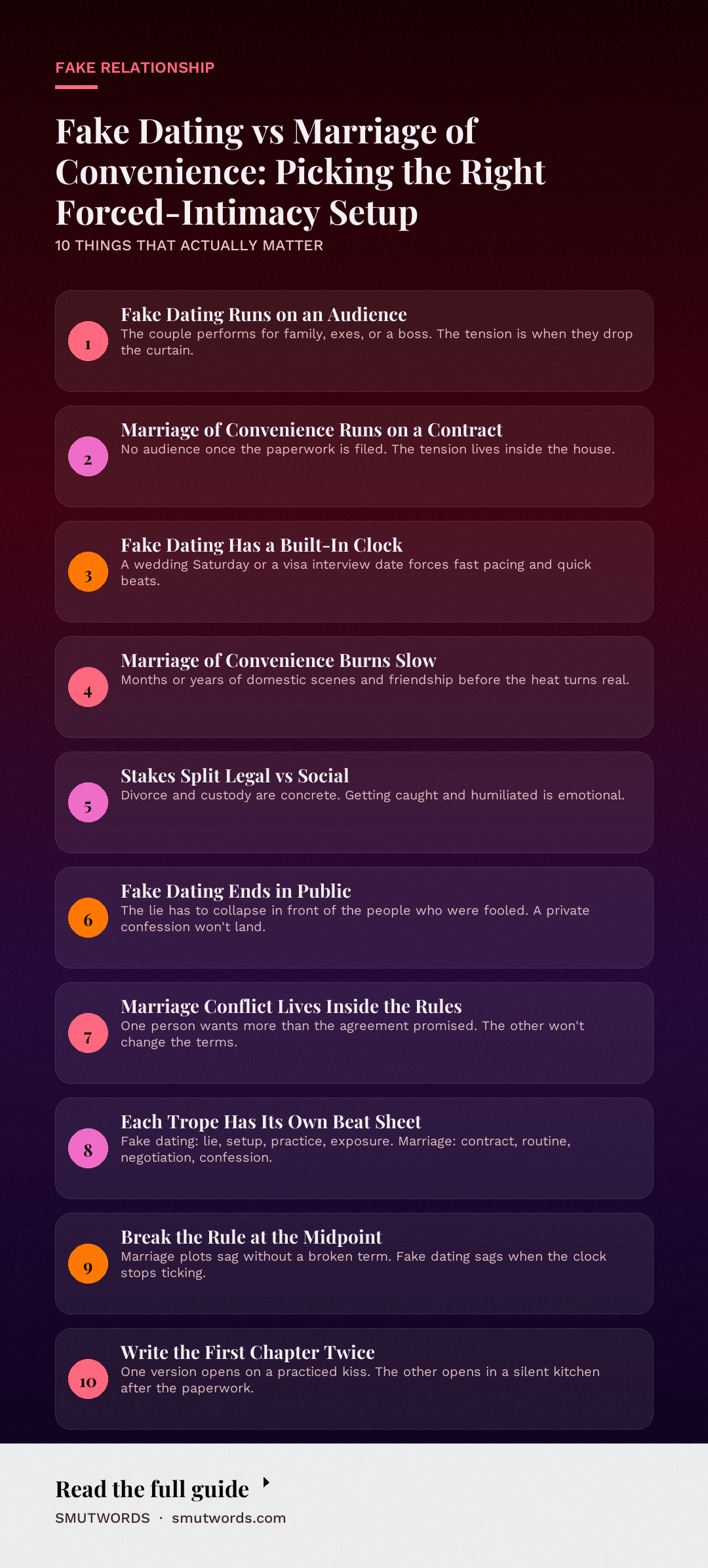
Fake dating is a performance. The couple has an audience, usually family, friends, an ex, a boss, or a wedding full of strangers, and the lie exists to satisfy that audience. Every touch and shared bedroom and hand on a lower back is choreographed. The tension comes from the curtain: when do they drop it, and who drops it first?
Marriage of convenience is a contract. There's no audience to perform for once the paperwork is filed. The two people are married whether anyone believes they're in love or not. The tension lives inside the house, at the kitchen table, in a shared bank account, in a bedroom with one bed they now legally share.
That difference drives every downstream decision. Fake dating keeps the characters aware of how they look to other people. Marriage of convenience strips the performance away and leaves them alone with the reality of a life they chose for reasons that had nothing to do with love.
Timeline and pace
A fake dating story usually runs tight. There's a defined window: the wedding weekend, the reunion, the holiday visit, the three weeks before the green card interview. The clock is built into the premise, so the plot moves fast and the beats come fast with it.
Marriage of convenience runs long. The couple might live together for months or years before the feelings arrive. That gives you room for slow-burn pacing, domestic scenes, and a friendship that deepens before it turns physical. If you want a book that simmers, this is the container for it.
Legal reality and stakes
The marriage of convenience has real-world teeth. Divorce paperwork, shared property, immigration status, a child who needs two legal parents, a business that survives only if the marriage holds. Those stakes are external and concrete, and they make the ending matter.
Fake dating stakes are social. Getting caught, hurting a family member, humiliating yourself in front of an ex, losing a job if the lie unravels. The consequences are emotional rather than legal, which suits a lighter book. They hit hardest when the other person is the one who gets hurt.
Where the Honest Version Lands
The fake relationship gets its power from the audience. Two people who can't stand each other have to act like they're in love at a family dinner, and the audience buys it. That performance demands a specific craft: the couple has to be convincing enough to fool the room while the reader sees the cracks.
Readers who want the hate-to-love energy of an enemies-to-lovers dynamic already know how this works. You can read more about that pattern in our guide to hate to love, because fake dating is one of the easiest ways to get two hostile people into the same bed without the plot feeling contrived.
The lie justifies the closeness. The audience justifies the lie. Everything else follows.
Why Fake Dating Moves So Fast
The clock is the whole trick. Fake dating stories almost always have a deadline: the sister's wedding is Saturday, the reunion is in two weeks, the visa interview is on the 14th. The couple has to be convincing by a specific date, and the reader knows it.
That deadline lets the author skip the awkward getting-to-know-you phase and go straight to the rehearsals. Two people practicing a kiss in a hotel room because they need to be good at it by tomorrow is one of the most reliable scenes in the genre. The intimacy is fake, the practice is real, and the gap between them is where the heat lives.
The break-up has to be public
Fake dating endings usually require the lie to collapse in front of the audience. The couple has to be caught, exposed, or forced to admit the truth in a way that's humiliating and freeing at once. A private confession doesn't carry the same weight.
That means the third act is social. A wedding reception, a family dinner, a crowded party: the setting has to be full of people who were lied to. The moment of truth has an audience, and the couple has to survive the exposure before they can choose each other for real.
Why Marriage of Convenience Burns Slower
Nobody's watching the married couple. They're alone in a house, in a shared kitchen, in a bed they agreed to share for practical reasons. The story can take its time because the characters aren't performing for anyone.
That slowness lets the author build domestic intimacy. The way one person takes their coffee, the way the other leaves their shoes by the door, the small fights over groceries. The physical relationship can start with a negotiated arrangement ("we'll have sex once a month so it feels normal") and then stop being an arrangement when the rules get bent.
The conflict is inside the marriage
In a marriage of convenience, the obstacle is almost never external. Nobody has to lie to a crowd. The obstacle is the contract itself: what happens when one person starts wanting more than the agreement promised, and the other person refuses to change the terms.
That's where the possessive dynamic does its best work, and our guide to the possessive alpha trope is worth reading if your marriage-of-convenience hero leans that way. A legally bound partner who gets territorial over someone he claimed for practical reasons is a very specific kind of tension, and it plays differently than the fake-dating version because the claim is real.
Enjoyed this? Get a free book.
Join the list and we will send a complete free story straight to your inbox, plus new releases every week after that. No credit card, no catch.
If you're writing the fake-dating version and want a character who guards her from the start without the legal tie, the bodyguard romance guide covers the same protectiveness with a different justification. The bodyguard has a job. The husband has a contract. Both give you a reason to be close that has nothing to do with love.
Picking the Setup That Fits Your Story
Ask yourself a few blunt questions before you write the first chapter. The answers usually point at one trope and quietly rule out the other.
- Do you want a ticking clock? If the plot needs momentum and a hard deadline, pick fake dating. If you want room for domestic scenes and slow heat, pick marriage of convenience.
- Who has to be fooled? If an audience matters (family, exes, a boss, a wedding), fake dating gives you built-in conflict. If the only person who needs convincing is one of the two leads, the marriage setup works better.
- How legal are the stakes? Immigration, custody, inheritance, a business: these belong to marriage of convenience. Social humiliation belongs to fake dating.
- How public should the ending be? Fake dating usually needs a public confession. Marriage of convenience can end privately, in a kitchen or a bedroom, with nobody watching.
- What's the heat source? Fake dating burns on performance and practice. Marriage of convenience burns on domestic proximity and broken rules.
None of these questions has a wrong answer. They just tell you which container your story belongs in before you've drafted three chapters and figured out the pacing is wrong.
The Emotional Beats Readers Expect
Both tropes share the same structural arc, but the beats land in different places. Fake dating goes: lie, setup, audience, practice, accidental feeling, exposure. Marriage of convenience goes: contract, cohabitation, domestic routine, negotiation, first crack in the rules, confession.
Fake dating readers want the moment the fake kiss stops being fake. Marriage readers want the first time the couple fights about something that actually matters and realizes they care about the outcome. Both are moments where the arrangement breaks down and something honest gets through.
When the truth has to come out
The fake-dating truth-telling scene is often the loudest in the book. It happens in front of people. There's shouting, maybe a spilled drink, a relative who feels betrayed. It's a scene built for maximum exposure.
The marriage-of-convenience truth usually arrives quietly. One person admits the feelings, or the rules get rewritten, or a crisis forces a confession in an empty room. The privacy is the point. Nobody else is supposed to hear it, which makes the admission harder.
The Grey Zone: Tropes That Bleed Into Each Other
Plenty of books run both setups at once. The couple fake-engages and then marries for a visa. Or the marriage starts real and the family thinks it's fake. Those hybrids can work, but they usually depend on one structure doing the heavy lifting while the other adds texture.
You can also borrow devices from neighboring tropes to complicate either setup. A secret baby thrown into a marriage of convenience rewrites every term of the contract overnight, and the same pregnancy landing on a fake couple during a wedding weekend raises the stakes on the public performance.
Authors who want the audience element cranked up should be careful with voyeurism vs exhibitionism, since a fake couple performing for an audience already lives in exhibitionist territory. Making that performance literal can push a light story into something much hotter and much more specific.
Other setups with forced proximity
Fake dating and marriage of convenience aren't the only containers that lock two people together. A coach and an athlete stuck in a training camp, or a soldier and a civilian forced to share a room during a deployment, hit some of the same notes from a different direction. Our coach/athlete romance guide covers one version of that pressure, and the soldier romance glossary entry covers the wartime version.
The shared rule across all these setups: the characters need a reason to be in each other's space that neither of them can walk away from. A contract, a job, a lie, a deployment. Pick the reason, and everything else follows.
Which One Holds Up Better for Rewrites
Practical note for authors mid-draft. Fake dating plots often stumble in the second act because the deadline hasn't moved. If the wedding is still three weeks away on page 150 and nothing is forcing the couple closer, the middle sags.
Marriage of convenience plots stumble differently. The middle can sprawl because the domestic scenes have no built-in pressure. Authors sometimes add a villain or a sudden accident to force conflict, and the book loses its quiet intensity.
If your draft is sagging in the middle, the fix often comes from knowing which structure you're writing. Fake dating needs the clock to tick louder with each chapter. Marriage of convenience needs a rule to break right around the midpoint, ideally one the couple negotiated at the start.
Readers who love the negotiation-and-rules part of a marriage of convenience already know how satisfying that agreement can be. The rope bondage guide breaks down negotiation in a different context, but the principle is the same: the couple sits down and talks about the terms, and the tension comes from watching those terms erode. A scene-within-a-scene mechanic like the one covered in our scene play guide can borrow that same negotiation logic for a fake couple rehearsing their cover story.
Final Thoughts
If you still can't decide, write the first chapter twice. One version opens with the two leads practicing a kiss in a hotel bathroom, both of them keeping score, the wedding two days away.
The other opens on the morning after the paperwork is filed, the two of them standing in a kitchen in silence with a marriage certificate on the counter and nothing at all agreed except the terms. Whichever version makes you reach for the keyboard again is the trope you're actually writing.
And if you want a starting point, the fake-dating books built around a live audience are usually the best place to see this setup done well. The marriage-of-convenience shelf is where you go when you want the slow heat instead.







Loading comments…