
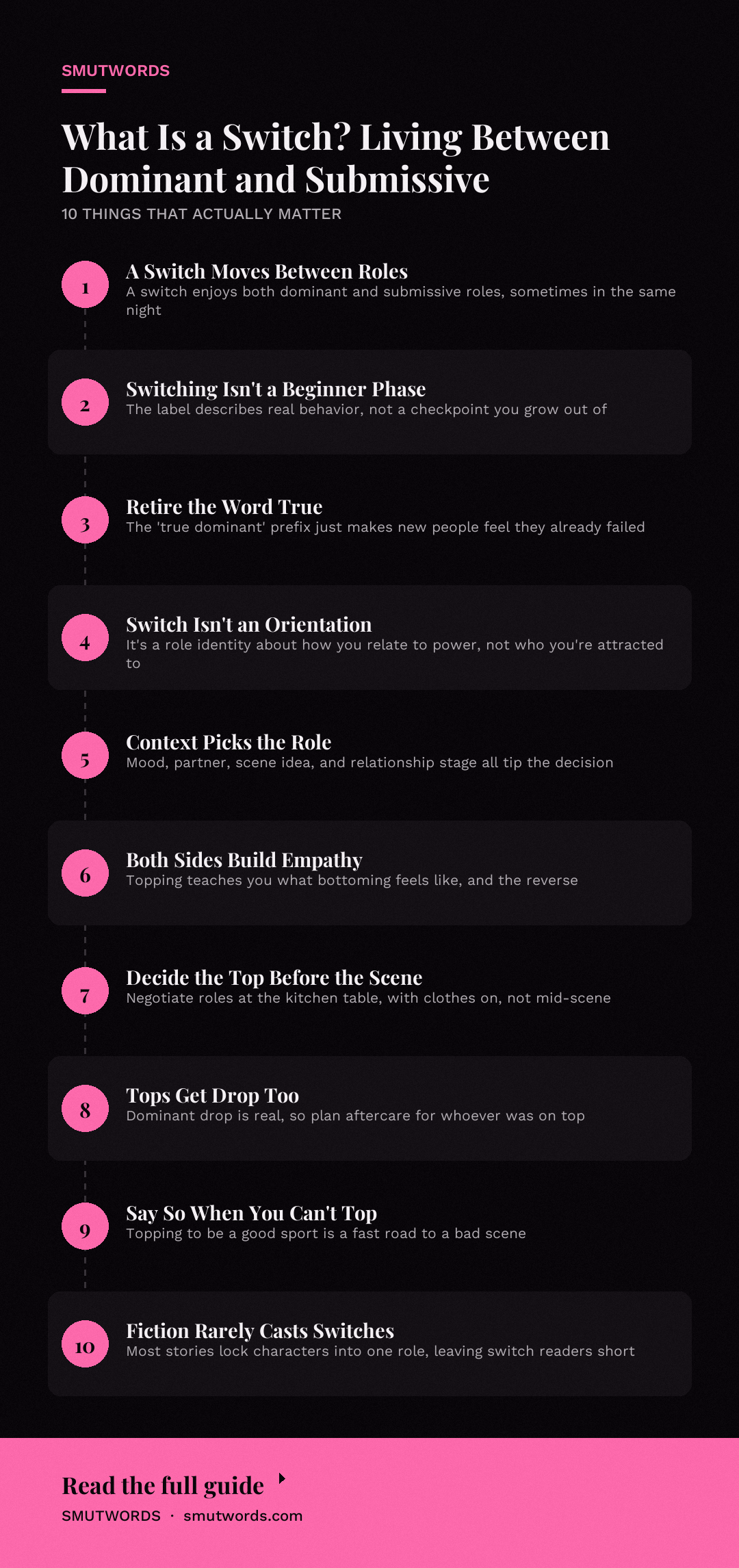
A switch is someone who moves between the dominant and submissive sides of a power exchange, sometimes within the same relationship, sometimes within the same night. If you've been reading BDSM writing for a while and keep finding yourself identifying with both the person holding the rope and the person in it, there's probably a word for what you are.
This guide covers what a switch is in BDSM, how switches decide which role to take, and how two switches build a dynamic together without tripping over each other.
No feelings-hurt, no hedging: switching is a real, common, unremarkable thing. Plenty of people come to kink convinced they're one thing and discover, six months in, that the other side fits too. The word for that is fine and has been for decades.
What Is a Switch in BDSM?
In plain terms, a switch is someone who can enjoy taking the dominant role in one scene and the submissive role in another. That's the whole definition. It doesn't mean "confused," it doesn't mean "hasn't picked yet," and it doesn't mean someone who's actually a dominant but is too polite to say so.
There's a tendency in online kink spaces to treat switching as a beginner phase you'll grow out of once you find your real identity. Some people do settle into one role over time. Many don't. The label describes a range of behavior, not a checkpoint on a journey.
Switching vs. being a "true" dominant or submissive
The "true" prefix is worth retiring. It comes from the same impulse that makes people claim their way of doing kink is more authentic than the next person's, and it tends to make new people feel they've failed at something before they've even gotten started.
What's real is that some people feel a strong, consistent pull toward one role across years and partners, and some people feel that pull toward both. Both experiences are stable. Both are valid. Which one you have says nothing about your skill or your commitment.
How common is switching, really?
Common enough that if you poll a hundred people in a kink community about their roles, you won't get clean binaries. You'll get dominants, submissives, switches, people who identify as one thing but switch for a specific partner, and people who describe themselves as "dominant in the bedroom, submissive in the rest of my life" or the reverse.
Switches are one of the largest groups in most communities. They're also the ones who tend to get written out of fiction, which is a shame, because a switch dynamic is one of the more interesting things fiction can do with power. More on that later.
Is "Switch" a Sexual Orientation?
No, and this trips up a lot of people when they're first figuring themselves out. Switch is a role identity, like dominant or submissive. It describes how you like to relate to power in kink, not who you're attracted to.
The practical upshot: you can be a straight switch, a gay switch, a bisexual switch, an asexual switch who enjoys kink without sex, a switch who only switches with women, a switch who only switches with people older than them, or anything else that fits. The role is a starting point, not a box.
How Do Switches Decide Which Role to Take?
This is the question people actually want answered, and the honest answer is that most switches use several signals at once. It's not usually a conscious calculation. Here's what tends to tip the decision:
- Mood and energy level. A long week at work can make topping feel impossible and bottoming feel like relief. A weekend with nothing on the calendar can make the opposite true.
- The specific partner. Plenty of switches are dominant with one person and submissive with another, and don't want to swap. Chemistry with a specific person often settles the question before you've thought about it.
- The scene idea. A switch can hear a scene description and immediately know which side they're on. "Restrained against a wall and teased for an hour" produces a fast answer. That's information.
- What the other person is offering. If your partner clearly wants to submit tonight, a switch who has both options available can choose to top and genuinely enjoy it, even if their first instinct was the other way.
- The stage of the relationship. Some switches start a new dynamic in one role because it feels safer, and shift once trust is established.
None of these are rules. The point is that a switch's role is usually determined in the moment, by context, not decided once and archived. If you're building a dynamic with a switch, build it around that.
Why People Like Switching
Different switches will give you different answers, but the common threads are pretty consistent:
Versatility. A switch can enjoy a scene from the top or the bottom, which means they can play with more people, in more configurations, without a compatibility dead end every time.
Range of sensation. Giving up control and taking control are very different experiences, physiologically and emotionally. Getting access to both is a big menu.
Empathy. Running a scene from the top teaches you what bottoming feels like, and bottoming teaches you what the top is risking. Switches tend to pick up both skill sets faster than single-role players.
The contrast itself. Some switches describe the appeal as the swing between the two, the way a dominant can be dominant precisely because they know what submission feels like. The role contrast does something for them that staying in one lane doesn't.
What Switching Looks Like in Practice
Three common arrangements, all of them normal:
1. Role rotation
Partners alternate who tops, often scene by scene. One scene on Saturday is you as dominant, the next is your partner. This is what most people picture when they think of two switches together, and it's one of the simplest arrangements to run, provided you keep the planning clean.
2. Role specialization by area
Some switches only top in specific kinds of play. Maybe rope, because they've spent years learning it, and only bottom in impact play, because that's the sensation they're chasing. Dividing by activity rather than by night makes the role choice trivial.
3. Role by relationship stage or partner
A switch can be dominant with a long-term partner and submissive with a casual play partner, or dominant with one partner and submissive with another in the same polycule. There's no obligation to offer the same role to everyone.
Enjoyed this? Get a free book.
Join the list and we will send a complete free story straight to your inbox, plus new releases every week after that. No credit card, no catch.
Two Switches Together: How to Communicate
Two switches in a relationship is its own skill set. Both partners are capable of running the scene, both partners sometimes want to, and both partners sometimes don't want to be the one in charge of anything. Left unmanaged, that produces a lot of hovering around the toy bag waiting for the other person to make a decision.
Decide who's topping before the scene starts
Negotiating the role mid-scene is a recipe for a slow, awkward negotiation when everyone's already half-aroused. Make the decision outside the scene, at the kitchen table, with clothes on.
A useful habit: whoever initiates a scene describes it as a request rather than a come-on. "I want to tie you up tonight, are you up for it?" is clear. So is "I'd like you to take me over the bench for twenty minutes when we get home." Both give the other person a real chance to say yes, no, or "I was hoping for the other direction."
Agree on a default when nobody's decided
Some two-switch couples keep a standing question they ask each other when neither has a strong pull: "Do you want to top or should I?" Asking directly cuts out the psychic dance. Others alternate by week, or by who's had the worse day.
Get visible about the negotiation
One of the biggest mistakes two switches make is each assuming the other will know which role they want. You won't. Nobody's mind-reading is that good.
If your partner suddenly wants to switch positions from what you planned, you need to be willing to say so, and to say no when that's the honest answer. A no is not a rejection of them. It's a report on your own state.
Use real scene negotiation, both ways
The complete guide to scene play covers this in detail, but the short version is that whoever is bottoming for the night is the one whose limits govern the scene, and whoever is topping is the one who owns the logistics. Both roles need preparation. Both roles need a check-in before the scene and after.
If rope is in the rotation, the physical risks change depending on which way you're facing. Read the complete guide to rope bondage before you try a first tie, not after.
Risks and How to Lower Them
Kink is a set of practices with real risks. Switching doesn't add new ones so much as multiply the number of positions you have to learn them from. Here's what to actually watch for:
- Physical injury on either side. Tops can strain wrists and backs lifting someone. Bottoms can take nerve compression from bad rope, or joint damage from being posed badly. Learn the specific physical risks of each activity before you do it, not during.
- Switching mid-scene without renegotiation. A scene can start one direction and flip, and if the flip happens without a check-in, one person can end up doing something they didn't agree to do. If roles change, stop the scene, discuss, restart.
- Drop, which happens to tops too. Submissive drop is well known. Dominant drop is less discussed and just as real: a top can come down hard after a scene, feeling guilty, hollow, or unsure they did it right. Plan aftercare for whoever was on top too, not just the person who was tied up.
- Resentment over time. If one switch always tops, or always gets to choose, the other can start to feel the arrangement is unfair. It's worth checking in on the pattern every few months, not just the individual scenes.
- Pushing past a clear no. A partner who doesn't actually want to top tonight but does it anyway to be a good sport is on the road to a bad scene. If you're a switch and you don't have it in you to run a scene, say so.
When to stop: if either of you is dissociating, if safety equipment isn't working, if someone's breathing or circulation is compromised, or if a limit is being crossed even slightly, the scene ends. Stop means untie, unpack the toys, get water, talk. Nothing is so good it's worth pushing through a warning sign.
Bringing It Up With a Partner
If you're new to switching and want to bring it up with someone, pick a low-stakes time. The middle of a scene is not that time, and neither is right after sex when everyone's half asleep.
"I think I might want to try the other side of this" is a perfectly good opening sentence. Follow it with what specifically you'd like to try, and give them room to decide whether they're up for it.
A partner who wants to top all the time may not want to bottom, and that's a compatibility conversation rather than a moral one. A partner who's only ever subbed may be thrilled. You'll find out by asking.
If you're the one being told: don't panic. A partner telling you they're a switch is not a partner telling you your current dynamic is over. Most switching couples find a version that works, and most of them are happy to keep the parts that already worked.
Switches in Fiction
Here's where the fiction on SmutWords splits from reality in a useful way. The site's stories tend to cast characters in a single role across a whole story, which makes sense for narrative momentum, but it means a switch reading for representation can come up short.
So where do you look if you want a fictional version of the role? Start with the breeding and ownership dynamics in Subroutine: Breed Her. That's a character who starts out as the one being controlled and ends up making decisions about the experiment that change the terms.
Absolute Surrender runs the opposite direction, showing the internal mechanics of a choice to submit. It's a useful read if you're trying to explain to a partner why submission is appealing in the first place. Commander's Brood Slave is written from the perspective of someone constrained by the situation, and Marked by the Bull plays out the version of dominance that runs on possession rather than negotiation.
Readers who like the version of dominance that edges toward a stalker romance or a possessive alpha trope relationship will find the fictional version of switching rarer, but the underlying tug of "who's actually in charge here" is the same engine. It's the switch's version of that question that fiction mostly hasn't caught up with yet.
Final Thoughts
If you're trying to figure out whether switching is for you, the fastest way to find out is to try one scene on the other side with someone you already trust, and see how your body reacts to it.
If you want to read a scene that stages the moment a character's apparent role gets turned inside out, start with Subroutine: Breed Her and pay attention to who's actually steering the situation. You'll probably spot some switch behavior in there. You've been doing it yourself without the label for a lot longer than you think.







Loading comments…