
An FFM threesome is a sexual encounter with one man and two women. In erotica, it's a specific engine for a specific kind of tension: two women who want each other, a man who is both participant and audience, and a power balance that keeps sliding around depending on who is touching whom.
The letters name the bodies in the room, and the order of the letters tells you what the story cares about most. That's the plain definition. The interesting part, the part that fills shelves of romance and pulls hundreds of thousands of searches, is what writers do with it once all three people are in the bed.
Readers come to the ffm threesome for doubling: double the attention, double the desire, two distinct women who each want the man and also want each other. It's a fantasy of being the fixed point that two orbits swing around.
It stays popular because it lets a story be greedy without anyone having to be the villain. This guide covers what the term actually means, where the trope came from in publishing, how strong scenes are built on the page, and the real-world logistics that make the fantasy land harder rather than softer.
What FFM Threesome Actually Means
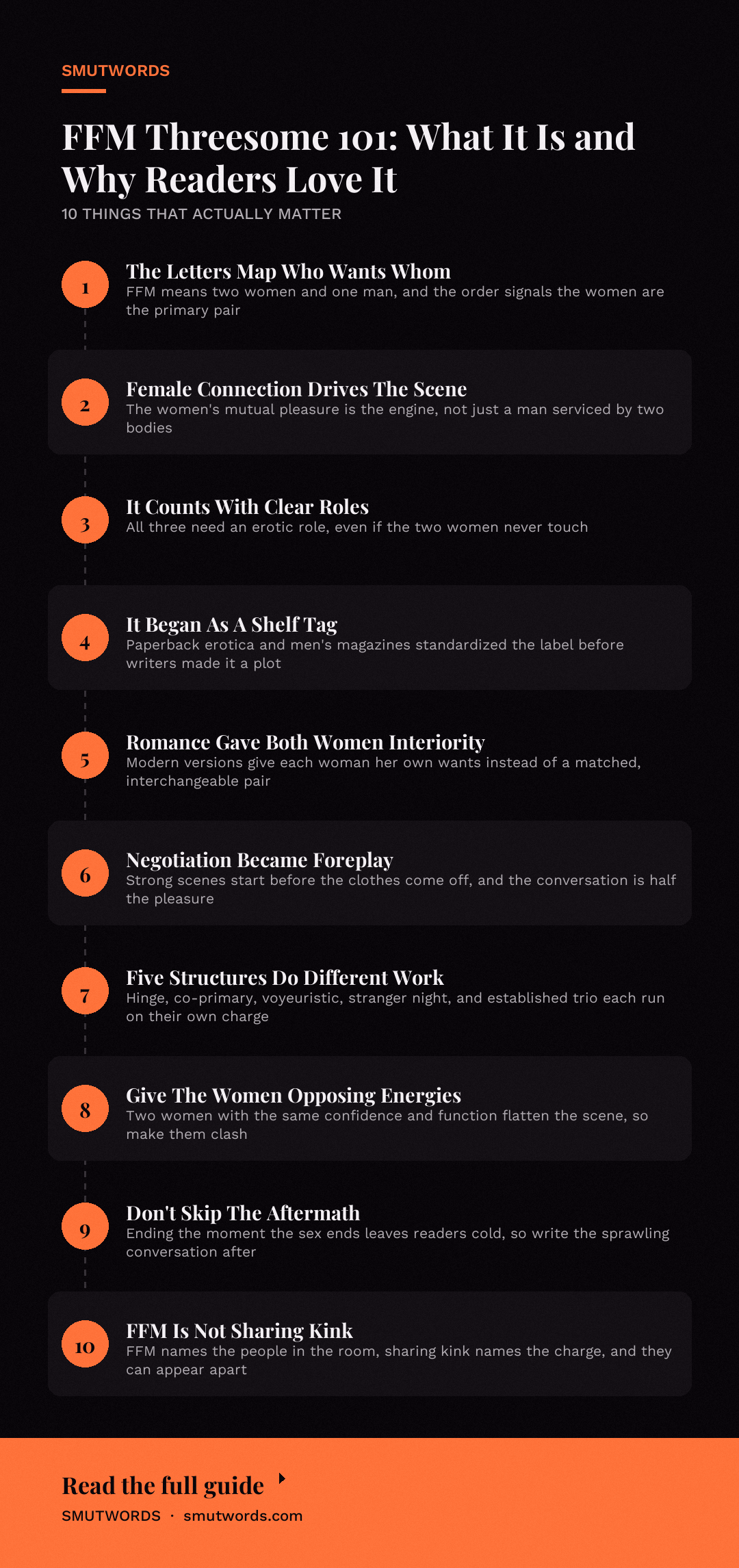
The acronym is anatomical and sequential. F, F, M: two women and one man. The order is not random. In FFM the women are typically the primary erotic connection and the man is the shared partner, the hinge, or the appreciative observer who gets folded in.
Flip it to MMF and the dynamic changes completely, because now the two men are the charged pair and the woman is the center. Flip it to MFM and you get two men focused on one woman, with no mutual interest between the men required. The letters are a map of who is looking at whom.
That distinction matters more than most readers realize. An FFM threesome is usually a story about female bisexuality or female-female intimacy as much as it is about the man. The women's mutual pleasure is the engine, and the man's arousal is the reward the scene keeps returning to.
If a scene has two women who barely acknowledge each other and both just service the man, that's technically one man and two women in a room, but it's not doing the work the FFM label promises.
What Counts and What Doesn't
A few boundaries are worth drawing plainly, because the term gets used loosely.
- It counts when all three people are sexually engaged with each other to some degree, even if the two women never touch. Voyeuristic FFM, where one woman watches and the other participates, still belongs under the umbrella.
- It counts when the encounter is a one-time scene, a recurring arrangement, or the start of something longer. FFM describes who is present, not how long they stay.
- It doesn't count as a threesome if one person is purely a bystander with no erotic role. A man in the corner reading a book is a couple having sex.
- It doesn't count as FFM if the two women are the only ones touching and the man is absent. That's a scene with an audience, and the label needs the third body in it.
One common misconception: that FFM is inherently a male fantasy with the women as interchangeable props. The best versions do the opposite, giving each woman a distinct personality, a distinct body, and a distinct reason for being there. Readers remember the woman who was nervous and the woman who was bossy far longer than they remember what the man looked like.
Where FFM Threesome Comes From
The term's history is a publishing history. Threesomes show up in erotic writing as far back as anyone cares to look, but the specific FFM configuration became a named, marketed category in the mid-to-late twentieth century, as paperback erotica and men's magazines standardized their labels. Publishers learned that readers searched by configuration the way they search by trope now. The letters became a shelf tag before they became a plot device.
Romance picked it up later and slower. For decades, mainstream romance kept threesomes at the edges: in erotic imprints, in scenes framed as a fantasy, a dare, or a thing that happened in Vegas.
The women in those early versions were often written as a matched pair, near-identical in appeal, existing to double the heroine's experience or to test the hero's restraint. The man was the fixed point. The women were interchangeable.
That changed as erotic romance grew its own readership through the two thousands. Writers started giving both women full interiority, and the genre discovered that the FFM setup could carry an entire emotional arc instead of just a hot chapter.
The mutual attraction between the two women moved from subtext to text. The man's role shifted from conqueror to something more interesting: a witness, a participant, sometimes a man who has to earn his place in a dynamic that would work fine without him.
The Shift Toward Female-Centered FFM
The most visible evolution of the last fifteen years is the rise of the lesbian-centered or co-primary version, where the two women's relationship is the spine of the book and the man is a guest star. This overlaps with a broader change in how romance writes group dynamics at all: less conquest, more negotiation. Orgy scenes in modern romance spend as much word count on logistics and consent as on bodies, and FFM followed that drift.
The other shift is structural. Contemporary FFM stories increasingly start before the clothes come off, because readers have learned that the negotiation is half the pleasure. The conversation about who wants what, who is nervous, who is allowed to touch whom, has become its own kind of foreplay on the page. Writers who skip it now read as dated.
How It Shows Up in Erotica
This is where the craft lives. An FFM scene has three bodies and six possible vectors of attention, and the writer's job is to keep the reader oriented without flattening the geometry. Strong scenes move the camera deliberately: close on the two women, close on the man watching, close on a hand that belongs to someone the reader just forgot about. The tension comes from the constant redistribution of focus.
The most common structural variations, and what each one is actually for:
- The hinge. One woman is experienced and one is new to it. The first guides the second while the man watches, then joins. This version runs on the thrill of initiation and works best when the nervous woman's pleasure is the measure of success.
- Co-primary partners. Both women are equally central, often already lovers or already in a relationship with each other, and the man is folded in as a shared addition. This is the version closest to polyamory on the page, and it needs the man to be generous rather than competitive.
- The voyeuristic FFM. One woman performs for the other's gaze while the man participates lightly or not at all. The erotic charge sits almost entirely in being watched by someone you want to impress.
- The stranger night. All three meet as strangers, often at a bar or a party, and the scene runs like a heightened one night stand with an extra body. This version lives on novelty and the delicious risk of people you'll never see again.
- The established trio. A couple brings in a third, or three friends finally stop pretending. Slower burn, more history, more room for jealousy to sneak in and get handled.
What separates a strong FFM scene from a flat one usually comes down to three things. First, both women get to want something specific, and those wants are not identical. Second, the man is given a real role, whether that's participant, observer, or the person being gently used, and the scene is honest about which one.
Third, there's a moment of check-in, verbal or physical, where someone makes sure everyone is still in. That moment reads as hot when it's written with the same attention as the rest of the scene.
Enjoyed this? Get a free book.
Join the list and we will send a complete free story straight to your inbox, plus new releases every week after that. No credit card, no catch.
The Craft Mistakes That Flatten a Scene
The most common failure is the interchangeable-women problem: two women with the same hair, the same confidence, the same function, distinguished only by a name the reader forgets. Give them opposing energies. One loud, one quiet. One in control, one along for the ride. The friction between them is the scene.
The second failure is camera drift. Too many hands doing too many things at once without a clear anchor, and the reader loses track of who is where. Pick a perspective and stay close to it. A third-person scene can still be anchored to one person's experience.
The third is the missing aftermath. An FFM encounter that ends the moment the sex ends leaves readers cold, because the best part is often the sprawling, sweaty conversation after, when everyone figures out what just happened. Real dynamics need aftercare, and so do fictional ones.
If you want to see how much page space thoughtful post-scene care can carry, the guide to impact play aftercare is worth reading even if your scene doesn't include impact, because it models the emotional rhythm.
Kinks That Pair Naturally
FFM doesn't sit alone. It combines well with dynamics that thrive on an audience, on being shared, or on one person being briefly overwhelmed. A little degradation kink can raise the temperature when one woman wants to be talked down to in front of a witness, but it has to be negotiated on the page so readers understand the consent behind it.
Shibari gives an FFM scene a gorgeous centerpiece: two women bound together while the man decides what to do with the arrangement, or the reverse if you want to flip the power. If the scene tilts toward raw, instinctive energy with less talking and more grabbing, that's primal play territory, and it pairs with FFM better than most writers expect.
A cloning kink angle can make FFM literal and strange: two versions of the same woman, one man, an impossible negotiation. And for the version where all three are genuinely building a life together rather than just a night, the mechanics overlap heavily with what group marriage asks of its characters.
FFM Threesome vs Sharing Kink
These two get confused constantly, and the confusion is worth clearing up because it changes what a reader should expect from a story. An FFM threesome names the people in the room. Sharing kink names the emotional charge, and it can happen with two people, three, or more.
Sharing kink is the specific erotic thrill of watching your partner be wanted by or be with someone else. It often runs through cuckold date night setups where the watching partner deliberately sets a scene in motion.
A story can be both: a couple explores sharing kink through an FFM encounter, with the man watching before he joins. But they aren't the same thing. An FFM scene can have zero sharing-kink charge if all three people are strangers, and a sharing-kink scene can happen with no threesome at all.
If you're searching for the tangle of jealousy and arousal that comes from watching your partner with someone else, you want the sharing-kink shelf. If you want two women and one man in the same bed with a fluid power balance, you want FFM.
Frequently Asked Questions
What does FFM stand for in a threesome?
The letters stand for female, female, male: two women and one man. The order signals that the women's connection is often the primary erotic thread, with the man as a shared partner or observer. It's distinct from MMF, where the two men are the charged pair, and from MFM, where two men focus on one woman.
What's the difference between FFM and MFF?
They describe the same bodies in a different order, and the order is a convention rather than a rule. FFM usually emphasizes the two women as the primary pair. MFF is sometimes used to center the man's perspective instead. Most publishers and readers treat them as variations on one category rather than separate shelves.
Is an FFM threesome always about bisexual women?
No. The women may be bisexual, bicurious, or simply willing to touch each other within a specific scene with a specific man. Some versions are written as a one-time experiment, others as the expression of a long-standing attraction. What the category guarantees is that two women are present and engaged, not that either has a defined orientation outside the encounter.
Why do readers search for FFM threesome stories?
The appeal is doubling: twice the attention, two distinct women with separate desires, and a man who is both participant and audience. It lets readers imagine being the center of a focused but shared erotic experience without the pressure of a single partner's full attention. The fluid power balance keeps the scene unpredictable, and unpredictability is what keeps pages turning.
What does a realistic FFM scene need to include?
Explicit ongoing consent from all three people, clear conversation about limits and exclusivity before anything starts, and a plan for the after. Everyone involved should know what they're agreeing to and should be checked in with during the scene. Aftercare for all three, not just the person who seems most fragile, is part of doing it well rather than an optional extra.
Can an FFM threesome work in a long-term romance plot?
Yes, and it's one of the richer uses of the trope. The established-trio and co-primary variants let a story explore jealousy, negotiation, and chosen family across an entire book instead of one scene. Books that pull this off borrow heavily from how polyamory gets written into romance, where the ongoing conversation is the romance itself.
Readers who like watching a mismatched set of desires get worked out over chapters should read about navigating a mixed-desire relationship, since the skills are the same.
Final Thoughts
The FFM threesome endures because it's a fantasy with room in it. Two women with different wants, a man who has to figure out his role, and a power balance that won't hold still long enough to bore anyone.
Write it with distinct people, a clear camera, and a check-in or two, and the scene will do the work the label promises. If you want a place to start reading, the ranked list below this article gathers the strongest FFM stories in the catalog, chosen by editors who read far too many of them and regret nothing.





Loading comments…