Mummification is a bondage practice in which a submissive’s entire body is wrapped, layer by layer, in cling film, bandages, vet wrap, tape, or plaster strips until they cannot move at all, and often until they cannot see or speak either.
In erotica it shows up as the total-surrender scene: a character reduced to a still, sealed shape that can only be touched, spoken to, or used. The appeal is exactly that reduction, the slow stripping away of every last degree of control until what’s left is breath, sound, and the person holding the wrap.
You’ll find the basic definition in our glossary, but this guide covers what mummification actually means on the page, where the trope came from, how skilled authors build the scene, and what real-world practitioners have to get right for it to be safe.
What Mummification Actually Means
The word comes straight from the burial practice, and the erotic version borrows the same logic: the body is encased, preserved, rendered immobile and intact inside its wrapping. That’s where the imagination goes, and it’s why “encasement,” “cocooning,” and “wrapping” all circulate as alt names.
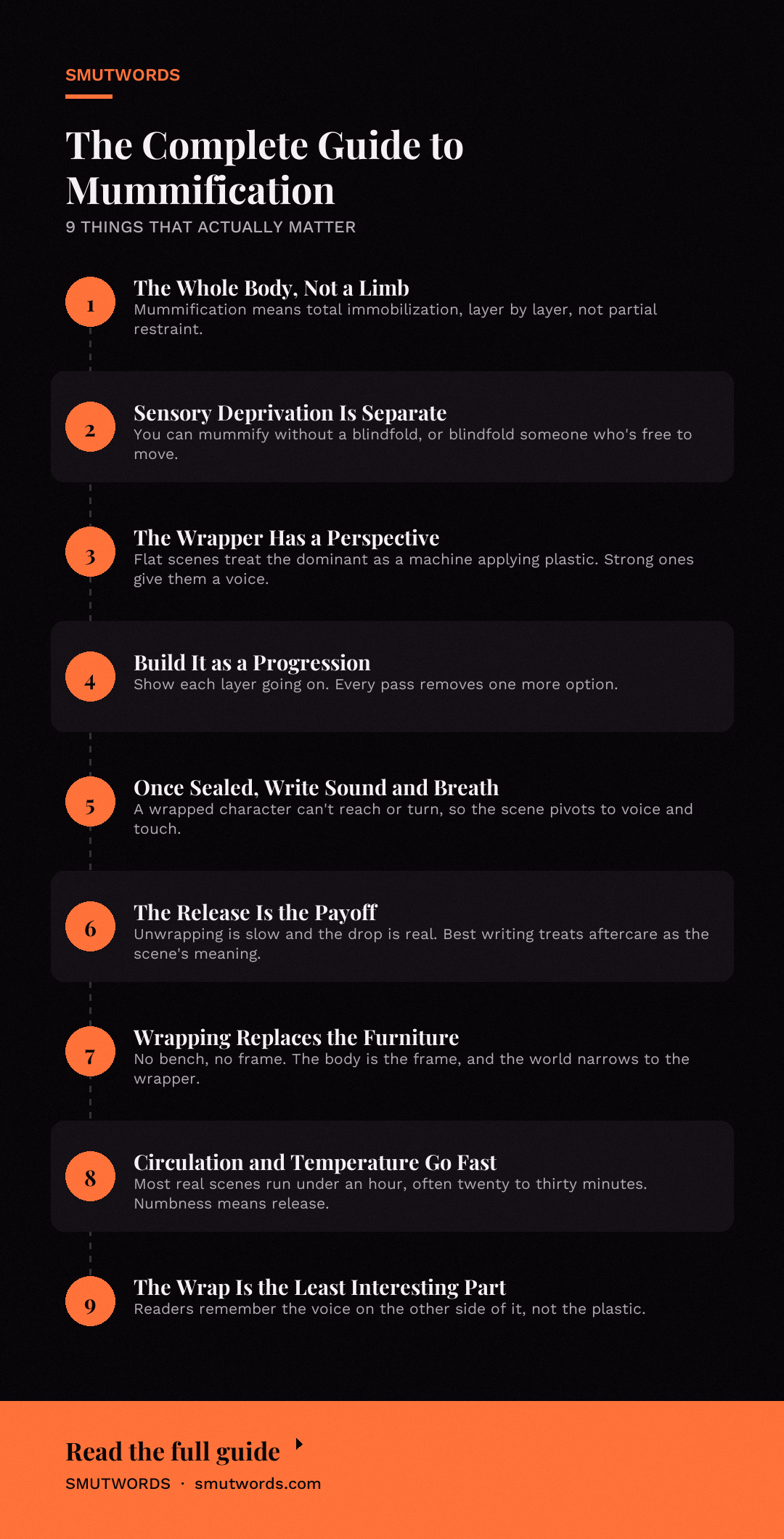
The core feature across every variant is total immobilization, not partial restraint. Rope ties a limb. Mummification takes the whole body.
What counts is full coverage. Arms pinned to the sides or crossed over the chest, legs together, torso wrapped solid, and, in the fullest versions, the head wrapped too, with the mouth and eyes covered for sensory deprivation. What doesn’t count is a body bag zipped over someone who can still wriggle, or a single layer of plastic that tears the moment they flex. The wrapping has to actually hold.
Several misconceptions cluster around the term. One is that mummification requires plaster or a cast. Plenty of scenes use nothing but cling film and tape.
Another is that it’s purely about helplessness with no reciprocity. In good writing, and in real practice, the wrapped person is the one whose experience drives the scene, and the wrapper is in constant conversation with them.
A third misconception: that mummification and sensory deprivation are the same thing. They’re not. You can mummify someone with their eyes and mouth left open, or blindfold and gag someone who’s otherwise free to move. The two practices combine beautifully, and most fictional scenes do combine them, but they’re separate tools.
Where Mummification Comes From
As a published erotic trope, mummification has a shorter, cleaner history than most bondage practices, and that history lives in the fetish press and early internet more than in mainstream romance. Through the 1980s and 1990s, it appeared in specialty bondage magazines and underground photography, usually framed as the extreme end of a restraint spectrum. Cling film and tape were cheap, available, and visually striking, which made the practice easy to photograph and easy to circulate.
The internet changed the trope’s reach more than any single book did. Usenet groups, early kink forums, and later video platforms let practitioners and readers find each other, and the vocabulary standardized fast: wrapping, encasement, cocooning, tape mummification. That’s also when the plaster cast variant picked up a following, partly because the visual of a body sealed inside a rigid shell reads as the maximum version of the idea.
Mainstream erotica and romance came late to mummification and still treat it as a specialty. Where it appears, it tends to arrive inside a larger BDSM narrative as the climactic scene, the one the whole dynamic has been building toward. That’s a genuine shift in how it’s portrayed: earlier fetish material often presented mummification as a standalone spectacle, while contemporary fiction folds it into a relationship arc and makes the trust the point.
The genre’s treatment has also gotten more honest about logistics over time. Older scenes skipped straight to the sealed body. Newer writing spends real page time on the wrapping itself, the check-ins, the scissors within reach, the release. That shift tracks the broader move in kink fiction toward showing the work that makes surrender possible, the same way impact play aftercare moved from an afterthought to a scene of its own.
How It Shows Up in Erotica
The strongest mummification scenes are built as a progression, not a state. The author gives you each layer: the first pass of cling film around the ankles, the arms guided down, the wrap climbing the torso, the moment the submissive realizes they can no longer adjust their own position. That slow reveal is where the psychological weight lives, because every layer removes one more option.
Once the body is sealed, the scene has to change its sensory register. A wrapped character can’t reach, can’t turn, can’t signal with a hand, so the writing pivots to sound, breath, temperature, and touch. The wrapper’s voice becomes the whole world. A hand on the plastic is a major event.
This is where mummification scenes earn their heat, and it’s why the practice pairs so naturally with anticipation play: the submissive has nothing to do but wait and feel.
Common variations authors reach for:
Enjoyed this? Get a free book.
Join the list and we will send a complete free story straight to your inbox, plus new releases every week after that. No credit card, no catch.
- Cling film and tape: the most common fictional version, cheap, visually tight, easy to describe, easy to remove.
- Bandage or vet wrap: softer texture, more layers, often used for longer scenes and a gentler aesthetic.
- Plaster cast encasement: the rigid, permanent-feeling variant, usually reserved for fantasy or long-form scenes because the removal is a whole production.
- Cocooning: wrapping that includes the head, with the face covered, pushing hardest into sensory deprivation.
- Partial mummification: torso and arms only, legs free, a gateway version that lets the character still kneel or be moved.
- Burial play: loosely related, heavier on the psychological weight of being enclosed, and a different practice with its own safety demands.
What separates a strong mummification scene from a flat one is attention to the wrapper. A flat scene treats the dominant as a machine that applies plastic. A strong scene gives them a perspective, a running commentary, a reason for each layer, and a visible awareness of the submissive’s breath. That awareness can shade into domspace, the focused, almost altered state a dominant can enter when a scene is going well, and good authors show it arriving.
Dialogue does a lot of work in these scenes because physical action is limited. The wrapper talks the submissive through each stage, and those exchanges carry the trust. A scene stalls when the author skips the talk and just describes tape. It soars when a single line, “tell me if your hands go numb,” lands as both care and control.
The release is where mummification scenes either stick the landing or fumble it. Unwrapping is slow, the body is stiff and cold, and the emotional drop is real. The best writing treats the release and the aftercare as the payoff, not the epilogue. The submissive comes out of the wrap and into someone’s arms, and the scene’s meaning resolves there.
For readers who like the power-exchange engine of mummification, the same dynamic drives much of the catalog. The he falls first structure, where one character surrenders control while the other is already gone for them, hits a similar nerve. So does opposites attract, when one partner’s need for total control meets another’s need to give it up entirely.
Mummification vs Bondage Furniture Use
These two get confused because both are full-body restraint, and the confusion is real enough to address. Bondage furniture use restrains a body against or onto a structure: a bench, a cross, a frame, a chair. The body stays in a shape the furniture dictates, but the person is still one object in a room.
Mummification removes the furniture entirely. The wrapping is the restraint. There’s no frame holding the body, because the body is the frame.
That difference matters for how a scene reads. Furniture scenes are about position, display, access. Mummification scenes are about enclosure, isolation, and the slow loss of the ability to move at all.
Furniture also tends to imply a whole room of possibilities: other people, other implements, a stage. Mummification narrows the world to the wrapper and the wrap. If a scene uses both, and some do by wrapping a submissive to a piece of furniture, the writing should be clear about which restraint is doing the work.
Frequently Asked Questions
Is mummification safe in real life?
It can be, with strict precautions. Wrapping restricts breathing, circulation, and the body’s ability to regulate temperature, so practitioners keep the face clear or lightly covered, check in constantly, keep cutting tools within arm’s reach, and never leave a wrapped person alone. The wrapped person needs a safeword or a signal they can still give, like a tap or a hum.
What materials are used for mummification?
Cling film, vet wrap, medical bandages, bondage tape, and plaster strips are the most common. Cling film and tape are the standard for beginners because they’re cheap and easy to cut away. Plaster is reserved for experienced practitioners who know how to manage heat and removal.
How long can someone stay wrapped?
Shorter than fantasy suggests. Most scenes run under an hour, and many practitioners keep it to twenty or thirty minutes, because circulation and temperature become problems fast. Any numbness, dizziness, or difficulty breathing means immediate release, no negotiation.
Why is sensory deprivation part of mummification?
Once the body can’t move, covering the eyes and mouth removes the remaining channels of control and pushes attention entirely into sound and touch. That combination is what makes these scenes feel so intense on the page, and it’s why the wrapper’s voice becomes the submissive’s whole world.
Is mummification the same as burial play?
They’re related but distinct. Burial play involves enclosing or covering the body in earth or a similar medium, and it carries its own serious safety requirements. Mummification is about wrapping. Authors sometimes blend the two for effect, but readers should treat them as separate practices.
What’s the appeal for readers who’ve never tried it?
Total surrender, made literal. Mummification removes every possible action except feeling and breathing, which turns the scene into pure trust. That’s the same engine behind a lot of popular power-exchange fiction, including stories built on jealousy kink, where the emotional stakes come from who holds the power and who gives it up.
Final Thoughts
Mummification works best when the wrap is the least interesting thing in the scene. The plastic is just the container. What readers remember is the voice on the other side of it, the check-ins, the slow release, the moment the submissive realizes they can stop holding themselves up. Read for that, and the next scene you find with a body sealed inside a cocoon will land differently.
When you’re ready for more, start with our comprehensive guide to the leather fetish, which treats restraint with the same patient attention this practice deserves.




Loading comments…