
A massage roleplay is a scene, written or real, in which two people act out a professional or therapeutic massage that slides into something sexual. One person plays the therapist or masseur, the other the client. The frame is legitimate bodywork: sore shoulders, a pulled muscle, a spa appointment booked on a whim.
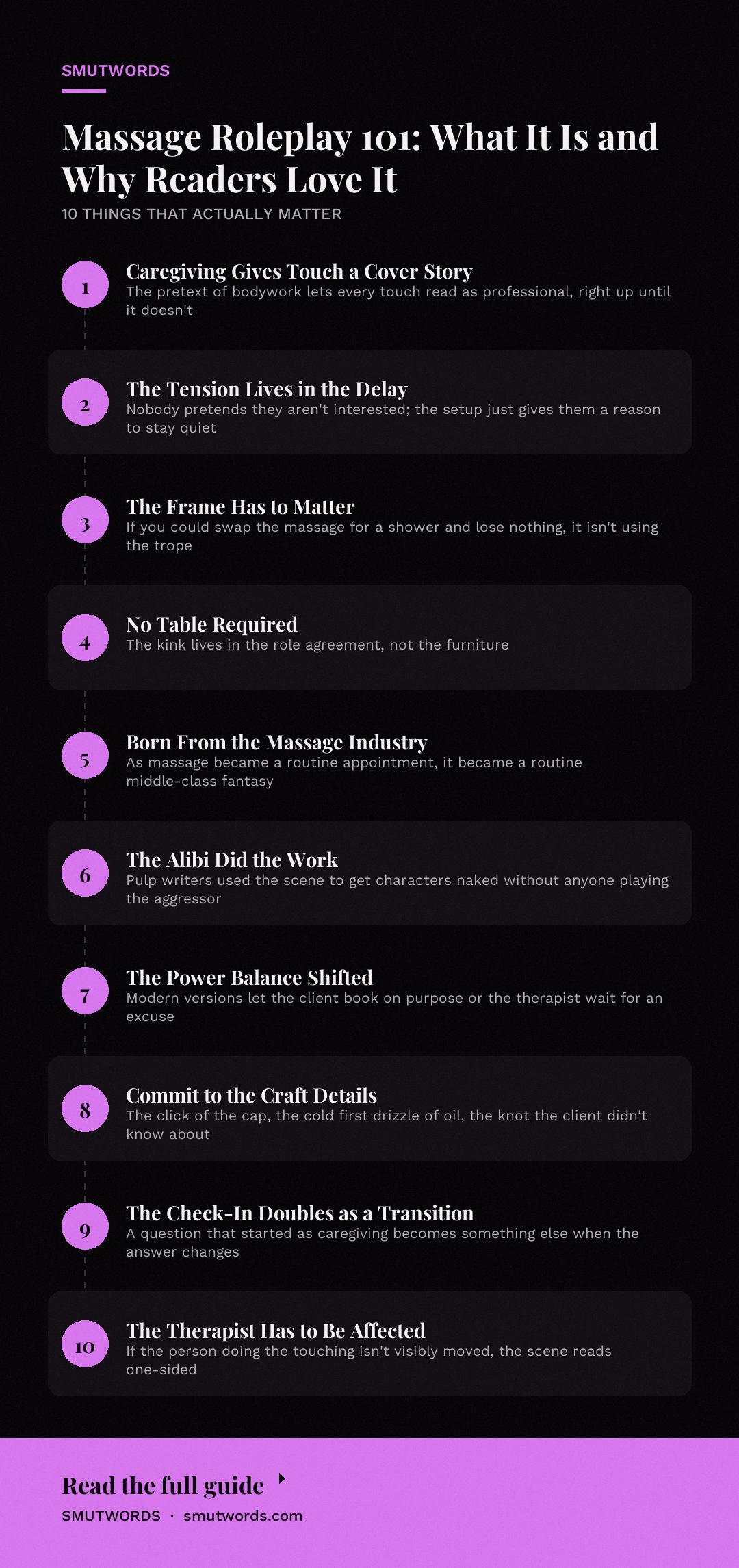
Then hands stay on skin a beat too long, the towel moves an inch lower, and the scene crosses over. It is one of the most reliable slow-burn structures in erotic fiction because the pretext of caregiving gives every touch a plausible cover story, right up until it doesn't.
What makes it work is the built-in delay. Nobody has to pretend they aren't interested; the setup simply gives them a reason to keep their hands moving and their mouths shut. The tension lives in the gap between what a massage is supposed to be and what it is becoming. Writers reach for massage roleplay when they want heat that arrives slowly and a power exchange that hides inside something as ordinary as a bottle of oil.
What Massage Roleplay Actually Means
The term covers two related things. In fiction, it describes a scene structure: the massage as a container for foreplay, seduction, or a full sex scene. In real life, it describes a kink scene where partners deliberately play the therapist and client roles, often with a table, towels, oil, and some light theatrical commitment to the bit.
The overlap is large. Most readers first meet the trope on the page and later wonder what it would be like to try.
The name is descriptive rather than technical. There is no single originating community or founding text; "massage roleplay" is what people started calling it when the internet needed a search term for "massage that turns into sex." Adjacent labels include sensual massage, the oiled body rub, the relaxation scene, therapist roleplay, and massage table seduction. All of them point at the same core mechanics: touch, oil, a table or bed, and a shift in intent.
What counts as massage roleplay
- A deliberate frame. One partner offers or requests a massage and both people know what the offer might become.
- Sustained touch before sex. The massage is not a two-line excuse; it gets real page time, with attention to hands, pressure, oil, and the client's reactions.
- A power arrangement. The therapist has access and authority; the client has vulnerability and surrender. The scene can lean either direction.
- The crossing-over moment. Something tips the scene from bodywork into sex: a hand that strays, a moan that isn't about a knot, a verbal check-in that turns into a question with a dirtier answer.
What doesn't count
A character getting a massage in the first chapter and then having sex with someone else later is not massage roleplay. Neither is a scene where the massage is purely transactional and the sex happens off the table with no connection to it. The frame has to matter. If you could swap the massage for a shower or a backrub on the couch and lose nothing, the scene isn't really using the trope.
There is also a common misconception that massage roleplay requires a massage table. A bed, a floor, a hotel room with decent pillows, and a towel all work. The table is a prop that reinforces the professional frame, and it is a good one, but the kink lives in the role agreement, not the furniture.
Where Massage Roleplay Comes From
The honest history here is a publishing history. Massage as a route to sex has been a fixture of erotic writing for as long as there has been erotic writing, but the specific trope of the therapeutic massage that becomes intimate consolidated in the twentieth century alongside the rise of the professional massage industry itself.
As massage became a normal middle-class appointment, it became a normal middle-class fantasy: a licensed stranger, a closed door, an hour of permission to be touched.
In mid-century pulp and the erotic paperbacks that followed, the massage scene was a standard device for getting two characters naked and horizontal without either of them having to be the aggressor. The masseuse or masseur could initiate; the client could claim they were just relaxing. That cover story did a lot of work in an era when fictional sex needed an alibi.
The romance boom of the 1980s and 1990s folded massage into the broader sensual repertoire of the genre, usually as foreplay inside a larger seduction. The 2000s and the rise of online erotica pushed it further: the massage scene became a tag, a searchable category, and eventually a subgenre of its own. Contemporary romance and dark romance both use it heavily now, and the trope has picked up variants that barely resemble the original spa setup.
The most visible shift is in who holds the power. Older versions tended to make the massage a gift the therapist gave the client, with the client as grateful recipient. Modern versions are more likely to make the client the one who booked the appointment on purpose, or the therapist the one who has been waiting for an excuse. The trope has gotten more conscious of its own dynamics, which makes for better scenes and dirtier ones.
How It Shows Up in Erotica
On the page, massage roleplay is a pacing tool before it is anything else. It buys the writer time. A massage scene can run for pages without anyone taking their clothes off, and every one of those pages is doing tension work.
The reader knows where it's going. The characters are pretending they don't. That gap is the whole engine.
The strongest versions commit to the craft details. Real massage has texture: the click of a cap, the cold first drizzle of oil, the way a good therapist finds a knot the client didn't know they had. Writers who know this use it. The scene becomes sensory and specific, and the eventual shift into sex lands harder because the massage was real first.
Common variations
- The professional frame. A licensed therapist, a spa, a booked appointment. The formality is the point; the scene works because the rules are clear before they get broken.
- The amateur setup. A partner offers a backrub after a long day. Lower stakes, more plausible, and often slower to heat up because neither person has a script.
- The athlete and the trainer. Sports massage after a game or a fight. Sweat, sore muscles, and a professional relationship that has been building for months. This variant often runs into opposites attract territory, with the gruff trainer and the client who won't stop talking.
- The hired stranger. An escort, a "specialist," a mysterious practitioner with a reputation. This version leans on use kink and often shades into darker power exchange.
- The reunion massage. Two people with history, one of whom is now a massage therapist. The appointment is an excuse to be in the same room again. This is a favorite in widow's new love stories, where the massage is the first touch after grief.
- The monster or alien variant. A nonhuman practitioner whose hands, oil, or anatomy work differently. This one overlaps with monster cock kink and gets a lot of play in alien romance, where the massage becomes a first-contact ritual.
What makes a strong version work
Specificity. A flat massage scene describes hands on a back and then hands somewhere else. A strong one describes the exact moment the therapist's thumb finds the spot where the client's shoulder has been locked for a year, and the sound the client makes, and the therapist's decision about whether to press harder or pull back. The reader should feel the pressure change.
Consent cues matter, and good writers build them into the massage itself. The check-in ("too much pressure?") is a natural part of the scene and doubles as a way to establish that both people are paying attention. When the check-in starts getting different answers, the scene has shifted. That is a clean, legible way to write the crossing-over moment without anyone announcing it.
The other mark of a strong scene is that the power dynamic is chosen, not defaulted. A masseur who is professionally calm and quietly in control is a different character from a masseuse who is nervous and pretending to be confident.
Enjoyed this? Get a free book.
Join the list and we will send a complete free story straight to your inbox, plus new releases every week after that. No credit card, no catch.
A client who surrenders is a different character from one who booked the appointment specifically to seduce the therapist. Both work. Neither should be automatic.
Weak versions share a few habits. They rush the massage to get to the sex, so the frame feels like a formality. They let the therapist be a blank pair of hands with no interiority.
They skip the oil, the table, and the sensory details that make the trope distinct. And they resolve the tension too quickly, when the whole appeal is the delay.
There's a related craft point that applies to massage scenes as much as any other kink writing: the heat comes from attention, not escalation. A writer who lingers on the client's hands gripping the edge of the table, or the therapist's breathing changing, gets more out of the scene than one who races to the obvious next beat.
The same principle shows up in he falls first stories and in the best shibari writing: the person doing the tying or the touching has to be visibly affected by it, or the scene is one-sided and the reader feels the lopsidedness.
Writing a massage scene: a practical checklist
- Establish the frame before the touch starts. Who booked this, and why? What does each person expect to happen?
- Pick a setting detail that does work. A table with a face cradle, a hotel room with bad lighting, a gym's back room. Setting is character.
- Give the therapist a technique. Not a generic "expert hands" but a specific move: thumbs along the spine, the heel of the hand on the glute, the moment they ask the client to turn over.
- Track the client's body in small increments. The shoulders drop, then tense again. The hands stay flat on the table, then curl.
- Make the first crossing deliberate. Someone chooses to push past the professional line, and the reader should know who and when.
- Use the check-in as a transition. A question that started as caregiving becomes something else when the answer changes.
- Keep a verbal lifeline open if you're writing restraints into the scene. See below.
Safety, in fiction and out
If a massage roleplay scene includes restraints, forced immobility, or a gag under the guise of the massage, agree on a safe signal before the scene starts. Speech may be restricted, and hands may be pinned, so pick something that stays available: a tap-out, a specific hand squeeze, a hummed note. This is standard practice in every form of restraint play and the massage scene is no exception.
Oil is the other practical note. Keep it away from eyes and other sensitive areas, and patch-test anything unfamiliar before slathering it on. In fiction, a scene where the oil gets somewhere it shouldn't is a legitimate hazard, and good writers either avoid it or use it deliberately. In real life, put a towel down and buy unscented.
Massage Roleplay vs Shibari
These two get compared because both are hands-on practices that build trust slowly and look great on a page, but they are doing different things. Massage roleplay uses touch to create permission and delay; the ropes in shibari use restriction to create the scene. A massage scene can stay entirely unconstrained and still work, while shibari is defined by the constraint itself.
The power dynamics differ too. In massage roleplay the therapist's authority is soft and temporary, granted by the client for the length of the appointment. In shibari the dominant's authority is explicit and physical.
Both can feed into a longer scene, and many writers do run a massage first to settle the submissive partner before rope work. The key is knowing which trope is carrying the scene. If the ropes are optional and the oil isn't, you're writing massage roleplay.
Frequently Asked Questions
Is massage roleplay a real kink or just a fantasy?
Both. Plenty of couples act out therapist-and-client scenes in real life, with or without a table, and the kink has a recognizable structure: negotiated roles, a set frame, and a planned shift into sex. It is also one of the most common erotic fantasies on the page. Real scenes usually keep the roleplay light and the touch attentive, and they agree beforehand on how far the scene will go.
What are the most common massage roleplay tropes?
The professional spa appointment, the amateur backrub after a long day, the athlete-and-trainer setup, the mysterious specialist with a reputation, and the reunion massage between people with history. Each one leans on a slightly different power arrangement. Writers pick the variant that matches whatever else the book is doing, which is why the trope shows up across contemporary romance, dark romance, and paranormal romance alike.
How do you write a massage scene without it feeling like filler?
Give the massage real texture and a clear crossing-over moment. The scene needs to do narrative work: reveal something about the characters' power dynamic, advance the relationship, or pay off tension built earlier. If the massage could be cut without losing any of that, the scene is filler and the reader will feel it. Specific sensory detail and a deliberate choice on the page fix most weak versions.
Can massage roleplay include restraints?
Yes, and it often does, especially in dark romance and dominance-heavy scenes. If speech or movement is restricted, agree on a physical or vocal safe signal before the scene begins, and keep oil away from the face and anything sensitive. In fiction, the scene should show the negotiation or at least imply it; a partner who has clearly thought about the safe signal makes the scene hotter and more believable.
What is the difference between sensual massage and massage roleplay?
Sensual massage is the broader practice: massage with erotic intent, often without any roleplay at all. Massage roleplay adds the therapist-and-client frame, which is what gives the scene its structure and its particular tension. You can have a sensual massage that isn't roleplay, and you can have a massage roleplay that stays professional for most of the scene and only tips over at the very end. The two overlap heavily but are not identical.
Why is massage roleplay so popular in romance?
It solves a problem romance writers face constantly: how to get two characters into intimate physical contact slowly enough that the reader believes it. The massage frame makes nakedness and touch plausible before either character has admitted interest. It also hands the writer a clean power dynamic and a built-in excuse to describe bodies in detail. The result is a slow burn with a plausible alibi, which is exactly what the genre wants.
Final Thoughts
Massage roleplay earns its place because it is patient. The oil, the table, the check-in, the hands that know exactly where to press: all of it teaches the reader to slow down, and the payoff comes from the delay.
If you want to see it done well, find a book that gives the massage itself real page time before anything else happens. Plenty of the recommendations on this site do exactly that, and the page below has them ranked and ready.





Loading comments…