
Forbidden love is the engine behind some of the most urgent, breathless romance ever written: two people who want each other badly and are not supposed to have each other at all. The barrier can be a family feud, a vow, a boss, a crown, an age gap, a species, or a rule the characters wrote for themselves.
What matters is that the desire is real, the obstacle is real, and the cost of acting on it keeps climbing. That pressure is why forbidden love has stayed the genre's most reliable source of tension for centuries, and why readers still search it out by name.
The short definition covers the skeleton. This guide covers everything else: where the trope came from, how it functions on the page, the variants authors keep reinventing, and what separates a forbidden romance that ruins you from one you forget by the next chapter.
What Forbidden Love Actually Means
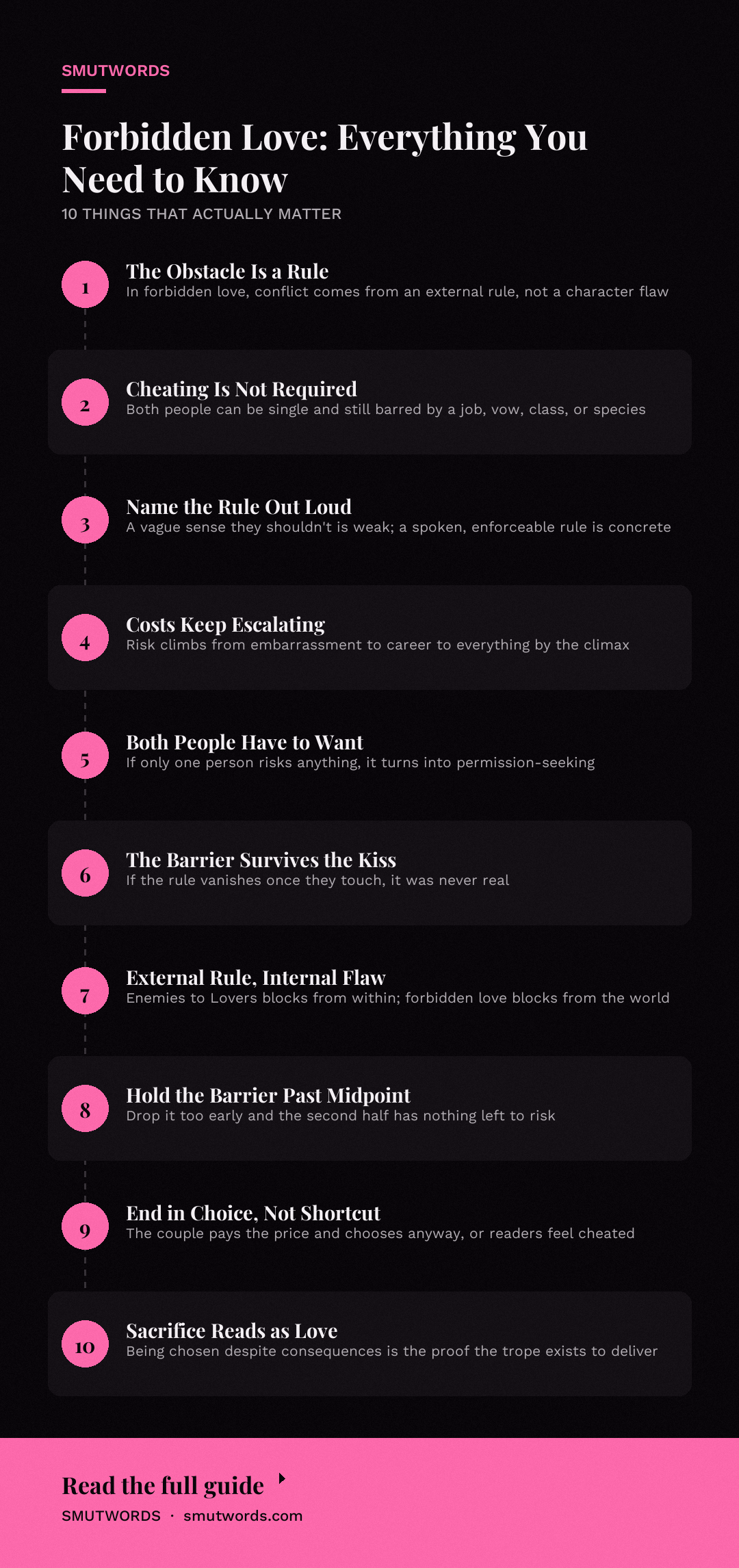
Forbidden love is a romance structure in which the primary obstacle to the couple's union is a rule, not a flaw. In a standard romance, the conflict often lives inside the characters: he's emotionally closed off, she's afraid of commitment, they miscommunicate for two hundred pages.
In forbidden love, the conflict lives outside them, or in the space between their desire and their own moral code. They often already know they're right for each other. The world disagrees.
The term itself is older than the romance genre as we know it. "Forbidden love" shows up in criticism and publishing long before it shows up on a back cover, borrowed from the older language of "star-crossed lovers." That phrase comes straight from Shakespeare's Romeo and Juliet, and earlier still from the astrological idea that the stars themselves conspired against a pairing. The two terms overlap but aren't identical.
Star-crossed lovers are thwarted by fate, timing, and catastrophe. Forbidden love is thwarted by rules that someone, somewhere, actively enforces.
The Montagues and Capulets are a feud, so that's both. A priest who can't break his vows and the woman he's counseling? Purely forbidden love.
Nobody's dying from a mix-up with a messenger. They're dying from the fact that there's a collar around his neck.
What Counts, and What Doesn't
The test is whether the couple could be together if the rule disappeared. If the answer is yes, you have forbidden love. If the answer is no because of something in the characters themselves, you have a different trope wearing the same coat.
- Counts: family feuds, arranged marriages to someone else, religious vows, sibling's exes, boss and employee, teacher and adult student, royalty and commoner, age gaps, mafia ties, species barriers, a best friend's partner.
- Doesn't count on its own: plain incompatibility, long distance, one character simply being rude. A barrier has to be a rule someone could, in theory, break.
- Grey area: forbidden attraction where the couple never actually acts, which is its own subgenre of ache. The trope can run entirely on restraint and still satisfy.
The most common misconception is that forbidden love requires cheating. It doesn't. Some of the best-known examples involve a couple who are both technically single and still can't be together, because the obstacle is a profession, a promise, or a hierarchy. Cheating is one flavor of the trope, and a contentious one, but the category is much wider than the affair novel.
Another misconception: that forbidden love is inherently darker or kinkier than other romance.
It overlaps with Enemies to Lovers often, and with power-exchange dynamics sometimes, but the trope is a plot engine, not a heat rating. You can write a sweet forbidden romance where nothing more scandalous than a kiss happens, and it lands just as hard.
If you want to see how restraint and rule-breaking get handled in practice, our breakdown of brat taming covers a dynamic built on the same push-pull.
Where Forbidden Love Comes From
Forbidden love is the oldest plot in Western literature that isn't a war. Tristan and Iseult, Lancelot and Guinevere, Pyramus and Thisbe, Romeo and Juliet: every one of them is the same machine, two people whose desire runs directly into an institution. The institution wins in the old versions. That's the tragedy, and for a long stretch of literary history, that was the only ending the story could have.
Modern romance flipped the ending. The genre's core promise, a satisfying ending for the couple, applies to forbidden love as much as anything else, which means the entire tradition got reverse-engineered. Where the medieval version punishes the couple for wanting each other, the contemporary version makes the punishment the price of admission and then hands them the win anyway.
The genre shift is more recent than people assume. Through the mid-twentieth century, the forbidden romance in mass-market paperback was often a morality tale, and the couple paid for their transgression by the final page. The change came with the rise of the category romance in the sixties and seventies, when publishers figured out that readers wanted the risk without the ruin. From there the trope split into recognizable lanes.
The 1980s and 1990s delivered the sweeping family-saga version: feuds, dynasties, and lovers on opposite sides of a war. The 2000s brought the workplace and the small town, where the barrier was a boss, an ex, or a reputation.
The last fifteen years have pushed into the explicitly taboo: age gaps, step-adjacent dynamics, monster and alien pairings that recast "we are not the same species" as a forbidden-love premise, and the whole monster breeding romance boom, which took the oldest possible barrier (he is not human) and made it the entire point. If you're new to that shelf, our piece on monster romance vs alien romance sorts out which one you're actually reading.
Self-publishing did more for this trope than any editor ever did. When authors stopped needing a publisher's permission to write the pairing, the forbidden category exploded, because the whole appeal is the pairing your family, church, or social circle would lose their mind over. Romance now publishes forbidden love at a volume that would have been unthinkable under traditional gatekeeping, and the trope's center of gravity has moved accordingly.
How It Shows Up in Erotica
On the page, forbidden love is a pacing device. The barrier is what stops the couple from falling into bed in chapter three, and in erotica that delay is the whole product. A forbidden romance works by converting "why aren't they doing it yet" into a live question that gets more urgent with every scene, not less.
Every near-miss, every hand on a lower back, every moment one of them remembers the rule, adds pressure. When it finally breaks, the payoff is proportional to how long the barrier held.
Enjoyed this? Get a free book.
Join the list and we will send a complete free story straight to your inbox, plus new releases every week after that. No credit card, no catch.
Strong forbidden love tends to do four things well. The first is naming the rule out loud. A vague sense that they shouldn't is weak.
A specific, spoken, enforceable rule, "you're my student," "your father would destroy my family," "I took a vow," gives the reader something concrete to root against. Vague taboo reads as hand-waving.
The second is an escalating cost. Early on, the risk is embarrassment.
Midway, it's a career, a reputation, a relationship with a parent. By the climax, the cost is everything, or it feels that way. If the stakes are the same in chapter twenty as they were in chapter two, the middle sags, and readers bail.
The third is making the choice active. The climax of a forbidden romance should be a decision, made on the page, by a character who knows exactly what she's giving up. The trope fails when the obstacle quietly dissolves, when the stern father conveniently dies or the rival spouse turns out to be a villain who doesn't matter. The best versions make the couple pay for their choice and let them choose anyway.
The fourth is reciprocal wanting. Forbidden love is a fantasy of being wanted by someone who shouldn't want you, which requires both people to be undone by it. If only one of them is risking anything, the story turns into permission-seeking. If both are, you've got a magnet.
Common Variations Authors Use
- Family feud: the Shakespearean default. Two families, one couple, a hundred years of grudge in the way.
- Religious vows: a priest, a nun, or a believer bound by doctrine, which makes the desire itself an act of faith and doubt.
- Age-gap taboo: a significant power difference, usually with an adult relationship at the center, and a barrier built from what other people will assume.
- Workplace forbidden love: boss and employee, coworkers, a policy against fraternizing. The barrier is a handbook, which makes it wonderfully breakable.
- Enemy's forbidden attraction: he's the rival, the opposing counsel, the man who took what was hers, and wanting him is a betrayal of her own side. This is the lane where forbidden love and Hate to Love run together and blur.
- Royalty and commoner: the crown versus a person, usually with a duty to a country in the balance. Prince/princess romance is the dressiest version of forbidden love, and often the most sweeping.
- Teacher and adult student: authority, age, and institutional rules in one tight package.
- Species barrier: the monster, alien, or creature who shouldn't be a viable partner, and is. This sub-variant has grown into a full shelf of its own.
The variants that work best are the ones where the barrier is specific to these two people. A generic "society disapproves" is weaker than "my brother will never speak to me again if he finds out I want the man who left him at the altar." Specificity is the difference between a trope and a cliché.
One craft note for writers: the barrier has to survive the first kiss. If the rule evaporates the moment they touch, the story reveals that it was never real. The tension should get worse after they cross the line, not better, because now they have something to lose.
That's why the strongest forbidden romances keep the couple cycling through indulgence and restraint, want and denial, until the final act snaps the whole thing. If you're writing that scene and it involves restraints, our guide to bondage for beginners is worth a look before you get the mechanics wrong.
Forbidden Love vs Enemies to Lovers
These two get mixed up constantly, mainly because they often co-occur. The difference is where the resistance comes from.
In Enemies to Lovers, the obstacle is personal. He's the man who wronged her. She's the woman who humiliated him. The wall between them is him and her, and it comes down through a change of heart, an apology, an act of proof, a slow thaw.
In forbidden love, the obstacle is external. The couple can be crazy about each other from the first page with zero hostility between them. What stops them is the world: a rule, a vow, a marriage, a kingdom, a family.
That's why some forbidden-love stories have a lovers' first kiss in chapter two and still run three hundred more pages. Nothing internal is blocking them, which means the pressure has to come entirely from the outside. When both are present, the book is doing the trope at its highest difficulty. The couple hates each other, the world forbids it, and every scene runs on two kinds of resistance at once.
That's a demanding structure, and it can absolutely break under the weight. When it's balanced, it's the kind of book readers finish in a single sitting and immediately start telling strangers about.
How Long Should the Forbidden Barrier Hold?
Most of the book, and past the halfway point for certain. A barrier that drops at the midpoint turns the second half into a completely different story, usually a flatter one, since the characters have nothing left to risk. The best structure keeps the external rule in force until the final act, then resolves it with a choice the couple makes with full knowledge of the price.
Does Forbidden Love Require Cheating?
No, and most of the genre doesn't go there. A couple can be entirely single and still be barred by profession, family, class, vow, or species. Cheating is one high-stakes version of the trope, and it tends to attract readers who want the sharpest possible edge, but it's a subcategory rather than a requirement.
Why Is Forbidden Love So Addictive?
Because the barrier converts desire into proof. When someone chooses you despite consequences, the choice itself is the message: you were worth the cost. Sacrifice reads as love more clearly than comfort does, and that's why the trope outlasts every publishing trend around it.
What Makes a Forbidden Romance Fail?
A barrier that isn't real, stakes that don't escalate, and a couple who never chooses. If the rule turns out to be imaginary, or the opposition folds without a fight, the reader feels cheated out of the payoff they came for. The book promised a price and delivered a shortcut.
Can Forbidden Love End Badly?
In literary fiction and historical tragedy, yes. In genre romance proper, the couple's union is the contract, and a forbidden romance that ends in separation is a different genre wearing a romance cover. There's an entire tradition of unhappy forbidden love going back to Tristan and Iseult, and if you specifically want that ache, it's out there. Just go in knowing you're reading tragedy, not romance.
Final Thoughts
Forbidden love endures because it turns the basic premise of romance up to full volume. Wanting someone is easy. Wanting someone you were told never to want, and choosing them anyway, is the fantasy the trope exists to deliver.
If you want a version that runs the whole structure at maximum charge, one where the barrier is a family debt, a loyalty owed, and a man who shouldn't be touchable, pick up Savage Hearts by J.T. Geissinger. It's the trope operating at full wattage, and it will remind you exactly why the rule was worth breaking.







Loading comments…