
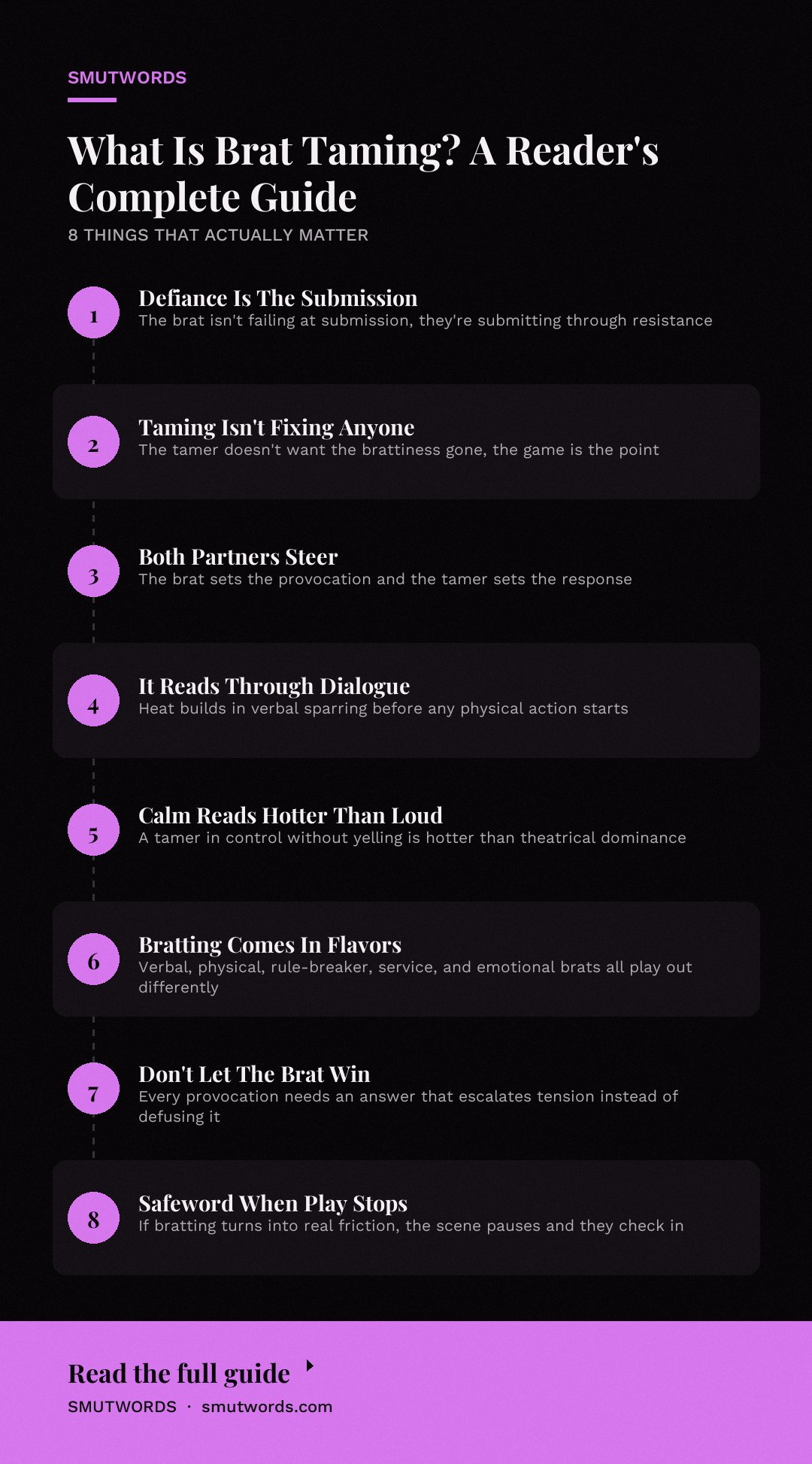
BDSM brat taming is the power-exchange dynamic where a submissive deliberately misbehaves, sasses, teases, or breaks small rules to provoke their dominant into a firmer, more assertive response. The defiance is the point. The brat isn't failing at submission; they're submitting through resistance.
The tamer's job is to meet that resistance with enough confidence, creativity, and control to make the surrender feel earned. It's a consensual game of push-and-pull where the dominant has to prove their authority rather than simply announce it. The payoff is the moment the brat finally, grudgingly, deliciously gives in.
If you've ever read a scene where the sub talks back, rolls their eyes, "forgets" an instruction on purpose, and then melts when the dom pins them with a look and a consequence, you've read brat taming. It's one of the most popular dynamics in modern erotic romance for a reason. It turns a power exchange into a conversation, and conversation is where chemistry lives.
Understanding what praise kink does for the reward side of the genre can help, because brat taming often runs on the same wiring in reverse. If you're still figuring out how to raise the subject with a partner, our guide to telling your partner about a kink without making it weird covers the conversation itself.
What Brat Taming Actually Means
The name comes from the animal-training metaphor, and yes, it's deliberately provocative. To "tame" something implies wildness, resistance, and a gradual winning-over rather than an instant command. In kink and erotica, that metaphor gets applied to a specific flavor of submission: the kind that arrives wearing a smirk.
A brat is a submissive who wants to be caught, corrected, and contained. They push because the pushing itself is pleasurable, and because a dominant who can handle the push without losing their temper or their cool is a dominant worth surrendering to. The tamer is the partner who reads the bratting correctly and responds with escalation that stays controlled, playful, and firmly in charge.
What counts as brat taming:
- Deliberate, consensual provocation. The brat knows what they're doing, and the tamer knows they know. The defiance is a bid for attention and control, not a genuine refusal of the dynamic.
- A firm, calibrated response. The tamer answers with consequences, restraint, a sharper tone, or a scene escalation that reasserts the hierarchy. The response is the reward.
- A power exchange that's being actively played with. Both partners are engaged in the game of who holds the reins, and both know who actually holds them.
- Playfulness as a throughline. Brat taming is fun. It's often funny. The humor is not incidental; it's the texture of the dynamic.
What doesn't count:
- Genuine disobedience with no consent frame. If a sub is actually defying the terms of the dynamic without that being negotiated, that's a breakdown, not bratting.
- Abuse dressed up as "taming." A dominant who responds to bratting with real anger, punishment that exceeds limits, or cruelty outside the negotiated frame isn't taming anything. They're just being cruel.
- One-sided scripts. If the brat is provoking and the tamer is genuinely annoyed rather than playing along, the dynamic has stopped working.
A common misconception is that brat taming is about "fixing" a difficult submissive. It's the opposite. The tamer isn't trying to eliminate the brattiness; they're responding to it as the exact thing they want.
A brat tamed into perfect, silent obedience would be boring to most tamers. The game is the point.
Another misconception: that the brat holds no real power. Bratting is a form of topping from the bottom, sure, but that's not a flaw in the dynamic. It's how the dynamic works. The brat sets the provocation and the tamer sets the response, and both are steering.
Where Brat Taming Comes From
Bratting as a recognizable kink identity took shape in real-world BDSM communities, and the term traveled from there into erotica and romance with very little translation needed. The archetype of the sharp-tongued, hard-to-handle submissive and the dominant who can match them has deep roots in romance fiction broadly, going back to the gothic and historical romances of the twentieth century where the heroine's wit was the primary weapon she had in a world that gave her very few others.
In erotica specifically, the modern brat-taming dynamic emerged alongside the boom in power-exchange romance in the 2000s and 2010s. Early depictions leaned toward the brat being "punished" in a fairly straightforward way, with the defiance read as a flaw to be corrected.
As the genre matured and reader tastes sharpened, the dynamic shifted. The brat became smarter, funnier, and more clearly in control of their own provocation. The tamer became less punitive and more playful, less interested in crushing the defiance than in meeting it head-on.
The mainstreaming of fanfiction and online kink communities in the 2010s accelerated this shift. Bratting became an identity readers recognized in themselves, and the fiction responded. What used to be a slightly embarrassing sub-type became a fully articulated dynamic with its own tropes, its own vocabulary, and its own dedicated readership.
The genre shift is visible in the framing. Older brat-taming stories often treated the dynamic as a conflict to be resolved, with the brat "learning their lesson." Contemporary versions treat it as a relationship to be enjoyed, where the brat doesn't stop bratting and the tamer doesn't want them to. The resolution isn't the end of the game; it's the mutual acknowledgment that the game is the relationship.
This mirrors a broader shift in how power-exchange fiction handles consent and interiority. Modern brat taming tends to spend real page time on the negotiation, the signals, and the collaborative nature of the play. Readers want the dynamic to feel alive, which means the tamer has to be reading the brat accurately on the page, and the brat has to be visibly choosing to push and choosing to yield. The dynamic got hotter as it got more psychologically honest.
How It Shows Up in Erotica
On the page, brat taming runs on dialogue. A scene that works usually has more verbal sparring than physical action in its first third, because the heat is built in the exchange.
The brat says something audacious. The tamer doesn't flinch. The brat escalates. The tamer answers with a quiet, devastating line, or a move that shifts the physical geometry of the scene, or a consequence the brat absolutely brought on themselves.
Enjoyed this? Get a free book.
Join the list and we will send a complete free story straight to your inbox, plus new releases every week after that. No credit card, no catch.
What makes a brat-taming scene land is the sense that the tamer is genuinely in charge without needing to yell about it. Calm authority reads far hotter than theatrical dominance here, because the whole point of the dynamic is that the tamer's control is solid enough to absorb a hit. A tamer who snaps, sulks, or loses composure has lost the game, and readers notice.
Common variations authors work with:
- The verbal brat. The sub sasses, needles, and refuses to take anything seriously. Taming often runs through restraint and denial of the thing the brat keeps asking for.
- The physical brat. The sub squirms, escapes, or "accidentally" disobeys a physical instruction. Taming involves gentle wrestling, holding them in place, or escalating restraint.
- The rule-breaker. The sub does exactly the small thing they were told not to do. The tamer's response is often a structured consequence, sometimes playful, sometimes delivered in front of an audience.
- The service brat. The sub drags their feet on a task or does it slightly wrong on purpose. Taming runs through repetition, correction, and the tamer's patience outlasting the brat's stubbornness.
- The emotional brat. The sub provokes because they're scared of the surrender they actually want. Taming involves the tamer seeing right through the deflection and naming it, which is often the moment the brat breaks.
The single most common craft mistake in brat-taming erotica is letting the brat get away with too much. If the tamer never lands a real reassertion of control, the dynamic has no shape; it's just two people bickering. Readers want the tamer to be genuinely formidable. Every provocation needs an answer, and the answer should escalate the tension rather than defuse it.
The second most common mistake is making the tamer come across as humorless. Brat taming requires the tamer to be playful back. The tamer enjoys the game, and that enjoyment is visible. A tamer who seems genuinely irritated by the brat, rather than delighted by them, kills the heat.
The strongest examples in the genre hit a specific beat: the tamer does something the brat didn't anticipate, something that proves the tamer knows them better than they know themselves. That's the moment the resistance tips from game into genuine surrender, and it's the moment readers are reading for. The brat thought they were in control of the game; the tamer reveals that they never were. That reveal has to be earned by the whole scene preceding it.
Writers working this dynamic often borrow texture from adjacent kinks. The praise that lands after the surrender has real overlap with the mechanics described in our guide to breeding kink, which is another dynamic where the sub's verbal resistance and eventual yielding drives the arc. The specific physical vocabulary of brat taming tends to overlap with discipline and impact-focused scenes, but the emotional architecture is its own thing.
Scene timing matters too. A brat-taming scene that resolves in one page usually feels thin. The longer the tamer lets the brat run their mouth before the correction lands, the more satisfying the correction is.
Denial is easy to write badly and hard to write well; the tamer should be visibly enjoying the delay, not simply withholding. When the dynamic is written well, the reader is often rooting for both people at the same time, which is what makes the eventual resolution feel loaded.
Frequently Asked Questions
Is brat taming the same as a punishment kink?
Not exactly. Punishment is often a tool within brat taming, but the dynamic is broader than discipline. Brat taming is about the provocation-response loop and the reassertion of control, which can include punishment, restraint, verbal correction, denial, or simply the tamer refusing to rise to the bait. The kink is the game; punishment is one of the ways the game is played.
Can a brat be a switch or a top sometimes?
Absolutely. Bratting is a role within a specific scene or relationship, not a fixed identity. Plenty of brats top, switch, or dominate in other contexts, and plenty of tamers enjoy bottoming in scenes that run the other direction. The dynamic lives in the negotiation, not in the person.
What happens if the bratting stops being playful?
That's when the safeword comes out and the scene pauses. Bratting relies on both partners reading each other's signals clearly, and if the provocation starts landing as genuine friction rather than play, the scene needs to stop. Negotiate limits and a safeword ahead of time, and check in after to confirm the bratting stayed on the right side of fun for both of you.
Why do readers love brat taming so much?
The verbal sparring creates chemistry that instant-obedience dynamics often can't. The dominant has to earn their authority on the page, which makes the power exchange feel active and specific rather than automatic. Readers get humor, tension, and a surrender that was actually resisted before it was given, which lands harder than a surrender that was a foregone conclusion.
How do I write a tamer who feels genuinely dominant?
Understatement. The tamer says less, moves slower, and doesn't argue when the brat tries to goad them. Their control is visible in what they don't do.
A tamer who escalates calmly and specifically reads more powerful than one who barks orders. Also, let the tamer win at least one exchange per scene, or the dynamic flattens.
Can brat taming work outside a romantic relationship?
Yes. It shows up in casual play, in scene-based dynamics, and in stories that don't lead to romance at all. What brat taming needs is a negotiated power exchange and two partners who read each other well. It doesn't require emotional entanglement, though many of the best examples in the genre layer romance on top of the dynamic to raise the stakes.
Final Thoughts
Brat taming is one of the few dynamics in erotica where the sub's resistance is the love language. The provocation is an invitation, the tamer's response is the answer, and the whole thing only works when both partners are reading each other accurately. When it's written well, it produces some of the sharpest dialogue and most earned surrenders in the genre.
For a novel-length example of the dynamic in full flight, Susan Fanetti's By His Rules handles the interplay of verbal defiance and calm authority about as cleanly as anything in the catalog. If you like the push-and-pull of a resistance that has to be won rather than assumed, it's a good place to start.







Loading comments…