
Why One Monster Isn't Enough Anymore
The single-mate monster romance has a ceiling. One gargoyle, one orc, one kraken can carry a book just fine, but the moment you close the cover you feel it: there was a whole world behind that one character, and you only got to see the slice of it that fit between the front and back matter.
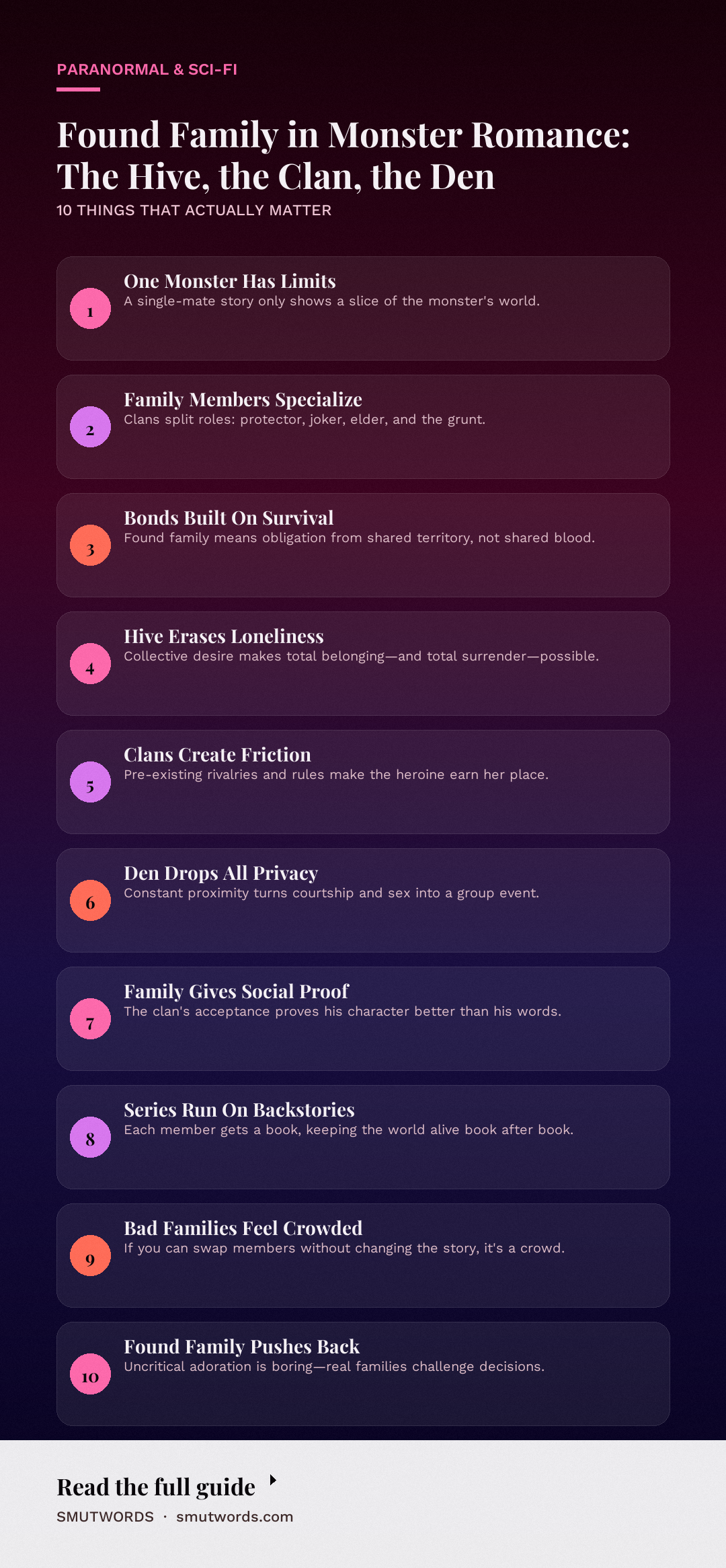
That's where the monster romance found family structure comes in. When the author builds a hive, a clan, or a den around the love interest, the story stops being a two-person affair and starts being an invitation into a functioning society that happens to be full of people who'd die for each other.
The appeal is structural as much as emotional. A lone monster love interest has to be everything at once: protector, provider, sexual partner, cultural ambassador, emotional support. Spread that across a clan and each member gets to specialize.
You get the gruff authority figure, the chaotic younger sibling energy, the elder who's seen too much and says too little, the one who communicates mostly through grunts and meaningful eye contact.
Together they're a family the heroine walks into, and the romance deepens because she's being adopted by a whole social unit that treats her presence as a matter of collective pride. She's falling for a system of loyalties, and the system is falling for her right back.
What Exactly Is Found Family in Monster Romance?
Found family means the bonds aren't biological. A clan of orcs who share no blood but would stack their bodies between you and a raiding party is found family. A gargoyle brood that wakes from stone sleep together and squabbles over whose turn it is to patrol is found family.
The key marker is obligation that has nothing to do with genetics and everything to do with shared survival, shared territory, and shared history.
In monster romance specifically, the found family often stands in for society itself. The heroes are outcasts from human civilization, or from their own kind, or from both. The clan is the place that took them in when nothing else would.
When the heroine gets taken in too, she's gaining the whole safety net. The safety net is usually way more interesting than the alternative the human world offered her.
There's also the practical layer that makes the trope work so well on the page. Multiple characters means multiple sources of sexual tension, multiple personalities for the heroine to bounce off, and enough bodies to justify the gangbang scenes that monster romance readers frequently seek out.
You can write a perfectly good monster romance with one partner. But when you've got a whole den and everyone's been watching the courtship with varying degrees of patience, the group dynamics do half your storytelling work for you.
The Hive: Collective Desire and Shared Purpose
The hive model runs on unity. Insectoid aliens, some arachnid species, and the occasional tentacled collective all use this shape. Everyone in the hive wants the same thing, and individual preference gets subordinated to group need. That might sound like a nightmare in human terms, and in a human context it would be.
But written well, the hive's unanimity becomes a fantasy of total belonging. Nobody in a hive has to wonder if they're wanted. The whole structure of the society is built around making sure each member is exactly where they're needed, doing exactly what they're best at.
The erotic charge comes from the surrender of individuality. A hive-minded partner doesn't just want you. The entire collective wants you, coordinates around you, and has discussed you at length in ways that you'll never fully understand.
Some readers find that terrifying. Others find it deeply comforting: the idea of being absorbed into a network of desire so total that loneliness becomes structurally impossible.
Titles like The Breeding Spiral: Captured in the Tentacle Alien Incubation Chamber and Star Sower: A Captive in the Tentacle Alien Breeding Chamber lean into this collective energy, where the protagonist is folded into a system that has clear ideas about how she should be used. The hive doesn't negotiate. It incorporates.
A well-built hive also gives the author room to explore consent in layered ways. One mind may be running the show, or a few, or none, with the group acting on shared instinct.
The heroine's consent has to be negotiated with a culture, not a person, and that culture may have its own internal disagreements about her even if it presents a unified front. Those disagreements are where the story lives.
The Clan: History, Hierarchy, and Squabbling Relatives
The clan is the most recognizable found family shape because it maps closest onto human extended family structures, just with more tusks. Orc clans, dwarf holds, wolf packs, and gargoyle broods all run on this model. There's a hierarchy, usually earned through strength or age or both. There are internal rivalries that have been simmering for decades.
There's a collective memory of past slights that gets brought up at the worst possible moments. What makes the clan work as a romance vehicle is the friction. The heroine isn't walking into a welcoming committee.
She's walking into a pre-existing ecosystem with its own rules, and she has to find her place in it. The love interest may be the clan leader, in which case she's suddenly responsible for everyone by association. Or he may be the clan outcast, in which case she's choosing the faction nobody else wants to acknowledge.
The orc romance space is particularly good at this, since orc clans traditionally have elaborate honor codes and social structures that the heroine has to navigate.
The romance gets denser when she realizes that accepting the mate means accepting the clan's expectations, and that some members of the clan are rooting for her while others are waiting for her to fail so they can say they told everyone so.
The Den: Privacy Within the Pack
The den model is the most intimate of the three. Dens tend to be smaller, more tightly wound, and more physically close-knit than clans.
A den might be five members. It might be fifteen. The defining feature is proximity. They sleep together, eat together, groom together, and guard together. There's no retreating to a private chamber because the den is one shared space and everyone in it has seen everyone else in every possible state.
For a heroine coming out of a human world where privacy is sacred, the den is a slow adjustment. She arrives with human expectations about personal space and boundaries, and the den patiently, or not so patiently, works her out of them.
The forced proximity here isn't a plot device that locks two people in a room together. It's a permanent condition of the social structure.
The erotic writing in a den story gets to play with audience. When the heroine and her love interest finally come together, the rest of the den can react in real time. Some look away. Some watch openly. Some offer commentary.
The sex becomes a group event whether anyone intended it to be or not, and the heroine has to decide how she feels about being wanted that publicly.
Planet Of Orgasms plays in this space, where the culture of the setting itself treats sexual openness as the default rather than the exception.
Enjoyed this? Get a free book.
Join the list and we will send a complete free story straight to your inbox, plus new releases every week after that. No credit card, no catch.
How Found Family Deepens the Single-Mate Romance
Here's the part that matters for the actual love story. When a heroine falls for a monster with a family, she's gaining witnesses. The clan saw him before she did.
They know what he was like when he was young and stupid. They've seen him fail and recover and fail again. Their acceptance of her carries weight because it comes from people who have no reason to flatter her and every reason to protect their own.
That social proof works in both directions. The heroine gets to see her love interest through the clan's eyes, which gives her context she'd never get from him alone.
She learns his history from the people who lived it with him. She sees how he treats the weakest members of the group, which tells her more about his character than any declaration of love could.
The family also applies pressure to the relationship that keeps it from going flat. A couple alone in a cabin can coast on chemistry for a while. A couple embedded in a clan has to justify itself constantly.
Why should the clan accept this outsider? What does she bring? Is she going to be a drain or an asset?
Those questions force the heroine to prove herself, and the proving is where the character growth happens.
Building a Series on a Family, Not Just a Couple
The smartest move an author can make with a monster romance found family is using it to launch a series. Each member of the den or clan gets their own book, and the family structure carries continuity between installments.
Readers who fell in love with the world in book one come back for book two because they want to see what happens to the supporting characters they got attached to along the way.
This is where the found family shows its economic value as well as its emotional value. A series built around a single couple has to manufacture new conflict every volume, and eventually the well runs dry.
A series built around a family never runs dry because there's always another member whose backstory hasn't been explored, whose mate hasn't been found, whose personal demon hasn't been confronted.
The gargoyle romance subgenre runs on this model constantly. A brood of gargoyles wakes from stone sleep, and each one gets a book as he finds his mate and deals with whatever threat the group is facing.
The incubus romance space does something similar with demon courts, where the political structure of the demon family creates both obstacles and allies for each couple.
Books like Officer's Orders: Breed Her and Taken by the Celestial King show the range of what family structures can do in the genre.
In one, the structure is military hierarchy, a clan of warriors bound by order and duty. In the other, it's celestial court intrigue, a denial of family as much as an embrace of it. Both work because the social context gives the romance somewhere to happen beyond just two bodies finding each other.
When Found Family Goes Wrong
Not every execution lands. The found family trope fails when the family members are interchangeable, when they all speak in the same voice and serve the same function.
If you couldn't swap character A and character B without changing the story, the author hasn't built a family. They've built a crowd.
It also fails when the found family exists only to praise the heroine. A clan that uncritically adores every decision she makes is a fantasy of unconditional acceptance, sure, but it's a boring one.
The best found families push back. They call out bad decisions. They have their own agendas that sometimes conflict with the heroine's desires.
They're family in the full sense, which means they can hurt her in ways strangers never could, and the romance has to survive that too.
The secret baby complication is a natural fit here, since a found family has collective opinions about reproduction and lineage. A clan that's been waiting generations for an heir will react very differently to a pregnancy than a human nuclear family would. That reaction becomes part of the story, for better or worse.
Where to Find the Best Monster Romance Found Family
Start with the books that take the family structure seriously rather than treating it as set dressing. Look for titles where the clan or den has internal politics, where members disagree with each other, where the heroine has to earn her place through action rather than just being declared worthy by the love interest.
Series are your friend here. A single book can introduce a family, but a series gives you the room to actually care about all of them.
By book three or four, you'll have favorites among the supporting cast. You'll be reading mainly to find out what happens to the shy one, or the scary one, or the one who never speaks in book one and turns out to have the most devastating backstory of everyone.
That's the sign of a well-built monster romance found family. You stop reading for the couple and start reading for the whole dysfunctional, devoted, occasionally murderous group they're part of.
The romance is still the spine of the story. The family just makes the story big enough to live in.
Final Thoughts
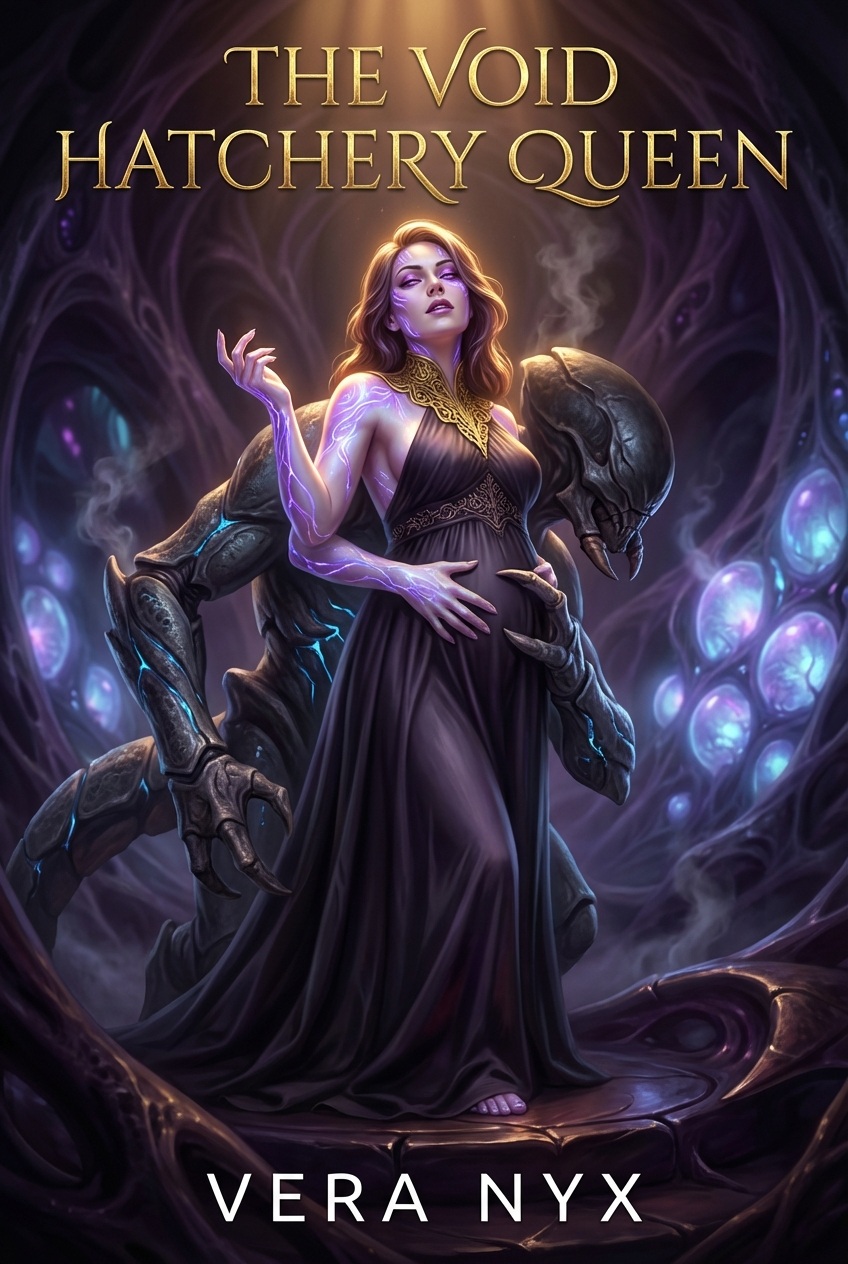
If you want to see the structure done well with real attention to group dynamics, pick up Worship The Womb, which builds its whole erotic tension around how a collective treats the one member who carries their future.
That book understands that when a family has a single point of hope, everyone's devotion gets louder, weirder, and more interesting to read about.
Read it after you've finished a few single-mate stories, and you'll feel the difference immediately. The family makes the monster real. Without one, he's just a set of interesting anatomical features attached to a romance plot.





Loading comments…