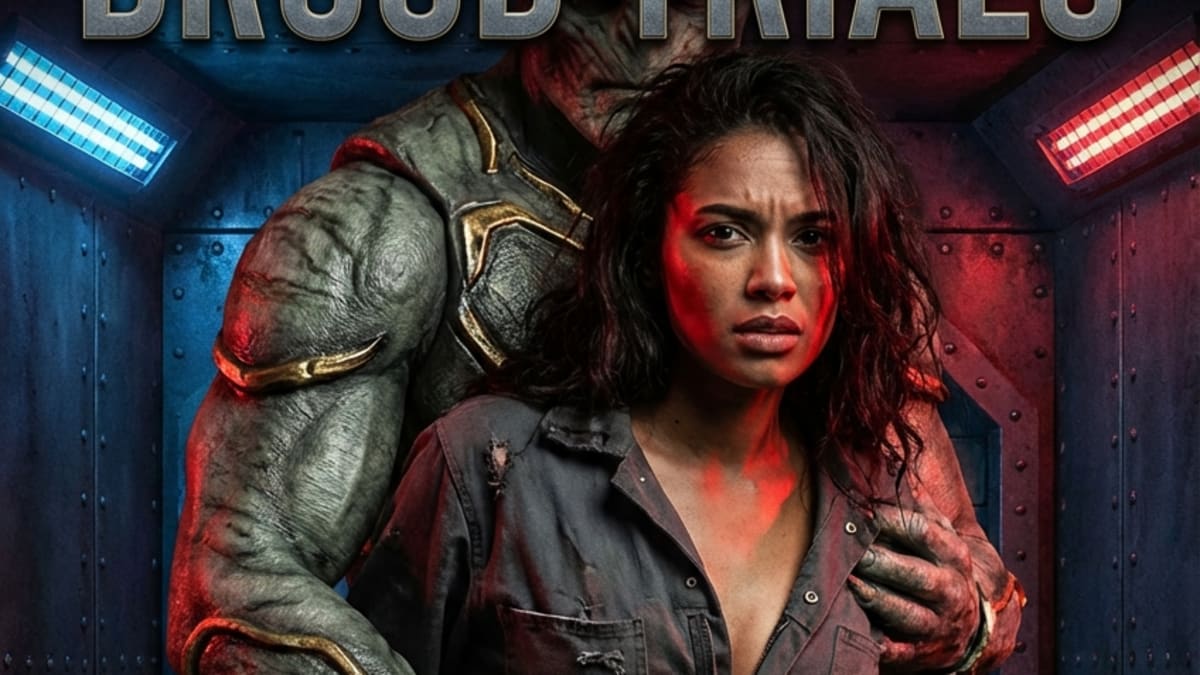
There’s a specific moment in every good orc romance book where the hero does something that should be terrifying and turns it into something unbearably tender. He’s got tusks, he’s twice your size, his hands could crush rocks, and then he carefully braids a flower into your hair because he saw you look at it twice. That contrast is the entire appeal, and it’s why orc romance books have carved out a permanent, beloved corner of monster romance.
The genre doesn’t ask you to pretend the orc is a human in green face paint. The fantasy works because he isn’t. He’s big, he’s blunt, he’s culturally alien, and he’s absolutely certain about what he wants. That certainty, paired with a softness that only shows up for the heroine, is the engine the whole genre runs on.
Why the Brute With a Soft Spot Works So Well
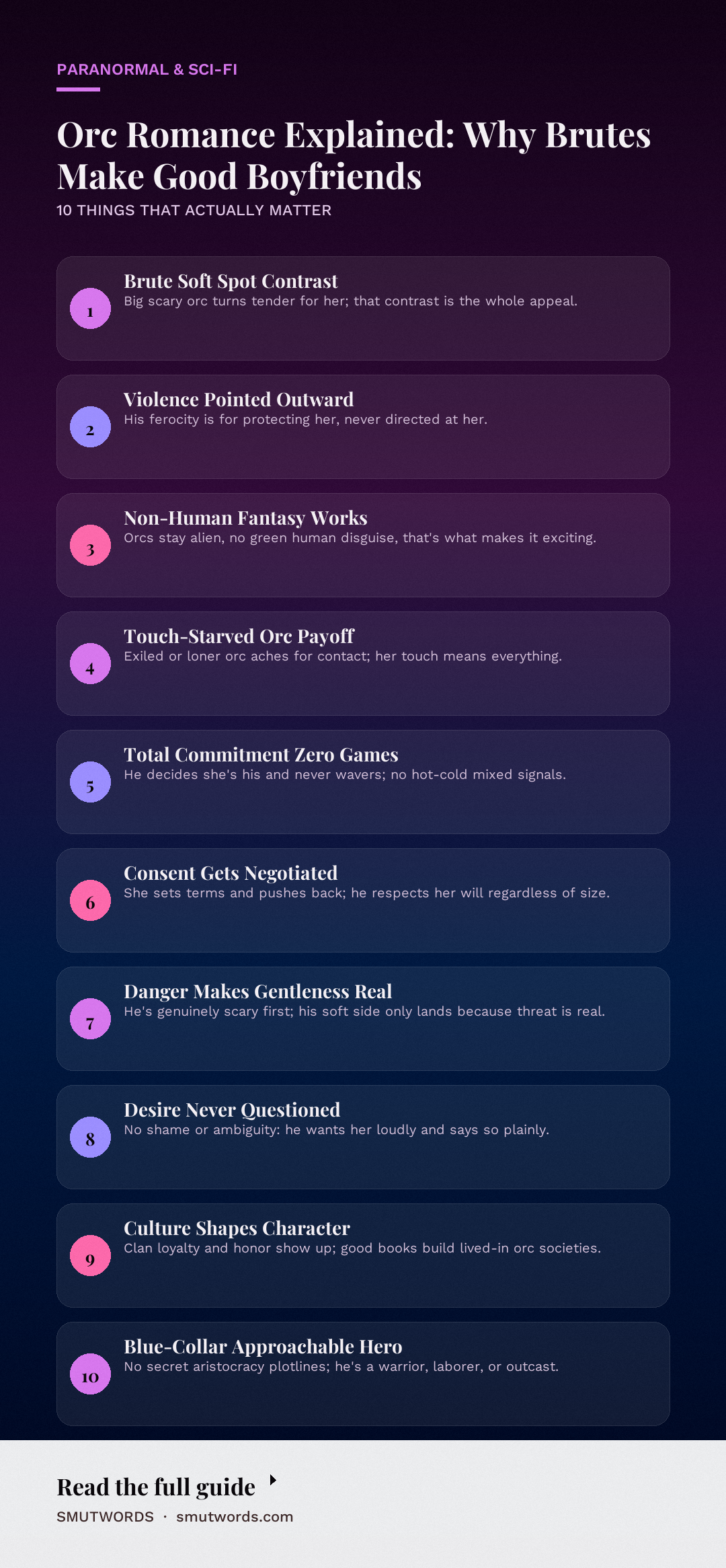
The brute-with-a-soft-spot dynamic is a shortcut to emotional investment, and orc romance exploits it better than almost any other subgenre. The hero’s physical power makes his restraint meaningful. When a character who could break you in half instead uses that strength to shield you from rain or carry you across rough terrain, the gesture lands harder than it would from a man your own size.
This is also why the size difference trope pairs so naturally with orcs. The physical gap between the leads makes every moment of gentleness feel deliberate, chosen rather than automatic. It’s the same reason the size difference in monster romance content is so popular: bigger feels safer when the bigger one clearly prioritizes your comfort over their own convenience.
In the best orc romance books, the hero’s violence is never directed at the heroine. It’s directed at the world, at threats, at anything that might touch her. That framing makes his ferocity part of the romance rather than a red flag. He’s dangerous, but he’s dangerous for her, and that distinction is where the fantasy lives.
What Makes an Orc an Orc in Romance
Different authors treat orc anatomy and culture differently, but a few conventions hold steady across the genre. The tusks, the green or grey skin, the sheer size, and the cultural markers of clan loyalty and honor show up in most versions. Some books lean into noble savage coding, which can get uncomfortable if handled clumsily. Others give their orc societies complex political structures, religious practices, and domestic lives that feel genuinely thought through.
The best orc romance books treat the orc’s culture as a real place, not a costume. Maybe the hero is a warrior who’d rather tend the clan’s gardens.
Maybe he’s a chieftain who never wanted the job. Maybe he’s an exile who’s been alone for years and doesn’t know how to ask for help. That variance keeps the genre fresh.
This is where the monster romance guide on this site earns its keep, breaking every creature type down by what they offer the fantasy. Orcs offer a specific blend of human-legible emotion and alien physicality that few other monsters can match.
The common thread is the emotional reading of the orc’s physicality. A human hero’s jealousy is a clenched jaw. An orc’s jealousy is a low growl that vibrates through the floorboards.
A human hero’s heartbreak is a phone call he doesn’t make. An orc’s heartbreak is him leaving offerings outside your door because his culture doesn’t have words for what he feels, only actions.
The Touch-Starved Orc Trope
Few things hit harder in orc romance books than the touch-starved hero. An orc who’s been exiled from his clan, or who’s spent decades on the battlefield with no one to hold, reads as a being of pure physical need. When the heroine finally touches him, the emotional payoff is enormous.
This is the exact dynamic covered in the touch-starved monster romance piece on this site. The orc version of the trope works especially well because his size makes his loneliness more pronounced. He can’t easily find comfort in casual contact; anyone he touches might get hurt. So he’s been starving, quietly, until the heroine walks in and isn’t afraid.
The physical scenes in these books carry that weight. Every touch is a negotiation, a revelation. The heroine’s small hands against his back, her fingers tracing the ridge of his tusks, the way he has to consciously soften his grip. It’s the tenderness that makes the explicit scenes land, and the explicit scenes in return make the tenderness feel earned.
Why Orcs Make Better Boyfriends Than Human Heroes
Let’s be honest about the appeal. Orc romance books sell a fantasy of total commitment with zero games. The orc hero doesn’t play hot and cold. He decides she’s his, and that’s the end of the matter.
He’s protective, possessive, and communicative in his own blunt way. Here’s what the genre repeatedly delivers:
- Clear intentions. An orc hero says what he wants and doesn’t waffle. No ambiguity, no mixed signals.
- Physical safety. The fantasy of being with someone who can make the world leave you alone has obvious appeal.
- Emotional safety through action. He may not have the vocabulary for feelings, but he catalogs her preferences, keeps her warm, feeds her, and guards her sleep.
- No shame about desire. Orc heroes want the heroine with an intensity that’s never framed as something to be embarrassed about.
- Monogamous fixation. Once he picks her, everyone else ceases to exist. The loyalty is absolute.
That last point is worth emphasizing. The orc hero’s possessiveness often reads as endearing rather than controlling because it’s presented as his species’ natural orientation toward a chosen mate. It’s the fated mates logic applied to a love interest who doesn’t need mystical justification. He just knows, and he acts.
The Gender Politics of Being "Claimed"
A lot of orc romance books lean on the language of claiming, breeding, and marking. The fated mates angle explains why these connections happen instantly in alien and monster romance, and orcs often get the same treatment. This framing can be a turn-off if the heroine loses all agency, but the best books are careful to give her choices and desires that matter.
The key is consent, even when it’s framed in primal terms. The heroine might say yes under pressure, and that’s fine as a fantasy, but the truly good stuff gives her a real say. She negotiates. She sets terms.
She pushes back when the orc gets too intense, and he listens because he respects her.
That push-pull, where his size and strength are real but her will matters more, is what separates a good orc romance from a questionable one. The genre also plays with reversing the power dynamic in small ways.
She might be the one with social status. She might be the one who knows more about the world. The orc hero, for all his physical dominance, is often the one who needs guarding emotionally. That inversion makes the "claimed" dynamic feel consensual and mutual rather than one-sided.
How Orc Romance Handles the Brutal vs. Gentle Balance
The best orc romance books let the hero be genuinely scary when the situation calls for it, then let him be soft with the heroine. The contrast only works if both sides of the equation are real. If he’s never actually dangerous, the gentleness means nothing.
Enjoyed this? Get a free book.
Join the list and we will send a complete free story straight to your inbox, plus new releases every week after that. No credit card, no catch.
So you’ll see orc heroes fight, kill, and intimidate. Then you’ll see them carefully wash the heroine’s hair, apologize with their hands, or sleep with their head in her lap because they feel safe with her. The juxtaposition is the entire point.
Here’s how the best books structure that balance:
- The hero’s reputation precedes him, in-world and for the reader.
- He does something violent or threatening within the first few chapters, establishing the stakes.
- He encounters the heroine and immediately recalibrates, showing a gentleness that surprises even him.
- Mid-book conflict forces him to choose between his brutal nature and what she needs from him.
- He chooses her, and that choice is the climax of his arc, more than any fight.
That arc is why the enemies to lovers dynamic shows up so often in orc romance. She starts afraid of him, or she’s been hurt by someone like him, and he has to prove he’s different. It’s the same shape as the captor to protector arc that monster romance readers pretend to feel guilty about loving, and orc romance is one of its best homes.
Spicy Tropes That Pair Well With Orcs
Once the emotional foundation is set, orc romance books go all in on the physical. Many of them lean toward breeding themes, which works because orc culture is often framed around clan growth and legacy. Some of the most popular titles on SmutWords hit this exact note.
For instance, Officer’s Orders: Breed Her pairs a soldier’s disciplinary structure with explicit breeding content, and the dynamic of obedience plus possessiveness maps neatly onto the orc fantasy even when the hero is human. A reader who loves the commanding-officer dynamic will often find the orc version even more satisfying because the physical stakes are higher.
Worship The Womb takes the reverence angle, and that’s a tone that works beautifully with orc heroes who treat the heroine’s body as something sacred. The Planet Of Orgasms title leans into pure hedonism, which is the other half of the orc fantasy: a hero who is entirely unashamed about wanting her, loudly, often, and specifically.
Then there’s the captive end of the spectrum. The Breeding Spiral and Star Sower both use alien captivity frameworks that share DNA with orc romance’s "claimed" trope, and Taken by the Celestial King shows how a powerful, alien authority figure can be flipped from threat to protector. That arc is exactly the shape many orc romance books take.
The through-line is a hero whose desire is never in question. He wants her.
He says so. He acts on it. The heroine never has to wonder where she stands.
Good Orc Romance vs. Flat Orc Romance
There’s plenty of bad orc romance out there, and it’s worth knowing the difference so you don't waste money. The weak stuff treats the orc as a costume on a generic alpha hero, or leans so hard on the primal angle that the heroine becomes a prop.
Signs you’re reading a good one:
- The orc has a personality beyond "strong and horny." He has preferences, grudges, humor, history.
- The heroine gets a point of view that matters. Her wants and limits shape the plot.
- The physical scenes include the orc’s size and strength as factors, not just his genitals.
- The cultural worldbuilding feels lived-in rather than sketched.
- The tenderness lands because the danger was real.
Signs you’re reading a weak one:
- The orc is interchangeable with any human alpha, just with green skin.
- The heroine is carried through the plot with no decisions of her own.
- The scenes are all friction and no emotional texture.
- The orc’s violence is directed at the heroine or at random NPCs in a way that reads as mean, not protective.
- The book promises a soft landing and delivers a thud.
The genre rewards authors who commit to the fantasy. If you’re writing an orc hero, you have to keep him orc, and that means paying attention to how his body and culture shape every interaction. The readers who love orcs tend to read dozens of them, and they know when a book is phoning it in.
Orc Romance vs. Other Monster Types
Orcs sit in an interesting middle space between fully monstrous creatures like tentacle aliens and recognizably humanoid figures like elves or shifters. That placement gives them a versatility other monster types lack.
Compared to the tentacle erotica tradition, orcs are more emotionally legible. You can guess what an orc is feeling from his posture and facial expressions, even if he can’t articulate it. Tentacle creatures, by contrast, operate on a different communicative register entirely. Both are excellent, but they serve different cravings.
Orcs also differ from vampires and shifters because there’s no inherent aristocracy lurking in the mythos. An orc hero is rarely a secret prince with a tragic backstory. He’s a warrior, a laborer, a former bandit, or a clan outcast. That blue-collar quality makes him more approachable, which pairs nicely with the size difference content that’s so popular in this space.
Where to Start With Orc Romance Books
If you’re new to orc romance books, the good news is that the subgenre is deep enough to support a long reading list, but not so sprawling that you can’t find your way in. Start with titles that emphasize the soft-spot contrast, because that’s the hook. A hero who spends the whole book growling and fighting without ever turning tender is just a violent story, and one who’s never genuinely threatening loses the point.
For something that leans into the protective, possessive dynamic with a healthy dose of explicit content, the titles above are a solid entry point. Officer’s Orders: Breed Her gives you the commanding-tone arc, while Taken by the Celestial King offers the "scary authority figure turns devoted" beat in a different flavor. If you want the full fated-mates intensity, the breeding-heavy titles in the captive-and-chamber vein will scratch that itch.
Read a few, figure out which flavor of orc you like best, and go deeper. Some readers want clan politics. Some want exile-and-redemption arcs.
Some just want a hero who can lift a horse and will absolutely use that strength to give you a piggyback ride when you’re tired. The genre has all of it.
Final Thoughts
The orc romance fantasy works because it lets desire and safety share a body. The hero can break the world with his hands and chooses instead to build a calm space around the heroine. The affection only means something because the danger is real and the restraint is chosen.
Start with Officer’s Orders: Breed Her if you want a hero who gives orders he eventually breaks for her, or Taken by the Celestial King for the authority-figure-who-falls angle. Either one will show you exactly why the brute-with-a-soft-spot formula refuses to go out of style.





Loading comments…