Nobody walks up to a vampire or a werewolf and gets offered a deal in the first five minutes. Those monsters tend to lurk, circle, and spend a full third of the book brooding about their dark nature before committing to touching anyone. The incubus shows up, puts his terms on the table, and waits for you to negotiate. That is the entire appeal, and it's why incubus romance books hit a nerve other monster subtropes can't reach.
The bargain is baked into the concept. An incubus exists to feed on desire, and the feeding requires consent, or at least a very convincing performance of it. Some versions of the myth let him drain victims in their sleep, but the romance genre almost always gives him a better angle: he needs her willing, and she needs something only he can supply.
The result is a relationship built on transparent want rather than lurking threat, and the transparency is the fantasy. No guesswork about what he's after. He says what he wants before he's even gotten his coat off.
What Makes Incubus Romance Different From Other Monster Romance
Most monster romance tropes run on fear, danger, or the thrill of being caught. A kraken romance is about scale and the terror of being dragged into the deep. Orcs bring physicality and the sense that the heroine is in over her head with someone who could snap her in half. The captor to protector arc is about fear turning into devotion.
Incubi don't threaten. They tempt. The danger isn't that he'll hurt the heroine; it's that she'll say yes to something she can't take back. He represents pure appetite with a contract attached, and the tension comes from watching her decide whether to sign it.
The incubus is also oddly honest compared to his monstrous peers. A vampire will hide what he is for three chapters. A werewolf will pretend the mate bond doesn't exist. The incubus introduces himself, explains that he needs her sexual energy to survive, and asks if she's in.
That directness reads as respect, and it's a big part of why the trope works for readers who want the fantasy of being pursued without the fantasy of being hunted.
The Bargain Scene: The Core Fantasy
Every good incubus book has one scene that functions as the thesis: the negotiation. It usually happens in the first third of the story, sometimes in the first chapter. She's alone, often at a low point, and he appears or is summoned. The details of the summoning vary, but the shape of the conversation stays consistent.
He tells her what he wants. She asks what she gets in return. He offers pleasure, protection, revenge, or information. She names her price.
They shake on it, or they don't, and the whole book becomes about whether the contract was too steep.
That scene lands because it makes the heroine an active participant. She's not being seduced against her will or claimed by fate. She's making a deal, which means she has power in the exchange.
That power separates the trope from its darker cousins. The fated mates bond removes choice from the equation entirely. The bargain restores it, then sits back to watch what she does with it.
Why the Temptation Angle Works Better Than Pure Seduction
Seduction implies the target doesn't know what's happening. Temptation implies she knows exactly what's on the table and is weighing the cost. The incubus romance genre leans hard on the second one, and that's the right call.
A hero who simply seduces the heroine gives her no agency. She's acted upon, and while that has its place in romance, it doesn't produce the sustained tension the bargain does. Temptation creates a countdown. She has to decide, and every scene she spends with him makes the decision harder, because he keeps delivering on his promises.
The pleasure isn't a trick or a trap. It's a preview of the full contract terms.
That preview is where the best authors get cruel with the pacing. They give the heroine one taste, then make her wait. They show her trying to find a loophole in the deal, only to realize the loophole was never there. The incubus might not lie, but he's not obligated to make the truth comfortable either.
Incubus Romance Books That Understand the Assignment
Not every book in the genre gets the balance right. The ones that fumble usually make the incubus too soft, turning him into a generic supernatural boyfriend who happens to feed on sex. The ones that land treat the bargain as a real contract with real consequences, and the pleasure as both the currency and the punishment.
You can see the bargain structure working in other monster subgenres too, even when the monster in question doesn't call itself an incubus. Officer's Orders: Breed Her runs on an authority figure setting explicit terms and the heroine deciding to meet them. The power imbalance there is institutional rather than supernatural, but the shape of the story is the same.
The heroine is told exactly what will happen if she complies, she complies, and the book spends its energy on how she feels about that choice rather than on whether the other party will change his mind.
For a purer dose of the otherworldly bargain, Taken by the Celestial King gives the heroine a deal with a being so far above her that the terms feel cosmic rather than personal. The incubus version of that dynamic keeps the supernatural weight but brings the negotiation down to earth. He isn't a god. He's closer to a contractor, one who happens to specialize in orgasms and who expects to be paid.
If you want the bargain to collide with a fated-bonds framework, Planet of Orgasms drops its heroine into a setting where the currency is literally desire and the stakes are survival. That book is a great example of how a bargain structure can drive a plot even when the incubus figures as part of a larger world rather than a lone seducer.
Enjoyed this? Get a free book.
Join the list and we will send a complete free story straight to your inbox, plus new releases every week after that. No credit card, no catch.
The Incubus as a Bargaining Partner, Not a Predator
The most interesting thing about the trope is the way it flips the predator label. Superficially, an incubus is a predator. He hunts for sexual energy, and he's built to be irresistible. But the genre's best versions of him refuse to use that irresistibility on anyone unwilling, and that refusal turns him from a monster into a love interest.
He can't compel her. The mythology usually makes that explicit. If he takes her without consent, the feeding doesn't work, or it damages him, or it voids the contract. He has to be wanted, and wanting takes time.
He has to learn what she likes, what she fears, what she'll trade to get what she needs. That learning process is the courtship, and it's why the sex scenes in good incubus books feel earned rather than gratuitous.
The best incubus heroes are also terrible at emotional honesty with anything that isn't a physical need. He can talk about her thighs with the fluency of a poet, but the moment she asks what he wants beyond feeding, he goes quiet. That asymmetry is catnip to readers who love their love interests slightly incompetent at feelings.
He's deeply skilled at one thing and completely out of his depth at another, and watching him fail upward through the emotional parts is half the fun.
How the Deal Ends: The Hidden Heart of the Trope
Incubus books have to answer one question that most monster romance doesn't have to touch. The vampire can decide to stop feeding. The werewolf can choose not to bite. The incubus has to eat.
His survival is tied to the heroine's body, and no amount of love removes that need.
Some books handle this by making the deal permanent. She signs on to be his source, and the story ends with her accepting that role. That's a satisfying conclusion for readers who want the fantasy of total usefulness, the idea of being the only person who can sustain someone who would otherwise starve.
Other books rip up the contract. She either finds a way to feed him without sacrificing her autonomy, or she breaks the bargain and he has to learn to survive differently. Those books tend to be more about growth and partnership than about submission, and they appeal to a different reader entirely.
There's also a subset where the bargain was the misunderstanding all along. He didn't need her body. He needed her to believe he did, because admitting the truth would have meant admitting he was lonely. The reveal that the deal was a pretext for connection is a wonderful gut punch when it's handled well, though it takes a skilled author to sell it without making the hero look manipulative.
Where the Trope Crosses Paths With Other Monster Romance
The bargain structure isn't exclusive to incubi, and the crossover material is worth seeking out. Worship the Womb uses a similar give-and-take dynamic with a being whose interest in the heroine is reproductive rather than sensual. The negotiation there is about what she'll carry, and the pleasure is the currency paid for her participation.
Books with tentacle alien breeding chambers like The Breeding Spiral take the opposite approach. There's no negotiation at all. The heroine is captured and used, and the pleasure is a biological response she can't control rather than a price she agrees to pay. Readers who like the incubus bargain often bounce off this kind of story, because the loss of agency is exactly what the bargain fantasy exists to avoid.
Star Sower splits the difference. The heroine is captive, but she's also given choices within that captivity, and those choices function as a kind of bargain. She can't escape, but she can decide how she responds to what's being done to her, and that decision-making space is where the erotic tension lives.
If the incubus trope appeals to you specifically because of the hate-to-love or enemies to lovers energy, the desperation bargain in books like Officer's Orders will scratch that itch. If you're in it for the fantasy of being chosen above all others, the prince/princess romance structure in Taken by the Celestial King gives you the same exclusivity with a crown attached.
For the size-difference angle that overlaps with incubus appeal, the bigger-feels-safer dynamic in monster romance supplies the same protective energy with a different explanation. Worth a read if the physical asymmetry part of the bargain is what does it for you.
Signs of a Great Incubus Romance
Once you know what you're looking for, it gets easy to separate the strong entries in the genre from the ones that coast on the concept. Here's what the good ones have in common:
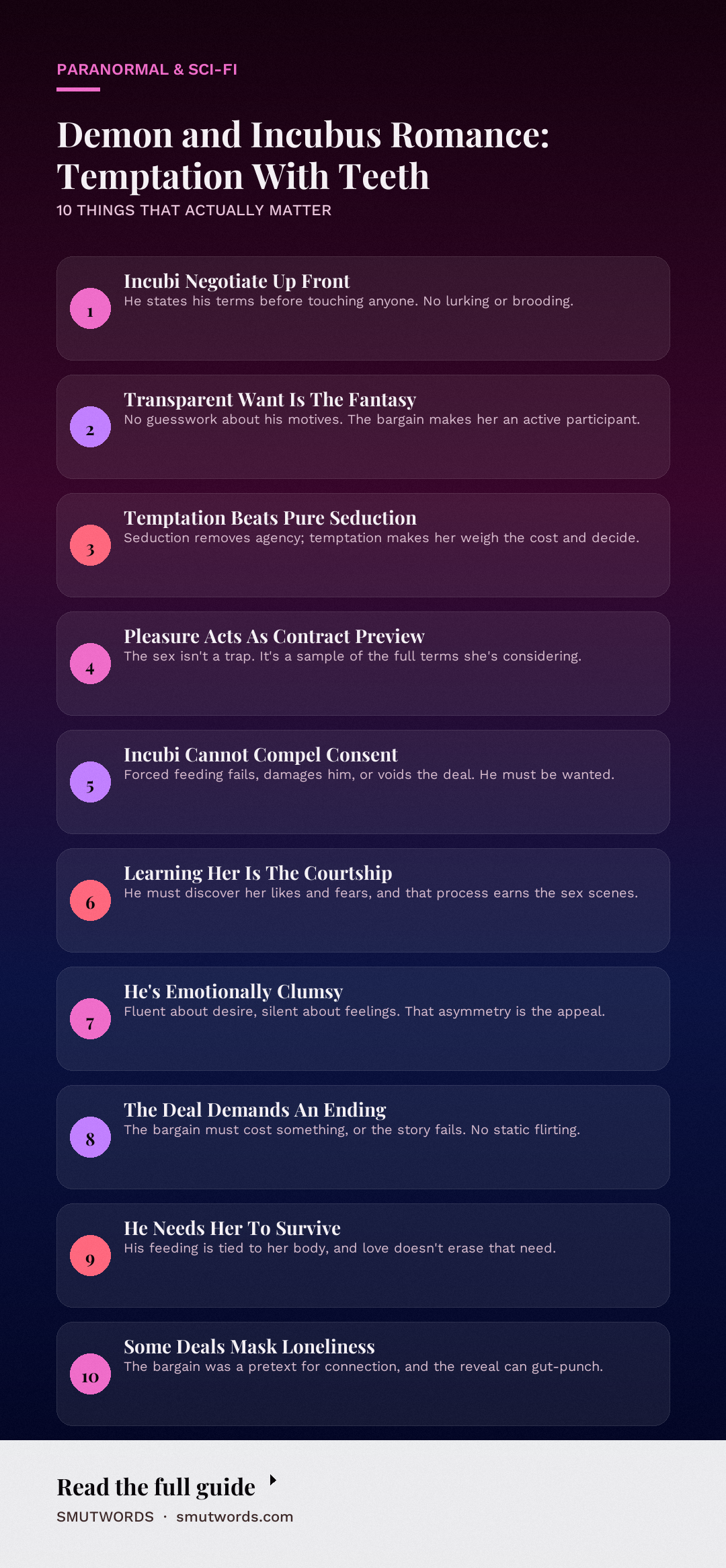
- The bargain is stated explicitly, usually in dialogue, before the first sex scene. If you're past 20% of the book and nobody has named the terms, the author is stalling.
- The heroine gets something real out of the deal. It doesn't have to be material, but it has to be something she couldn't get without him, and the story has to show her using it.
- The incubus has a personality beyond wanting sex. He's vain, or pedantic, or secretly lonely, or pathologically honest to the point of rudeness. Something has to exist under the horny surface.
- The sex scenes advance the plot. The bargain changes with every encounter, either because he gets stronger, she gets more addicted, or the stakes of the deal escalate. If the scenes could be rearranged with zero impact, the author missed the point.
- The ending costs something. Either she keeps the bargain and loses something to it, or she breaks it and loses him, or she renegotiates and loses the original fantasy. An incubus romance that ends exactly where it started is a failure.
That last one is the biggest differentiator. The best entries in this subgenre understand that a bargain is a structure, and a structure demands a payoff. The book has to close the deal, not just keep the flirtation going forever.
Final Thoughts
Incubus romance books succeed when they treat the bargain as the love story instead of a plot device to get to the sex. The contract, the negotiation, the moment she decides the pleasure is worth the price: that's the heart of the trope, and every good scene builds toward or away from it.
Start with Officer's Orders: Breed Her if you want the dynamic sharpened into a power exchange with clear terms, then come back to the otherworldly version of the deal after you've got a taste for how the negotiation should go.





Loading comments…