
The Kindle Unlimited vs going wide erotica debate has been settled about four hundred times, usually by someone who's been publishing for nine months and has a screenshot of one good month. Here's the honest version: both models work. Both models punish certain kinds of writers. And the right answer for your catalog has almost nothing to do with which one is trending on Reddit this week.
What it actually comes down to is how your readers find you, how fast you publish, and whether you can survive a slow month without checking your dashboard every forty minutes. Let's get into it.
How Kindle Unlimited Actually Works for Erotica
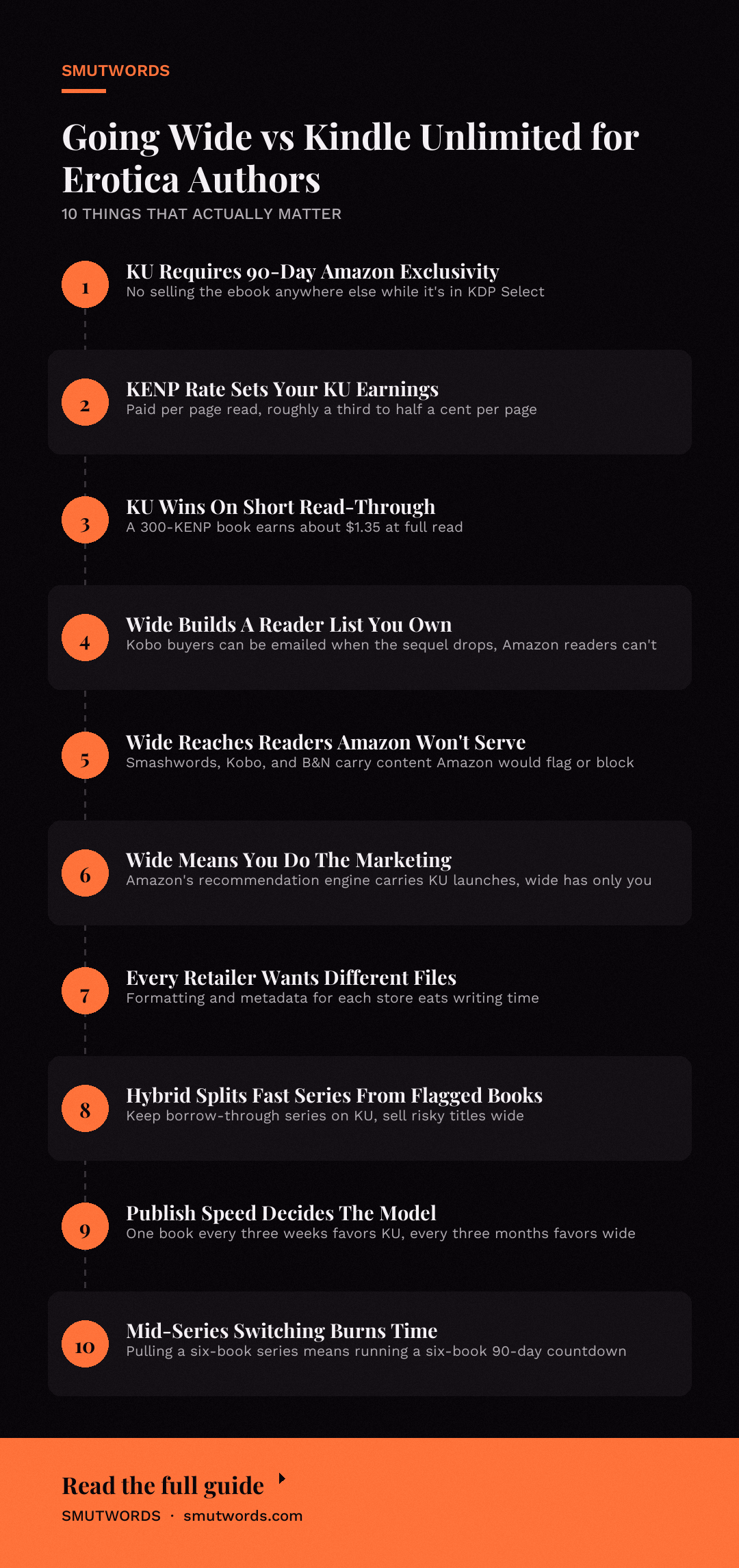
You enroll your book in KDP Select, which means Amazon gets exclusive digital rights for 90 days. No selling the ebook anywhere else. No Gumroad, no Smashwords, no your own site. In exchange, your book goes into Kindle Unlimited, where subscribers read it for "free" and you get paid per page read out of a pool that Amazon sets every month.
For erotica specifically, KU has been the default move for years because the genre reads fast and reads a lot. A reader who finishes a 40,000-word cuckold novella at 2am and wants another one immediately is exactly the customer KU was built for. Impulse buying is real, and so is finishing a book and grabbing the next one in the same session without a second thought about price.
The catch is exclusivity. If you write monster breeding romance and your readers hang out on a subreddit that will not touch Amazon, you're invisible to them for 90 days at a time. That's the trade.
The real math on page reads
KU pays per page read through Kindle Edition Normalized Pages, or KENP. The per-page rate floats, and it's been somewhere around a third of a cent to half a cent for a while, depending on how big the pool is that month and how many pages get read across the whole program.
A 300-KENP book earning the full read at $0.0045 per page nets you about $1.35. Sounds thin. But a book that sells at $2.99 as a purchase nets you roughly $2.06 after Amazon's cut. So KU needs a book to get read about 460 times to match 300 sales at $2.99.
For a lot of erotica, that read-through math actually favors KU, because readers burn through shorts fast and don't hesitate to borrow something they'd never pay for.
How Going Wide Works for Erotica
Going wide means dropping exclusivity. You sell on Apple Books, Kobo, Barnes & Noble, Google Play, Smashwords, Eden Books, your own storefront, and anywhere else that'll take you. You keep your list, your pricing control, and your rights. You also take on every distribution headache Amazon used to handle for you.
The upside is that wide authors build something KU authors don't: a reader list they own. If someone buys Permission Slip: A Cuckold Erotic Short Story on Kobo, you can email them when the sequel drops. On Amazon, that reader is Amazon's, not yours. You get the sale and a ranking bump and nothing else.
Wide also unlocks the parts of the market KU can't touch. Smashwords and its retail partners will carry content Amazon won't, and Barnes & Noble and Kobo have sizable erotica readers who specifically avoid Amazon for a dozen different reasons. Some of those readers pay full price for a short story without blinking because they've already accepted that they don't want to be in the Amazon ecosystem.
Where wide gets expensive
Wide authors have to do their own marketing. That means ads, newsletters, social, promo swaps with other authors, or a slow grind of organic discovery that can take eighteen months to pay off.
A KU launch lets Amazon's recommendation engine carry you for the first couple weeks, especially if you've got a hot niche and good covers. Wide doesn't have an engine. Wide has you.
The other sting is the tax on formatting and file management. Every retailer wants a different EPUB, a different cover size, a different metadata scheme. You can pay a service like Draft2Digital to handle it for a cut, or you can build the files yourself and spend a Saturday afternoon on it. Either way, it's time you're not spending writing.
The Case for Staying in Kindle Unlimited
If you publish erotica quickly and your series hook is strong, KU is the simplest path to volume. Three things make it work:
- Read-through. A reader who finishes book one borrows book two the same night. Series are how KU authors print money.
- Discovery. Amazon's recommendation engine pushes KU books hard to readers already in your niche. Being free-to-borrow removes the "should I spend $3.99 on this random author" hesitation entirely.
- Simplicity. One dashboard, one file, one payout schedule. You can launch a book, forget it, and focus on the next one.
That third point is underrated. A lot of the writers who rage-quit KU and go wide end up spending more time on distribution logistics than they did on actual writing, and their sales don't grow enough to make up the difference. KDP Categories for Erotica Authors: A Practical Guide covers how much work category placement alone takes if you want to compete on Amazon, and it's a good reality check on whether "just go wide" is really the lower-effort path.
The catalogue of what's selling well on KU tells its own story. He Paid Him to Fuck Me and Shared Without Shame: A Hotwife Exhibition & Sharing Fantasy sit in the sweet spot KU readers eat up: taboo-adjacent premise, short, single-sitting read, easy to finish and immediately borrow something similar. That borrow-again behavior is the engine KU authors rely on.
The Case for Going Wide
If your niche is underserved by Amazon, if you write content Amazon would pull, or if you already have an audience somewhere else, wide is often the better call. Four situations where it usually wins:
Enjoyed this? Get a free book.
Join the list and we will send a complete free story straight to your inbox, plus new releases every week after that. No credit card, no catch.
- Kink that Amazon will bury or block. Non-consent fantasies, certain taboo dynamics, and anything with underage-adjacent framing are risky on KU. Wide doesn't care.
- Readers on non-Amazon platforms. Apple Books and Kobo have their own erotica communities, and they're loyal to authors who show up there.
- Direct sales. Selling from your own site gives you the email address. Email addresses are worth more than KU page reads over a five-year horizon.
- Audio and print aside. Wide and KU both have audiobook complications, but going wide lets you place ACX and Findaway without exclusivity clauses tripping you up.
If you write a lot of stalker romance or revenge romance, the wide market is more forgiving. Those subgenres get flagged on Amazon more often than people realize, and having a Kobo or Smashwords fallback means your book doesn't disappear from sale because a reviewer decided it crossed a line.
The glossary entries on stalker romance and revenge romance both point to subgenres where the audience exists, and where KU authors routinely have to tone things down to keep the book live.
Monster breeding romance readers are split the same way. A chunk of them buy direct because they don't want to risk a book disappearing mid-series.
That's a real market. If Lured by the Lizard Beast is your kind of book, wide distribution on Smashwords and Eden Books reaches readers who specifically go looking for that content elsewhere. The curated monster breeding romance glossary page exists because that audience knows what it wants and where to get it.
The Hybrid Approach (and Why It Usually Works Best)
You don't have to pick. Plenty of erotica authors run a hybrid: keep the fast-reading series on KU, and sell the books Amazon would flag on wide. Same author, same pen name, two different distribution strategies.
This works because the two catalogs serve different readers. Your KU series is optimized for borrow-through discovery. Your wide catalog is optimized for readers who come from your newsletter or a niche community and don't care where the book lives.
Two rules make it survive contact with reality. First, don't try to be hybrid both ways with the same title. The 90-day exclusivity window means you can't. Second, decide upfront which series goes where and don't second-guess it every time a book has a slow launch week.
How to actually decide
Ask these five questions before you commit either way:
- Do you publish fast enough to feed a KU read-through engine? If you push one book every three months, wide is probably better. If you push one every three weeks, KU starts to make more sense.
- Is your kink in Amazon's gray zone? If yes, plan on wide from day one.
- Do you already have a newsletter list? If it's over 2,000 targeted subscribers, wide gets better fast.
- Can you afford to run ads and lose money for six months? If not, KU's free discovery is doing real work for you.
- What does your best-performing book look like? If your top seller is a 30,000-word single-sitting read, KU. If it's a 90,000-word sprawling subplot-heavy novel, wide usually holds up better.
And if you haven't already, read Writing Sex Scenes That Matter to the Plot. It sounds tangential to the KU vs wide question, but it's not. Wide readers pay full price and expect more from a book than a KU reader who borrowed it on a whim. Plot quality matters more on wide, and it shows in the reviews.
What Nobody Tells You About Switching
Switching from KU to wide mid-series is messier than switching from wide to KU, and both are messier than starting on the side you intend to stay on. If you're taking a completed series out of Select, you have to wait out the 90-day window for each title. If your series has six books, you're running a six-book countdown calendar before your first wide sale.
Going the other way is easier. You pull a title from Kobo and Smashwords, wait for it to come off the other retailers (usually a couple weeks), and enroll it in Select. First-time KU enrollments get a small launch boost from Amazon's recommendation engine, so some authors deliberately stagger series, running book one as a KU loss leader and selling a wide-exclusive bundle of the whole series on their own site.
The one strategy I've watched fail repeatedly: enrolling the first book of a series in KU, then trying to sell books two through five wide. Readers who borrow book one are creatures of convenience. They don't switch platforms mid-series. You end up with a KU book one, five orphaned wide titles, and a lot of angry reader emails.
Where the Money Actually Lands
If your books are short, fast, and inside Amazon's content rules, KU usually wins on volume. If your books are long, your niche is on the edge of what Amazon permits, or you're building a business that outlasts any single platform, wide wins over a three-to-five-year horizon.
The Free Use Casino and Zorgon's Pet style of book, short, high-concept, fantasy-forward, is a good bellwether for what KU readers borrow aggressively. Look at your own top ten and ask how many of them a reader would finish in one sitting. That's your KU number. The rest belong wide.
Publishing strategy isn't a religion. It's a set of trades. Each distribution model has costs, and the trick is picking the trades you can actually live with for the next two years, because that's how long it takes for any of this to compound.
Final Thoughts
If you're still on the fence, run one series KU and one series wide for a full year and compare the actual dollars. Not the vibes, not the Reddit consensus: the numbers in your own KDP and Draft2Digital dashboards. Series that read in one sitting, like Shared Without Shame: A Hotwife Exhibition & Sharing Fantasy, are usually the ones that make KU worth it. Start there, keep notes, and let the second quarter of 2026 tell you the truth.






Loading comments…