
Amazon's category system is the most reliable free discovery tool erotica authors have, and most of us are using it badly. Not because the system is broken (though it is confusing). The problem is that the advice floating around author forums is three years out of date. Half of it describes a dashboard that no longer exists, and the rest assumes you're publishing sweet small-town romance instead of a 40k-word cuckold story with a very specific readership.
Getting your KDP categories for erotica right is worth more than most paid ads. It puts your book in front of readers who are already scrolling the exact shelf you belong on.
Here's what actually works right now.
How KDP Categories Actually Work in 2025
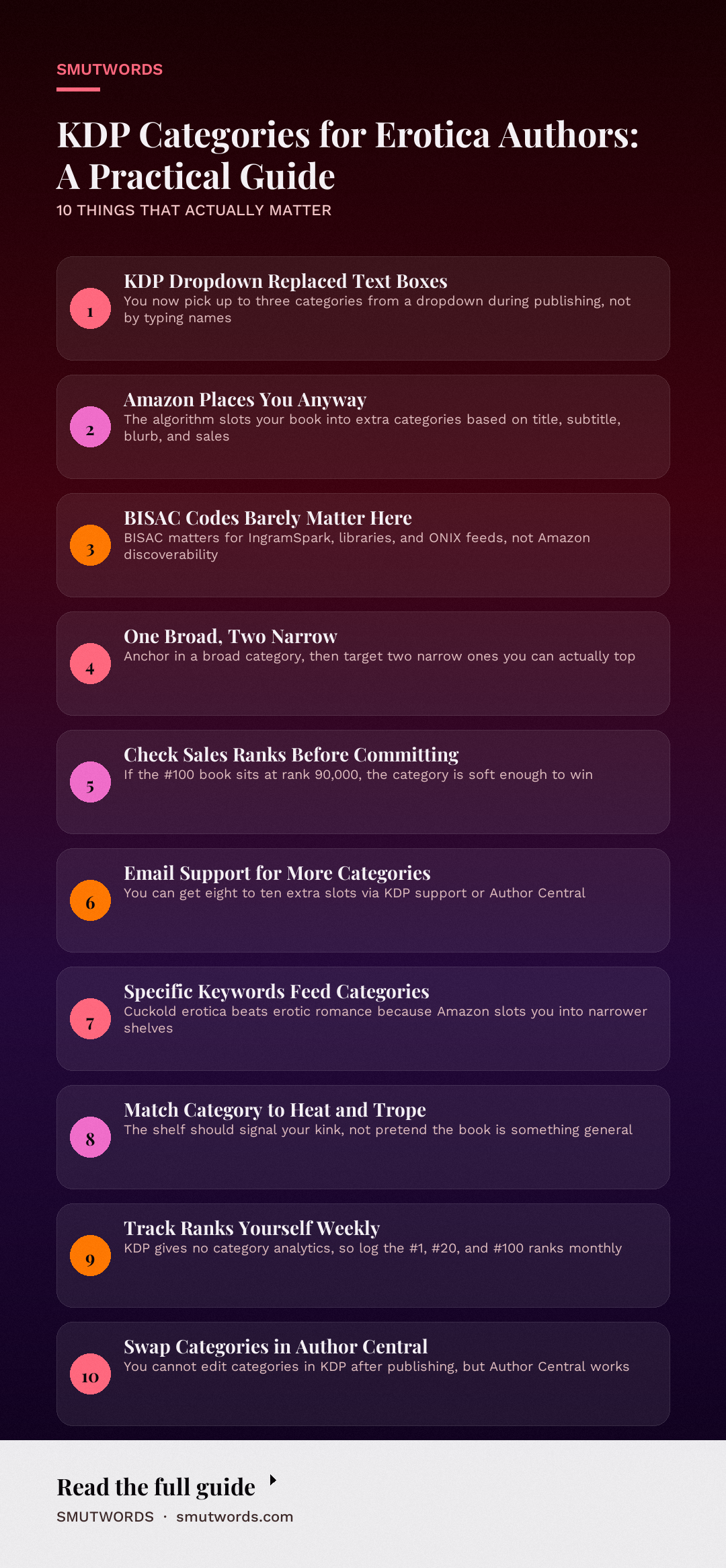
You no longer type category names into a text box during publishing. That changed. Now you pick up to three categories from a dropdown menu inside KDP, and everything beyond that gets set through Author Central or by emailing KDP support, which is exactly as tedious as it sounds.
The dropdown gives you a path: Fiction, then a genre, then a subcategory, sometimes a sub-subcategory.
What it does not tell you is that Amazon will also place your book in categories on its own, based on keywords in your title, subtitle, and blurb, plus whatever the algorithm decides your book is after it starts selling. You control three. Amazon controls the rest, and it will absolutely put a book with "beast" in the title into monster romance whether you asked for it or not.
Two things follow from this. Your three chosen categories matter enormously. So does your metadata, because it's feeding the machine that decides where else you land.
The BISAC code thing you keep hearing about
Some of the older guides tell you to pick BISAC codes. You still select a BISAC code during setup, but on Amazon it does almost nothing for discoverability. BISAC matters for IngramSpark, for libraries, and for retailers that ingest ONIX feeds. On Amazon, the category dropdown does the work.
If you're publishing wide, keep your BISAC codes clean anyway. Other stores lean on them harder.
Choosing Your Three Categories Without Wasting Them
Most authors pick the three biggest categories they can find and then wonder why they never crack the top 100. A category where the #100 book has a sales rank of 4,000 is a category where you have no chance in week one. A category where the #100 book sits at rank 90,000 is a category you can top with a modest launch day.
The move is to pick one broad category for long-term legitimacy and two narrow ones you can actually win. Something like:
- Broad anchor: Fiction > Erotica > Romantic Erotica (or the closest available parent)
- Narrow target #1: a subcategory specific to your trope, like Erotica > BDSM or Erotica > Science Fiction
- Narrow target #2: a second trope-adjacent subcategory, ideally one with lower competition
Then go check the bestseller lists in each candidate category before you commit. Open the top 100, look at the sales ranks of the books sitting between positions 20 and 80. If those ranks are in the six figures, the category is soft. If they're all under 10,000, walk away.
Where trope-specific subcategories actually live
This is where erotica gets annoying, because Amazon's category tree doesn't map cleanly onto how readers actually search. A few placements worth knowing:
- Monster and beast content usually sits under Erotica > Science Fiction, Fantasy, or Paranormal. Something like Lured by the Lizard Beast is competing with paranormal romance in that tree, not with contemporary.
- Hotwife and cuckold work tends to land in Erotica > Romantic Erotica or Erotica > Contemporary, which are crowded. This is a case where you want to hunt for narrower subcategories. Permission Slip: A Cuckold Erotic Short Story would be fighting in the wrong weight class if it just sat in a generic category.
- Sci-fi with power dynamics can go two directions: Erotica > Science Fiction, or Romance > Science Fiction > Cyberpunk. If your book is a cyberpunk romance with a filthy streak, the romance-side category has more readers and less author competition.
And your glossary hobbyist readers will find you either way, as long as you don't bury yourself in a dead category.
Requesting Additional Categories
Three is the limit inside the dashboard. In practice you can get into eight to ten more by emailing KDP support or going through Author Central, and it's worth doing for every book you intend to market seriously.
The process is unglamorous. You email KDP support, list your book's ASIN, and request the specific category paths you want. Amazon's support team will add them if the paths exist and your book plausibly fits, though "plausibly" is doing a lot of work in that sentence. Some requests get through, others get bounced, and there's no appeals process worth fighting.
A few things that make the requests land more often:
- Ask for categories on the Amazon storefront, not BISAC, and write the exact full path.
- Keep each request to a handful of paths per email. Ten categories in one message tends to get ignored.
- Don't request categories your book has no business being in. Amazon's category validators notice.
- Give it a week before you follow up.
It's a slow, manual chore, and the payoff is a modest bump in exposure. If you're publishing a lot, it's worth building a template email and reusing it.
Metadata, Keywords, and the Categories You Never Chose
The categories you select are only half the picture. Amazon's algorithm also places books based on the seven keyword slots you fill during publishing, plus the words in your title and subtitle.
For erotica, the keyword slots are where you want to be specific. "Cuckold erotica" is better than "erotic romance." "Humiliation kink short story" is better than "BDSM." The more specific the keyword, the more likely Amazon slots your book into a subcategory you couldn't otherwise request. If a trope term has a clean hit with readers, use it: stalker romance, motorcycle club romance, lumberjack romance. These are all real search categories that readers actually browse.
Enjoyed this? Get a free book.
Join the list and we will send a complete free story straight to your inbox, plus new releases every week after that. No credit card, no catch.
Two warnings. First, don't stuff keywords. Amazon will reject or deprioritize books with keyword strings that read like spam.
Second, don't use another author's name in your keywords, ever. That's a fast track to a takedown.
Categories that come from your trope, not your list
If your book is built on a trope Amazon doesn't have a category for, lean hard on its closest neighbor. There's no "only one bed" category, but only one bed scenes drive reader behavior, and a book that hits that beat hard can ride the romance subcategories even when the actual erotica ones are too crowded.
Same with heat levels. If your book goes dark, you're not competing for the same shelf as someone writing sweet contemporary. Heat levels explained: sweet, steamy, high heat, and dark is a useful reference when you're figuring out which subcategory you actually belong in, because the subcategory determines who sees your cover, and the wrong subcategory means the wrong reader bounces off your sample.
Matching Categories to What You Wrote
This is where erotica authors get sloppy. It's tempting to slot everything into one crowded category and skip the homework. That's how you end up invisible.
The categories you pick should match three things: the heat level, the trope spine of the book, and the audience you want. A book like He Paid Him to Fuck Me has a specific kink at its center, and its category choices should signal that kink to readers scanning thumbnails, not pretend the book is something more general.
A hotwife story like Shared Without Shame: A Hotwife Exhibition & Sharing Fantasy is a different reader profile again, and the category tree treats it differently. The shelf matters as much as the blurb.
If you're writing a book with a serious emotional spine, like a marriage in trouble arc where the sex and the repair are tangled together, you can legitimately place it in both erotica and romance categories. That's a real edge, because you catch readers from two directions.
Books with redemption arcs, with one protagonist earning their way back into the other's good graces, do the same trick. (See the redemption arc romance definition if you want to check whether your story actually qualifies.)
Don't chase the category, chase the reader
Every category decision should answer one question: which reader, browsing which shelf at 11pm, is most likely to click my cover. If a category has 8,000 competing books but the readers there want exactly what you wrote, that category is better than a soft category full of readers who want something sweeter.
Tracking Category Performance
You won't get category-level analytics from KDP. You'll get vague orange dots on the sales graph and nothing else. So build your own tracking.
A workable routine:
- Note your three primary categories and any additional ones Amazon accepted.
- Check the #1, #20, and #100 sales ranks in each category once a week for a month after launch.
- Watch your rank in your narrowest category. If you're not in the top 100 there two weeks after launch, that category may be wrong for the book.
- If a book stalls, try swapping a category in Author Central (you can't do it in KDP) and watch the rank curve for two weeks.
A book with a solid cat placement will see its rank rise disproportionately on days when its category is actively browsed. You won't get direct evidence that a category is doing work, but you'll get correlation. That's enough.
Common Mistakes Erotica Authors Make
The mistakes are consistent enough that they're worth listing:
- Picking the biggest category. You're not going to beat Nora Roberts to the top slot. Pick a smaller one and beat someone your size.
- Forgetting you can't edit categories in KDP after publishing. You can. It's in Author Central. Most authors don't know this and assume their choices are locked.
- Ignoring keyword slots. Your category is a shelf, your keywords are the signposts. Skip them and you're invisible.
- Requesting categories that don't exist. If you can't see the path in the storefront dropdown yourself, support won't honor it.
- Never revisiting categories after launch. A category that didn't work in week one might work in month three once you know who's actually buying.
Placement Is a Long Game
The books that win on Amazon are the ones that keep tinkering with their category placement for months after launch. Not because the system rewards churn, but because the only way to know which shelf is right for a book is to test it.
If you're going to spend an afternoon on marketing tasks, category work is high-leverage. It's free, it's redoable, and it directly affects who sees your cover. A book like Zorgon's Pet only needs a handful of readers scrolling the right sci-fi subcategory to break into its top 100, and that first orange flag under the title is worth more than any $20 ad buy.
Treat your categories the way you'd treat the first page of the book itself. If it's wrong, nobody gets further in.
Final Thoughts
Start with the specific reader, not the specific category. Figure out who's most likely to click your cover at 11pm, then back into the three shelves where that person scrolls.
If you want a book that teaches the whole process by example, spend a weekend with Free Use Casino. It's a fast, trope-forward read with a clear audience, which makes it a good study in how a targeted shelving choice changes who ever finds the book in the first place.







Loading comments…