
Most sex scenes in erotic fiction fail for the same reason most fight scenes fail: nothing changes. Two (or more) people get naked, things happen, everyone finishes, and the plot picks up exactly where it left off, as if the last eight pages were a commercial break.
You can skip them and lose nothing. That's the tell. If the reader could jump from the scene before to the scene after without confusion or emotional loss, the scene wasn't doing a job. It was just there.
Knowing how to write sex scenes that actually carry weight means treating the scene as a plot point that happens to be explicit, not an explicit detour from the plot. The mechanics of bodies are the easy part. Anyone who's read enough of the genre can write a passable blowjob. What separates a scene you skim from one you reread is whether something is different in the characters or the situation once it's over.
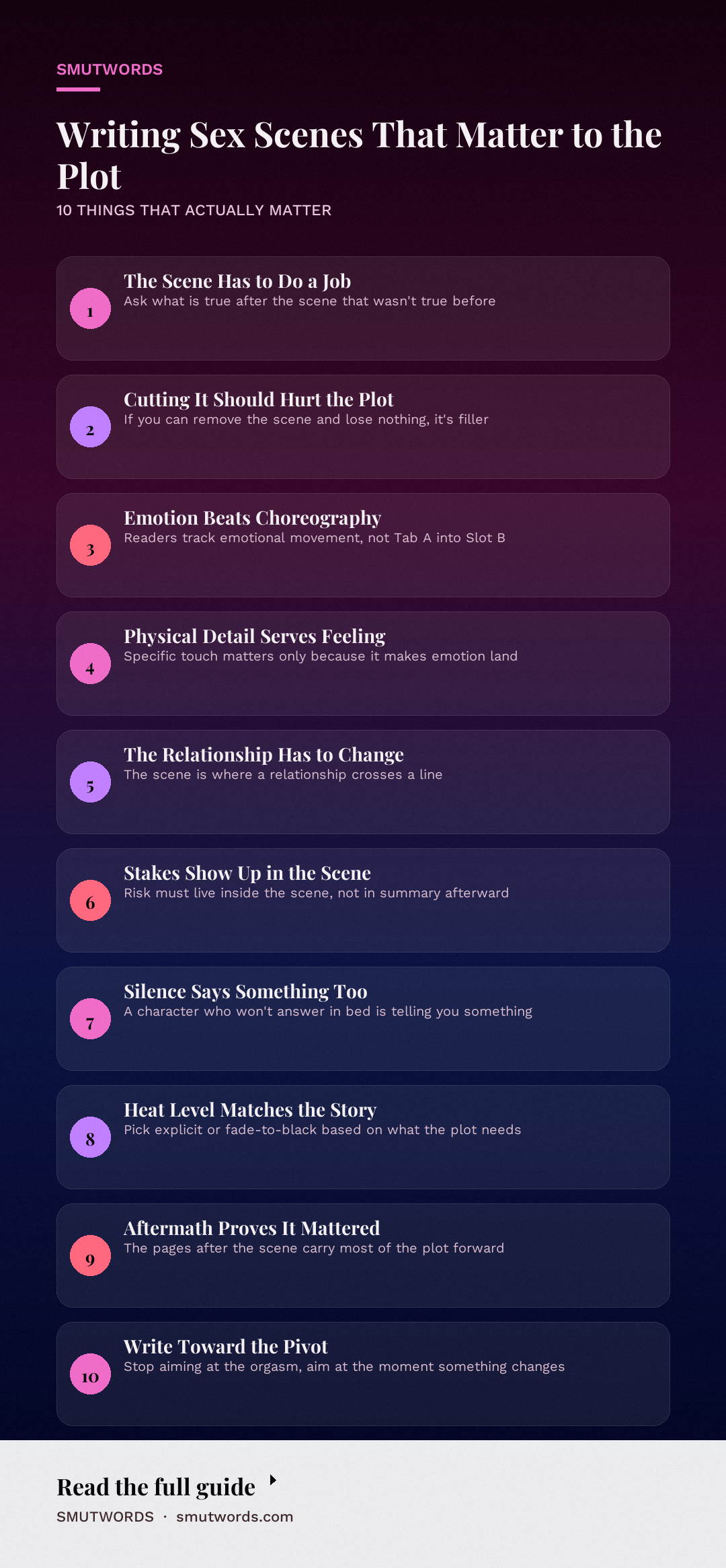
The Scene Has to Do a Job
Before you write a word of the scene, answer one question: what is true after this scene that wasn't true before? If the answer is "they had sex," that's not enough. "Had sex" is an event. You need a change.
Characters can end a scene with new information. They can end it with a new power dynamic between them. Someone can learn something about their own wants that they didn't have words for an hour ago. A relationship that was one thing can become another thing.
In Permission Slip: A Cuckold Erotic Short Story, the sex isn't the payoff of a fantasy so much as the mechanism by which a marriage gets rewritten. The scene is the plot. Remove it and the story collapses, because the story is the scene.
Compare that to a scene where two characters hook up because they're both in the same room and the author wanted to hit a word count. The latter can be well-written, hot even, and still feel disposable. Readers notice. They might not articulate why one scene sticks and another slides off, but the ones that stick are the ones where the stakes got moved.
A quick test for whether your scene has a job
- Can you summarize what changed in one sentence? If not, the scene might be redundant.
- Would cutting the scene force you to rewrite the next two chapters? If not, it's filler.
- Does at least one character want something in the scene that they don't fully get, or get in a way they didn't expect? Pure wish fulfillment is fine for some subgenres, but it rarely does plot work.
- Does the aftermath feel different from the setup? If the emotional weather is identical before and after, nothing happened.
Emotion Over Mechanics
The single biggest mistake in erotic writing is treating the scene as a physical description contest. Tab A into Slot B, then Slot B reacts, then Tab A does the thing again. The result reads like an instruction manual with adjectives. It's technically correct and completely inert.
What the reader actually tracks during a scene is emotional movement. The tension between what a character wants to do and what they're allowing themselves to do. The hesitation before a kiss. The decision to stop pretending they don't want it.
Descriptive specificity still matters. "He touched her" is nothing. You need to know where, how, with what pressure, and what it does to her breathing. The physical detail is what makes the emotion land, because emotion is abstract and bodies aren't.
But the physical detail is in service of the feeling, not the other way around. If you find yourself writing three paragraphs of choreography without a single line about what either person is thinking or afraid of, you've lost the thread.
There's a useful check: cover the dialogue and inner thought with your hand and read just the physical beats. If the scene still makes sense and you feel nothing, you've probably written a mechanic's manual. If it makes no sense at all without the emotion, you've probably buried the plot in feelings. The good scenes balance both.
The Scene Should Change the Relationship
In most genres, a sex scene is where a relationship crosses a line. Enemies become something else, or pretend to, or fail to. Two people who were going to keep it casual find out they can't. A power dynamic gets established that then has to be maintained for the rest of the book, or broken.
This is why certain tropes work so reliably. The only one bed setup doesn't matter because there's one bed. It matters because the shared bed forces a proximity that creates a decision. The sex (or the refusal to have it) is the decision.
Similarly, if you're working with a stalker romance dynamic, the first sexual encounter has to do something about the power imbalance, or deepen it, or complicate it. It can't just be a scene where two hot people finally get horizontal; the whole point of the subgenre is that the getting horizontal is loaded with the imbalance.
This is where a lot of formulaic erotic fiction goes wrong. It stacks tropes like ornaments. Fake marriage, forced proximity, one bed, enemies to lovers, all checked off in sequence. But if the sex scenes don't interact with any of those tropes, they're not doing the work the tropes promised.
The fake marriage trope is interesting because the sex in that setup has consequences the characters didn't sign up for. If a scene happens and the fake marriage stays fake, unchanged, you've squandered the trope.
Let the Stakes Be Visible in the Scene Itself
A sex scene that matters lets the stakes show up in the scene, not in the summary afterward. If the two characters are risking a marriage, that risk has to be present in how one of them looks at the door. If someone is being watched, the watching has to be part of the scene, not an excuse for it.
This is why exhibitionist and hotwife stories can be so effective when they're done well. Shared Without Shame: A Hotwife Exhibition & Sharing Fantasy works because the whole point of the sharing is the dynamic it creates between the couple, the consent that's in play, the specific ways each participant is negotiating what they're allowed to feel.
If the sex happened off-page and the story just reported on it later, none of that negotiation would land. The scene has to carry the tension because the tension is the material.
The same principle applies to more extreme subgenres. A leather catsuit fetish story where the outfit matters only as costume has no reason to exist.
The catsuit has to do something: restrict the person wearing it, change how others read them, make a specific physical reality that the scene has to contend with. Costume as set dress fails. Costume as pressure on the characters works.
Dialogue and Silence
Sex scenes are often the only place in the book where characters say things they wouldn't otherwise say. That's a tool. Writers overuse it (everyone confesses true love mid-orgasm and it reads as cheap), but the underlying instinct is correct: something in the character loosens. If nothing loosens, the scene probably didn't need to be a sex scene.
Silence can do the same work, and it's underused. Two characters who stop talking right at the moment they'd normally deflect are saying something. A character who won't answer a question in bed is saying something.
So is a character who answers a question they weren't asked. The dialogue doesn't have to be about the sex. Often, the most effective lines are about everything else happening around it.
Heat Level Is a Choice, Not a Temperature
Not every book needs to go dark or explicit. What matters is that the heat matches the story's emotional register. If heat levels explained: sweet, steamy, high heat, and dark are all equally on the table for you, pick the one that actually serves the plot.
A thriller that needs a single charged contact between two people might be better served by a scene that fades to black than by an explicit chapter, because the fade preserves the tension that the plot needs to carry forward.
Enjoyed this? Get a free book.
Join the list and we will send a complete free story straight to your inbox, plus new releases every week after that. No credit card, no catch.
Conversely, a story whose whole point is the breaking down of someone's defenses will often need to stay in the room for the full scene. Cutting away at the exact moment everything is on the table can feel like the author is flinching, and readers sense the flinch. You don't want your readers to sense the flinch. You want them to sense that you knew exactly what you were doing with the scene, even if the characters don't.
What the Aftermath Does
The scene doesn't end when the physical act ends. The pages right after a scene are where the plot does most of its work moving forward. Someone has to live with whatever just happened.
The discovery that the fantasy was hotter than the reality, or the reverse. The morning after with a specific kind of light in a specific kind of room. The awkwardness that didn't exist before.
The way one character starts building a small story about what it meant, and the other character is building a different one. If you end the scene and immediately go back to business as usual, you've told the reader the scene didn't matter. The aftermath is your chance to prove that it did.
This is why some of the most memorable entries in the genre stick to you for weeks. A scene in a story like celebrity romance where the sex is the moment the famous character stops performing is a scene that has to be followed up with an aftermath about dropping the persona, because the persona is the whole plot.
A scene in a soldier romance has to be followed by the specific disorientation of two people who are about to be split up by deployment, or who already know they're about to be. The scene isn't the scene. The scene is the pivot.
Practical Stuff: Scene Length, Pacing, and Cut Points
A couple of working notes that help more than any amount of abstract advice.
Scenes don't need to be long to matter. A short, sharp scene that ends at the point of maximum change can hit harder than a long one that exhausts the moment. Long scenes are for when the buildup is part of the payoff, when the characters and readers need to stay in the pressure before the release.
If your scene is running 3,000 words and nothing is changing except the physical configuration, you've probably stacked two scenes that should have been separated by a chapter break or a time skip.
Cut points matter. Ending a scene at the orgasm is almost always the wrong call unless the orgasm is the exact moment something changes (a confession, a decision, a betrayal, a revelation). Usually the real cut point is five or ten beats after the physical climax, when the emotional consequence drops.
Sometimes it's even further out, in a small scene the next morning. Trust your reader to feel the weight without you underlining it.
And give every character a want within the scene that's specific enough to be thwarted. Not "I want him." Try: "I want to make him admit he's been lying to himself," or "I want to prove I can do this without feeling anything, and I need him not to notice when I fail." Wants like that generate behavior. Wants like "I want him" don't, because they're not really a want, they're a state.
Why Writing a Scene That Matters Is Harder Than It Sounds
It's harder because the mechanics of the scene will happily absorb all your attention. You can spend an afternoon getting the blocking right and never once ask what any of it means to the person doing it. Erotic publishers and editors know this; it's why so many competent, technically correct erotic stories get rejected. They're hot in the mechanical sense and inert in every other way.
If you're working on your first attempts at this, the fastest improvement comes from rereading scenes you love and, instead of analyzing the physical beats, asking where the pivot is. Where does something change? When does the scene stop being set dressing and become plot?
Mark that sentence. Notice how close it usually sits to the beginning, even though the physical action often runs much longer than the pivot itself.
If you want a model for what this looks like at the trope level, a story like He Paid Him to Fuck Me is instructive, because the entire premise is a transactional setup where the transaction is a plot event, not background. You can watch the pivot happen in real time. Something is set up, something is exchanged, and the emotional meaning of the exchange shifts as the scene runs. That's the thing you're trying to build.
The scene is doing a job, and it's doing it in explicit detail because the job requires the detail, not because the author wanted to write a hot scene and needed a place to put it.
The same applies to wilder material. Redemption arc romance needs the sex scene to do something about the redemption, which means the scene has to be a place where the character's shame or self-punishment or false bravado is either broken or reinforced. If it's just two beautiful people being beautiful at each other, whatever redemption arc was promised has stalled out.
Lured by the Lizard Beast and Zorgon's Pet work in the monster/alien register for the same reason: the physical specifics matter because they're operating on a being whose body, culture, or rules are different, which makes every physical detail carry information. The body itself is plot.
Writing Toward the Change, Not the Climax
Here's a reframe that helps more than any checklist. Stop writing toward the orgasm. Write toward the pivot. The orgasm is a beat. The pivot is the reason the scene exists.
Outlining a scene around its pivot rather than its peak changes what you emphasize, what you slow down for, and where you put the best sentences.
You'll notice it immediately when you read your draft back. Scenes structured around the physical peak start strong and deflate. Scenes structured around the pivot build toward something and, more importantly, keep building after the physical action ends, because the aftermath is where the wreckage shows. That's the part readers come back for.
If you can only take one thing from this whole thing, take this: writing a sex scene that matters is mostly an editing problem. Draft the scene the way it wants to be drafted. Then go back and figure out where the change is, whether or not that change is earning its place, and what the scene would look like if the physical choreography got shorter and the emotional movement got more room.
Cutting two hundred words of body description and adding fifty words of interiority will do more for a scene than any amount of better choreography. Almost every time.
The mechanics are a skill. The plot work is a discipline. The people who write scenes that get reread, screenshotted, argued about in group chats, are almost always doing the second thing well and treating the first as support.
Final Thoughts
If you want a single scene to study before you go back to your own draft, spend an evening with Free Use Casino. Watch how the premise itself is a pressure cooker for the characters rather than an excuse for a string of scenes, and notice how much of the book's emotional weight gets carried by what the people do right after each encounter, not inside it. That's the move. Then go rewrite yours.







Loading comments…