The hero knows before she does. That's the whole engine. He's been gone on her since page twelve, maybe page four, and she's still treating him like a coworker who's mildly annoying about the thermostat.
If you're hunting for he falls first trope books, you already know the feeling you're chasing: the slow burn where one side of the couple is already on fire and the other is still deciding whether to strike a match. Done well, it produces some of the most excruciating, re-readable tension in the genre. Done badly, it deflates the whole book by chapter three.
Why does it work? Because the reader is now in on a secret the heroine isn't, and every scene between them carries a subtext she can't hear. He's cataloguing the things she says. He's rearranging his entire schedule around a two-minute conversation.
She's wondering why the guy from accounting keeps showing up at her coffee shop at exactly 8:15. That asymmetry is where the heat lives. It's a structural choice authors either commit to or waste.
What "He Falls First" Actually Means
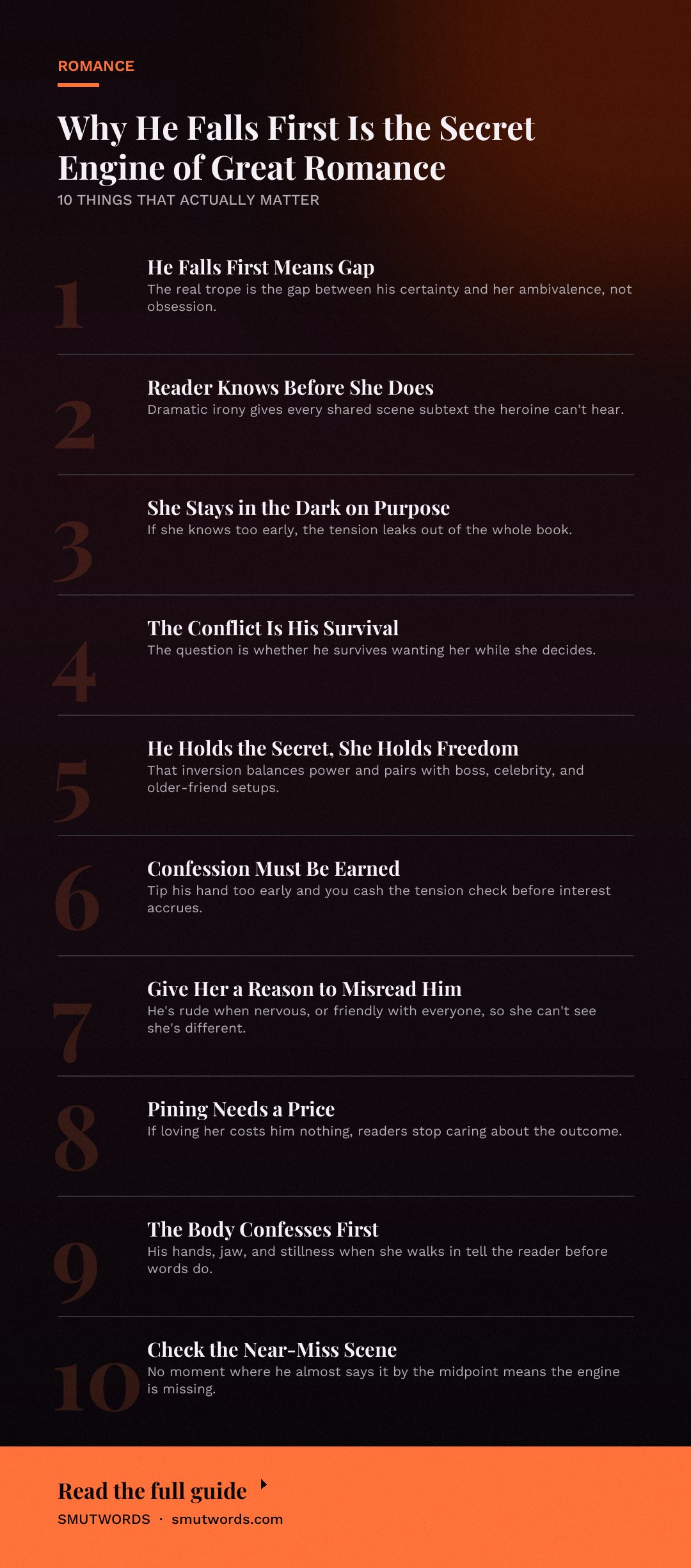
The trope gets flattened into "he's obsessed with her from page one," and that's the lazy version. The real version is more specific: he recognizes what she is to him before she does, and then he has to survive the gap between his certainty and her ambivalence without tipping his hand so hard that the plot collapses.
That gap is the book. Everything else is furniture.
A well-built hero in this trope has already decided and is now managing the fallout of that decision. He's rationing his reactions. He's choosing his words.
He's letting her think she has the upper hand when he handed it to her three chapters ago. And the reader, who's been let in, watches him do it and feels the friction of a man losing his composure on a delay.
Why the Heroine Stays in the Dark
She can't know. If she knows too early, the tension leaks out. The whole pleasure of he falls first trope books depends on a controlled information gap, and the moment it closes, you'd better have something else loaded and ready.
Some authors swap in external conflict. Some go straight to the bedroom. Either way, the reveal is a hinge, and a book that blows its hinge on page fifty has to find another one.
Why It Powers Tension Instead of Killing It
A reader who thinks "he's already in love, so where's the conflict?" is reading the trope wrong. The conflict was never "will he want her." It's "will he survive wanting her while she decides" and "will she forgive him for wanting her before she was ready to be wanted." Those are different questions, and the second one is meatier.
There's also a power dynamic running underneath that most authors handle at least half-consciously. He's the one with the secret. She's the one with the freedom. That inversion is why the trope pairs so cleanly with setups where he has status she doesn't: the boss, the celebrity, the older family friend, the guy who owns the bar she just got hired at.
When he's the one already gone, her relative powerlessness in the situation gets a little less lopsided, because she's holding the one thing he actually wants and hasn't been given.
Contrast that with the grumpy hero soft for her trope, where the reveal is the shift in his behavior rather than the existence of his feelings. Different machinery, same emotional payoff. Both work because the reader gets to watch a man lose a fight he was never going to win.
The Structural Rules Authors Get Wrong
Most drafts that fumble this trope fumble it in the same three places. Here's where to look if you're the one writing it.
He tips his hand too early
The confession has to be earned by the withholding. If he tells her on page forty that he's been in love with her since the wedding, you've cashed the tension check before the interest accrued. The reader wants to see him almost say it and not. Wants to see her catch the edge of something in his voice and dismiss it.
The near-misses are the book. An author stingy with them is writing a different, easier book.
She's too stupid to notice
The worst version of this trope requires the heroine to be willfully oblivious to a man who is following her around like a golden retriever with a credit card. Readers will forgive a lot, but not a woman who can't read a room when the room is one hundred percent yearning.
The fix is usually to give her a reason to misread him. He's rude when he's nervous. He's flirtatious with everyone so she can't tell she's different. He once called her "kid" in front of his brother and she's been holding that grudge for six years.
The pining has no cost
If loving her costs him nothing, the reader stops caring. A hero who can pine comfortably is a hero with no stake in the outcome.
Enjoyed this? Get a free book.
Join the list and we will send a complete free story straight to your inbox, plus new releases every week after that. No credit card, no catch.
Give him something to lose. A friendship, a job, the version of himself he's been carefully maintaining. The best pining is expensive.
What Great Pining Actually Looks Like on the Page
It's rarely the grand gesture. It's the small, weird specificity of a man paying attention to things nobody else is.
- He remembers the throwaway detail. She mentioned once, in November, that she hates the smell of lavender. His sheets are unscented by March. Nobody in the book comments on it. The reader does.
- He rehearses conversations. Three paragraphs of a man practicing a sentence in the shower before he says it. The sentence is four words long.
- He lies about small things to stay close. He's not really that into the Sunday market. He's into being within six feet of her for two hours.
- The tell is physical before it's verbal. His hands. His jaw. The way he stops moving when she walks in. The body confesses first.
- He isn't pining in a vacuum. He's got a life. Friends, work, opinions about parking. The pining is one thread, and it's more convincing for being one thread.
Notice that almost none of these involve dialogue about feelings. The trope depends on subtext, and subtext dies under explicit narration. If the author has to tell the reader he's in love, he isn't, or at least the reader won't believe it. The trick is to make the reader and the heroine occupy different rooms in the same scene.
Where This Trope Pairs Best
It's flexible, but some setups make it sing.
Forced proximity and fake dating. When the fake couple setup requires him to perform devotion in front of an audience, the performance and the reality start to blur. The fake dating and forced proximity books breakdown covers how to layer those two, and he falls first slots in neatly as the engine underneath.
One bed. The man is already ruined. There's one bed.
He is going to be a gentleman about it and he is going to suffer on a scale the reader can feel. The books with the only one bed trope roundup has some of the better examples.
Friends to lovers. The slow burn version of this trope is a man who's been quietly gone on his best friend for years and has to watch her date around. The best friends to lovers books slow burn picks handle that ache with real care.
Celebrity setups. A celebrity romance where the famous one is the one already in love has an extra charge: he's the one with the world at his feet, and he's still rearranging his life around her, and she has no idea. The reversal of "which of us has more power" is doing half the work.
Common Questions About He Falls First Trope Books
Do authors have to make the hero a simp?
No. The strong versions keep his competence intact. He's still the guy who can fix the boat, win the case, negotiate the deal.
He's just also the guy who opened her contact on his phone so many times the green message bubble auto-filled and he has to delete it. Competence plus a single, catastrophic weakness is the sweet spot.
Is the trope only one POV?
Dual POV is the most common structural choice because it lets the reader sit inside his head and watch him lie to the world. Single POV is harder, and when it works it's tighter because the reader is stuck in her perspective and has to read him correctly through subtext. Both work. The dual-POV version is easier to write and easier to fumble.
What's the biggest warning sign it's being done wrong?
The reader hits page one-fifty and hasn't yet felt the pain of watching him almost say it. If there's no near-miss scene by the midpoint, the book is missing its engine.
Recommended Reads That Nail the Pining
If you're looking for the trope done right, start here. Each of these takes the basic premise and finds a fresh way to keep the reader on the hook while the hero loses every battle he's privately fighting.
- Grumpy and already gone. The grump-is-the-piner version is the better version, and the grumpy hero soft for her trope list has a good stretch of them. Read the article and then read the books it points at.
- Small-town he falls first. The lumberjack romance shelf has an unusual amount of this trope for reasons that should be obvious from the cover art. The hero's been watching her from the treeline for two winters and she's still asking him to fix the fence.
- Redemption version. A redemption arc romance where he's the one who has to earn forgiveness and is already in love with her before he has any right to be. The trope gets teeth when the pining is also penance.
- Alien and monster romance. See the alien romance breakdown for how the trope plays when the hero is enormous and doesn't fully understand the feeling and has to be told by three different characters what he's experiencing. It's some of the best pining in the genre.
- Leather-fetish version. For readers who like the pining wrapped in something specific, the leather fetish guide is worth a skim before you hit the related shelves. The dynamic-heavy books work here because a hero following rules can still be a hero who's completely lost it behind the mask.
If you're reading more than writing, the checklist is simple. Read the first three chapters. If he's already told her something honest by chapter four and she's dismissed it, keep going.
If he's been confirmed in love by chapter ten and she's still confused about whether he likes her at all, the book is fumbling the trope. Skip it and pick up the next one.
Final Thoughts
He fell first. He never got back up. That's the book.
The trope earns its place because it hands the reader dramatic irony pressed right up against the body, and very few other setups can do that. If you want a starting point that does it perfectly, pick up the marriage in trouble shelf and read the one where the husband has been in love with his wife for the entire duration of a marriage she thought was falling apart.




Loading comments…