
Group sex is a scene or story where three or more characters have sex together, everyone in the room awake, willing, and getting something out of it. The category covers threesomes, foursomes, orgies, gangbangs, partner swaps, and any arrangement where the count climbs past two and the geometry stops being a straight line.
In erotica it's one of the oldest crowd-pleasers on the shelf, and also one of the hardest scenes to write well, because every extra body doubles the logistics and the emotional voltage. This guide is the full map: what counts, where the trope came from, how editors judge it, and what separates a group sex scene readers reread from one they skim.
What Group Sex Actually Means
The definition sounds simple until you start poking at the edges. Three or more people, sexual activity, mutual consent. The complications live in the phrase "sexual activity," which in fiction stretches to cover everything from a fully choreographed orgy to two people having sex while a third watches with permission and a hand between their own legs.
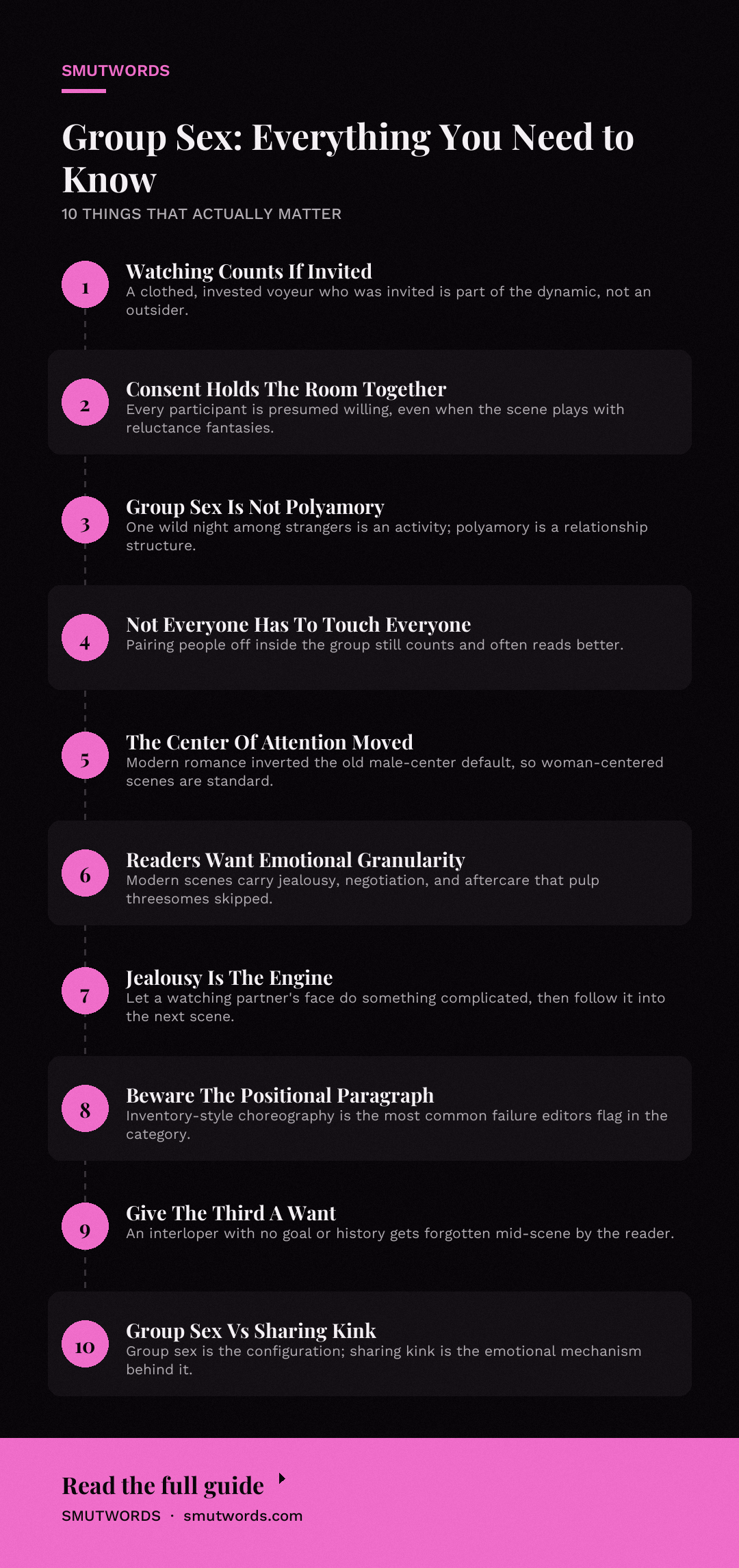
That watching question is where most arguments start. A scene with a voyeur who stays clothed and invested still counts as group sex in most editors' books, because the third person is participating in the dynamic even without touching anyone else. A scene where a stranger happens to witness something through a window does not count. The difference is invitation.
Consent is the other hinge. In fiction, group sex presumes every participant wants to be there, even when the scene plays with reluctance, coercion fantasies, or power imbalance. A scene where people are genuinely forced is a different category entirely, with its own conventions and warnings.
Where the name comes from
"Group sex" is a plain descriptive term, the kind that showed up in mid-twentieth-century sex research and clinical writing before it migrated into pornography and then into romance. The variants carry older, dirtier pedigrees. "Orgy" comes from the Greek orgia, secret nighttime rites for Dionysus, which tells you everything about how long respectable people have been nervous about gatherings of this kind.
"Threesome" and "foursome" are golf words repurposed, which is either funny or perfect depending on your mood. "Gangbang" surfaced in American slang in the mid-twentieth century and hardened into a specific porn convention by the 1970s. "Cuckold" is older than all of them, a birding term (the cuckoo lays eggs in other birds' nests) that became an insult and then, eventually, a kink with its own proud flag.
What doesn't count
- Serial monogamy. Three people having sex in three separate bedrooms on three separate nights is not group sex. Simultaneity matters.
- Fantasy only. A character imagining an orgy during a solo scene is group sex adjacent, but the tag belongs to scenes actually on the page.
- Accidental overlap. Two couples who happen to book adjoining rooms with a shared balcony have not had group sex. They've had a coincidence.
- Flashback crowding. A character remembering a past threesome in a paragraph of summary is backstory. The category applies when the scene itself unfolds.
Common misconceptions
The biggest one: that group sex and polyamory are the same thing. They overlap, but a single wild night among strangers is a one night stand with extra bodies, while polyamory is a relationship structure. Books confuse these constantly, usually by accident.
Second misconception: that group scenes are automatically degrading or anonymous. Plenty of group sex in romance is tender, giggly, and domestic, especially in the group marriage corner of the genre. Third: that everyone in the scene has to touch everyone else. Choreography that pairs people off within the group is still group sex, and often reads better than a free-for-all.
Where Group Sex Comes From
Group sex is older than the printing press, but its history as a romance and erotica category is a publishing story. The eighteenth-century libertine novel made the orgy a set piece; Fanny Hill and its cousins treated a crowded room as the natural climax of a rake's education. Those scenes were comic and satirical as often as they were hot, with the group functioning as evidence of aristocratic excess.
Victorian underground publishing turned the orgy into a genre fixture with flagellation clubs and country-house revels, usually framed as confession or cautionary tale. The twentieth century stripped the frame off. Mid-century pulp paperbacks put threesomes on the cover whenever a publisher wanted a sales bump, and the 1970s brought the orgy into mainstream cinema and the emerging porn industry simultaneously.
The term "gangbang" hardened into a specific format through that decade's adult film market, with its own staging conventions: one person at the center, a rotating cast of partners, an emphasis on stamina and generosity. The cuckold dynamic split off and developed separately, quiet and psychological where the gangbang was loud and physical.
How the trope shifted
The real change in the last thirty years is who gets to be the center of attention. Older erotica put a man in the middle and a rotating female cast around him, the so-called reverse gangbang as the exotic exception. Contemporary romance and fanfic inverted that default so thoroughly that a woman-centered group scene is now the standard in most of the genre.
The other shift is emotional granularity. Pulp threesomes were mostly physical. Modern group scenes come with jealousy, negotiation, aftercare, and three-way conversation. Readers want to know how the characters feel about the arrangement, not just what the arrangement looks like from above.
Consent language migrated from clinical writing into the genre itself, and scenes now routinely show negotiation before the clothes come off. That's a craft improvement most editors would defend to the death, even in dark romance where the negotiation happens in a single loaded look.
How It Shows Up in Erotica
Every group sex scene solves the same three problems: who is where, who is feeling what, and who is watching whom. Get those right and the scene writes itself. Get them wrong and you have a tangle of limbs and pronouns that reads like a delivery schedule.
The core variants
- Threesome. The workhorse. Two people who already have a bond plus one interloper is the most common arrangement, because the conflict is built in before anyone removes a stitch.
- Foursome. Usually two couples, which turns the scene into a partner swap with tension over who's looking at whom.
- Orgy. An open group, often a party or ritual. Hardest to stage, because the writer has to keep the reader oriented without narrating every hand.
- Gangbang. One person at the center, many partners in sequence. The craft problem is avoiding a repetitive rhythm.
- Partner swap and cuckold. Two dyads exchange partners while the emotional fireworks happen inside the original pairs. The cuckold date night setup is a close cousin with a public stranger as the third.
- Reverse gangbang. One man, many women. Now a minority format in romance but still common in erotic shorts.
- Bukkake. A finish-focused format, rarely a whole scene. Effective as an ending beat, tedious as a full chapter.
What makes a strong version work
The strongest group sex in the genre is built on desire that already exists and gets redirected. Two characters who want each other but won't say it, plus a third who says it for them, plus a room. That's a whole novel's worth of tension resolving in an hour, and readers feel the release in their chest.
Point of view is a craft decision that changes everything. First person from the center of the group gives intensity but blinds the reader to the crowd's reactions. Third person omniscient lets you dip into the jealousy of the partner standing by the door, which is often the best part. Many authors alternate, giving the center a paragraph, then the watcher.
The jealousy engine deserves its own paragraph. Group scenes that ignore possessiveness feel frictionless and dull. The good ones let a partner's face do something complicated when they watch, then follow that face into the next scene. That's where a group encounter becomes character development instead of a stunt.
What makes a flat version fail
Flat group scenes read like inventory: hand goes here, mouth goes there, one, two, three, everyone finishes. The bodies are in the room but the people aren't. Editors flag this as the "positional paragraph," and it's the single most common failure in the category.
Enjoyed this? Get a free book.
Join the list and we will send a complete free story straight to your inbox, plus new releases every week after that. No credit card, no catch.
The other failure is the forgettable third. In a threesome, if the interloper has no goal, no history, and no reaction beyond enthusiasm, the reader will forget them mid-scene. Give them a want. Even a simple one, like wanting to be chosen or wanting to break a couple up, wires the whole scene for electricity.
Consent on the page is a craft strength, not a box check. When characters check in, negotiate, or set a signal word, the tension doubles because the reader knows someone is responsible for the room. Plenty of kinks in the genre get sharper with clear rules attached, the same way shibari gets better when the rope has an exact logic.
Dynamics that pair well
Group sex is a platform for other kinks more than a kink of its own. It carries use kink beautifully, since a person at the center of many partners is literally being used with consent and often with enthusiasm. It can carry degradation kink when the language gets rough, though good authors keep consent explicit when the words get ugly.
Primal play gives group scenes a chase structure, with a group chasing or being chased through a space. Friends with benefits arrangements often expand into a group scene for one night before the feelings arrive. None of this is required. It's ammunition for writers who want the encounter to do more than one job.
Real-world notes, where natural
Fiction doesn't need logistics. Real group scenes do: clear communication among everyone before anyone gets naked, an agreed safeword system that works even when someone's brain has gone quiet, and aftercare for all participants, not just the center. Water and snacks are not a joke, and someone needs to be sober enough to drive or call the cab.
The genre is honest about this in the best books and vague in the worst. If you're writing a realistic contemporary scene, show the check-in. If you're writing fantasy or historical, you can leave the negotiation implied, but don't leave the consideration out. Readers notice the difference, and the impact play aftercare conventions translate almost directly.
Group Sex vs Sharing Kink
This is the confusion most readers bring to the glossary. Group sex describes the configuration: three or more people in the room. Sharing kink describes the emotional mechanism: someone gets off on their partner being intimate with someone else, with the partner's full cooperation.
You can have one without the other. A threesome among friends with no couples involved is group sex without sharing. A couple where one partner has a solo night with a stranger at the other's request is sharing without a group on the page. The overlap is the "partner swap" corner, where both things happen at once.
The distinction matters for tagging and for search. A reader looking for the sharp jealousy edge should look at sharing kink. A reader looking for the crowded-room logistics should look at group sex.
And a reader looking for a whole crowd that stays together afterward should look at group marriage instead. If your couple disagrees about whether they even want this, start with negotiating a mixed-desire relationship before you go anywhere near a crowded room.
Frequently Asked Questions
Is group sex a kink or a category?
Both, depending on how you look at it. Structurally it's a category that describes a configuration, the way "outdoor scene" describes a setting. Functionally it acts like a kink because the appeal is specific and repeatable: the thrill of many, the risk of jealousy, the fantasy of being the center. Most writers treat it as a platform that other kinks get layered onto.
Does a threesome count as group sex?
Yes. Three people is the minimum for the category, and a threesome is the most common form on the page. Publishers and tags usually list them separately because readers search by exact arrangement, but in glossary and genre terms, a threesome is a group sex scene with a small cast.
Do group scenes have to be rougher than two-person scenes?
No. Plenty of group scenes are playful, tender, or even domestic, especially in polyamory and group marriage romance. Roughness comes from the tone and the kinks layered on top.
A foursome can be entirely sweet. A gangbang is usually not, but that's the format, not a requirement of the category.
What's the difference between a gangbang and an orgy?
A gangbang has a center: one person receiving attention from a rotating cast, usually in sequence. An orgy is a free-for-all with no single focal point, where many things happen at once. The staging, the pacing, and the emotional flavor all differ. Most authors choose based on whether the scene needs a star or a swarm.
Why does jealousy turn up so often in these books?
Because it's the same fuel that makes any romance work: someone wants to be chosen, and a crowded room makes the choosing visible. A partner who watches is a partner whose feelings become legible. Readers don't want the jealousy resolved before the scene starts. They want to watch it hit in real time.
Can group sex and polyamory be the same story?
They can, and often are, but they're different things. Polyamory is a relationship structure with multiple ongoing connections. Group sex is an activity that may or may not repeat. Many novels open with a group scene and then become a polyamory slow burn, which is one of the most reliable arcs in contemporary romance.
Final Thoughts
The category's best trick is that it turns a private act into a social one, and social acts have stakes that private ones can't match. If you want the version that gets the stakes exactly right, start with a book where the third person has a name you remember three chapters later. The SmutWords catalog list below does the sorting for you, ranked, with the crowded rooms and the complicated faces intact.





Loading comments…