
A hair fetish is a fixation on hair as the main source of sexual charge: the look of it, the weight and texture, the smell, and the acts of touching, pulling, braiding, brushing, or styling it. In erotica and romance, hair fetish writing turns a body part everyone already notices into the load-bearing element of a scene.
A ponytail caught in a fist. A braid unraveled strand by strand. A partner kneeling to have their scalp worked over slow. The fixation is specific and personal, and that specificity is exactly what makes it land on the page.
It also makes it a gift for writers. Hair sits at the intersection of public presentation and private access. Everyone sees it; almost nobody is allowed to touch it the way a lover does. That gap is where the heat lives.
What Hair Fetish Actually Means
A hair fetish is a sexual or romantic fixation on hair itself, or on specific acts involving hair, to a degree that hair becomes central to arousal rather than background detail. The pull can be visual, tactile, olfactory, or all three at once. It can fixate on a particular feature (length, color, curl pattern, thickness) or a particular action (pulling, brushing, washing, braiding).
The term covers a wide range, and that range is part of why it's so useful in fiction. What counts as a hair fetish includes:
- Hair pulling. Gripping the hair at the root and using it to control the angle of a partner's head or throat, or simply to steer them. This is the most common variant in dark romance and BDSM-adjacent fiction.
- Hair worship. Devotional attention to hair: kissing it, nuzzling it, running fingers through it for pages at a time, treating it as something sacred.
- Ponytail play. The ponytail as a handle, a harness, a target, or a symbol of the wearer's discipline or athleticism.
- Hair brushing and scalp massage. Slower, tenderer territory. Often used as foreplay or as aftercare.
- Color fixation. Arousal tied to specific hair colors or textures, sometimes with strong class, age, or type-coding attached.
- Hair as identity. Cutting, growing, or hiding hair as an act of power over a character.
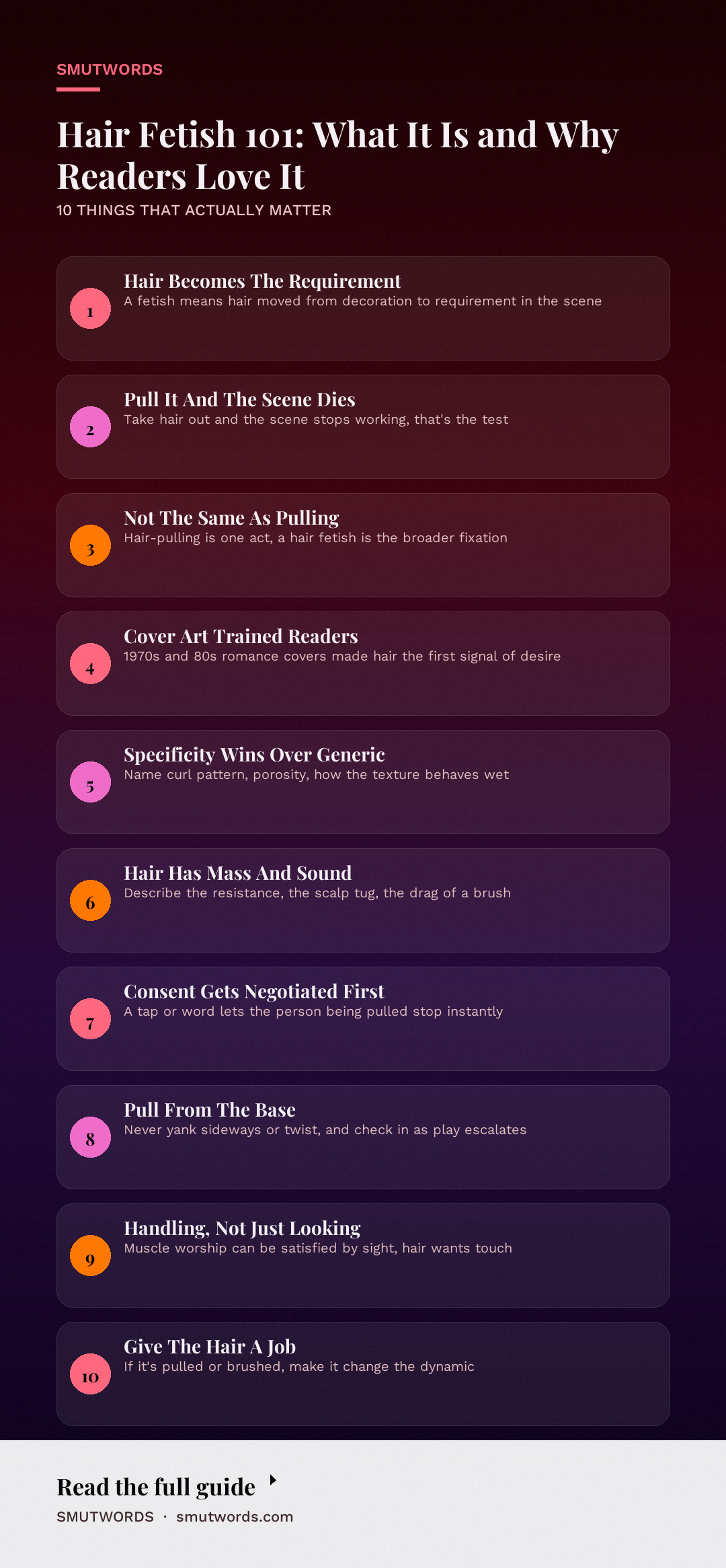
What doesn't count matters just as much. Liking your partner's hair is not a fetish. Noticing a great haircut across a room is not a fetish. A fetish, in the sense this glossary uses it, means hair has moved from decoration to requirement.
Pull it out of the scene and the scene stops working. That's the test, and it's a useful one for writers to hold onto.
The most common misconception is that a hair fetish and a hair-pulling kink are the same thing. They overlap heavily but they aren't identical. Hair-pulling is one action; a hair fetish is the broader fixation that action belongs to. Someone can love having their hair pulled without any particular interest in hair otherwise, and someone can be fixated on the smell and weight of long hair without any interest in roughness at all.
Another misconception: that this is a niche so small it barely registers. Hair shows up in more erotica than almost any other body detail, usually without anyone calling it what it is. Writers are already writing hair fetish scenes. Plenty of them just haven't labeled the tool they're using.
Where Hair Fetish Comes From
Hair has carried erotic and symbolic weight in human culture for as long as there's been writing to record it, but the history that matters here is the genre history: how hair became a reliable device in erotica and romance publishing specifically.
In twentieth-century erotic literature, hair was largely a marker of femininity and beauty. Long hair signaled desirability and availability; short hair signaled independence, or occasionally danger. This was descriptive, not fetishistic. Hair was part of the set dressing that told the reader who a character was.
The shift toward hair as an active erotic device came with the rise of mass-market romance in the 1970s and 1980s, when the genre's cover art made hair a headline feature. Those painted covers, all windswept manes and loose cascades, trained an entire readership to read hair as the first signal of a heroine's desirability and, often, her untamed spirit. The hair on those covers was doing narrative work whether the text acknowledged it or not.
By the 1990s and 2000s, hair-pulling had migrated from the edges of erotic writing into mainstream romance as a shorthand for dominance and roughness. This is when the ponytail grab became a recognizable beat: the moment a controlled, buttoned-up character loses composure and something in the scene escalates. The action was so legible that it survived being used lazily for decades.
The bigger change came with the self-publishing boom and the mainstreaming of explicit BDSM romance. Once kink was on the table as plot rather than subtext, writers could treat hair as a full system rather than a single gesture. Hair became something to negotiate, to use as a leash, to maintain as ritual, to strip away as punishment. The vocabulary expanded from one move (the pull) to a whole repertoire: braiding, washing, brushing, scalp work, cutting.
The most recent shift is specificity. Earlier hair fetish scenes leaned on a generic idea of "long hair." Contemporary writers are far more likely to name curl pattern, porosity, the way a certain texture behaves when wet, the specific sound of a brush through tangles. That specificity is what separates a hair fetish scene a reader remembers from one they skim.
How It Shows Up in Erotica
The strongest hair fetish scenes share one trait: they treat hair as a living material with its own behavior, not a static feature on a character sheet. Hair moves, tangles, dries, smells like whatever it was last washed with, and takes time to work through. Writers who respect those properties get scenes that feel physical. Writers who don't get a hand near a head.
Here's what separates a strong version from a flat one:
- Weight and tension. Hair has mass. Pulling it moves a whole head, and the neck follows. A scene that describes the resistance of it, the scalp tugging, the counterweight of the skull, reads as real.
- Sound. The drag of a brush through knots. The hiss of hair being gathered. The soft snap of a hair tie. Small sounds do enormous work in a quiet scene.
- Smell. Shampoo, sweat, smoke, rain, the specific scent of a scalp. Arousal tied to smell pushes this fetish close to the territory covered in our guide to the petrichor kink, where scent is the primary trigger rather than a supporting detail.
- Consent and negotiation. In a kink context, the pull gets discussed before it happens, at least in shorthand. A signal or a safe word keeps the scene from tipping into accidental strain or injury, and a partner checking in mid-scene keeps the heat intact rather than killing it.
- Consequence. Hair pulled hard leaves the scalp sore for hours. Hair brushed vigorously leaves it warm. The strongest scenes let the sensation outlast the moment.
Hair worship is the gentlest register and the one most writers undersell. It's easy to write a scene where someone pets a head and calls it devotion. It's much better to write the slow, almost excessive attention: separating strands, working from root to tip, the worshipper treating the hair as an object worth an entire evening.
Devotional fixation has a natural kinship with muscle worship, where the same impulse (reverence for a specific physical feature) drives the whole scene, though the texture of the reverence is different.
Ponytail play lives in the register of control. The ponytail is a handle by design, which is why it shows up constantly in predator/prey dynamics, the kind of chase-and-capture structure covered in our breakdown of predator/prey play explained. The pursuer catches the tail, and the catch itself is the point.
High ponytails read as athletic and untouchable; low ones as composed and vulnerable. Writers get real mileage out of the difference.
Hair brushing and scalp massage almost always function as aftercare, or as foreplay dressed as aftercare. This is one of the richest uses of the fetish because it lets a scene slow down without losing charge. The softness is the point, not a break from it. For more on why scenes shouldn't end at the climax, our piece on aftercare in fiction covers the structural argument, and hair work is one of the most reliable tools for executing it.
Enjoyed this? Get a free book.
Join the list and we will send a complete free story straight to your inbox, plus new releases every week after that. No credit card, no catch.
Mirror scenarios push hair fetish into visual territory, since a character watching their own hair be handled sees something they can't feel directly. That combination of sensation and reflection is the same mechanism at work in mirror play, where the doubling of the image intensifies the physical experience.
Hair can also carry materials into a scene. Wet hair clings and drips and changes the shape of a face, which puts it in conversation with the sensory logic of a wet and messy fetish. Hair caught in latex, leather, or a collar ties the fixation to the object world of BDSM. If your character's hair is tangled in a leather harness or slicked against a latex hood, the hair stops being decoration and becomes part of the apparatus.
One thing to get right if you're writing hair pulling as kink: the practical safety details. Pull from the base, not the tips. Don't yank sideways or twist.
A signal (a tap, a word, a squeeze) lets the person being pulled stop the scene instantly without breaking the spell. The scene that ignores this reads as sloppy to anyone who actually knows the territory. The scene that includes it, even in a single line, reads as credible.
Hair Fetish vs Muscle Worship and Glove Fetish
Hair fetish is often lumped in with other body-part fetishes without much thought about how they differ, and the differences are useful for writers choosing which tool to reach for.
Muscle worship centers on a shape: visible mass and definition, usually at rest or under strain. It's a fetish of displayed form, viewed from outside.
Hair fetish is closer to a fetish of handling. Muscle worship can be satisfied by looking. Hair fetish almost always wants touch, because the sensory payoff (weight, texture, tension, smell) requires contact.
Glove fetish is the closest structural cousin. Both fixate on something that sits on the body's surface, both involve covering and uncovering, and both can be indulged through the tactile properties of material.
The difference is that gloves are removed.
Hair is grown, cut, maintained, and belongs to the person wearing it in a way no garment does. Hair feels like part of the body; gloves feel like an intervention.
A scene about a character removing a glove is about what's underneath. A scene about a character letting someone else touch their hair is about access to the person themselves.
Frequently Asked Questions
Is a hair fetish the same as a hair-pulling kink?
No, though they overlap. Hair-pulling is one specific act. A hair fetish is the broader fixation on hair as the source of arousal, which can play out through touching, smelling, styling, or worship rather than pulling. Plenty of people with a hair fetish never pull at all.
Why does hair show up so often in romance novels?
It's the fastest way to signal access and intimacy. Everyone sees a character's hair; almost nobody is allowed to touch it. A scene where someone is permitted to handle it carries immediate weight without any extra exposition.
Is hair pulling safe in real BDSM play?
It can be, with precautions. Pull from the base of the hair rather than the tips, avoid twisting or sideways yanks, and agree on a safe word or physical signal before any pulling happens. Check in during the scene, especially if the play escalates.
What is hair worship?
Hair worship is the devotional register of a hair fetish: extended, focused attention on a partner's hair, often slow and reverent. It's usually about the intensity of the attention rather than any roughness, and it frequently functions as foreplay or extended aftercare in erotica.
Can a hair fetish focus on just one hair color or texture?
Yes. Color or texture fixation is a recognized variant, and it often comes bundled with type-coding: a specific color or curl pattern standing in for a whole set of character traits. Writers should be aware that this is where the fetish can drift into stereotype, and specificity usually saves it.
How do you write a hair fetish scene without it feeling like padding?
Give the hair a job in the scene.
If it's being pulled, make the pull change the dynamic. If it's being brushed, make the brushing mean something. Hair described as decoration slows a scene down. Hair used as a tool keeps it moving.
Final Thoughts
A hair fetish works on the page when a writer remembers that hair is one of the few parts of a body that a person presents to the world and controls access to. The second someone else is allowed to touch it, style it, ruin it, or grip it, the scene has already changed. Write that change and the fixation writes itself.
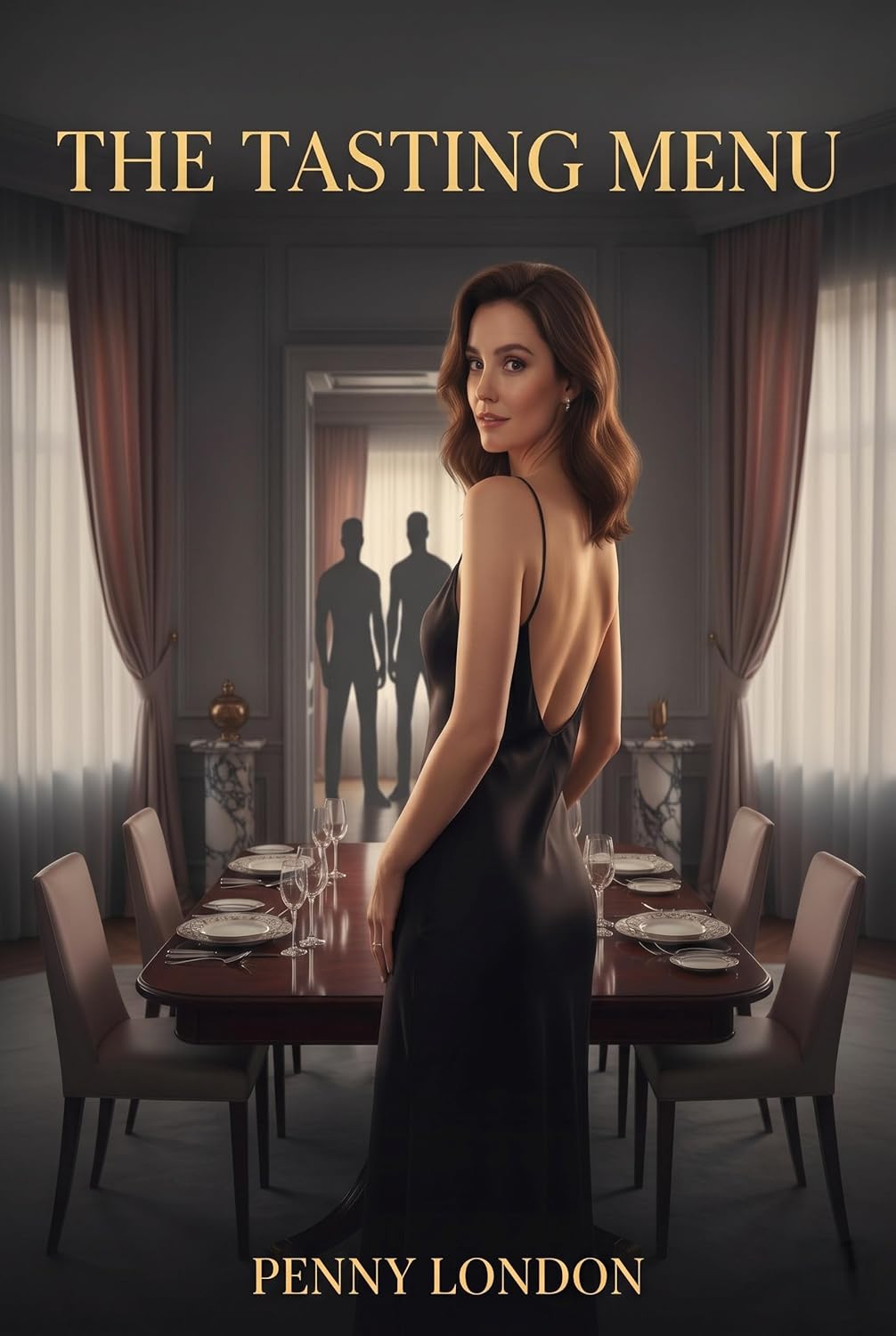
If you want to see the full range of what the fetish can do, start with a book that treats hair as a real system rather than a single gesture. The catalog list below is the fastest route to one.






Loading comments…