
A holiday romance is a love story built around a specific celebration, most often Christmas, where tinsel, snow, family dinners, and a ticking calendar push two people together and guarantee they'll be together by the time the last candle is blown out. The season does real narrative work here. It compresses time, forces proximity, and hands the couple a deadline.
That's why holiday romance has become one of the most reliable comfort reads in the genre. You know the ending. You came for the ending. What keeps you turning pages is watching two people earn it between the office party and the tree lighting.
The category spans sweet small-town stories and filthy ones with the same seasonal wrapping. A holiday romance can be a slow-burn reunion between a widow and her late husband's best friend, a snowed-in one-night stand that turns into forever, or an enemies-to-lovers setup between a grinch and the woman hired to run the town's tree festival. The holiday is the engine, not the decoration.
What Holiday Romance Actually Means
The name is literal. Holiday romance refers to a romance novel, novella, or short story whose plot is anchored to a holiday season and whose emotional arc is inseparable from that season. Christmas dominates by volume, but Hanukkah, New Year's Eve, Valentine's Day, Thanksgiving, Diwali, and Lunar New Year all have their own catalogs. Publishers schedule them hard, readers buy them in bursts, and the subgenre has its own release calendar that peaks from October through December.
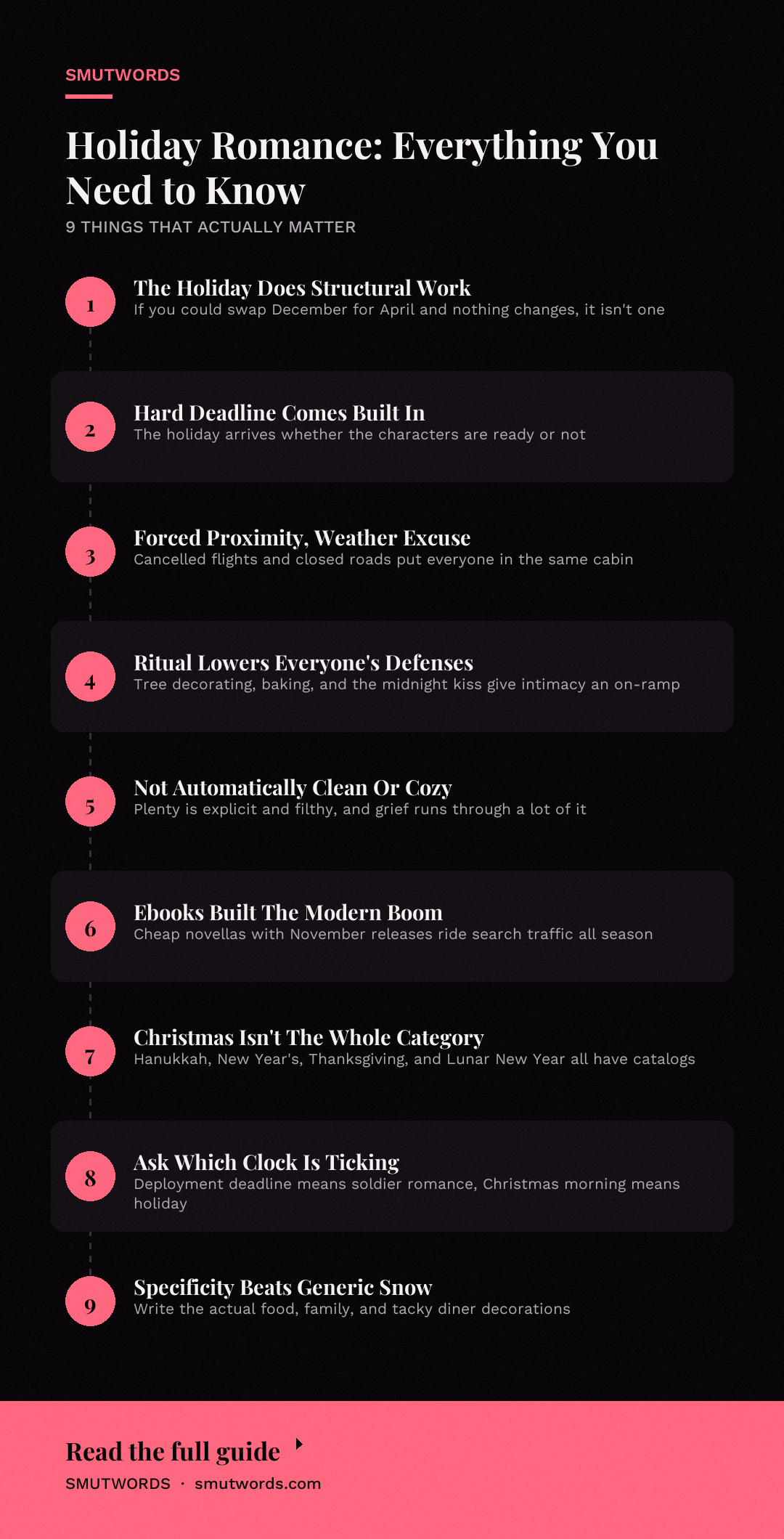
What counts as a holiday romance requires the holiday to matter structurally. If you could swap December for a random Tuesday in April and nothing in the plot changes, you're reading a romance that happens to mention Christmas. The real thing uses the season as a pressure system.
Think about what the calendar actually does in these books. It creates a hard deadline, since the holiday arrives whether the characters are ready or not. It creates forced proximity, because flights get cancelled and roads close and everyone ends up at the same cabin. It creates a built-in cast of family members, exes, and small-town gossips who show up for the season and stir the pot.
Then there's ritual: the tree, the menorah, the office Secret Santa, the midnight kiss.
Several misconceptions float around this trope. It is not automatically clean or closed-door. Plenty of holiday romance is explicit, kinky, and filthy, with the festive setting acting as contrast rather than censorship.
It is also not always cozy. Holiday romance overlaps heavily with grief, second chances, and family estrangement, and some of the best entries in the category are quietly devastating before they get sweet.
One more correction: the happy ending is close to mandatory but not universal. A small slice of holiday romance ends bittersweet, with the couple parting after the season and the holiday standing in for what they couldn't keep. Those books exist and they hurt, and readers who seek them out know exactly what they're doing.
Where Holiday Romance Comes From
Seasonal love stories are old. Charles Dickens gave the English-speaking world the template for Christmas as a moral and emotional reset in 1843, and Victorian periodicals ran sentimental Christmas fiction for decades afterward. Those stories weren't romances in the modern genre sense, but they established the machinery: a specific night, a gathering, a person who arrives or returns, and a transformation that only the season could trigger.
The modern holiday romance as a publishing category is much younger. Mass-market romance publishers started leaning into Christmas titles in a serious way through the 1980s and 1990s, when category lines discovered that a December release with a snowy cover sold. Those early entries were short, formulaic, and chaste, and they set reader expectations that the industry still trades on.
The real explosion came with ebooks and self-publishing. A holiday novella is cheap to produce, quick to read, and easy to market, and independent authors figured out that a Christmas release in early November could ride search traffic straight through the season. The result is a modern catalog so large that readers now treat holiday romance as a genre season of its own, the way television treats Christmas movies.
Diversity in the category lagged and is still catching up, but Hanukkah romance, Kwanzaa-adjacent stories, and holiday romances centered on non-white families and queer couples have grown substantially since the 2010s. The dynamics have shifted too. Earlier holiday romance leaned hard on the magic-of-Christmas resolution, where the season itself fixed everything. Contemporary versions put more weight on the characters doing the work, with the holiday as catalyst rather than solution.
How It Shows Up in Erotica
The holiday setting is one of the most efficient scene machines in the genre, and editors who read a lot of these books look for authors who use it deliberately. A strong holiday romance understands that the season hands you tools most stories have to build from scratch. Here are the moves that show up again and again, and what separates the ones that land from the ones that don't.
- Forced proximity with a weather alibi. The blizzard that closes the pass, the cancelled flight, the one hotel room with one bed and a fireplace. It's a classic for a reason, and it works when the characters have a reason to be tense about the closeness beyond generic awkwardness.
- The countdown structure. Chapters marked by days until Christmas, an advent calendar used as a device, a series of holiday events the couple has to survive together. The ticking clock does the pacing work for you.
- Ritual as foreplay. Decorating a tree, baking, ice skating, sharing a bed for warmth, a midnight kiss on New Year's Eve that neither of them planned. Ritual lowers defenses and gives physical intimacy a plausible on-ramp.
- Family as obstacle and engine. The nosy mother, the ex who shows up at the party, the grandmother who's been waiting for this match for years. Family pressure creates scenes and forces honesty.
- Grief in the middle of celebration. A widowed lead, an empty chair at the table, a first holiday after a loss. This is where the more emotional holiday romance lives, and it's often where the explicit scenes hit hardest because the characters are raw.
- Public and semi-public sex. Coat closets, church bathrooms, the back of a truck during a tree-lighting, a snowy field. The season supplies venues a normal contemporary romance wouldn't.
Variations matter as much as devices. The holiday single dad variant puts a competent, exhausted father at the center, usually paired with a woman who isn't looking for a family and gets one anyway. The holiday widow finds love variant revolves around grief and permission to want again. Holiday wedding stories stack two ticking clocks, the season and the ceremony.
Hanukkah romance often leans harder on cultural specificity and family, since the eight-night structure gives you eight built-in scenes. New Year's Eve romance runs shorter and sharper, with midnight as the deadline and a kiss as the payoff.
Authors also blend holiday romance with other tropes freely, and this is where the category gets interesting. Pair it with Enemies to Lovers and you get the grinch setup, where two people who despise each other are stuck co-planning the town festival.
Enjoyed this? Get a free book.
Join the list and we will send a complete free story straight to your inbox, plus new releases every week after that. No credit card, no catch.
Pair it with Lumberjack Romance and you get the flannel-and-chopping-block cabin story, snowed in with a man who owns exactly one Christmas sweater. Pair it with Secret Baby and you get the reunion story, where a man comes home for the holidays and finds out what he left behind.
Strong versions of this trope do a specific thing well: they let the season expose something about the characters rather than paper over it. A flat holiday romance uses Christmas as wallpaper and resolves every conflict with a montage and a hug. A good one uses the holiday's particular emotional weight, the way December forces people to take stock of their lives, to push the couple somewhere they wouldn't have gone in June.
Specificity is the other dividing line. Generic snow and generic carols read as filler. The books that stick write the actual food, the actual family dynamics, the actual tacky decorations in the actual diner.
If you're writing one of these and you want the intimate scenes to earn their heat, the same rule applies as in any subgenre: the physical detail has to be as specific as the setting. A scene in a snowed-in cabin should feel like that cabin, not like a bed with different weather outside.
It's the same craft principle that separates a good restraint scene from a lazy one, or a genuinely unsettling brat taming dynamic from a shallow imitation of one. If you want another angle on why fantasy subgenres live or die on this kind of specificity, the breakdown of monster romance versus alien romance makes the same argument about worldbuilding.
Holiday Romance vs Soldier Romance
These two get confused constantly, and the confusion is understandable because they overlap so often. A Soldier Romance centers a military lead, usually on leave, deployment, or homecoming, and the emotional engine is the military structure itself: distance, danger, sacrifice, and a reunion that may or may not happen on schedule.
A holiday romance centers the season. The two converge in the enormously popular "soldier comes home for Christmas" story, which is both at once.
The way to tell them apart is to ask what the ticking clock is. If the deadline is a deployment date or a tour ending, you're reading soldier romance with a holiday setting. If the deadline is Christmas morning, and the emotional work is about family, ritual, and the season, you're reading holiday romance that happens to star a man in uniform.
The distinction matters for readers hunting a specific feeling. Soldier romance runs on anxiety and relief. Holiday romance runs on warmth and the promise of coming together. When both are firing at once, the result can be devastating, which is why the homecoming-on-Christmas-Eve story refuses to die.
Frequently Asked Questions
Is holiday romance always about Christmas?
No, though Christmas dominates the category by sheer volume. Hanukkah romance has a loyal and growing readership, and New Year's Eve stories slot in right behind Christmas. Valentine's Day, Thanksgiving, Diwali, and Lunar New Year all have their own seasonal catalogs, and the structure works the same way in each.
Does holiday romance have to end happily?
Nearly always. The category is built on the guarantee of a happy ending by the time the holiday arrives, and readers come to it specifically for that certainty. A small minority of books end bittersweet or open, but they're the exception, and they usually announce themselves.
Can holiday romance be explicit?
Absolutely. The festive setting doesn't imply clean content. Plenty of holiday romance is open-door, filthy, and occasionally kinky, with the season acting as contrast rather than restraint. Snowed-in cabin stories in particular tend to run hot because the characters have nothing to do but each other.
What's the difference between a holiday romance and a Christmas romance?
Christmas romance is a subset of holiday romance, not a synonym. Holiday romance covers any celebration-anchored love story, while Christmas romance specifically uses Christmas. If you're browsing and you only want Christmas, filter for it, because the broader term will hand you Hanukkah, New Year's, and Thanksgiving titles too.
Why are holiday romances so short?
Many are novellas because the season itself supplies the pacing, and a compressed timeline doesn't need 400 pages. The countdown structure, the limited number of holiday events, and the built-in deadline all favor shorter books. Full-length holiday romance exists, but the novella is the category's native form.
Do you have to read holiday romance only in December?
No, and plenty of readers don't. The appeal is the register, not the calendar. If you want warmth, ritual, forced proximity, and a guaranteed landing, a holiday romance delivers that in July just as well. The publishing schedule is seasonal; the reading doesn't have to be.
Final Thoughts
Holiday romance works because it delivers a specific emotional contract with unusual efficiency: two people, a deadline, a season that forces them to be honest, and an ending you can count on. The best entries in the category use all of that on purpose and refuse to treat the tinsel as decoration.
If you want one to start with, look for a snowed-in cabin story with a widowed lead and a man who came home for reasons he hasn't admitted yet. The ranked list below has the specific titles worth your December, and your July.








Loading comments…