
Most writers who claim to write every day are lying about the number, the length, or both. Miss Dolly X writes roughly 2,000 words before her coffee goes cold, and she'll tell you the word count is the least interesting part of the routine.
This miss dolly x author interview is less about craft theory and more about what happens between 6:15 a.m. and 8:00 a.m. in her kitchen, in a specific chair, with a specific playlist running.
She's written cuckold shorts, hotwife exhibition pieces, monster breeding, free use scenarios, and at least one book about a lizard beast that a lot of readers finished in a single sitting. The output is consistent. The process behind it is stubbornly unglamorous, and that's the point of asking about it.
What Does a Typical Writing Day Look Like for Miss Dolly X?
She gets up before her partner does, mostly because the house is quiet and nobody asks her anything before 9 a.m. Kitchen table, laptop, one mug of black coffee that she reheats twice because she forgets it exists once the scene gets going.
The first twenty minutes are not writing. They're rereading yesterday's last page, out loud, quietly, to catch the rhythm. She says she can hear when a sentence is limping. Reading it aloud is faster than diagnosing it on the screen.
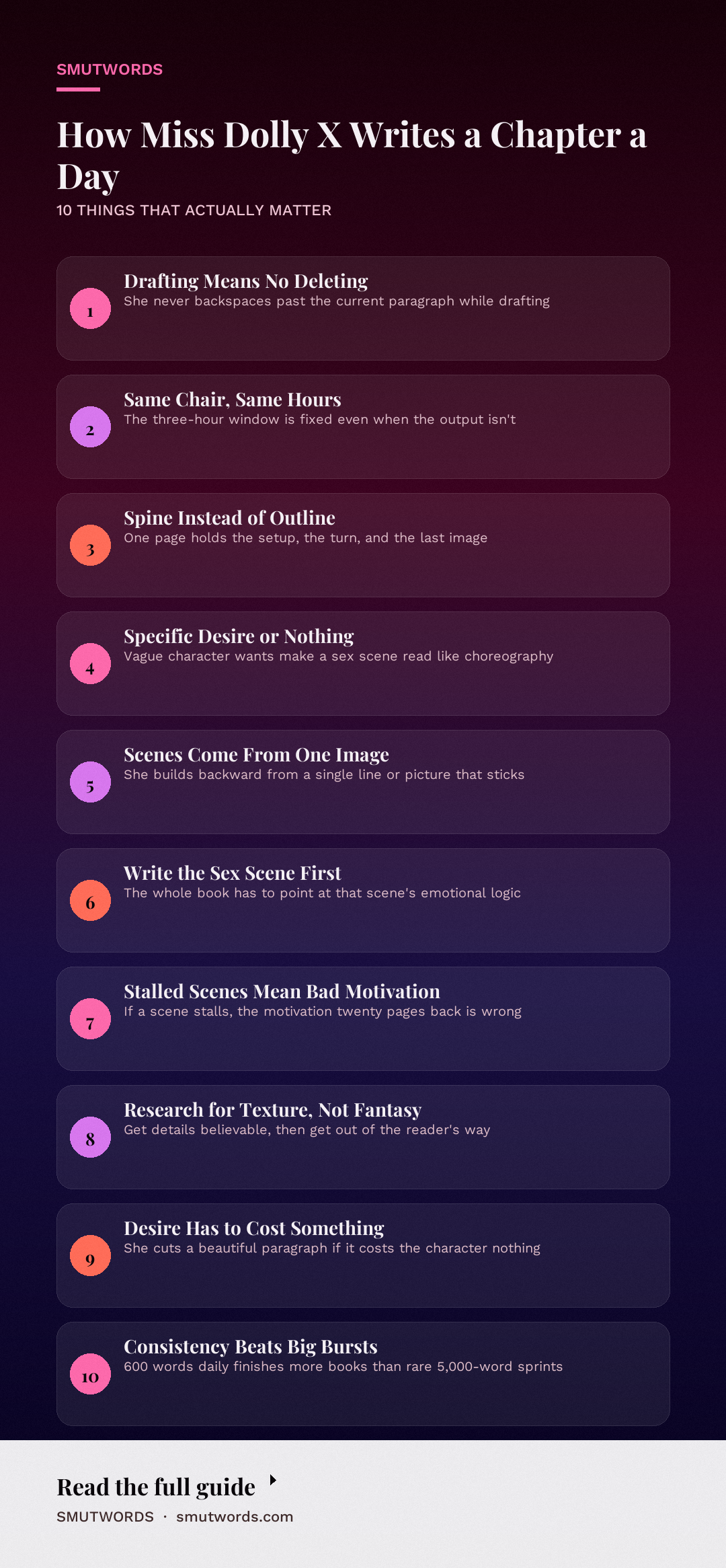
Then she writes straight through until she hits a scene break or 2,000 words, whichever comes first. No editing, no backspacing past the current paragraph. If a character's name changes halfway through because she forgot what she called him on page four, she keeps going and fixes it in the afternoon pass.
"Deleting while drafting is just procrastination with extra steps," she says. "You're not improving the book. You're avoiding the next scene because you don't know what it is yet."
The three-hour window, loosely enforced
She aims for three hours of drafting, but the actual number fluctuates. Some days it's ninety minutes and a really good scene. Some days it's four hours and a fight with a chapter that won't end properly.
What doesn't fluctuate is the window itself. Same chair, same time, same refusal to answer messages before it closes. She treats the schedule like a shift at a job she'd get fired from if she skipped it. Less romantic than "inspired by muses." Much more accurate.
Outlines, Or the Lack of Them
Miss Dolly X doesn't write full outlines. She writes what she calls "the spine": a one-page document with the setup, the turn, and the last image of the final scene. Everything between those three points is discovered on the day.
That sounds chaotic until you hear her describe how tightly she controls the setup. She knows exactly who wants what before page one. If a character's desire is vague, the sex scene has nothing to push against and reads like choreography instead of fiction.
For Permission Slip: A Cuckold Erotic Short Story, the spine was three lines: husband asks, wife says yes too fast, the yes is the problem. The chapter where she says yes took four drafts because the first three versions had her hesitating, and hesitation wasn't the story she wanted to tell.
She rewrote it so the wife agrees immediately, which made everything after it worse for the husband and better for the reader. That's the trade she's always making.
Worth noting how much this overlaps with straight-up artist/muse romance, where the whole engine is one person shaping another and then having to live with what they made.
Where the Scenes Actually Come From
Not from mood boards. Not from scrolling inspiration accounts at midnight, which she calls "research that's really just stalling." The scenes come from a single image or a single line of dialogue that won't leave her alone, and she builds backward from it.
Sometimes the image is a location. Sometimes it's a specific humiliation, a specific power imbalance, a specific moment of eye contact across a room. She keeps a running notes file called "uncomfortable" where she drops these fragments, no context, no explanation, just the image. When she's stuck on what happens next in a book, she scrolls that file until something fits.
That file is also why her range looks scattered from the outside. A note about a casino floor and a note about a lizard's nest end up living three lines apart, and both eventually become books.
- Single image with no explanation
- One line of dialogue with no speaker attached
- A setting that makes the power dynamic obvious before anyone speaks
- A physical detail that's slightly wrong for the character and worth investigating
Drafting Habits That Actually Stick
She writes in scenes, not chapters, which matters more than it sounds like it should. A scene ends when something changes. A chapter ends when the change is expensive enough to sit with overnight.
She also writes the sex scene first if it's the reason the book exists. Some writers save it for last as a reward, and she thinks that's backwards because the emotional logic of the whole book has to point at that scene. Writing it early tells her what the rest of the chapters owe it.
That's visible in something like He Paid Him to Fuck Me, where the central transaction is established so early that the rest of the story is really about what both men do with the aftermath. The sex isn't the climax. It's the setup, and every scene after it is paying rent on that choice.
How she handles a scene that isn't working
She doesn't push through a dead scene by force. She rewrites the first line three different ways and picks whichever one makes the next sentence easier to write. If none of them do, the problem is usually earlier, not in the scene itself.
Enjoyed this? Get a free book.
Join the list and we will send a complete free story straight to your inbox, plus new releases every week after that. No credit card, no catch.
Her rule: if a scene stalls, the motivation twenty pages back is wrong. Fix the motivation, and the scene writes itself in an afternoon.
Research, Boundaries, and Knowing the Difference
She does look things up. Not for the fantasy, for the texture.
The layout of a casino floor. How a motorcycle club actually patches someone in. What the inside of a monster's den might smell like if you're being honest about it instead of romanticizing it.
She's specific about where research stops and invention starts, and she's equally specific about not over-explaining a world readers came to it for the fantasy, not a manual. Get the details right enough to be believable, then get out of the way.
That discipline shows up in something like Free Use Casino, where the setting has rules you can track, and the rules are the whole reason the scenario works. Without structure, free use is just anarchy with better lighting.
She Reads Her Own Genre, Extensively
This is where she gets a little heated. Miss Dolly X reads more erotica than almost anyone she knows, and she thinks writers who don't read their own category are guessing at what readers actually want.
She keeps a running list of tropes that keep working and tropes that have gone stale. Monster breeding is having a moment, and she thinks part of that is readers wanting a partner who's categorically not going to be weird about it. Enemies to lovers still works because the tension is built into the premise before anyone touches anyone. Fake marriage still works for the same structural reason: proximity plus a deadline.
Her current read is a monster breeding deep dive, mostly to see what other writers are doing with the nesting instinct that she keeps circling back to in her own beast books. If you want the full breakdown of that trope, there's a good one here: Monster Breeding Romance: Everything You Need to Know.
She also swears by keeping a few shorter, sharper reads in rotation to reset her sense of pacing. Books like Lured by the Lizard Beast and Zorgon's Pet sit in that rotation because they do a lot with a little, and reading tight structure when you're drafting long is a good corrective.
What she thinks separates a scene that lands from one that doesn't
Desire has to be specific, and it has to cost something. A hotwife scene where nobody's conflicted reads like a checklist. A scene where the husband watches and hates how much he likes it is doing actual work, and that internal friction is what Shared Without Shame builds its whole tension structure around.
She'll cut a beautiful paragraph if it doesn't cost the character anything. Every scene has to move someone closer to wanting the thing they said they'd never want.
Editing, Which Happens Later and Fast
The afternoon pass is mechanical. She reads the morning's pages once, fixes continuity, cuts anything she wrote to hear herself talk, and checks whether each scene actually ends with a change. If it doesn't, she marks it and moves on rather than rewriting in the same session, because the fresh read the next morning catches things a same-day pass never will.
Line editing happens at the end, after the whole draft exists. She calls it "cleaning the house after the party" and refuses to do it scene by scene, because polishing early means polishing things she'll cut anyway once she sees how the ending actually lands.
Her Actual Daily Word Count, and Why It Doesn't Matter Much
2,000 words on a draft day. Fewer on a scene-repair day. Zero on Sundays, which she protects more fiercely than she protects anything else in the schedule.
She's quick to point out that 2,000 words a day isn't a flex and isn't the reason the books work. Consistency is the flex. Anyone who writes a middling 600 words every single day finishes more books in a year than someone who writes a brilliant 5,000-word burst every third Sunday.
She also writes explicitly and without apology, which she says is a skill like any other. You get better at writing a sex scene by writing a lot of bad ones first, the same way you get better at dialogue or endings.
That's part of why her range keeps widening. A stranger roleplay piece, a prince dynasty story, a redemption arc, a horror-tinged monster romance, all built the same way: one uncomfortable image, expanded into a spine, drafted in scenes, cleaned up at the end. Different tropes, identical workday.
If you're building your own version of this routine, the honest advice from someone who's actually doing it: pick the time, protect the time, and stop treating a stalled scene like a personal failure. It's a signal that something upstream needs fixing, and fixing it is faster than forcing a scene that was never going to work.
Final Thoughts
Start with Zorgon's Pet if you want to see the method in action: a tight spine, a scene that changes the power dynamic every single chapter, and a monster that's written like it has actual wants instead of just claws. Read it once for the story, then read it again with a notebook open. The scaffolding is right there on the page.






Loading comments…