
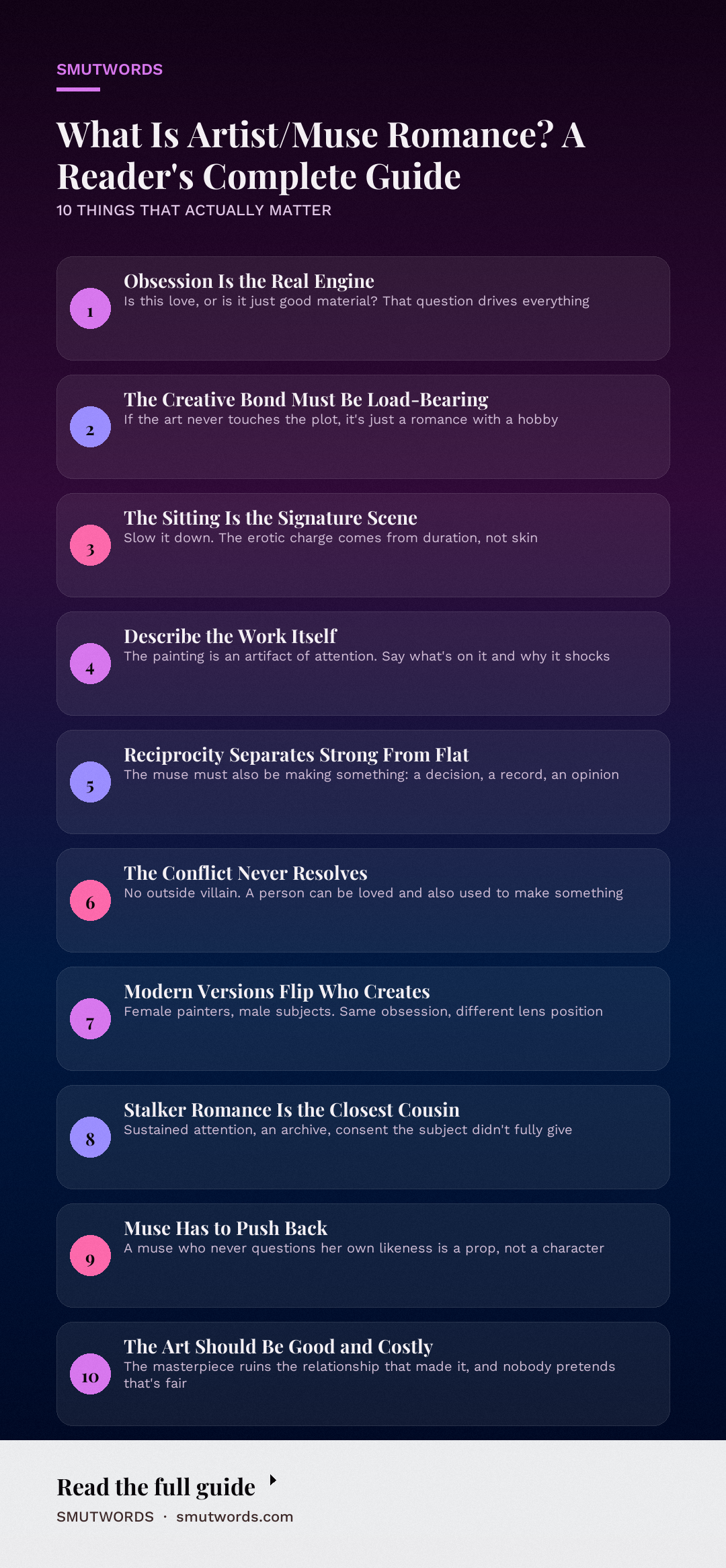
An artist/muse romance is a love story built around creative obsession. One lead makes things (paintings, novels, sculptures, photographs) and the other becomes the reason the work exists. The artist sees something in the muse nobody else has bothered to look for, the muse discovers they can be seen that way, and the whole thing runs on a question neither of them can answer cleanly: is this love, or is it just good material?
That question is the engine. Everything else is staging.
The fantasy underneath is specific and a little vain in the most satisfying way. Being so compelling that you cause someone's best work is a stronger pitch than being simply desired. Desire fades by morning. A masterpiece with your face in it hangs on a wall forever.
Readers come to this trope for that permanence, and they stay for the mess it makes of two people who can't tell whether they're in a relationship or a professional arrangement with feelings attached.
What follows is the full anatomy: the definition, the publishing history, the craft mechanics that separate a scene that burns from one that reads like a museum placard, and the variants you'll run into across painters, novelists, sculptors, and photographers.
What Artist/Muse Romance Actually Means
The term pairs two roles that don't sit symmetrically. The artist holds the power of the gaze (they look, they interpret, they commit the muse to a permanent object). The muse holds the power of the subject (they are the thing being looked at, and they can walk out of the frame at any time).
The tension comes from that imbalance being unstable. Either person can flip the dynamic with one decision.
It counts as artist/muse romance when the creative relationship is load-bearing. If the hero paints but his art never touches the plot, you're reading a small-town romance with a hobby in it. If the muse sits for him, changes what he makes, and the finished work forces a choice between the person and the project, you're in the trope.
Some things that don't count, despite looking close:
- A one-time portrait scene. A single sitting that exists only for a spicy set piece is a scene, not a trope. The creative relationship needs to recur and develop.
- A creative lead with an off-page career. If the art happens between chapters and gets summarized, the obsession has nowhere to live.
- The muse as pure decoration. A muse who never pushes back on how she's being depicted is a prop. The good versions give her opinions about the likeness.
- Artist and patron. Money changing hands for art isn't the same as a person becoming the art. Commission dynamics are their own thing.
The most common misconception is that the trope requires a real-world model-and-painter setup. It doesn't. A novelist who bases a character on a woman he's known for years hits the same beats. A photographer who shoots the same face for a decade hits them harder, because the archive of images becomes evidence of obsession that either party can point to in an argument.
The name itself comes from the classical idea of the muse as a divine source of inspiration, a figure who visits the artist rather than being hired by him. Modern romance keeps the visit and throws out the divinity, which is why the trope reads as eerie even in sweet versions. Someone has been chosen, and neither party agreed to it.
Where Artist/Muse Romance Comes From
This is a trope with a genuine literary pedigree and a separate, messier life in genre romance, so it's worth tracking both.
The high-art version runs from the Renaissance through the nineteenth century, where painters and their models were a standing scandal in European culture. The Romantic poets gave the world the artist-as-tormented-genius, and the muse got folded in as the woman who either saved him or ruined him, usually both. Nineteenth-century novels are full of painters who fall for their subjects, and the convention has always carried a whiff of transgression attached to it.
The genre romance version is more recent and much more specific. In the twentieth century, the artist/muse setup migrated from literary fiction into category romance, where it became a reliable conflict engine for short, intense books. Category romance needed a reason two people couldn't simply date, and a working creative relationship supplied one: professional entanglement, power imbalance, the possibility that the attraction is exploitative in both directions.
The big shift over the last few decades is who gets to be the artist. For most of the trope's history, the painter was a man and the muse was a woman, and the story was told from her point of view while the camera stayed on him.
Contemporary romance has flipped it constantly. Female painters with male subjects, photographers shooting lovers, writers profiling people they're sleeping with. Same obsession, different lens position.
The other shift is honesty about the exploitation. Older versions treated the artist's use of the muse as romantic suffering. Current versions tend to name it. The muse finds the sketchbook, sees herself drawn in poses she never held, and the story has to account for that as a violation as well as a declaration.
This is worth noting if you read widely: several tropes dress up obsession as romance, and a few of them get compared endlessly. The stalker romance is the closest cousin, and the artist/muse version usually sits on the softer end of that spectrum. If you want the full breakdown of the harder variant, the stalker romance glossary entry covers where courtship stops and surveillance starts.
The artist/muse trope borrows most of that tension but usually resolves it with the work itself serving as the confession.
Class difference also runs underneath this trope more than most readers notice. The artist is often broke and the muse is often wealthy, or the reverse, which is the same fault line explored across the whole subgenre covered in Understanding Class Difference Romance. A muse who commissions nothing but controls the money in the room is a different animal than a muse who has nothing to offer but her face.
How It Shows Up in Erotica
The trope lives or dies on the craft of looking. Here's what the good versions actually do on the page.
The sitting as a scene engine
The core set piece is the sitting: subject posed, artist working, time stretching. Strong books slow that scene down instead of rushing to the kiss. The erotic charge comes from duration.
He adjusts her shoulder. She holds the position too long and it starts to ache. He notices her discomfort before she mentions it, which is the first real intimacy in the book.
Notice what's being withheld. The painter is fully dressed and fully occupied. The subject is on display and mostly still. That asymmetry does most of the work.
Weak versions skip the sitting and go straight to the studio floor. The result reads like any other scene with a paintbrush nearby. The sitting is what makes the trope's central question land: if she posed for him fully clothed and it was unbearable, the charge was never about skin.
Description of the work itself
The best versions spend paragraph space on the art. Not just that he finished a canvas, but what's on it and why it's shocking.
Enjoyed this? Get a free book.
Join the list and we will send a complete free story straight to your inbox, plus new releases every week after that. No credit card, no catch.
The likeness is too exact. He painted her mouth from a memory she didn't know he had. There's a detail in the corner of the painting that only makes sense if he watched her when she thought she wasn't being watched.
This is where the trope earns its heat. The painting is an artifact of attention. Attention, sustained and precise, is the most intimate thing in the book, and good writers know it.
Common variations
- Painter and subject. The default. Studio, stillness, the reveal of the finished piece.
- Writer and source. A journalist or novelist who gets too close to the person they're writing about. The threat is publication: the book will come out, and it will contain her.
- Sculptor and model. Pressing clay or plaster against a body, casting from life. The vibe is tactile and ceremonial, closer to ritual than performance.
- Photographer and muse. The archive problem. There's a folder, and it goes back years, and the dates overlap with relationships she didn't know about.
- Artist and rival artist. Two makers circling the same subject, using her work as a reference, competing to see her more accurately.
- Muse as artist. She starts making her own work about being looked at, and the power shifts mid-book.
What makes the strong versions work
The difference is almost always reciprocity. In a flat version, one person creates and the other is created. In a strong version, the muse is also making something: a decision, a performance, a private record of what it feels like to be looked at that hard. She's not just a subject; she's a witness to her own portraiture.
Strong books also let the art be genuinely good and genuinely costly. The artist isn't flattered by his own talent. The masterpiece ruins the relationship that made it possible, and the story doesn't pretend that's a fair trade.
Here's a short checklist for what separates the two:
- Strong: The muse has a life, an opinion, and a reason to sit for him beyond convenience.
- Flat: The muse exists to be seen and says little when she isn't in frame.
- Strong: The art changes after they sleep together, and the change causes a problem.
- Flat: The art is scenery that gets mentioned and forgotten.
- Strong: Someone accuses the artist of exploitation, and the accusation isn't dismissed.
- Flat: Everyone agrees the artist's attentions are romantic and fine.
The explicit content in this trope runs a gamut. Some books stay almost entirely in the studio and use the looking as the sex. Others go hard once the boundary breaks, usually framed as the artist finally touching what he's been depicting, which reads as a defilement of the work as much as a consummation. Both approaches work when the buildup has been specific.
One practical note for readers: if the artist/muse dynamic gets pushed into institutional territory, like a professor grading the subject he's painting, the mechanics change and the moral math changes with them. That overlap is real and there's a clean breakdown in the tutor/student romance glossary entry, which handles the power-imbalance complications this trope usually keeps in the background.
The ambiguity is the whole point
Every great artist/muse romance has a scene where someone asks the question out loud: do you want me, or do you want the work? The answer in a good book is "both, and that's not a resolution, that's a condition." The story ends when the couple chooses to live inside the ambiguity on purpose rather than pretending one need cancels the other.
That's harder to write than an enemies-to-lovers arc, because the conflict never resolves. There's no outside villain. The antagonist is the fact that a person can be loved and also used to make something, and no amount of honest communication changes that. The best books stop trying to solve it and start showing two people agreeing to keep it.
Pairings that keep working
Readers who like this trope tend to like one specific adjacent element: someone with a rough, physical, unglamorous life colliding with the artist's rarefied studio. A lumberjack romance crossed with an artist/muse setup produces a pleasing jarring texture, since the muse has no vocabulary for being looked at and no patience for being catalogued. The reverse pairing, a soldier on leave who becomes a photographer's subject, works the same collision from the other direction.
Artist/Muse Romance vs Lumberjack Romance
These get lumped together as "creative-adjacent" tropes more often than you'd expect, and the confusion is worth clearing up because they're built on opposite mechanics.
The lumberjack romance is a trope about being wanted for exactly what you already are. The appeal is a straightforward man with rough hands and no pretense, and the heat comes from how undressed the honesty is. Nobody in a lumberjack book is being interpreted. He likes her, he says so, they go to bed.
The artist/muse romance runs on interpretation. The entire question is whether the artist's version of the muse is better than, or simply different from, the real thing. There's a layer of mediation between desire and the person, and that layer is the plot.
Put differently: in a lumberjack romance, the muse would already have been looked at, fully and unhurriedly, and it wouldn't cause a crisis. In an artist/muse romance, being looked at is the crisis. The same scene plays as tenderness in one and as exposure in the other.
If you're choosing between them, ask what appeals more: being accepted exactly as you are, or being seen as something more than you thought you were. Ambiguity versus certainty. Interpretation versus fact.
Frequently Asked Questions
Is the artist always male in an artist/muse romance?
No, and the ratio has swung a lot in the last twenty years. Female painters, photographers, and novelists working with male subjects are common, and some of the strongest books in the trope come from that inversion. What matters is who holds the interpretive gaze, not their gender.
Does the muse have to be a love interest, or can the artist's obsession be one-sided?
It can be one-sided, and some of the most interesting versions start that way. The trope tips into romance once the feeling is mutual, but the early stretch where only one person is obsessed carries a lot of the tension. Books that keep it one-sided to the end belong in a different conversation entirely.
Why does artist/muse romance feel so similar to stalker romance?
Because the mechanics overlap: sustained attention, an archive of images or notes, an interest the subject didn't fully consent to. The difference is consent and how the book frames it. Stalker romance leans into the violation; artist/muse romance usually converts the attention into a love language. Some books blur the line on purpose.
How explicit do these books usually get?
It varies enough that you can't generalize. Some stay in the studio and treat looking as the sex scene. Others go fully explicit once the artist breaks his own rule about touching his subject. If explicitness matters to you, read the pen name before the blurb; the complete guide to every SmutWords pen name tells you what each one tends to deliver.
Can a romance have an artist/muse dynamic and still have a happy ending?
Yes, and the good ones earn it by changing the terms. The couple either finds a way for the art to exist without exploiting the person in it, or they decide the exploitation is mutual and choose it anyway. A happy ending that pretends the ambiguity never existed usually reads hollow.
Where do I start if I've never read this trope?
Pick a book with an explicit studio scene described in reviews, since the sitting is the trope's signature and will tell you immediately whether the writer can handle it.
If you like your artists with rougher edges, the motorcycle club romance glossary entry has a similar power-dynamic flavor with less melancholy. If you want to start with something darker and more obsessive, the alphahole guide covers the controlling archetype that often shows up when an artist decides the muse belongs to him.
Final Thoughts
The artist/muse romance is the trope for anyone who has ever wanted to be looked at so hard it changed them. It runs on attention, and attention is the only thing in romance that can't be faked.
If you've never read one, start with a book that lingers in the studio and treats the sitting like foreplay, because that's where the trope shows its hand. For the higher fantasy ceiling on the same obsessive mechanics, the best SmutWords books for monster romance beginners covers what happens when the muse might not be entirely human. Read both, and notice how much heat comes from somebody finally paying close attention.





Loading comments…