
Why Dirty Talk Goes Wrong (And Why It's Usually Fixable)
Most people who say they're bad at dirty talk aren't bad at it. They're bad at doing it cold, with no plan, mid-thrust, while also trying to breathe. That's a lot of jobs at once.
Learning how to talk dirty isn't about summoning your inner porn star. It's about lowering the stakes until your mouth can catch up with the rest of you.
There's no script to memorize. There are four things: knowing what you actually want to say, testing it somewhere low-pressure, watching your partner instead of your own performance, and knowing when to stop. Get those in order and the words come easier than you'd expect. Get them out of order and you end up whispering something you half-remember from a book while your partner's face goes blank.
What Dirty Talk Actually Is
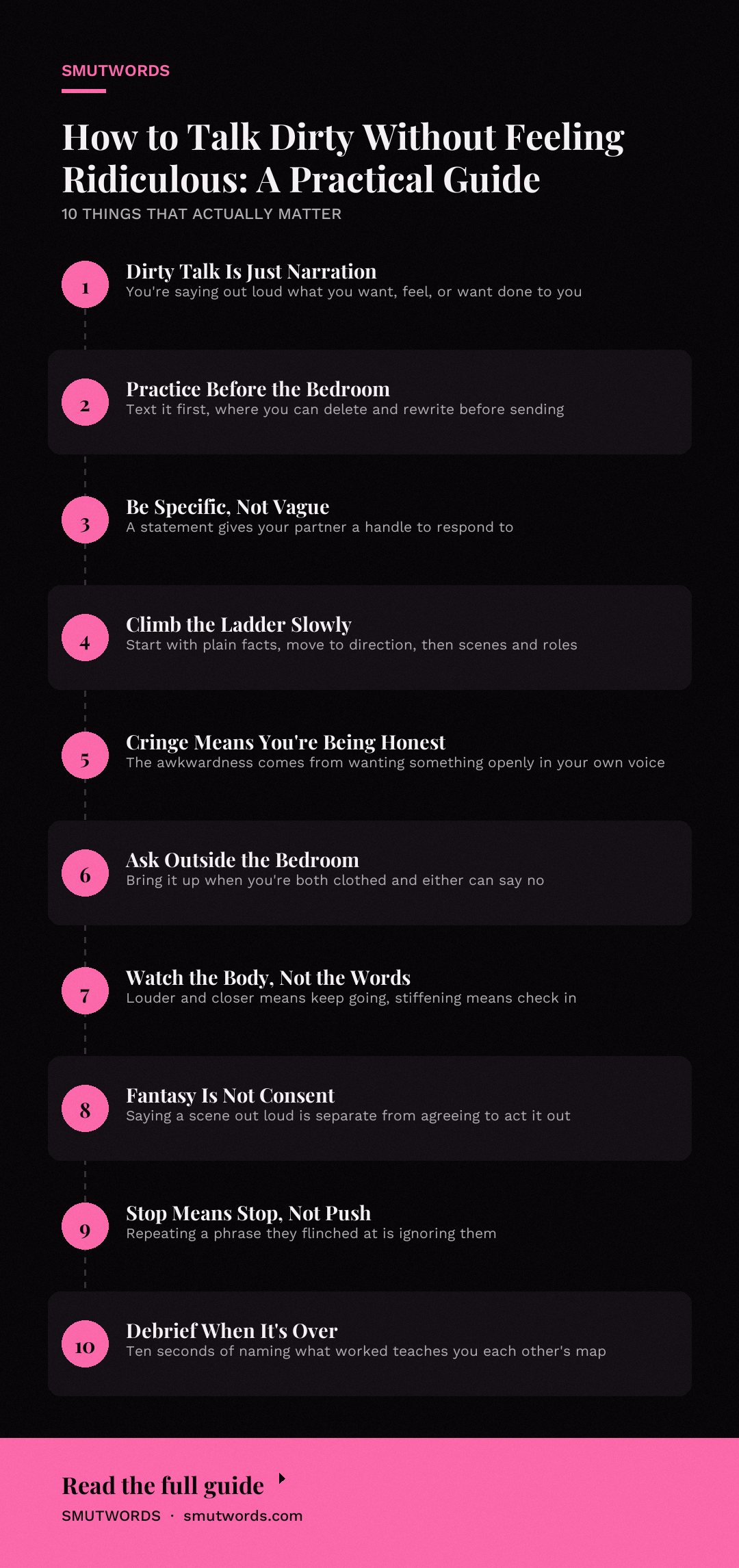
Strip away the porn version and it's just narration with intent. You're saying out loud what you want, what you're feeling, what you're about to do, or what you want done to you. That's it.
A single "don't stop" delivered at the right second is dirty talk. So is describing exactly where your hand is going.
People like it for a few concrete reasons. It works as a consent check that doesn't break the mood ("you want me to keep going?" lands differently than a formal question). It creates anticipation, because the words arrive before the action. And it lets you say a thing you'd never say in daylight, which is its own charge.
If you read a lot of erotica, you already know the sound of it working. The dialogue in something like Free Use Airbnb does the same job your words do in bed: naming the fantasy out loud so both people can stop pretending they're not into it.
Start Outside the Bedroom
Nobody said the first attempt has to happen in the middle of sex. The worst place to debut a new skill is the moment you're already breathless.
Do a dry run somewhere neutral. Text it. Say it in the kitchen. Whisper it in a parking garage.
Texting is the cheat code everyone underrates. You get to write, delete, rewrite, and send only the version that doesn't make you cringe. You also find out fast whether your partner plays along.
If "thinking about your hands on me" gets a one-word reply, that tells you something. If it gets a paragraph back, you've found your lane.
A low-stakes script to borrow
You don't need to be original. You need to be specific. "I want you" is wallpaper. "I want your mouth on my neck before you even get my shirt off" gives your partner something to picture and something to answer.
The bar for "good" is whether your partner can respond. A statement invites a response. A vague noise doesn't.
If you say something and get nothing, it's rarely because you said the wrong thing. More often you left them no handle to grab.
Phrases by Comfort Level
Treat this like a ladder. You don't skip to the top rung because you're impatient. You climb, and you check each rung holds weight before you put your foot on the next one.
Level one: plain and present
These are statements of fact about what's happening right now. Zero risk, real payoff.
- "I've been thinking about this all day."
- "Right there. Don't move."
- "I want you closer."
- "Look at me."
- "That's it."
Notice how short these are. Short sentences are easier to deliver without your voice doing something weird, and they land harder because there's no filler around them.
Level two: direction and permission
Now you're telling your partner what you want. This is where dirty talk stops being decoration and starts being useful, because you're getting what you actually want instead of hoping.
- "Slower. I want to feel it."
- "Use your teeth this time."
- "Hold my wrists down."
- "Tell me what you're going to do to me."
- "Ask me for it."
That last one does the heavy lifting. It hands the next line to your partner, which takes the pressure off you and turns the thing into a back-and-forth instead of a monologue.
Level three: talking about the scene
This is where people narrate roles, dynamics, or scenarios. It scares beginners most and pays off best, provided you've already tested the ground below.
If you've read any monster breeding romance, you know the register: bigger-than-life, possessive, deliberately over the top. You can play in that register out loud. The fiction gives you the vocabulary, and the bedroom gives you the reality check.
Roles aren't just for fiction, either. They map onto real dynamics people actually ask for: the stranger, the boss, the person who has waited years for this. If your thing runs toward hate to love, the dirty-talk version is a rivalry that finally cracks.
If it runs darker, you might be circling something closer to stalker romance, and that's fine to name out loud as fantasy as long as both people know it's a game.
Why Some People Find It Cringe
There's a real reason it feels ridiculous, and it isn't a character flaw. Dirty talk requires you to want something openly and say it in your own voice, which is the exact thing most people spend their whole lives learning to avoid. The cringe is the sound of a person being honest.
Two things make it worse than it needs to be. First, trying to sound like a movie. Borrowed language always sounds borrowed.
Second, playing to an audience that isn't in the room. If you're performing for a fantasy version of your partner instead of the person actually under you, they can hear it.
The fix on both counts is the same: say less, mean all of it. "I want you" in a voice that means it beats five filthier sentences you're reciting from memory.
Enjoyed this? Get a free book.
Join the list and we will send a complete free story straight to your inbox, plus new releases every week after that. No credit card, no catch.
How to Bring It Up With a Partner
Ask first. Not during, when they're busy and can't think. Sometime when you're both clothed and relaxed, with an exit available to either of you.
The opener that works: "I read something about dirty talk and I'm curious, do you like it when I narrate things, or does it take you out of it?" Real question, real answers, and it gives your partner room to say no without wounding anyone.
If they say yes, ask what they like hearing.
If they say no, believe them and move on. Some people get pulled straight out of the moment by talking. Some find it corny. Some like it in text but hate it spoken.
All three are normal, and none of them is a verdict on you.
If your partner needs help finding the words, point them at erotica that does the kind of talking you both want to try. Something like He Left the Door Unlocked: A Hotwife Invitation Fantasy and How to Write a Hotwife Pickup Scene give you two angles on the same energy, one as fantasy, one broken down into craft. Reading a scene aloud together is a genuinely effective way to find out what you both react to.
Reading Your Partner's Response
Your partner's body will tell you faster than their mouth will. Watch for the response, and adjust in real time. This is the skill, more than any line you memorize.
Green means keep going. They get louder, they pull you closer, they answer you back, they start narrating too. They might go quiet and glassy-eyed, which is often a very good sign. Say more of the same.
Yellow means you hit a nerve, and you need to find out which kind. They stiffen, they laugh awkwardly, they say "that's different," they go still and flat.
Stop talking, keep doing whatever's working, and check in after. "Too much?" is a fine sentence. So is "that was a miss, what do you actually want to hear?"
Red means stop. They pull away, they say no, they tell you to quit. You stop the topic, apologize if it landed badly, and don't relitigate it in the moment.
If they've said no to a specific thing twice, that's a no. You can ask later, outside the bedroom, whether it's a hard no or just a wrong night. You don't test it again by sneaking it back in.
Consent Inside Dirty Talk
A fantasy said out loud isn't consent to act it out. Those are two separate conversations and people conflate them constantly. You can whisper something filthy and never do it. That's allowed, and it's a lot of the fun.
The practical rule: talking about something is a conversation, doing something is a decision, and you need both people's agreement on the second one, in words.
If your dirty talk involves a role where someone's in charge, the person calling the shots still checks in. If it involves restraint, you agree on a safeword before anyone's hands leave the headboard. If you don't know what that looks like in practice, What Is BDSM? The Four Letters Explained for Beginners covers the framework without the intimidation.
And say the limits before the scene, not during. Mid-scene is the worst possible time to discover you have different ideas about what's on the table.
When to Stop
Stop when your partner says stop. Take the word at face value rather than waiting for emphasis. Also stop when you're not enjoying yourself, because dutiful dirty talk reads exactly like what it is.
There's a specific failure mode worth naming: using words to push past something your partner hasn't agreed to. Talking someone into a thing they said no to is a real line, and crossing it is the difference between a game and a problem. If you find yourself repeating a phrase your partner has already flinched at, you're not being seductive. You're ignoring them.
When it's over, do the boring part: talk about it. Ten seconds of "that was good, that thing you said near the end, that worked" is worth more than any guide, including this one. That's how you learn each other's specific map instead of guessing from general tips.
Dirty Talk in Fiction, and What It Teaches You
Erotica is a surprisingly good training ground because it gives you vocabulary without the pressure of a live audience. You get to see how different writers handle escalation, and you notice quickly which ones overwrite it.
The dialogue in College Fund Whore and The Pleasure Drone Experience is instructive for the same reason. The good lines are short and specific, and the writers let silence do work instead of filling every beat with words. That's a lesson you can steal directly.
If you want the extreme version of a dynamic played out so you can hear the register clearly, alien and breeding fiction is where it lives. Breeding Bunker 9 and The Brood King's Legacy both run heavy on possessive narration, which is exactly the mode people freeze up on in real life. Hearing it done well in fiction makes it easier to attempt badly in your own bed, and badly is fine to start.
Not every fantasy needs to be one you'd say out loud, though. Some reading works better left as reading. If your taste runs toward arranged unions and structured dynamics, Understanding Arranged Marriage: A Full Breakdown and Understanding Royal Romance: A Full Breakdown are worth reading for the vocabulary alone, even if you never use a word of it.
Final Thoughts
Pick one sentence. Say it out loud to your partner this week, somewhere low-stakes, and watch their face instead of worrying about your voice. That's the whole method. Start with something small and true, get one real reaction, and build from there.
If you want a scene that does the heavy lifting for you and gives you a few lines to steal, Free Use Airbnb is the place to start. Read it, notice what lands, and try saying one of those things in your own words. The cringe fades after the first time. It really does.







Loading comments…