
Nobody warns you that "steamy" on a book's back cover can mean a closed-door kiss in a garden or two people negotiating a three-day scene with a spreadsheet.
The heat levels romance explained conversation usually starts too late. By then you've bought the book, and you're on a train, tilting your e-reader away from the person next to you. This is the actual breakdown, framed for readers picking their next read, not for authors figuring out where to file their manuscript.
Heat level vocabulary shifts depending on who you ask. Some sites use a 1-5 scale, some use flavor words like sweet and spicy, some use content warnings instead of ratings entirely. The labels below are the ones you'll actually see on SmutWords and most indie erotica listings, and they map roughly onto a five-point scale from sweet to dark.
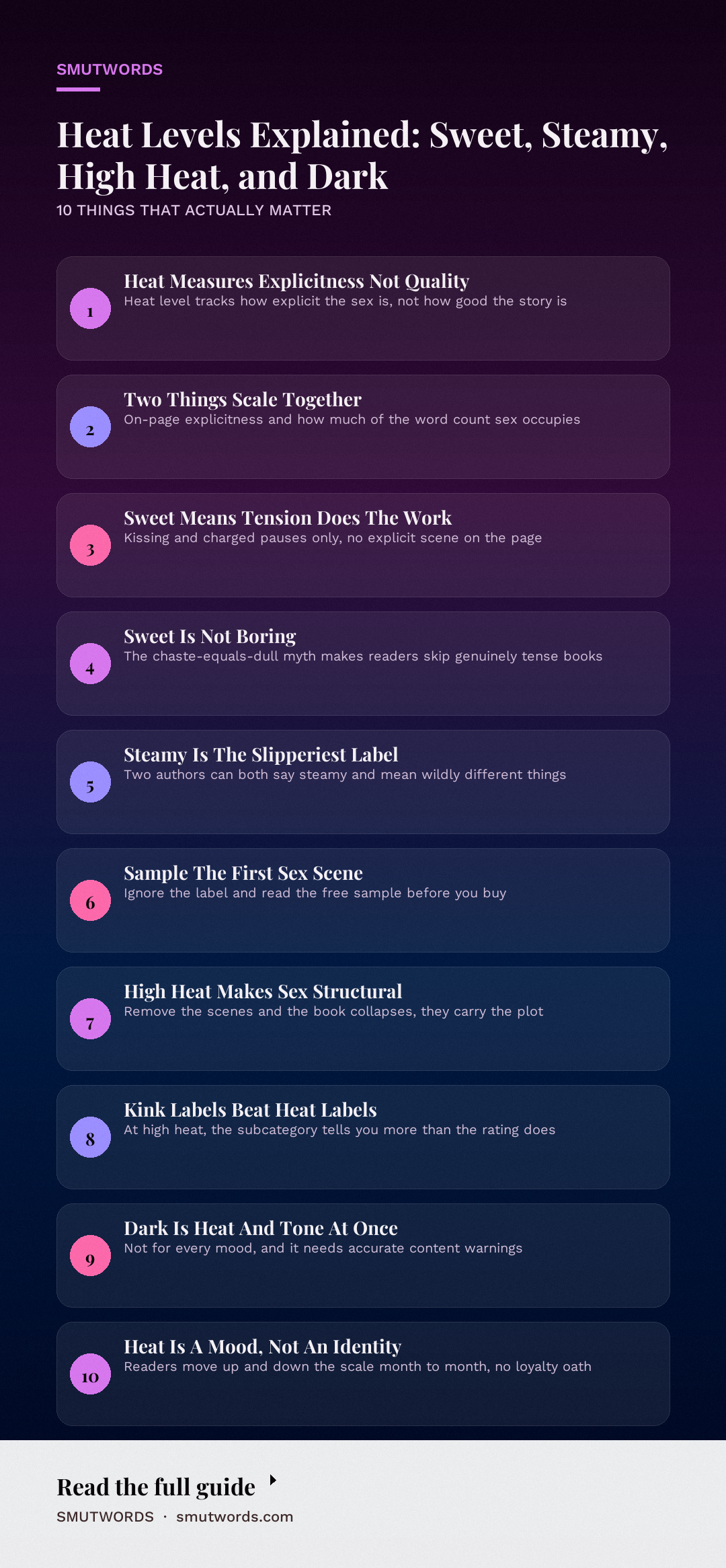
What Heat Levels Actually Measure
Heat level describes how explicit the sex is, and how much of the book is built around it. It doesn't describe quality, and it doesn't describe how emotionally intense the story is. A sweet romance can wreck you harder than a high-heat one. A dark erotica novella can be, honestly, kind of boring if the writing doesn't hold up.
Two things scale together as you move up the levels: on-page explicitness, and the percentage of the word count that sex occupies. A sweet romance might have one kiss and 300 pages of longing. A high-heat book might have six full scenes and 180 pages. Neither is more "real" than the other, they're just doing different jobs.
The most useful thing you can do as a reader is figure out which level you actually want on a given night, because it changes. You might want high heat on a Tuesday and a slow-burn sweet romance by the weekend. There's no loyalty oath here.
Sweet: All Tension, No On-Page Sex
Sweet means the physical relationship stays at kissing, hand-holding, maybe some heavy makeout that fades to black at the bedroom door. If it's a fantasy or paranormal, there might be a mating bond and a lot of charged staring, but no explicit scene.
The tension does all the work. Sweet romance lives and dies on atmosphere: the almost-touch, the loaded pause before someone says the thing, the way a character notices the other person's hands and then forces themselves to look away. If you're the kind of reader who gets more out of anticipation than payoff, this is your tier.
What sweet is not: boring. The misconception that sweet equals chaste equals dull gets people skipping past some genuinely tense books.
The fae romance subgenre in particular runs a lot of sweet-leaning titles where the entire appeal is a centuries-old being circling someone mortal and refusing to close the distance, and that restraint is the point. If that sounds like your thing, What Is Fae Romance? A Reader's Complete Guide (Relationships) covers how those relationships are usually structured.
Signs you want a sweet read:
- You want to be able to read it on a plane without angling your screen
- The slow burn is the part you replay, not the payoff
- You'd rather the book end on a charged look than a sex scene
- You're in the mood for emotional tension without explicit content
Steamy: Sex on the Page, Doors Open a Crack
Steamy usually means explicit sex exists but it's not the engine of the book. Maybe one or two scenes, written clearly enough that you know what's happening, without graphic anatomical detail. The plot is still carrying most of the weight.
This is the widest, slipperiest category, and it's where most reader disappointment happens. Two authors can both label their book steamy and mean wildly different things. One writes a single tender scene fading to black at the critical moment, the other writes three pages of detailed foreplay. There's no industry standard enforcing the word.
My practical advice: ignore the label and read the first sex scene in the sample. Every retailer gives you a free chapter or two. If the scene is detailed enough that you'd feel weird reading it aloud to your dentist, that's the level you're buying, regardless of what the marketing says.
Steamy is a good landing spot if you want the sex to matter to the plot without dominating it. A steamy romance can still spend 200 pages on the characters deciding whether they're going to do this at all, which is a specific and satisfying kind of tension that gets lost once you're three sex scenes in.
High Heat: The Sex Is the Point
High heat means multiple explicit sex scenes, graphic detail, and the sexual relationship is central to how the characters change. If you removed the sex, the book wouldn't just be tamer, it would collapse. The scenes are doing structural work: a power shift happens during one, a confession happens during another.
High heat covers a huge range of content, which is why it's the level that most needs subcategories. Two high-heat books can share a rating and have nothing else in common. A hotwife story about a married woman watching her husband with someone else operates on completely different wiring than a monster romance where the monster's anatomy barely maps to human. Both are high heat, and the reader who wants one may not want the other at all.
This is also where kink labels start mattering more than heat labels. Someone browsing Shared Without Shame: A Hotwife Exhibition & Sharing Fantasy knows what they're getting because the title and description do the work up front. Vague blurbs at high heat are a red flag; specific ones are a green light.
High Heat With a Consensual Frame
A lot of high-heat erotica runs on negotiated scenarios, which changes how it reads. The characters agree to something ahead of time, set rules, and the heat comes from what happens inside those rules. Permission Slip: A Cuckold Erotic Short Story is a clean example: the whole premise is that someone granted permission in advance, and the tension lives in what gets done with it.
This category also includes hotwife and sharing dynamics, exhibitionism, and cuckold scenarios where the emotional charge comes from watching, being watched, or being shown off. If that specific flavor of watching is what you're after, A Comprehensive Guide to Watching Kink breaks down the many directions that kink runs before you commit to a book.
Enjoyed this? Get a free book.
Join the list and we will send a complete free story straight to your inbox, plus new releases every week after that. No credit card, no catch.
High Heat With No Rules At All
Other high-heat books take the opposite approach and lean into premise over negotiation. Free Use Casino sets up its own world with its own logic and lets the scenario carry the heat. Same heat level as a negotiated cuckold story, completely different reading experience.
If your taste runs toward nonhuman partners, high heat gets its own set of conventions: anatomy, size, instincts, and the way a human partner has to adjust. Lured by the Lizard Beast is a good test case for whether beast and monster high heat works for you, because it's explicit about what you're signing up for rather than easing you in.
For the broader conventions of that pairing, A Comprehensive Guide to Human/Alien Romance Relationships lays out how these stories usually handle the mismatch.
Dark: Explicit, Intense, and Not For Every Mood
Dark is a heat level and a tone level at once, which is why it makes people nervous. The sex is explicit, the content pushes into rough territory, and the emotional register is heavier: obsession, manipulation, coercion, power imbalance, morally ugly characters doing morally ugly things.
The important distinction most articles skip: dark does not mean "nonconsensual in real-world terms and the book endorses it." Plenty of dark erotica is built on scenarios the characters chose and are getting off on, written in a register that's intense and unsettling on purpose.
And plenty of it genuinely is a fantasy about not having a choice, which is a real fantasy a lot of readers have and enjoy precisely because it's fiction. Both exist. Neither needs defending to anyone who already reads the genre.
What you actually need from a dark book is accurate tagging: dubcon, noncon, CNC, violence. If it's there, it should be labeled. Readers who seek dark content want it labeled too, because clicking into a book expecting a specific dark flavor and finding a different one is just annoying.
Dark is also where the villain-driven romance lives. Characters who spend most of the book doing unforgivable things before any softness shows up belong here, and the payoff is a whole genre of its own.
A redemption arc romance can run at any heat level, but the dark versions are where it goes hardest. Same with enemies to lovers: you'll find the trope at sweet and at dark, and the dark version is doing something considerably less tidy with it.
How to Match a Heat Level to Your Mood
Here's a shortcut version for the next time you're scrolling a store page and can't decide.
- You want tension, not relief: sweet. Look for "slow burn" and "closed door" in the description.
- You want one or two good scenes in a plot-heavy book: steamy. Sample the first scene before buying.
- You want the sex to be the plot: high heat. Check the subcategory (sharing, kink, monster, etc.) before the heat label.
- You want to feel a little unstable afterward: dark. Read the content warnings first, every time.
- You genuinely don't know: read the sample. Every single time. It's free and it's the only reliable heat gauge.
One more thing worth saying out loud: heat preference is a mood, not an identity. Plenty of readers move up and down the scale month to month, and nobody's tracking it. If you spent last year on sweet fantasy and this year you're reading Zorgon's Pet at midnight, that's not a personality change, it's Tuesday.
Dynamic labels sit on top of heat levels, not inside them.
Hate to love can be written sweet or explicit. A book about someone learning to submit can be gentle or brutal. Don't use heat level as a stand-in for a dynamic, or vice versa. Read both labels.
A Note on Subgenre and Heat
Certain subgenres skew toward certain levels by convention, and knowing the pattern saves a lot of scrolling. Small-town contemporary romance tends to run sweet to steamy. Monster, alien, and paranormal erotica tends to run high heat to dark.
Fantasy romance is all over the map and basically requires you to read the tag. Revenge and hate-driven plots can live at any level, though the darker variants usually push higher.
Author interviews are a decent way to hear how this actually plays out from the writing side. Penny London: Behind the Pen Name is worth reading if you want the view from inside a pen name. It won't tell you a book's heat level, but it explains why the labels stay messy.
If you want one genre that consistently plays fast and loose with heat expectations, reality TV romance is it, because the premise itself is strangers performing intimacy on camera. Reality TV Romance: Everything You Need to Know covers how those stories handle the overlap between performing and actually wanting something.
Final Thoughts
If you've been defaulting to high heat because it's what you assume you're supposed to want, try a steamy book with a plot that keeps you up.
And if you want a clean test of the dark end of the scale, read He Paid Him to Fuck Me and see how you feel about the premise before you're three pages in. Heat level is a tool for picking the right book tonight, not a scorecard for your taste. The fastest way to figure out where you land is to read a sample and trust your own reaction over the label.





Loading comments…