
Only one bed is the romance trope where two characters who have every reason to keep their distance end up sharing a single bed for the night. A double booking, a blizzard, a sold-out conference, a broken-down car in the middle of nowhere. The logistics do the work that neither character will do themselves, and the reader gets to watch two people who want each other try very hard to pretend they don't.
It's one of the most reliable engines in the genre, and it's been running for decades.
What makes it so durable is the compression. You take two people with unresolved tension, strip away every escape route, and give them exactly one square of mattress to negotiate. Every elbow, every accidental knee, every "you can have the blanket" becomes a scene.
The only one bed setup doesn't need a plot to generate heat. The room does it for you.
What Only One Bed Actually Means
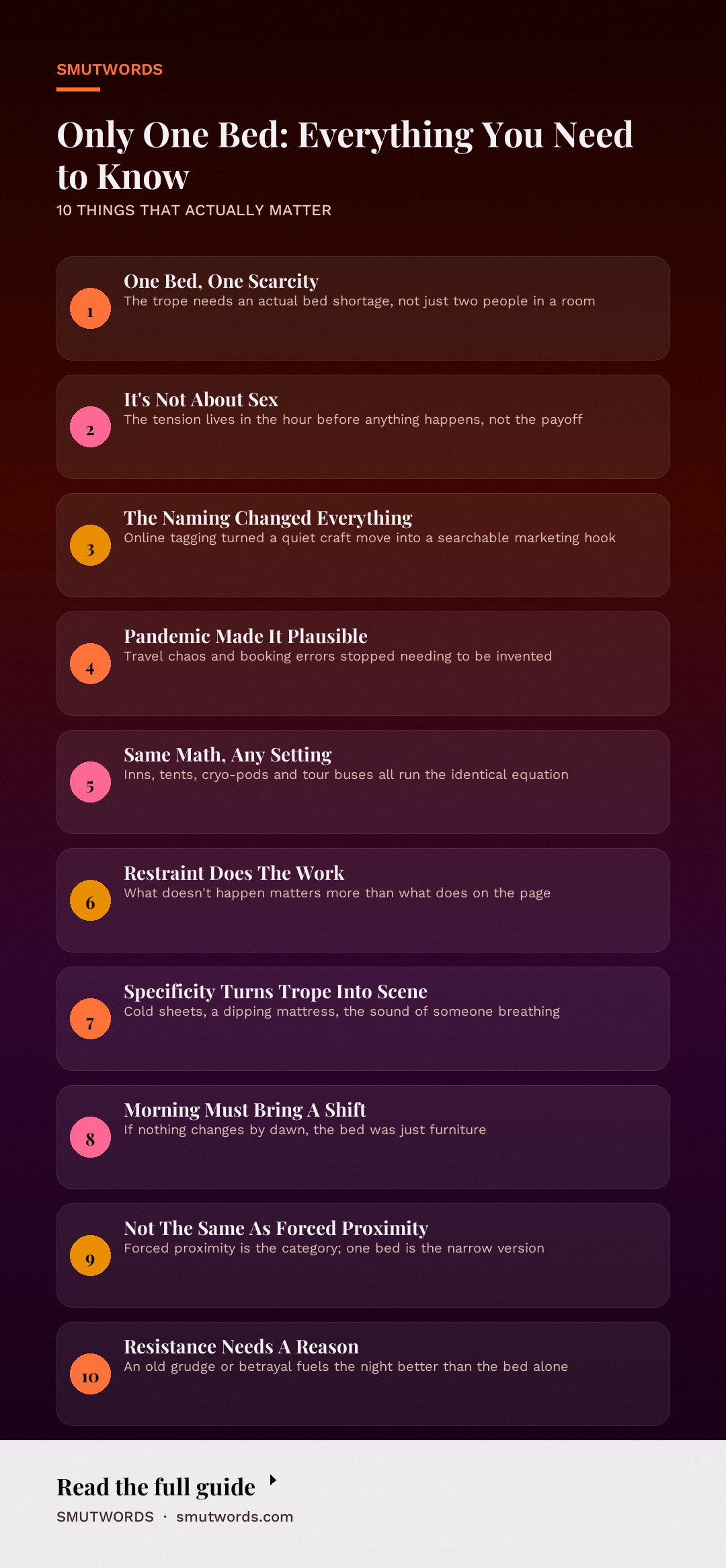
The name is literal, and that's part of its charm. There is one bed. Two people need to sleep. That's the premise, and everything else follows from it.
The term describes both the physical situation and the emotional trap it creates: two characters who are not yet together, or who are together but resenting it, forced into shared sleeping arrangements by circumstance. The bed is non-negotiable. There's no couch, no second room, no floor that anyone is willing to take without a fight. The characters have to share, and both of them know it.
What doesn't count: a couple who already share a bed by choice. A scene where one character sleeps on the couch and the other takes the bed. A hotel room with two queens. The trope lives on the shortage, the specific scarcity of horizontal space and the way that scarcity forces a conversation the characters have been avoiding.
A common misconception is that the trope is only about sex. It isn't. The best versions are about the hour before anything happens, the negotiations, the line down the middle of the mattress, the way one character pretends to be asleep so they don't have to talk about why their heart is pounding.
The physical contact is the payoff. The tension is the product.
Another misconception: that the trope only works in contemporary romance. It shows up everywhere. Historical romance uses inns and snowed-in carriages. Fantasy uses one tent on a scouting mission.
Sci-fi uses a broken cryo-pod or a single bunk on a transport ship. The setting changes. The math doesn't.
Where Only One Bed Comes From
The trope's history is a publishing history, not a real-world one. Nobody invented it in a single book. It grew out of the broader forced proximity tradition in romance and erotica, which has been a staple since the genre's earliest mass-market days. The shared room, the shared carriage, the shared cabin: these are old devices, and writers have been using them for as long as there have been novels about people who want each other and can't say so.
What changed in the last twenty years is the naming. Once readers started tagging and sorting their books online, "only one bed" became a searchable phrase. Readers who wanted that specific rush could find it, request it, and recommend it by name. The trope went from an unspoken craft technique to a marketing signal.
That shift changed how authors write it. In older books, the shared bed was often a plot beat buried in a longer story. In contemporary romance and erotica, it's frequently the hook, sometimes the entire premise, and often announced in the blurb or the cover copy. Readers now pick up a book because it has only one bed, the same way they pick one up because it's enemies to lovers or a secret baby story.
The pandemic years pushed it further. With travel chaos, cancelled flights, and shared spaces suddenly loaded with meaning, the trope picked up a new layer of plausibility. Authors stopped needing to invent reasons for a booking error. The world was supplying them.
Today the trope is one of the most recognizable in the genre. It has its own shorthand, its own fan art conventions, its own running joke about characters who insist on building a pillow wall and then wake up tangled together anyway. That joke works because it's true to the trope's core promise.
How It Shows Up in Erotica
On the page, only one bed is a pacing tool. It slows everything down. Two characters who might otherwise fall into bed in chapter six are forced to spend a night in the same room first, and that night is where the real writing happens.
A strong version of the trope does four things. It establishes why the characters can't just leave. It establishes why they can't just sleep on the floor. Then it gives them a reason to be painfully aware of each other's body in the dark, and makes the first contact feel earned rather than convenient.
The variants authors use most often:
Enjoyed this? Get a free book.
Join the list and we will send a complete free story straight to your inbox, plus new releases every week after that. No credit card, no catch.
- The pillow wall. One character builds a physical barrier down the middle of the mattress and then spends the whole night aware of exactly how thin it is.
- The blanket war. Two people sharing one blanket, one of them cold, one of them territorial, both of them lying about how much they care.
- The fake sleep. Both characters pretend to be unconscious so they don't have to talk about the fact that neither of them is sleeping.
- The middle-of-the-night conversation. The dark makes honesty easier, and the characters say something in the small hours they'd never say in daylight.
- The accidental touch. A hand on a hip, a leg pressed against a leg, and the long, loaded silence that follows.
- The one-tent version. Same math, less civilization, often on a mission or a hike, frequently with a shared sleeping bag.
- The one-room version. Two beds, one room, and a character who chooses the other bed and immediately regrets it.
The heat level of the scene varies wildly. Some versions are pure slow burn with nothing more than a brush of fingers against a wrist. Others escalate the same night, because the proximity tips a character past the point of restraint. If you want a sense of where a given book sits, the heat levels romance explained breakdown is a good place to start before you buy.
The trope pairs naturally with enemies to lovers, because the hostility gives the proximity something to grind against. It also works well with a redemption arc romance, where the character who has done something wrong spends the night next to the person they're trying to make it up to. And it can carry a rockstar romance or a motorcycle club romance just as easily, since tour buses, safe houses, and clubhouses all come with limited sleeping options.
What makes a flat version of only one bed: the characters share the bed and nothing changes. They wake up, the plot moves on, and the night was just a logistical inconvenience. The scene didn't do any emotional work. It was furniture.
What makes a strong version: by morning, something has shifted. A confession, a kiss, a decision, a silence that both characters understand means something. The bed forced a change the plot couldn't have forced on its own. The best versions leave at least one character lying awake at the end, replaying the night, which is exactly where the reader is too.
The craft move most authors get right is the restraint. The tension comes from what doesn't happen. Two characters lying four inches apart, both awake, both aware, neither moving. That paragraph, done well, will do more for a reader than a graphic scene in the wrong place.
The other craft move is specificity. The cold of the sheets. The sound of the other person's breathing.
The way the mattress dips when someone shifts. Concrete details are what turn a trope into a scene.
Only One Bed vs Forced Proximity
Readers confuse these two constantly, and it's worth untangling. Only one bed is a specific instance of forced proximity, not a synonym for it. Forced proximity is the umbrella: any situation that traps two characters in the same space, whether that's a shared apartment, a road trip, a mission, a broken elevator, or a snowed-in cabin. Only one bed is the narrow version where the specific shortage is sleeping space.
That distinction matters when you're searching for a book. If you want the bed, the pillow wall, the 2 a.m. conversation, you want only one bed.
If you want the broader pressure of two people stuck together, forced proximity will get you there, and you may or may not get the single-mattress payoff. A tutor/student romance with an all-night study session in one room is forced proximity. It becomes only one bed the moment there's one blanket and no couch.
Frequently Asked Questions
Is only one bed always a sexual trope?
No. Plenty of books use it for pure slow-burn tension and never go past a kiss, or past nothing at all. The trope is about forced intimacy, and intimacy covers a lot of ground. Heat level is a separate dial from the trope itself.
What's the difference between only one bed and forced proximity?
Forced proximity is the category, only one bed is one specific flavor within it. Every only one bed scene is forced proximity, but not every forced proximity scene has a bed shortage. The bed is the specific pressure point.
Why do readers love only one bed so much?
Because it makes honesty unavoidable. The characters can't retreat, can't stall, and can't pretend the attraction isn't there. The shared bed collapses the emotional distance the plot has been maintaining, and readers get to watch it happen in real time.
Does only one bed work in genres other than contemporary romance?
Yes, and often better. Historical, fantasy, sci-fi, and romantic suspense all supply natural reasons for a shared bed, from snowed-in inns to one bunk on a transport ship. The setting changes the texture, not the mechanics.
Can only one bed be a full plot, or is it just a scene?
Both. Some books use it as a single pivotal night and build the rest of the plot around it. Others stretch it out over a weekend or a whole trip, with the shared bed recurring night after night and the tension compounding each time.
What should I look for in a good only one bed book?
Look for characters who have a reason to resist each other, not just a reason to be in the same room. The best versions pair the bed shortage with genuine conflict, whether that's an old grudge, an unresolved betrayal, or a jealousy kink setup where someone else's presence raises the stakes. If the only obstacle is the bed, the scene runs out of fuel fast.
Final Thoughts
Only one bed works because it's honest. It takes two people who have been lying to each other and puts them somewhere they can't keep lying, and then it makes them wait. If you want one specific book that nails it, start with Astra Quinn's work, which handles the slow-burn version of this trope with unusual patience. The list below has more, ranked, and worth working through in order.








Loading comments…