
Most readers searching kitten play vs pet play already know they want something with a collar in it. They just aren't sure which collar. How much meowing is involved? Is the book going to hand them a sweet little brat who kneads the couch, or a full-blown handler-and-pet arrangement with a leash, a kennel, and a set of rules posted on the fridge?
Those are different books. They scratch different itches. Confusing them is how you end up three chapters into something you didn't order, which stings a lot more when you paid for it.
So let's draw the line properly, then point at the books that actually get it right.
What Is Kitten Play?
Kitten play is a specific flavor of pet play where the "animal" register is feline and the energy is soft, playful, often teasing. The kitten is a brat more than a beast. She bats at things. She curls up. She sulks when she doesn't get attention and then demands it back with a nudge.
The physical vocabulary runs to ears, a tail, sometimes a collar with a bell, and a handler who is more amused than stern. The collar matters because the collar is the whole visual. A kitten collar is usually thin, decorative, jingly.
It says owned in a fond way, the way you'd put a collar on a cat you spoil. Compare that to a dog's thick leather buckle and you already understand the tonal gap between the two halves of this genre.
What kitten play usually doesn't include: degradation as a default, heavy obedience protocols, or anything resembling guard-dog training. The power exchange is real, but it's warm. The kitten has opinions, expresses them, and the handler finds the opinions charming right up until the point he decides to correct them.
The caretaker dynamic, spelled out
Both kitten play and the broader pet play shelf lean hard on a caretaker. A handler, an owner, a trainer, a Daddy, whatever label the book picks. The caretaker's job is to provide the structure the pet plays inside: feeding, bathing, resting, being told when to stop and being held after.
It reads as caretaking even when the scene is filthy, and that's the appeal. Someone is in charge, entirely, and that someone is also looking after you. This is why so many of these books land for readers who wouldn't touch a humiliation-heavy scene. The collar gets buckled, the rules get laid down, and underneath it all is a person making sure the kitten eats dinner and sleeps.
If you want a sense of how caretaking structure changes a story, the same principle shows up in mismatched desire dynamics, where the person with more appetite has to learn to hold the other gently.
What Is Pet Play More Broadly?
Pet play is the umbrella, and the umbrella is wide. Puppy play is the most common cousin, and it runs harder, louder, often more obedience-focused. There's training. There's fetching. A heavier collar-and-leash presentation, plus a lot more growling.
Pony play pushes further into tack and harness and gait work. Some corners of the genre go full animal headspace; others keep the human present the entire time and use the animal gear as shorthand for ownership.
Here's the practical split most readers actually care about:
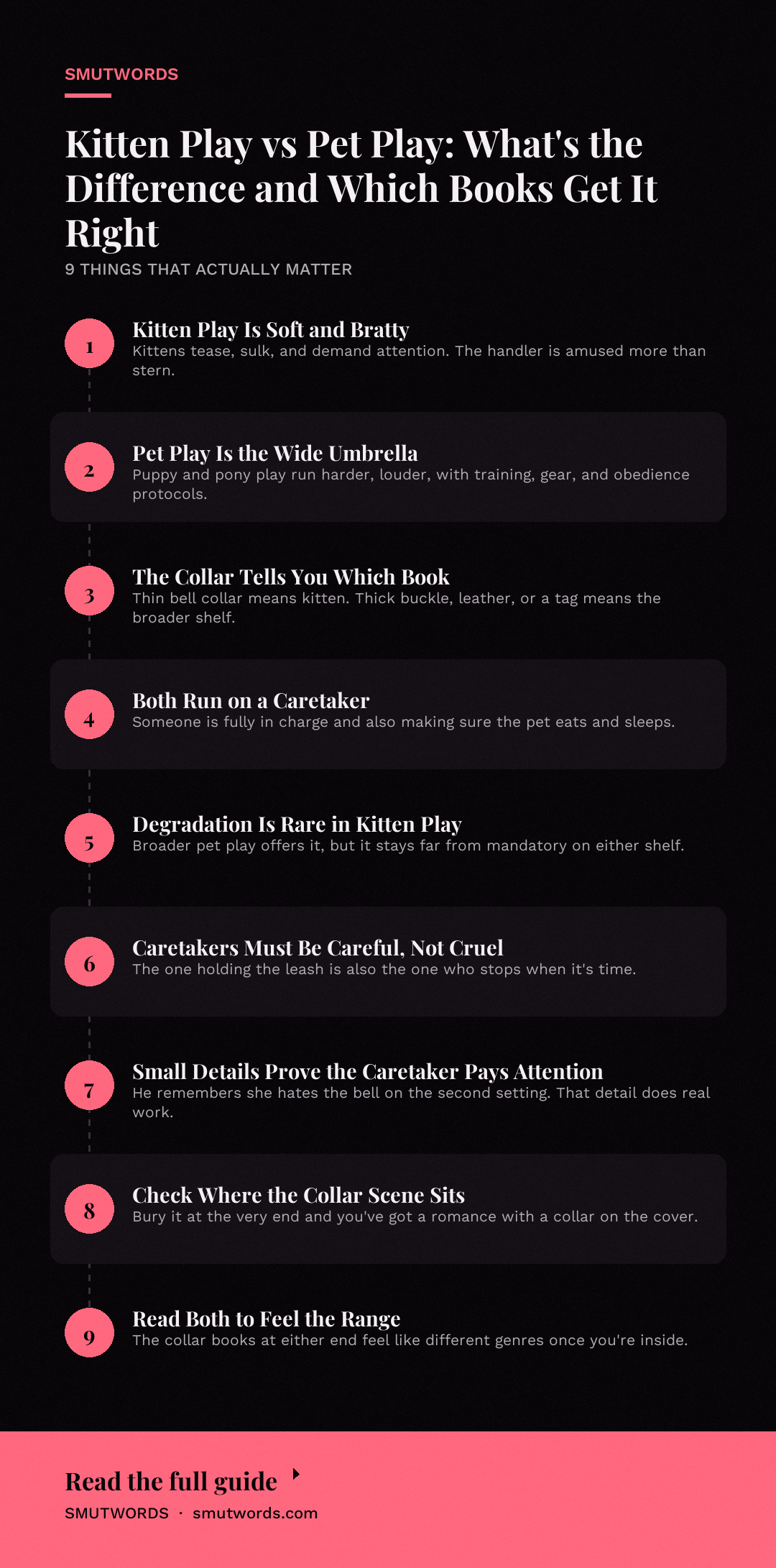
- Register. Kitten play reads playful and cute. Puppy and pony play read more athletic, more obedient, more physically demanding.
- Gear. Thin bell collars and ears for kittens; thick buckle collars, leashes, muzzles, harnesses for the wider shelf.
- Behavior asked of the pet. Kittens tease and sulk and demand. Dogs obey and perform. Ponies are driven.
- Degradation. Rare and usually light in kitten play. More available, though far from mandatory, across broader pet play.
- Caretaker flavor. Both have one, but kitten play's caretaker is frequently a fond, indulgent handler. Puppy play's is more often a trainer with a clipboard of rules.
The words readers actually type into a search bar tell you which one they want: collar and leash, handler, kitten, on all fours, good girl. Notice how much of that overlaps. The difference lives in the tone of the response, not the props.
Where Kitten Play and Pet Play Overlap
Plenty. Both are power-exchange stories dressed in animal clothing. Both use the collar as a visible claim of ownership, which is why collar scenes read as intensely intimate even when nothing sexual happens during them. Both run on the pet's surrender of small decisions (what to eat, when to rest, where to lie down) and the caretaker's assumption of those decisions.
And both, done well, treat the pet's pleasure as the caretaker's responsibility. The scene isn't over until the pet is taken care of. That's the load-bearing wall of the whole subgenre, and it's the thing bad versions of these books skip.
How to Tell Which Book You're Getting
The cover blurb usually gives it away if you read for three details.
- The collar description. Bell and ribbon means kitten. Buckle, leather, or a tag means the broader shelf.
- The verb the handler uses. "Come here" skews kitten. "Sit" and "heel" skew puppy.
- Whether the pet talks back. A pet with a mouth and opinions and a taste for being a brat is nearly always written as a kitten, regardless of what the book calls her.
Beyond that, check whether the book treats the caretaker as tender. If the blurb promises rules and discipline with no hint of warmth underneath, you're in puppy territory or further. If it promises being spoiled, being fed, being curled up in someone's lap after, that's kitten play with a collar on it.
Enjoyed this? Get a free book.
Join the list and we will send a complete free story straight to your inbox, plus new releases every week after that. No credit card, no catch.
Kitten Play and Pet Play Books That Get It Right
Look for books where the power exchange is specific and the caretaking is real. Vague dominance with a collar slapped on top reads thin, and you can feel it on the first page. Here are a few that don't fumble it.
The AI Wants to Watch runs the caretaker dynamic through a technological wall, which sounds cold on paper and isn't. Someone is always watching, someone always has the reins, and the surrender to that gaze has the same shape as a hand on the back of a collar.
It sits closer to the pet play umbrella than the kitten end. But the "someone is in charge and is paying very close attention to you" engine is exactly the engine that makes a collar scene land.
Lured by the Lizard Beast plays the creature and the human across a size difference kink that does a lot of the same work an animal register does: the body is bigger, stronger, and the smaller one has to be looked after. Different species, same caretaking skeleton.
Free Use Casino goes to the ownership end hard. If you want the extreme of the collared-and-claimed register, that's the one where the claim is total and the pet's role is laid out plainly. It's a good palate-cleanser after a few soft kitten books, because it reminds you how far the pet play shelf stretches in one direction.
For a dominant whose tenderness is the entire point, He Paid Him to Fuck Me puts a third party in the room and lets the caretaker run the whole scene from the chair. The "someone is deciding what happens to your body, and doing it with care" structure is textbook handler logic. Same with Permission Slip, where the whole story is permission being granted by a person who is watching out for you.
The Collar and Leash Vocabulary, Defined
Readers type these terms a lot, and the books don't always explain them. Quick decoder:
- Collar. The visible claim. Buckling it on in a scene usually functions as the story's commitment moment, the point of no return.
- Leash. Control at a distance. A kitten on a leash reads as "kept close," a puppy on a leash reads as "guided." Same object, different warmth.
- Handler / Owner / Trainer. The caretaker. "Handler" skews kitten and casual, "Owner" skews formal and possessive, "Trainer" skews obedience-and-protocol.
- Headspace. The pet's internal state during the scene. In kitten play it's often floaty, contented, a little mischievous. In broader pet play it can go deeper and quieter.
If those terms keep coming up in what you're reading, you'll probably enjoy spanking as the natural punishment-and-reward mechanic for a collar scene, and overstimulation as the go-to for the caretaker pushing the pet past what she asked for because he's decided she can take it.
What the Caretaker Dynamic Really Runs On
Both subgenres die on the same hill: a caretaker who's written as cruel without being careful. The whole fantasy requires that the person holding the leash also be the person who stops when it's time, who asks if the collar is too tight, who puts you to bed after. Take that away and the story turns sour on the page. The collar stops meaning safety and starts meaning threat, and most readers bail.
The good versions build in a small, concrete detail that proves the caretaker is paying attention. He remembers she doesn't like the bell on the second setting. He brings the food she actually likes. He checks the leash before he tugs.
That one detail does more work than a full page of declarations. Books that skip it and go straight to the scene read hollow, and you notice.
If you want a caretaker whose attention runs the other way, in an enemies to lovers frame where the "owner" is the last person she'd willingly kneel for, the same rules apply. The collar only works when the hand on it is gentle.
Which Should You Reach For?
Read kitten play if you want the softer, brattier, more playful register: the bell collar, the teasing, the handler amused and indulgent until he isn't, the scene dissolving into being held rather than put through the wringer.
Read broader pet play if you want the training, the heavier gear, the obedience protocols, the more athletic or animal-forward push. Read both if you want to feel the range, because the shelf is wide and the collar-and-leash books at either end feel like different genres once you're inside them.
One last thing worth knowing: if the book buries the collar scene at the very end, it's probably not really a pet play book. It's a romance that used a collar for the cover. Which isn't a crime. It's just a mislabeled product, and the whole point of knowing the difference is so you can spot the label before you buy.
Final Thoughts
If you want one book to feel the difference up close, start with The AI Wants to Watch. It puts a caretaker behind a screen who never stops watching, never stops deciding, and never stops making sure the person under that attention is looked after. Read it, then pick up a soft kitten book and read the same structure played far warmer. You'll know within a chapter which end of the collar you keep reaching for.






Loading comments…