Most couples who get into kink never sit down and pick a consent framework. They borrow whatever language they heard first, usually SSC, and run with it until something in their play stops fitting the model and they can't say why.
That's the point where knowing the difference between SSC vs RACK actually matters. Not because one is correct and the other is wrong, but because they answer different questions. Figuring out which question you're actually asking will change how you negotiate everything from a first rope scene to a weekend at a dungeon.
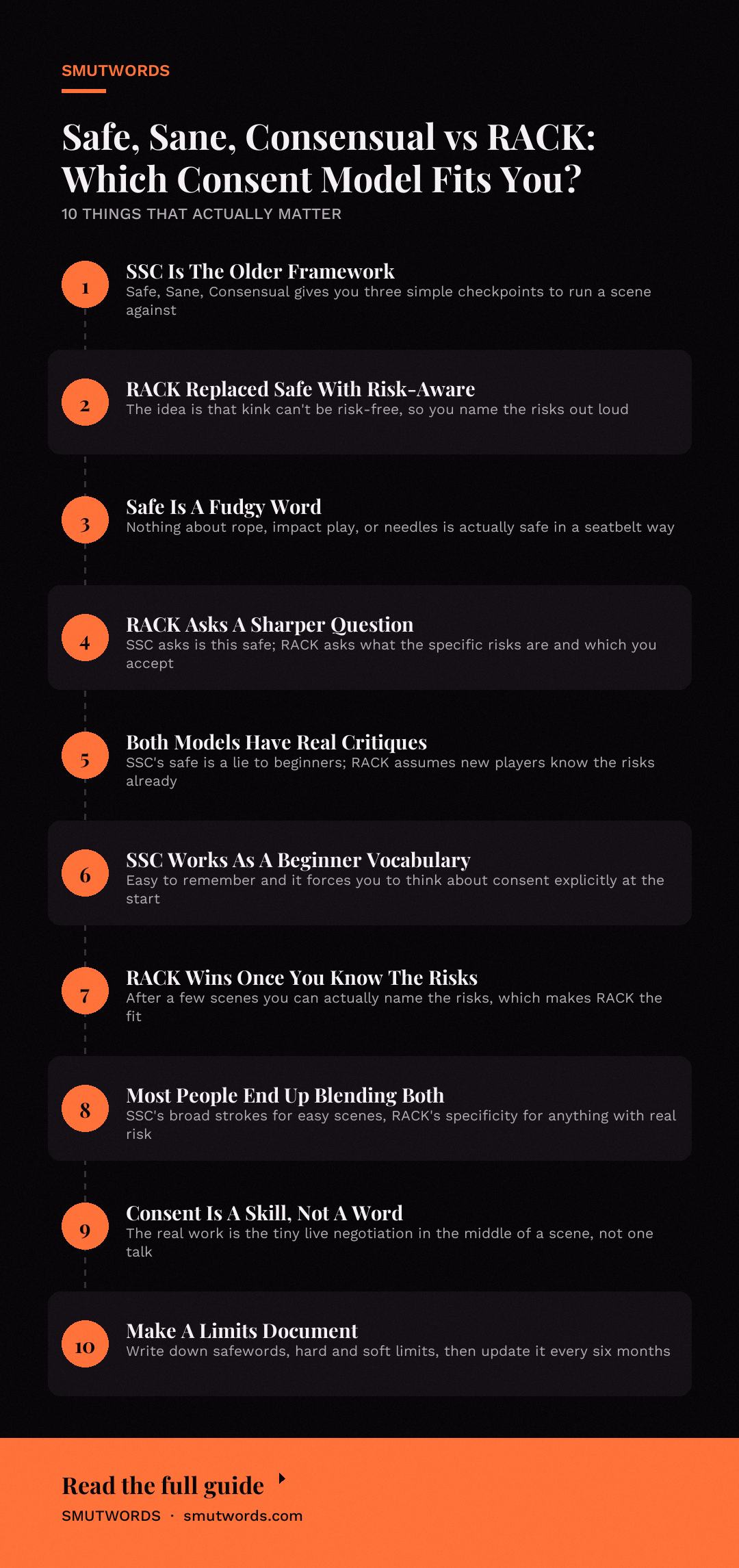
Here's the short version before the long version. SSC stands for Safe, Sane, Consensual, and it's the older, more cautious framework. RACK stands for Risk-Aware Consensual Kink, and it showed up because a lot of experienced players found SSC too vague to be useful.
Neither is a rulebook you have to sign. They're lenses. Most people who've been doing this a while end up blending them without thinking about it, which is fine as long as you're deliberate about the blend.
What Is SSC (Safe, Sane, Consensual)?
SSC is the framework that most beginner resources still teach first, and for good reason. It's simple, it's easy to remember, and it gives you three checkpoints to run a scene against before anyone takes their clothes off.
- Safe. The play carries a manageable level of physical and emotional risk, and you've taken steps to reduce what you can.
- Sane. Everyone involved is in a clear enough headspace to consent, which rules out playing drunk, playing in a crisis, or playing to prove something.
- Consensual. Every person has said yes, freely and with a real understanding of what's about to happen.
The origin story is a bit murky. Most people credit it to a group of gay men in the 1980s who were trying to distinguish their play from the predatory reputation leather culture carried at the time. It spread through kink education and ended up as the default vocabulary, which is why it's the first thing you'll see in most intro guides.
The problem is the word "safe." Nothing about impact play, rope, or needles is actually safe in the way a seatbelt is safe. A flogger can bruise a kidney. Rope can compress a nerve. A collar can get caught on something.
When you call a scene "safe," you're usually saying "safe enough for me to tolerate the risk," and that fuzziness is exactly what RACK was built to fix. If you want a deeper look at how risk shows up in practice, the guide to hair pulling kink is a good example of a common activity where the line between fun and actual neck strain is thinner than most people assume.
What Is RACK (Risk-Aware Consensual Kink)?
RACK dropped the word "safe" entirely and replaced it with "risk-aware." The idea is that you can't make kink risk-free, so the honest move is to name the risks out loud, decide together which ones you're willing to take, and then take them with your eyes open. The "sane" checkpoint also quietly disappears, because a lot of people in the scene found it patronizing and vague.
Who decides what sane means? A suspended scene can look insane from the outside and be perfectly organized from the inside.
The framework was pushed by Gary Switch, a kink educator, in the early 2000s, though the acronym floated around in various forms before that. RACK assumes adults can weigh their own risks. That's a more respectful stance than SSC's implied "we'll make sure it's safe for you," and it also puts more responsibility on you to actually do the weighing.
Where SSC asks, "Is this safe?" RACK asks, "What are the specific risks here, which ones are acceptable to us, and what are we doing to manage the rest?" That's a more useful question for anything past beginner play. It's also a more honest one when you're talking about edge activities where the whole appeal is a controlled dose of danger.
The Main Critiques of Both Models
SSC's critics argue that "safe" is a lie that lulls beginners into thinking a scene can be risk-free if they just follow the checklist. They also point out that "sane" is culturally loaded and has been used to pathologize kinks that seem strange from the outside, from teratophilia-style monster fantasies to the rougher power exchange in something like Absolute Surrender. Calling a fantasy insane because it's unusual is a bad reason to write it off.
RACK's critics argue that it assumes too much. A brand-new player doesn't know what the risks are yet, so asking them to be "risk-aware" before they've learned the terrain is a bit like handing someone a motorbike and telling them to be careful. There's also the concern that RACK can be used to justify genuinely reckless play if the person doing the justifying is persuasive enough.
Both critiques are fair. Neither framework prevents an asshole from being an asshole. That's why neither model works without actual conversation, and why most experienced folks treat the acronym as a starting prompt rather than a script.
How the Two Frameworks Differ in Practice
The clearest way to see SSC vs RACK in action is to watch how each one handles the same scene, say a first suspension. Under SSC, you'd check that the rigger is competent, that the hardpoints are rated, that the bottom is sober and enthusiastic, and that you have safety shears within reach. All good.
Under RACK, you'd also talk about nerve compression specifically, ask what numbness or tingling means and what to do when it starts, discuss whether the bottom wants to stay in the air after their hands go cold, and agree on a verbal check-in every few minutes.
Those extra steps don't contradict SSC. They're just more specific, which is almost always better. The shorter way to put it: SSC gives you three broad categories, RACK gives you a conversation. If you've ever tried to negotiate a scene using only "is this safe and sane," you know it produces vague answers.
Where SSC Wins for Beginners
If you're two weeks into reading about kink and haven't done a scene yet, SSC is a fine starting place because it's easy to remember and it forces you to think about consent explicitly. That matters when you're new and everything feels overwhelming. Use it as a training wheel. The vocabulary gets you to the first conversation.
Where RACK Wins for Experienced Players
Once you've done a few scenes, RACK becomes more useful because you actually know what the risks are. You can name them. You can talk about the specific nerve pathways, the specific emotional risks, the specific places where play stops being a game. The framework lets you be honest about what you're doing.
RACK vs PRICK and Other Variations
RACK isn't the last word either. PRICK (Personal Responsibility, Informed, Consensual Kink) was introduced in the 2010s to push the responsibility back onto the individual: you informed yourself, you accepted the risk, you own the outcome. Some educators prefer it because it's blunter. Others find it isolating, since it can read as "you're on your own."
There's also 4Cs (Caring, Communication, Consent, Caution), which some people find warmer than RACK, and CCC (Caring, Communication, Consent) for people who want to skip the risk talk entirely, which is a choice you should probably avoid if you're doing anything spicier than mild sensation play. None of these frameworks are standardized. There's no governing body handing out certifications. That's part of why knowing the landscape matters, and why you shouldn't treat any acronym as more than a starting prompt.
The good news is you don't have to pick. Most people who've been at this for a few years are functionally using a blend: SSC's broad strokes for easy scenes, RACK's specificity for anything with real risk, and deep communication throughout. That blend has a name in some circles (sometimes CCCC, or just "the conversation"), but calling it a name is less important than having it.
Enjoyed this? Get a free book.
Join the list and we will send a complete free story straight to your inbox, plus new releases every week after that. No credit card, no catch.
How to Bring This Up With a Partner
The worst way to introduce a consent framework is as a lecture. The best way is as a practical question. Something like: "Before we do anything more, can we figure out how we want to think about risk? I've been reading about SSC vs RACK and I want to know what you actually want to be told in advance of a scene." That's a conversation starter, not a class.
Once you're in it, be specific. Don't ask, "are you okay with this?" Ask, "if I tie your wrists behind your back, do you want me to check your circulation every five minutes, or do you want me to ask once and then let you tap out if it gets bad?" Those two questions sound similar and produce completely different scenes.
The second one respects that your partner might want to actually feel restrained, rather than being interrupted constantly with "how's that feel?"
It also helps to name the categories you'll never cross.
Bruising is fine. No neck pressure. No breath restriction. No leaving visible marks where a colleague would see.
Those clear lines are what make the rest of the play bearable, and they're more useful than any acronym.
What "Risk-Aware" Actually Means for a Newbie
Risk-aware doesn't mean you have to know every possible edge case before you tie a single rope. It means you can answer, for the specific thing you're about to do, what could go wrong and what you'd do about it. Here's a quick way to check yourself before any scene:
- Can I name the worst realistic outcome of this scene? If yes, what's my plan for it?
- Do I know where the safety shears, water, and phone are?
- Does everyone know the safeword, and is it something we'd actually say in a panic (avoid words that could plausibly come up as dirty talk)?
- Have we talked about what happens if someone wants to stop and also can't speak?
- Are we both clear on what the aftercare looks like?
If any of those get a shrug, you're not ready for the scene yet. That's fine. Go do something easier and come back to it. The brat play guide is a good example of a low-stakes dynamic where you can practice the conversation skills before the stakes get higher.
Consent Is a Skill, Not a Word
A lot of people treat consent like a permission slip you sign once at the start of the relationship and then never revisit. That's how consent violations happen in otherwise decent relationships.
The real skill is the tiny negotiation that happens in the middle of a scene: "can I do more of this?" "slower." "harder?" "yes, but not on my spine." That's not the same as the big conversation. It's a live adjustment, and it's where most scenes live or die.
Both SSC and RACK are attempts to put language around that adjustment. SSC says "check that it's safe and sane and consensual." RACK says "be specific about the risk." Neither one does the work for you, and neither one stops you from misreading your partner's face in the middle of a scene. The only thing that does that is paying attention, and stopping the second something feels wrong rather than riding it out because the script said you should.
Worth saying plainly: a lot of the fiction that gets people into kink leaves the negotiation out entirely. Hot in fantasy, dangerous if copied in real life.
Stories like The House Party Whore and Free Use Casino lean on a certain fantasy where everybody's already agreed to the stakes, but that's the fantasy, and the real thing needs a conversation first. The guide to public sex is a good example of a fantasy where the real-world version carries legal risk that the fiction ignores.
When to Stop and When to Bring It Back Down
Stopping is part of the framework, not a failure of it. The scene ends when someone says so, and the fact that you're using SSC or RACK doesn't override that.
If your partner goes quiet, that can mean they're deep in subspace or that something's wrong.
The only way to know which is to have established, in advance, what quiet means for them. Some people want you to check in when they get quiet. Some want you to keep going and let them ride it. You have to know which before you start.
The other thing worth saying: if you're not sure whether to stop, stop. It costs you a scene. The opposite costs you a partner's trust, which is harder to rebuild. The guide to semi-public sex makes a similar point about legal risk: the fantasy version and the real thing are held together by the conversation, and if you skip the conversation because you're excited, you don't get to complain about the consequences.
Which One Actually Fits You?
If you're brand new to kink, start with SSC, but treat it as a vocabulary lesson rather than a finished framework. It'll get you to your first real conversation, which is where the actual work begins.
Once you've done a few scenes and know what the risks are, move toward RACK, because it gives you the specificity that SSC lacks. If you have a partner who likes power exchange and rough play, RACK's risk conversation is non-negotiable, and a lot of motorcycle club romance dynamics that look spontaneous on the page are actually held together by exactly that kind of negotiation underneath.
Make a document. Write down the safewords, the hard limits, the soft limits, and the specific things you'd need a conversation about before doing. Update it every six months or when something changes. That document is more useful than any acronym, and it's the thing that makes SSC and RACK work in the first place.
Final Thoughts
If you want one book to read next that puts the negotiation on the page without flattening the fantasy, pick up Subroutine: Breed Her, and pay attention to how the power exchange stays legible the whole way through.
Then read The Work Party Dare if you want a lighter, messier version of the same question. Both are fiction, but both are useful for seeing what it looks like when two people actually know what they're doing to each other. The rest is just practice.





Loading comments…