Strip the covers off and a reader could be forgiven for thinking they're holding the same book twice. Big nonhuman male, human woman, a biological imperative he can't override, a heat cycle or a breeding contract or a ship full of eggs with her name on them.
The monster breeding vs alien breeding question comes up constantly in reader groups, and it's a fair one, because the two subgenres share a skeleton. What separates them lives in the muscle and the setting: why the breeding has to happen, where it happens, and what the male is actually offering when he says the word "mine."
The Short Answer: Same Kink, Different Engine
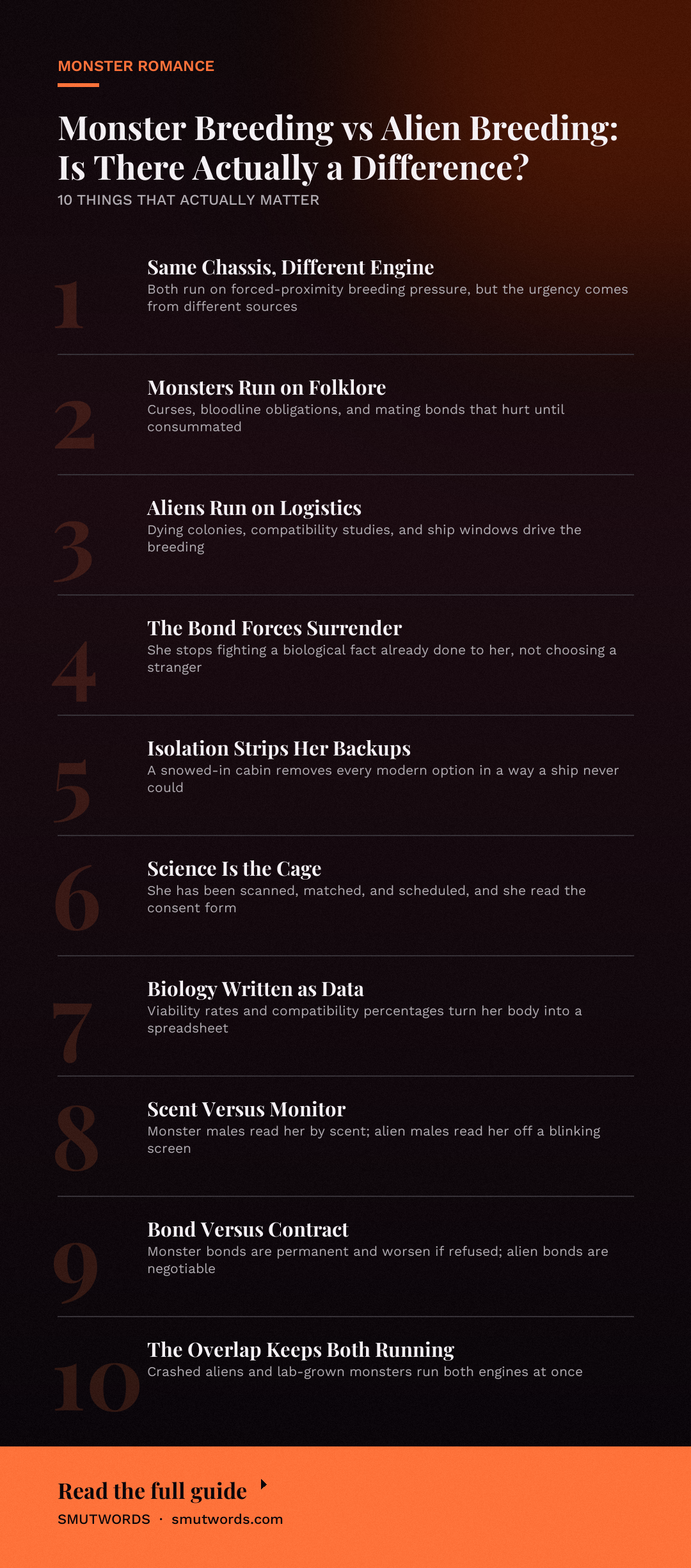
Both subgenres run on forced-proximity breeding pressure. A human woman ends up in a situation where reproducing with a nonhuman is either required, inevitable, or the only way anyone survives the winter. That's the shared chassis, and it does most of the work.
The difference is the engine under the hood. Monster breeding gets its urgency from a curse, a species collapse, a mating bond that physically hurts until it's consummated.
Alien breeding gets its urgency from logistics: a dying colony, a genetic compatibility study, a spaceship with a three-week window before the next jump. One is folklore with teeth. The other is biology with a flight plan.
Monster Breeding: The Bond Does the Work
Monster breeding stories keep one foot in old-world logic. The male is a minotaur, a wolf-shifter, a thing with antlers and a resentful attitude, and the breeding drive is written as a curse or a bloodline obligation. He doesn't want to claim her. He has to, or he'll go feral, or his line ends, or the land itself starts dying because the old pact went unfulfilled.
Read enough of these and the pattern is obvious. The knotting scene, the full-moon window, the ceremonial cave, the female lead learning that her body "responds" to something she has no name for. The prose leans on heat, scent, and animal instinct, and the setting is usually pre-industrial or rural enough that a mating bond still reads as believable.
What the Bond Actually Requires
In monster breeding, the mating bond is a contract with physical consequences. Skip the ritual and the male degrades. Refuse the bond and the female feels the pull in her chest every night until she gives in. That reciprocal suffering is what gives the subgenre its teeth, and it's why the breeding scenes land harder for a lot of readers than the alien equivalent.
It also means the emotional arc is about surrender. She isn't choosing a stranger. She's choosing to stop fighting a biological fact that's already happened to her. If that structure sounds familiar, it's the same engine powering a lot of dark romance, just wearing fur.
The Setting Is Doing Real Work
A cabin in the woods with one bed and a snowed-in road is doing more for monster breeding than any spaceship ever could. Isolation without technology. No phone, no shuttle, no way to call for a doctor when the contractions start. The monster's world strips the female lead of every modern backup, and the breeding becomes the only plan available.
That's why so many of these books open with a wrong turn, a broken-down car, a research trip that goes sideways. The genre needs her alone with him, and it needs her unable to explain any of it to another human being.
Monster Breeding Checklist
- A curse, prophecy, or species decline forcing the pregnancy
- Physical mating bond with withdrawal symptoms if refused
- Non-industrial or hidden setting with no outside help
- Heat cycles, scent-marking, knotting, nesting behavior
- Male POV chapters where he hates how badly he wants it
Alien Breeding: The Science Is the Cage
Alien breeding books hand the male a lab coat and a translator chip. He's not cursed. He's a geneticist, a warlord collecting compatible females, or a colony administrator who ran the numbers and realized the human population is the only viable gene pool left.
The breeding pressure is bureaucratic and cold, which is exactly the appeal. The female lead has been scanned, matched, and scheduled. She's read the consent form. She still ends up in the breeding chamber, because the alternative is watching the colony flatline in eighteen months.
Where monster breeding leans on folklore, alien breeding leans on worldbuilding. Expect an incubator room, an ovulation monitor, a culture dish with her name scrawled in alien script, and a male who speaks in clinical terms right up until he doesn't. If you like the technical side of this, it overlaps heavily with monster romance vs alien romance territory, where the setting does most of the genre classification by itself.
Biology Written as Data
Alien breeding has a specific vocabulary. Viability rates. Genetic compatibility percentages. Gestation cycles measured in "sols." The female lead gets scanned, charted, and prodded, and the erotic charge comes from how much of her body has been turned into a spreadsheet by a male who then loses control of it anyway.
That's the tension the subgenre runs on. He built a system to manage her reproductive cycle. Then the system starts producing results he didn't plan for, like a protective instinct, a claim he can't justify in a report, or an emotional response that shows up in the data as elevated heart rate.
The Setting Strips Her of Everything Except Him
A ship in deep transit, a colony dome on a hostile moon, an outpost where the only humans are her and a skeleton crew. Alien breeding needs isolation too, but the isolation is mechanical rather than geographic.
There's no walking out. There's a hull. There's a locked airlock and a male who controls the key.
Enjoyed this? Get a free book.
Join the list and we will send a complete free story straight to your inbox, plus new releases every week after that. No credit card, no catch.
This is a big part of why cyberpunk romance readers sometimes drift into alien breeding without meaning to. The corpo-controlled biology, the surveillance, the body being a resource someone else is managing: it's a direct pipeline.
Alien Breeding Checklist
- Colony collapse or genetic bottleneck creating the demand
- Clinical monitoring, scans, charts, data logs
- Sealed setting: ship, dome, station, lab
- Compatibility testing, viability percentages, breeding contracts
- Male POV where his data-driven calm starts cracking mid-scene
Where the Two Subgenres Actually Diverge
The clearest difference shows up in how the male handles her body. In monster breeding, he reads her by scent, heat, and animal cues. He knows she's ready because he can smell it.
In alien breeding, he reads her off a monitor. He knows she's ovulating because the screen is blinking at him.
That single change rewires the whole scene. Animal instinct versus instrument reading. Dumb, overwhelming need versus informed, deliberate procedure.
The first makes the male the danger. The second makes the system the danger and the male the man who runs it.
The Mate Bond Versus the Contract
Monster breeding bonds are permanent and if anything gets worse over time. Walk away and both parties suffer, sometimes to death.
Alien breeding runs on contracts, breeding terms, renewal periods, custody clauses for the hybrids. The bond is negotiable. The pregnancy is not.
So the emotional stakes differ. Monster breeding forces a woman to accept that the bond has already chosen for her. Alien breeding forces her to accept a bargain she can argue with, which is its own type of awful, because she can't claim she had no choice.
Both work. They just play into different reader appetites, and figuring out which one you want is half the reason the comparison keeps showing up. If you're also trying to sort out what kind of body the male has, size queen vs monster cock kink covers a lot of that confusion directly.
Which One Fits the Reader
Simple test. Do you remember the knotting scene in your favorite monster breeding book better than the plot? Monster breeding.
Do you remember the spreadsheet the alien male was updating while she stood naked in the scanner? Alien breeding.
Some readers happily read both and don't mind the overlap. If you're one of them, the real question is which fantasy you want to sit inside for three hundred pages. Being claimed by something that can't help itself, or being filed inside a system that has decided your uterus is colony infrastructure.
Both fantasies rely on the same underlying pressure, which is why they get lumped together in rec threads. Both are one half of a much larger argument in the community, too. If you want the wider version of this fight, it's the same confusion answered in monster romance vs alien romance, just with the breeding element pulled out of the center.
The Overlap, and Why It Doesn't Ruin Either Genre
Plenty of books blur the line on purpose. A crashed alien who's also a beast. A monster who was grown in a lab on a colony ship. A setting that's technically sci-fi but reads like a haunted forest because the ship crashed somewhere with no signal and a lot of predatory wildlife.
The best of these keep both engines running. The bond hurts him and the contract traps her. That double pressure is why some breeding romances hit harder than either pure subgenre manages on its own.
If the messier, wetter, more tactile side of the breeding scene is what you're chasing, that's a slightly different appetite, and the wet and messy fetish guide covers the territory both subgenres occasionally wander into during a clutch or a heat scene.
Final Thoughts
Pick your next read by which engine you want under the hood. If you want the bond, the curse, and a male who degrades without her, start with a monster breeding title and skip anything with a star map on the cover. If you want the colony, the contract, and the cold clinical monotone that cracks mid-scene, go the other direction. They don't wear the same skin once you know what to look for.






Loading comments…