
Most couples who get curious about the free use kink don't start with a spreadsheet of rules. They start with a scene that won't leave their head: someone bent over the kitchen counter pretending to ignore their partner, or a movie paused halfway through because one of them reached over and the other one just kept watching.
The fantasy is specific. Being available, being used. The hard part is figuring out whether the thing that's hot on the page still sounds good when you're standing in your own living room on a Tuesday.
So here's the practical version. What the dynamic actually is, why it works on so many people, and how to build one at home without letting standing consent turn into a giant gray area nobody can point to.
What the free use kink actually means
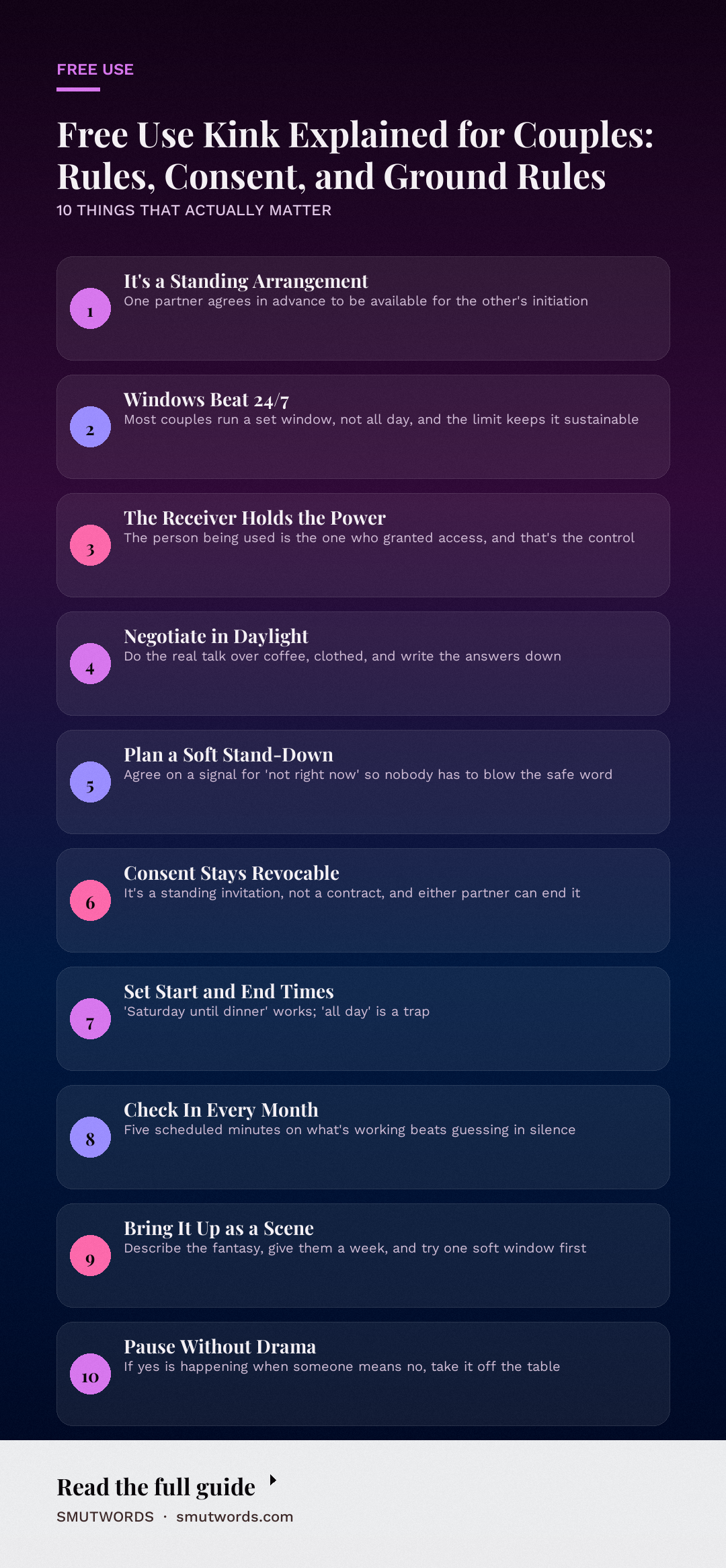
Free use is a standing arrangement, usually negotiated in advance, usually with a time limit, where one person agrees to be available for the other's sexual initiation. The initiating partner doesn't have to ask permission in the moment. The receiver might be reading, cooking, half asleep, on a call with their mom. The whole point is the interruption.
In practice, most couples don't run this 24/7, no matter what the search results imply. The realistic version looks like a Saturday afternoon window, a weekend away, or a rule that says "if the door's closed, you can come in." The restriction is part of the fun, and it's the part that keeps it sustainable.
What separates this from being a pushy partner with a boner and a philosophy is the negotiation and the off-switch. The fantasy is "no asking in the moment." The reality is that the asking happened, thoroughly, weeks before, and both people know exactly what they signed up for.
Why people are drawn to it
Different couples get drawn in for different reasons, and it's worth knowing which one is yours before you set anything up.
- The objectification angle. Being wanted as available, as an object of desire, as something to reach for. It can feel flattering and genuinely hot, especially for people who spend most of their lives being the responsible one.
- The receiving partner's power. Less obvious, but real: the person being "used" is the one who granted the access. That's a specific kind of control, handing over the keys and knowing the car comes back.
- Surprise and interruption. Everyday tasks becoming the site of something explicit. Doing the dishes and getting pulled away from them.
- Relief from initiation fatigue. For couples where one person is always the one reaching and getting turned down, the arrangement can take the sting out of "not right now" because the window for it is already defined.
A lot of these overlap with consensual non-consent fantasies, and plenty of readers who come to free use fiction from that direction bounce between the two. The difference is the shape of the "no." CNC is about simulating resistance. Free use is about removing the need to ask at all.
If you've been trying to figure out which side of that fence you're on, the explainer on free use vs somnophilia sketches how the two dynamics split. Reading it side by side with the somnophilia explainer usually settles the question in under ten minutes.
If the fiction on the site is what pulled you here, the free use novels are the obvious starting point. Free Use Neighbor is the version that runs on a shared wall and a too-thin fence. If you want to see how the dynamic works as a series, start with the Penny Pepper free use reading order.
There's also an interview on how the free use series got built that's oddly useful for understanding which beats readers actually want. And a piece on free use world-building that explains why the fantasy needs a reason attached to land properly.
Free use kink rules you should actually write down
The mistake most couples make is agreeing in bed, at midnight, after the mood is already rolling. That conversation feels fantastic and produces almost no usable detail.
Do the real negotiation over coffee, in daylight, with clothes on, and write the answers down somewhere you can both check later. A shared note on your phone is fine. Boring is fine.
Here are the things to actually decide.
- Which days and windows count. All day Saturday. Every evening after the kids are down, with the bedroom door closed. Weekends away only. If it's not a time you both agreed to, it's not a free use window.
- What "use" covers. Whether that means an interruption on the way to the shower or a fifteen-minute session on the couch, or something involving toys or restraints. Be explicit about the menu. Vague consent gets interpreted generously, and that's exactly the failure mode you're trying to avoid.
- The receiver's stop signal. One word, something you'd never say in normal life. When it's said, everything halts immediately, no discussion in the moment. Talk it through after.
- How the receiver signals "not right now, but the window is on." This is the one most couples forget. A little pre-agreed gesture, hands in the air, a specific phrase, turning the phone face down on the counter, lets someone stand down without the fantasy collapsing. If the only options are "yes" or "safe word," the dynamic gets brittle fast.
- What's off the table permanently. Specific acts, specific body parts, anything tied to a previous injury or a bad experience. Write these down and don't relitigate them mid-scene.
- Who gets to end it. Either partner, at any time, outside the window too. Revocability is the load-bearing wall.
That last point deserves its own section, because it's the entire difference between a hot arrangement and something that will quietly get resented.
Standing consent and the revocability question
"Standing consent" is real consent. Consent given in advance, before a scene, is still consent, as long as it can be pulled back.
The mental model most people find useful is a standing invitation, not a standing contract. You can invite someone to reach for you in the kitchen every Saturday. You're not signing an agreement that says Saturday is theirs no matter what's going on in your body or your head.
Which means both people need to know they can call the whole thing off without it turning into a fight or a cold week. A receiver who's worried a pause will get taken as rejection will push through bad days, and the dynamic will curdle. The people who run this well treat a pause as completely ordinary. "Not today" doesn't need to be a whole scene of its own.
Enjoyed this? Get a free book.
Join the list and we will send a complete free story straight to your inbox, plus new releases every week after that. No credit card, no catch.
If your partner's reaction to "not today" is sulking, guilt, or a lecture, the free use dynamic isn't the problem. That's the thing to address first, and the dynamic itself should come off the table until it's sorted.
Risks, and how to lower them
The real risk with free use isn't some exotic injury scenario. It's the slow erosion of communication because everything was agreed in advance and nobody wants to be the person who keeps checking. A few structural fixes handle most of it.
- Always have a landing window. A window is defined by a start and an end. "All day" is a trap; "Saturday afternoon until dinner" is not.
- Schedule a five-minute check-in. A monthly conversation: what's been good, what's been off, is the arrangement still doing what we want it to. Not scheduled sex, scheduled communication. Do it over a meal on a regular night so it's not a weird interrogation vibe.
- Bodies belong to real life. Medications, medical conditions, exhaustion, injuries, and pregnancies all change what a body can actually do on any given day. No scene should require a partner to ignore their own body's signals, and neither person's health gets to be overridden by the arrangement.
- Watch for the power imbalance. If one partner has a lot more leverage outside the bedroom, the earner, the decision-maker, the one who's not the default parent, a downward shift in the arrangement can feel much harder to call. That person needs to be the one checking in more.
- Keep the vanilla going. A steady diet of interruption-only sex can leave one person feeling like a service. Sex that isn't about the arrangement, that's warm and slow and asks clearly, keeps both sides topped up.
Worth saying plainly: nothing in a free use dynamic involves breath restriction, heavy restraint, or anything that could actually hurt someone. If you're moving toward those, they need a separate conversation with someone who knows what they're doing, and the free use arrangement isn't a shortcut into them.
How to bring it up with a partner
The safe way to test the water is to make it about a scene, not about your relationship rules. "I read something about a couple who had a standing agreement for one afternoon a week, and it's been living in my head" tells your partner what you want without demanding a policy change over dinner.
Give them a week to think about it. Some people are immediately into it, some need to sit with it, and some are going to say no, which is fine and doesn't need to be a referendum on your sex life.
If they're curious but nervous, try a soft version first. One agreed window. Clothes stay on. The receiver can interrupt at any point. Afterwards, in the cold light of day, see which parts actually landed.
Lots of couples discover that what they love is one specific element, the surprise, the objectification, the aesthetic of being ignored, and the rest can go.
If you found this stuff through fiction and have always thought about it that way, be honest with yourself and your partner about which needs you're trying to meet. There's a whole catalog on the site for scratching that itch on a page rather than in the bedroom, and plenty of couples get exactly what they need from a story without ever running the scenario.
Reading it together is a low-stakes test run, and the conversation that follows is often more useful than the story was.
Common mix-ups with adjacent kinks
Free use gets confused with three other things regularly, and the differences matter when you're negotiating.
- Free use vs. CNC. CNC involves pretending a "no" is being overridden. Free use removes the need to ask, which means there's no pretended resistance. You can run them together, but they're different knots to tie. The CNC explainer is the place to start.
- Free use vs. somnophilia. Somnophilia is about the sleeping state itself. Free use can happen while the receiver is asleep, and if that's part of the appeal it needs its own separate, very clear agreement about sleep and waking.
- Free use vs. hotwife dynamics. Hotwife arrangements involve third parties. Free use is usually two people and no one else, and the negotiation is about reaching for each other, not about outside partners. If there's overlap, it gets negotiated separately. He Left the Door Unlocked is worth reading specifically for how the invitation mechanics differ.
If you like the objectification and power-exchange elements in your fiction too, The Impregnation Trials runs the dynamic through a very different set of rules, and Wetware Slave takes it into a far future with a completely different ethical frame. None of those are instructional. They're fiction, and the negotiation on the page is a plot device, not a manual.
When to stop, and how to end it cleanly
Ending the arrangement is fine at any time, for any reason, including none. Nobody has to make a case. But "I think we should stop" with no context is going to land badly regardless of how well the dynamic was running, so end it in a conversation, in daylight, ideally with a "here's why."
Signs to pull the plug, at least temporarily:
- Either of you is saying yes when you want to say no, even occasionally.
- One of you is monitoring the other's enthusiasm and keeping score.
- The check-ins have stopped happening and neither of you can remember the last one.
- It's bleeding into daily life, and the person being "available" starts feeling universally on-call.
- Anyone's using the arrangement as leverage in a bigger argument.
If any of those are true, the move is the boring one: take it off the table, talk it through at a normal volume in a normal room, and leave the door open to come back to it. Plenty of couples pause and restart. The dynamic that lasts is the one that can be put down without either person feeling like they're losing something.
Final Thoughts
The fiction is where most people figure out what they want, and that's a perfectly respectable way to start. Soles of Devotion is the one to pick up if you want a version where the power exchange is specific and strange and the negotiation is right there on the page.
Read it with your partner and talk about which parts made both of you laugh and which parts made somebody go quiet. That conversation tells you more about whether this dynamic belongs in your bedroom than any checklist in this post.







Loading comments…