
A personal assistant romance is a love story built on the charged, uneven ground between an employer and the person who runs their life. The assistant answers the phone at midnight, knows which files the boss needs before the meeting, sees the cracks behind the public face, and falls for the human underneath. The pairing runs on proximity, class friction, and the fantasy of being so essential that affection becomes inevitable.
What follows covers what the trope really is, where it came from, how the best authors make it work, and what separates a personal assistant romance worth your evening from a lazy one you will forget by Thursday.
What Personal Assistant Romance Actually Means
Strip away the press releases and the corner office and the definition is simple: one character is paid to be close to another, and that closeness turns intimate. The assistant is not a stranger who happens to work in the building. They are embedded in the employer's daily life, which is what separates this trope from general office romance.
The name points at the role itself. "Assistant" covers executive assistants, celebrity minders, nannies who run a household around a demanding professional, and the private aides who orbit powerful public figures. What ties them together is access: the assistant sees the boss before coffee, after the divorce papers arrive, during the panic before a board vote. Intimacy exists before any romance does.
The Boundaries That Do and Don't Make a Personal Assistant Romance
Plenty of workplace love stories get labeled personal assistant romance online when they do not fit the trope at all. The line matters for readers who come looking for a specific flavor and find the wrong book. Here is what counts as this trope, and what just borrows the word "office."
- Counts: The assistant reports directly to the love interest and the relationship lives or dies by that reporting line.
- Counts: The job involves intimate non-work access: the hospital pickup, the birthday errand, the late-night truth-telling over a hotel mini-bar.
- Counts: A power imbalance that both characters feel and neither can pretend away.
- Does not count: Two colleagues at the same level who share a break room and think it is forbidden.
- Does not count: A secretary who appears for two scenes and vanishes while the actual book is about a rival CEO.
One common misconception deserves a paragraph. Readers assume the trope requires the boss to be a man and the assistant a woman.
Plenty of titles flip it, and some of the most popular installments give the assistant the real authority through their knowledge of the company. Gender-swapped versions of the trope have grown steadily, especially in indie romance. The fantasy of indispensable access works in both directions.
Another misconception: readers sometimes expect the employer to be a flat tyrant. The best versions give the boss their own wound, which is why the trope so often overlaps with a redemption arc romance. A cold, exacting employer who softens only around the one person who has seen them fail is one of the most reliable engines in the subgenre.
Where Personal Assistant Romance Comes From
The trope's publishing history is younger than it looks. It runs through the same channel as much twentieth-century category romance: the boss and the secretary, the sheikh and the typist, the mogul and the temp. Pulp and serialized romance sold the office pairing for decades because the workplace was the one setting where men and women reliably shared daily hours.
What changed in recent years is the assistant role itself. The personal assistant replaced the typing pool and the general secretary as a distinct character type, and with it came a new fantasy: the person with access to the whole calendar, the whole life.
Celebrity culture fed the fantasy. The assistant who manages a film star's schedule, the aide who stands behind a public figure during a scandal, the nanny holding a famous household together. This is why the trope shares so much DNA with celebrity romance and rockstar romance: all three run on the gap between a public persona and the private person only a very few get to see.
The digital era pushed the trope into new territory. Billionaire romance serialized on phones, Kindle-short installments, and the rise of steamy indie publishing gave the pairing a huge second life. Authors stopped treating the assistant as a plot device and started writing their POV as the main event, which is the shift that made the trope feel modern. Indispensable access became the story, not the setup.
A quieter evolution happened in the ethics. Older versions glossed over the power imbalance, treating the boss's advances as romantic rather than something with consequences.
Contemporary versions address the friction head-on. Modern authors tend to build in either a resignation or an HR reckoning once things turn physical. Readers now want the characters to recognize what is at stake, and the result is a stronger trope with real stakes.
How It Shows Up in Erotica
The craft of the trope comes down to the power gap and the proximity. Strong authors know the first act is not a rejection of the gap but an acknowledgment of it. The boss's authority is what makes the assistant so interesting to watch.
Coworkers see a title, competitors see a threat, and the assistant sees a person who makes mistakes, loses their temper, and needs a steadying hand before a hard morning. This is why the point-of-view character so often wins the scene by being the only one paying real attention.
Common Variations Readers See on the Page
- Executive vs. temporary assistant: The temp arrives with nothing to lose and no career to protect, which makes the pushback sharper and the employer's interest more believable.
- Nanny and single parent: The job moves into the employer's home, so the intimacy is domestic rather than corporate. Childcare creates its own ethical pressure, especially when the kids bond with the nanny first.
- Celebrity or rockstar aide: The boss's public image is the obstacle, and the assistant becomes the one safe person in a life full of handlers.
- Bodyguard swap: The protection contract reframes the imbalance as chivalry, and the physical closeness does the romantic work up front. If you want the version with tactical gear and a hidden sidearm instead of a spreadsheet, start with soldier romance.
- Ghostwritten memoir: A writer working inside a famous name's life hits the same access problem, so many ghostwriter romance titles sit comfortably on the same shelf.
- Seasonal or short-term contract: The assistant's position ends at a set date, which forces the confession before the last day rather than letting the tension drift.
The strongest versions make the job feel real. A scene where the assistant reorders the boss's meetings so they actually eat lunch lands better than a parade of luxury descriptions nobody asked about. Good authors put the workplace competence on the page, because competence is what makes the reader believe the boss is drawn to this person and not just to a warm body in a pencil skirt.
Weak versions fail in predictable ways. One common failure is the boss who crosses a line in chapter three and the characters never discuss it again. Another is the assistant who never has a life outside the office, which makes the love story feel like a hostage exchange rather than a choice. A third, and the biggest, is when the office details are borrowed from bad television.
What does a strong version look like on the page? A few markers worth looking for:
Enjoyed this? Get a free book.
Join the list and we will send a complete free story straight to your inbox, plus new releases every week after that. No credit card, no catch.
- The assistant has ambitions of their own and the job is a step, not a sentence.
- The employer's power shows up in small, precise ways: who pays for dinner, who decides where the conversation ends, who forgets a name.
- The turning point lands at the exact moment the professional mask slips and the reader sees the vulnerability underneath.
- The friction gets named. Someone says out loud that this could cost the assistant their career, and the characters respond to that fact.
Some authors lean hard into the forbidden angle, and the forbidden wiring does not have to be the point. The day-to-day proximity is more than enough heat, because the reader already understands that an assistant and an employer cannot take a two-week trial run on a hookup and keep working together on Monday. That is the tension the whole trope runs on.
The physical scenes follow from the role. In the best versions, the employer is the one who has to ask, because asking is the only way the assistant can say yes without it also being a yes to their boss. That structural reversal is worth paying attention to. The employer's usual authority gets suspended the moment they want something the assistant controls, which is where a lot of the heat comes from.
For readers who like this dynamic extended into roleplay, the same pressure works outside the book, and the authors at SmutWords have a solid primer on roleplay scenarios for couples that do not feel cringe.
Craft note for writers: give the assistant at least one special competence that the employer genuinely needs. A talent for reading people, a spine under pressure, a memory for what the boss will not admit they need. The employer is supposed to be impressive, so their choice has to be significant. If the assistant is interchangeable with the last three hires, the reader feels it and the trope collapses into a power fantasy with no actual personality.
The other craft lever is the boss's loneliness. The trope lives or dies on whether the reader believes the employer could be genuinely isolated despite the public success. Show the empty calendar, the assistant scheduling the flowers to a parent, the boss calling the office at 11 p.m. because they do not know who else to call.
That last detail appears in enough books to count as a trope inside the trope, and it works every time.
Personal Assistant Romance vs. Marriage in Trouble
These two get confused in reader recommendations more than you might expect, and the reason is emotional structure. Marriage in trouble also runs on closed-door spousal intimacy and hidden corners of a long-term partnership, and plenty of blurbs across both subgenres sound nearly identical. The difference is who is on the inside.
In personal assistant romance, the lover starts outside the household and earns their way in through work. In marriage in trouble, the characters are already legally entangled and are fighting to stay that way. The assistant version is a courtship story with a contract; the marriage version is a reclamation story with a divorce filing.
Some authors combine them: the boss hires the assistant after the marriage falls apart, and the assistant's access to the boss's grief becomes the thing that eventually reopens the door. That hybrid is its own beast, and it works when the author is honest about which plot is actually carrying the book.
Frequently Asked Questions
What makes a good personal assistant romance?
Three things: a believable workplace, a genuine power imbalance that the characters acknowledge, and an assistant with a life and goals outside the office. The best versions make the reader feel the boss's authority in small details before any kiss happens, so the eventual romance feels earned rather than obligatory.
Is personal assistant romance the same as boss and secretary romance?
Close cousins, not twins. Boss and secretary usually emphasizes typing pools, corporate hierarchy, and a slightly older style of office. Personal assistant romance leans on 24/7 access, digital calendars, and the way the job bleeds into nights and weekends. The personal version is usually more modern and more intimate.
Can personal assistant romance be read on its own, or does it need a series?
Most titles stand alone easily. The trope is strong enough to carry a single book. Serialized installments exist and are popular on reading apps, but they are not required, and the standalone options tend to develop the characters more fully.
Does personal assistant romance always involve a billionaire boss?
No, though rich-boss versions are common. Plenty of titles feature mid-career employers: a surgeon, a struggling novelist, a small-business owner, a reality-TV star. The money is optional; the access and the imbalance are the load-bearing elements.
Is personal assistant romance appropriate for readers who want a slow burn?
It is one of the best tropes for a slow burn, since the workplace proximity makes closeness inevitable while the professional relationship keeps the characters apart. Readers who want acres of teasing before the first kiss will find a lot to like here.
Where can I find more work like this if I loved one of these books?
Start with celebrity and rockstar titles, which share the private-access fantasy, then look at nanny and bodyguard variations.
If you want the employer softened by someone who sees through their public image, the redemption arc subgenre overlaps heavily. Readers who like the emotional pressure should also try rags to riches romance for the same class-friction heat with a different backdrop. And if the power dynamics are what pulled you in, this breakdown of switch dynamics covers the same push-and-pull from the bedroom side.
Final Thoughts
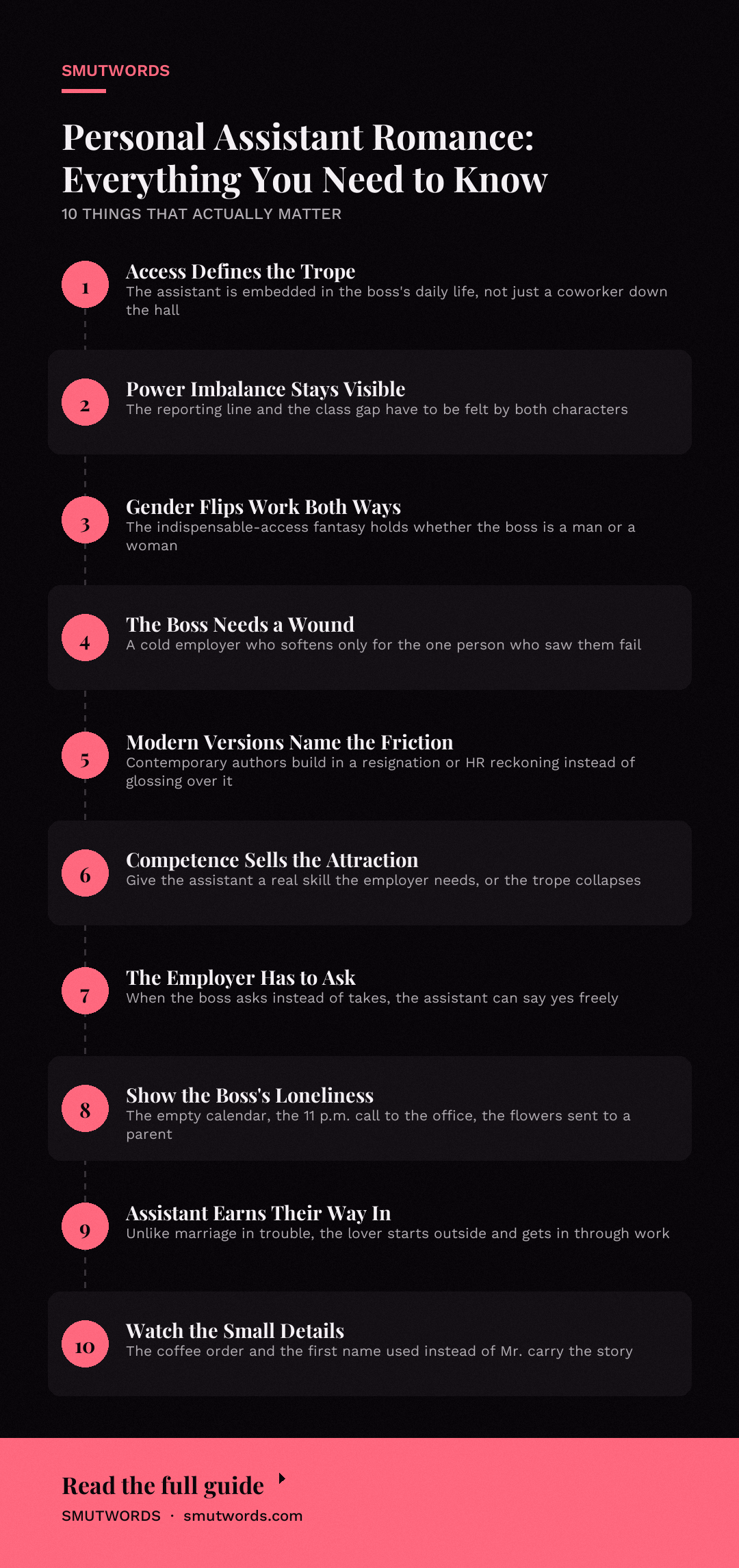
The trope endures because it gives readers a front-row seat to the moment a powerful person drops their defenses for the one employee who knows where the bodies are buried. Read closely for the small, specific details: the coffee order, the late-night call, the first name finally used instead of "Mr." That is where the personal assistant romance does its best work.








Loading comments…