
A wet and messy fetish is a sexual interest in the look, sound, weight, and temperature of substances on skin: food, mud, paint, lube, slime, cream, water, and everything in between. The wet and messy fetish treats the body as a surface to be covered, and the pleasure lives in the sensory overload of that covering.
Sometimes the mess is the whole event. Sometimes it's a stage the scene passes through on the way to something else. In erotica it's one of the most physically vivid kinks a writer can put on the page, because every sense has something to report.
What Wet and Messy Fetish Actually Means
The name is almost aggressively literal: things get wet, things get messy, and that is the point. The fetish sits inside a broader family of tactile interests, where arousal comes from texture, coverage, and the feeling of a substance moving over the body rather than from a specific body part.
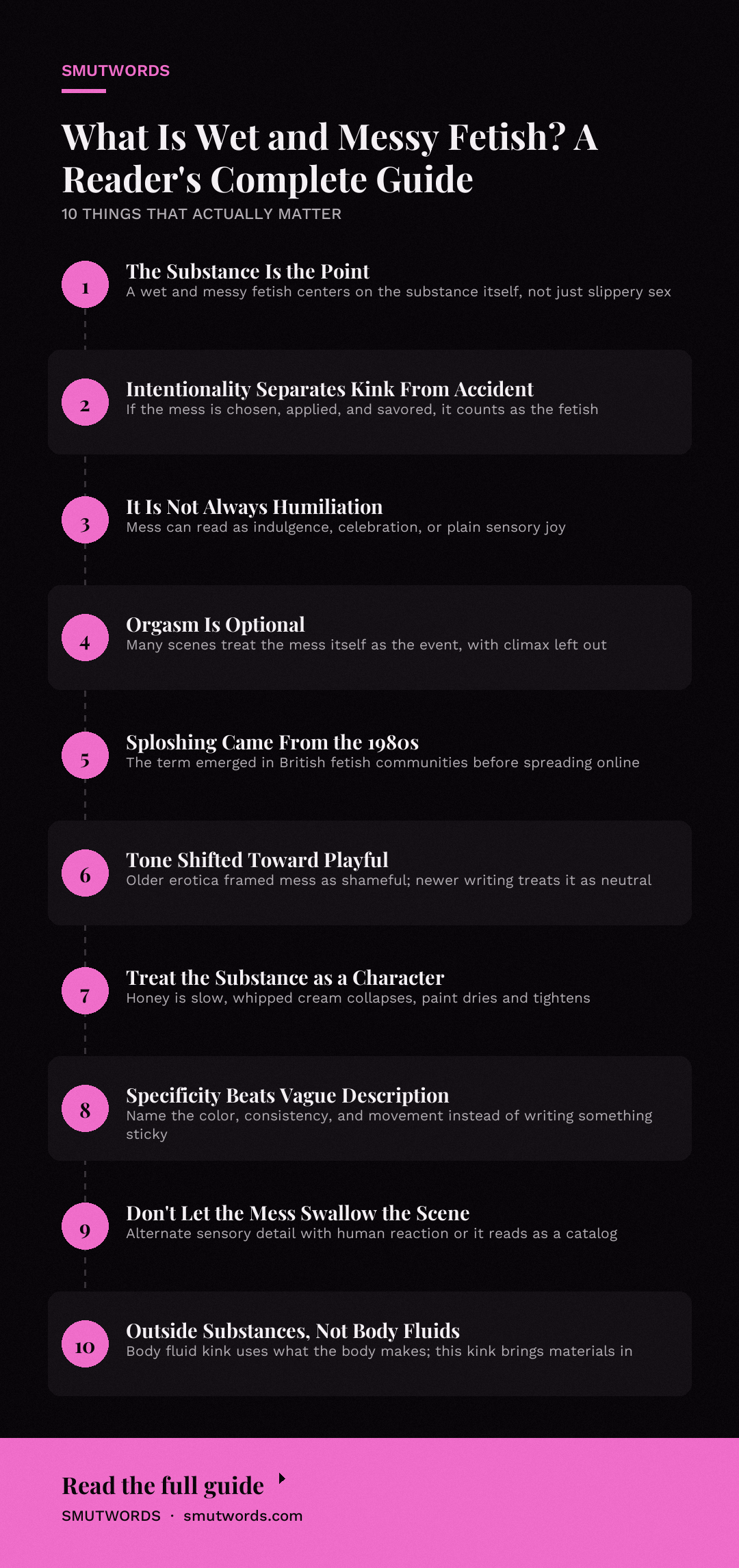
It's distinct from a general love of sex that happens to be sweaty or slippery. A wet and messy fetish is oriented around the substance itself: its color, its viscosity, how it drips, how it pools, how it dries. The mess is the erotic object.
The fetish overlaps heavily with the body fluid kink family, though the substances involved usually come from outside the body rather than inside it. The difference matters for how writers frame a scene and for how readers respond to it.
What Counts and What Does Not
Plenty of things get filed under this label that do not quite belong. The cleanest test is whether the substance is doing erotic work in the scene.
- Counts: a partner pouring honey down a lover's spine and licking it off. A food fight that turns into something else. Paint, mud, slime, cake, cream, chocolate, oil, foam, water.
- Does not count: a couple who happen to be sweaty after the gym and never mention it. A scene where a spilled drink is purely comic relief. A splash of water that exists only to justify a wet T-shirt.
The distinction is intentionality. In a wet and messy scene, the substance is chosen, applied, and savored. It's a prop the author has deliberately placed.
Common Misconceptions
The biggest misconception is that this is a niche so extreme it lives only on the fringes. In practice, food play and wetlook imagery are among the most mainstream entry points into kink writing, precisely because they look playful on the surface.
Another is that wet and messy always means humiliation. Some scenes use mess as a degrading act, but plenty more use it as indulgence, celebration, or plain sensory joy. The dynamic is entirely up to the writer.
A third is that the fetish requires actual sex. Many practitioners and many fictional scenes treat the mess itself as the event, with orgasm optional. The sensory experience carries the erotic weight.
Where Wet and Messy Fetish Comes From
The honest history here is a publishing history, not an ancient tradition. The term "sploshing" emerged in British fetish communities in the 1980s and 1990s, describing the specific thrill of sitting in or being covered by wet, messy substances, particularly food. The word spread through niche magazines, early internet forums, and specialist video catalogs before it ever appeared in mainstream fiction.
Food play has a longer, looser pedigree in erotic writing. Whipped cream, chocolate sauce, and champagne have been shorthand for decadent seduction in romance and pulp fiction for the better part of a century. Those scenes rarely called themselves a fetish, but the sensory mechanics were the same.
Wetlook as a visual and fashion category developed in parallel. Wet clothing, oiled skin, and water-soaked fabric became a recurring image in photography and film, and erotica borrowed the aesthetic wholesale. The look of being wet became its own signal of desirability.
What has shifted most is tone. Older erotica often framed mess as transgressive, something a character had to be coaxed into or ashamed of afterward. Contemporary writing treats it far more neutrally, as a preference among preferences, which has opened the door to lighter, funnier, more playful scenes.
The internet reshaped the genre again by making the vocabulary visible. Once readers could search "sploshing" or "wet and messy" and find a named community, writers started writing to that audience directly, with more explicit attention to substances, textures, and cleanup details that earlier fiction glossed over.
How It Shows Up in Erotica
This is where the kink earns its keep on the page, because it gives a writer access to senses that romance often skips. Most sex scenes lean hard on sight and touch. A wet and messy scene can lean on sound (the squelch, the drip, the splatter), temperature (cold cream on hot skin), weight (a full bowl of something poured slowly), and taste.
The strongest versions of this trope treat the substance as a character with its own behavior. Honey is slow and reluctant. Whipped cream collapses. Paint dries and tightens. Mud is heavy and warm. Let the material dictate the pacing of the scene.
Common Variations Authors Use
The variants below recur most often in published erotica, each with a slightly different emotional register.
- Food play. The most recognizable entry point. Cake, chocolate, fruit, cream, and champagne appear constantly, and the register ranges from romantic to chaotic.
- Slime and gel play. A modern variant with a sci-fi or playful edge that leans heavily into texture and sound.
- Mud play. Earthier and more primal, often paired with outdoor settings and a loss of civilized restraint.
- Paint play. Body as canvas, which lets a writer borrow the language of art and mark-making.
- Wetlook. The clothing-focused version: soaked fabric, clinging material, water streaming over skin. It pairs naturally with a lingerie fetish when the garment itself becomes the erotic object.
- Oil and massage. The gentlest on-ramp, where the substance is functional but the sensory pleasure is the whole show.
What Separates a Strong Scene From a Flat One
A flat wet and messy scene describes the substance without letting it do anything. "He poured chocolate on her" is a stage direction. The version that works slows down and gives the reader the temperature, the sound, the way the character reacts to the first cold contact.
Specificity is the other dividing line. "Something sticky" is a missed opportunity. Naming the substance, its color, its consistency, and the way it moves turns a generic mess into a scene a reader can feel.
Strong scenes also respect the character's reaction. Some characters luxuriate. Some flinch, then relax. Some laugh.
A scene that lets that genuine response drive the beat reads far better than one where everyone is instantly, uniformly into it.
Enjoyed this? Get a free book.
Join the list and we will send a complete free story straight to your inbox, plus new releases every week after that. No credit card, no catch.
One more craft trap: the mess can swallow the scene. If every paragraph is a description of a substance, the erotic tension flattens into a catalog. Alternate between sensory detail and human reaction, and let the mess reveal something about the characters.
For writers building a scene where a partner discovers a taste for this, the same principles that make any first-time scene work apply, and the roleplay scenarios for couples guide covers the pacing of that discovery well.
Mess and the Wider Fetish World
Wet and messy scenes cross-pollinate with a surprising number of adjacent kinks. The texture focus connects to a transformation fetish when a character is visibly changed by what covers them, coated in something that makes them unrecognizable.
The material focus also overlaps with a leather fetish in scenes where wet clothing or oiled gear is the centerpiece, and with a high heel fetish when soaking or soiling specific footwear is part of the appeal.
There is even a cross-link to the petrichor kink, where the smell of wet earth and rain does the work; mud play is the obvious meeting point.
Safety and Cleanup in Fiction and in Fact
Writers who handle this kink well also handle the practicalities. Body-safe substances, skin sensitivities, and a plan for cleanup are small details that add realism, and they let a scene end on a note of care rather than abruptly.
In real play, the standard considerations apply: avoid anything that irritates skin or eyes, patch-test unfamiliar substances, and keep food-based play away from areas prone to infection. Aftercare matters too, and a warm shower and a change of clothes belong at the end of a messy scene.
Fiction can acknowledge this without becoming a manual. A character who reaches for a towel or suggests a bath afterward signals attentiveness and closes a scene cleanly.
Wet and Messy Fetish vs Body Fluid Kink
These two get confused constantly, and the confusion is understandable given how much they overlap. The clearest distinction is the source of the substance.
A body fluid kink centers on fluids the body produces: sweat, saliva, cum, and similar. The wet and messy fetish centers on substances introduced from outside the body: food, paint, mud, slime. Similar sensory focus, different origin.
The overlap is real. Sweat, spit, and other bodily wetness can absolutely appear in a messy scene. Still, the label a writer chooses shapes how the scene reads. Body fluid framing tends toward intimacy and exposure; wet and messy framing tends toward indulgence, play, and the visual drama of coverage.
One adjacent confusion worth clearing up: lactation scenes and breeding scenes are often lumped together with fluid-focused kinks, and the lactation kink vs breeding kink breakdown is a good companion read for anyone sorting through the fluid-adjacent terminologies.
Frequently Asked Questions
What is a wet and messy fetish?
It is a sexual interest in the sensory experience of being covered in or in contact with substances: food, mud, paint, slime, water, oil. The pleasure comes from texture, temperature, sound, and the visual drama of coverage, rather than from a specific body part.
Is sploshing the same thing as a wet and messy fetish?
Sploshing is one name for the practice, most commonly associated with sitting in or covering the body with wet, messy substances, often food. It is a subset and a synonym rather than a separate kink. The broader term covers paint, mud, slime, and wetlook as well.
Do you need special substances or gear?
No. Many people start with food already in the kitchen or water in the shower. Writers and real practitioners who care about safety stick to body-safe, non-irritating materials and test unfamiliar substances on a small patch of skin first.
Can a wet and messy scene be gentle rather than degrading?
Yes. A lot of published erotica uses the kink for celebration and sensory indulgence rather than humiliation. Oil, warm water, and fruit are common gentle-entry substances, and the tone depends entirely on how the characters treat each other.
Is this kink ever paired with other fetishes?
Frequently. The texture focus puts it next to the foot fetish in scenes where messy feet or soaked footwear are the appeal, and it sits comfortably beside wetlook, leather, and body-fluid play.
How much cleanup work does a scene involve?
More than most. Practical scenes keep towels, wipes, and a shower nearby, and good aftercare includes drying off, changing clothes, and checking for skin irritation. Fictional scenes that mention cleanup tend to feel more grounded than those that skip it entirely.
Final Thoughts
The wet and messy fetish earns its popularity in fiction because it gives a writer access to almost every sense at once. It rewards specificity and punishes vagueness. Write the temperature, the drip, the startled laugh, and it lands.
If you want to see how a tactile scene can be built around character rather than novelty, the rags to riches romance guide is a useful study in how a single physical detail can drive an entire relationship arc, and the ranked list below has the best wet and messy books to read next.








Loading comments…