
The runaway bride is a romance heroine who walks out of her own wedding, usually mid-ceremony or in the final hours before the vows, and spends the rest of the book deciding what she actually wants. The trope turns a very public, very expensive mistake into the opening move of a love story.
The dress gets abandoned at the altar, the guests get a story for the rest of their lives, and the heroine gets something rarer in romance: a hard reset at the worst possible moment.
What follows is usually a road trip, a small town, a grumpy stranger with a cabin, or a face-to-face reckoning with the man she left behind. It is one of the oldest crowd-pleasers in the genre, and one of the most reliable engines for instant plot. Readers do not pick up a runaway bride book for the wedding. They pick it up for the exact second after.
What Runaway Bride Actually Means
Strip away the tulle and the runaway bride is a choice made in public. The character does not quietly call off the engagement over dinner. She leaves during the procession, in the vestry, from the back of a rented limo with the engine running. The spectacle is the point.
The trope requires three fixed elements to count as a true runaway bride story:
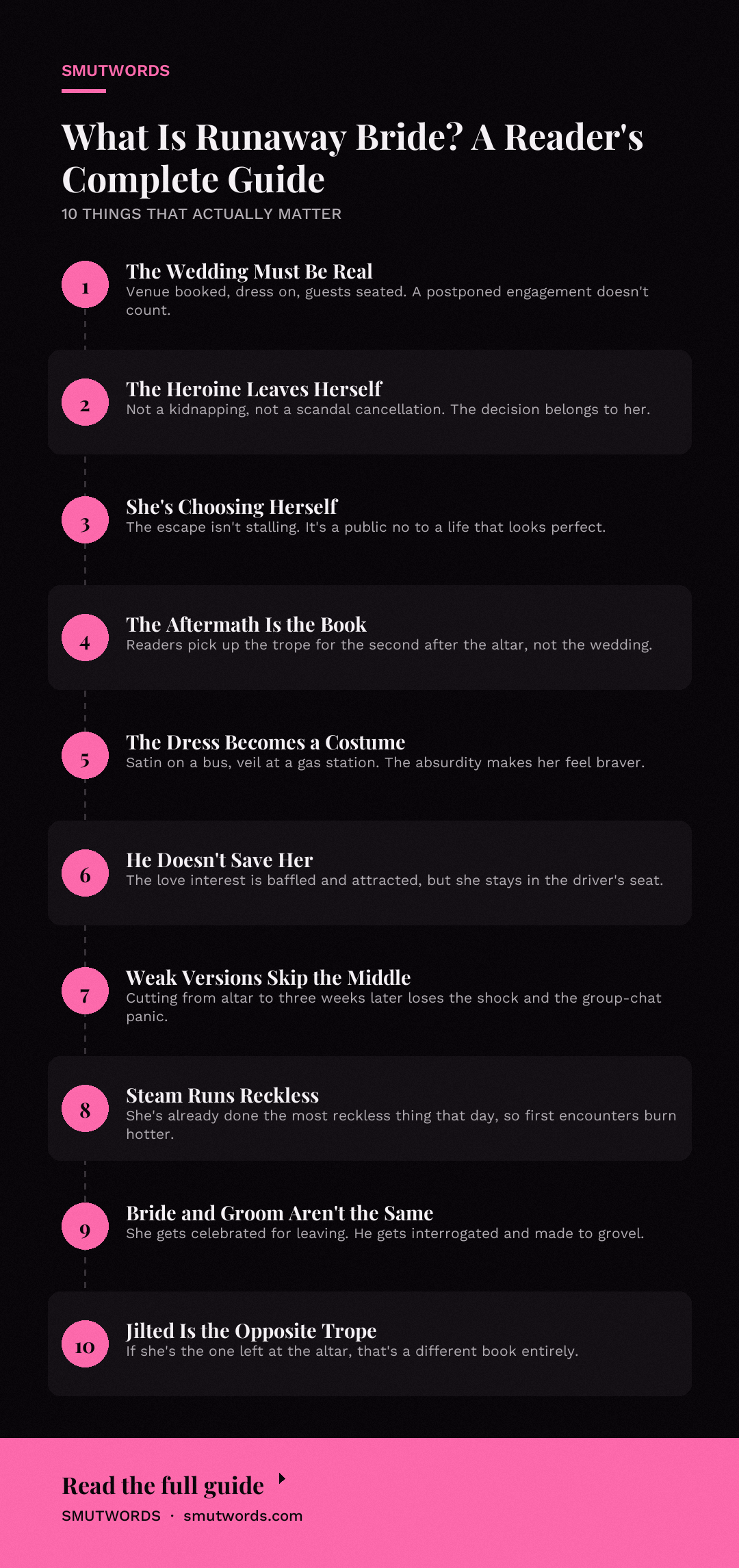
- The wedding is real and imminent. Venue booked, dress on, guests seated. A postponed engagement is a different, softer trope entirely.
- The heroine is the one who leaves. The runaway groom is its own variant, and readers treat the two very differently.
- She leaves to choose herself. The escape is not a stalling tactic, and it is not a kidnapping plot with a wedding backdrop. The decision belongs to her.
What does not count: a bride whose car breaks down on the way to the venue, a wedding that gets cancelled by a scandal, a bride left at the altar by a groom who changes his mind. All three are wedding-adjacent and all three sometimes get filed under the wrong tag, but the emotional machinery is different. The runaway bride is the one holding the steering wheel.
The term itself borrows from real life, where it is mostly a tabloid and folklore label. The romantic fiction version sticks because it names the image rather than the psychology. Readers search "runaway bride romance" because they want the dress in a backseat and the fiancé yelling into a phone, and publishers know exactly what that phrase sells.
Where the Runaway Bride Trope Comes From
The image of a bride fleeing her own ceremony has roots in folklore and nineteenth-century fiction, where it usually functioned as scandal, punishment, or tragedy. The modern romance version is younger and cheerier. It arrived in its current shape once twentieth-century popular fiction figured out that a jilted wedding could be the start of something instead of the end.
The psychological shift happened when romance novels started taking the heroine's own desires seriously as the engine of a plot. Once the genre accepted that a woman could look at a man, a dress, and a church full of guests and say no, the runaway bride became a natural plot device: an instant, high-stakes rejection of a life that looks perfect from the outside.
Contemporary romance writers treat the trope as a comedy or a drama about agency. The runaway bride is written as braver than the average heroine. She sacrifices social approval for honesty, and readers respect her for it. The trope has moved from comic misdemeanour to statement of self-respect, and contemporary publishers market it accordingly.
How the Runaway Bride Shows Up in Erotica and Romance
In romance publishing, the runaway bride is one of the most reliable structural openers in the genre. It gives the writer a public humiliation, a physical exit, and a found freedom in the space of the first chapter. From there, the rest of the book arranges itself around what she does next.
Common variants authors use:
- Runaway bride: the classic. She leaves the wedding and stumbles into a stranger, a small town, or a holiday she never planned to take.
- Runaway groom: the mirror version, usually written as a man escaping obligation and finding something real. Often darker, often with hate to love dynamics once the woman he left shows up again.
- Jilted at the altar: she is the one left behind. The runaway is the romantic problem rather than the romantic solution, and the arc becomes reckoning and forgiveness.
- Escape the engagement: the heroine leaves earlier, in the weeks before the wedding, and the plot spends more time on the life she is refusing.
- Wedding crasher romance: the bride does not make it down the aisle because someone in the back row interrupts, or a stranger's arrival changes her mind.
- Second-choice love: the heroine leaves one man for another, and the book spends real page time on why the second choice is the actual choice.
The strongest versions do something with the dress. It becomes a costume: she sits on a bus in satin, eats a gas-station sandwich in a lace veil, checks into a motel with the veil still pinned in her hair. The absurdity of the costume makes the character feel braver.
Weaker versions skip the aftermath. A flat runaway bride book cuts from the altar to three weeks later in a new town, and the reader loses the delicious middle: the shock, the humiliation, the phone blowing up with wedding-group-chat panic, the first night when she is alone in a hotel room still in her wedding underwear and finally breathes.
The best versions treat the escape as a sexual and emotional turning point. Once the structure of her old life is gone, the heroine has no rules left. Writers use this freedom to push the steam harder, with first encounters carrying a strange, almost reckless charge because the character has already done the most reckless thing in her life that day.
That reckless edge pairs especially well with tropes that reward impulsive decisions. A bride who runs away from a wedding might run straight into a stranger, and that stranger might be a road-trip one-night stand who turns into something more. If the heroine ends up in a small mountain town with a cabin, a beard, and an axe to grind, you have effectively combined the trope with lumberjack romance, a pairing that readers search for specifically.
There is also a tense, satisfying overlap with marriage in trouble books. When a runaway bride is written as older, already married, or already committed, the story shifts from escape into repair, and the "wedding" she is running from becomes a choice she has to revisit honestly.
What Makes a Runaway Bride Scene Work
A great runaway bride scene is specific and unglamorous. The best ones are ugly on purpose: mascara on the veil, a heel lost in the gravel, her aunt shouting from the church steps. The sacrifice should feel real. If her old life is a cartoon, the escape is cheap.
The man she meets should not save her. The strongest versions of the trope hold the heroine in the driver's seat all the way through. He is surprised by her, attracted to her, maybe baffled by her, but she is the one deciding what happens next.
And the sex in these books tends to be a little funny, a little frantic, and propulsive rather than polished. The heroine is making decisions that are unusual for her. The writer should honour that rawness rather than smoothing it into a slow, candlelit first encounter.
The middle act of a runaway bride book needs to survive on the character's own engine. Once the wedding is gone, why is she still interesting? A strong version has her building something new before the love interest arrives on the scene properly, so the romance is a choice rather than a lifeline.
Enjoyed this? Get a free book.
Join the list and we will send a complete free story straight to your inbox, plus new releases every week after that. No credit card, no catch.
How Erotica Writers Use the Trope
In erotic romance, the dress is almost always a fetish object. It is intricate, expensive, and impossible to get out of alone, which makes the undressing scene a real scene. Lace, corset backs, garters, and impossibly small buttons are gifts to the writer.
The public humiliation of the escape is often followed by a private, almost anonymous encounter in which the heroine gets to be someone new. She is not the bride anymore. She gets to be a stranger with a stranger, and the anonymity gives her permission to want things she would not have wanted two hours before.
Some writers extend the trope into roleplay territory. A couple staging a runaway-bride fantasy can borrow a lot from the public-escape energy, the costume, and the impulsive stranger premise. The generic roleplay ideas in this piece on roleplay scenarios that do not feel cringe work well here, and the "stranger in a motel" setup is one of the most popular no-prop scenes a couple can try.
The Hidden Tropes That Ride Alongside It
Several other tropes attach themselves to the runaway bride almost automatically:
- Second chance: the man she left turns up again, and the book becomes about whether leaving was the right call.
- Fish out of water: a city bride in a small town, usually with a stranger and a single bed.
- Rags to riches: she leaves a wealthy marriage and lands somewhere plainer, only to find the new life richer. The SmutWords guide to rags to riches romance covers the mechanics of that reversal well.
- Celebrity or spotlight: a wedding with a photographer and a magazine deal amplifies the humiliation. The celebrity romance angle is especially strong when the groom is famous.
- Childhood friends to lovers: she runs from a stranger's wedding to the one man who has known her since she was seven. Try childhood friends to lovers for the full mechanics.
There is a surprising overlap with secret baby in books where the runaway is also pregnant, though that variant is harder to pull off and often feels forced. A better fit for readers who like the runaway bride's impulsive, public energy is a rockstar romance in which the heroine flees a stuffy wedding for a night with someone famous and unavailable.
Older readers with a taste for tense, slow-burn heroines often find the runaway bride pairs nicely with a ghostwriter romance, where the woman escaping her wedding is also escaping a life she had been writing on someone else's behalf. And if a reader wants the high-stakes, no-way-out heat of the trope but with a harder romantic edge, a stalker romance is a legitimate dark variant: the man from the wedding does not let her go.
The trope also has a softer side that fits the "second chance at a first love" reader. When the runaway groom is the hero and the woman he left is the heroine, the emotional geometry is closer to hate to love than anything else, and the reconciliation arc has to earn its way past genuine anger.
Runaway Bride vs Runaway Groom
These two are more confused than any other pairing in the subgenre, and readers search both under the same keywords.
The runaway bride is typically a heroine who exercises agency and is rewarded for it. She is sympathetic by default, and the abandonment of the wedding is usually framed as brave.
The runaway groom is far more likely to be a hero with a real moral debt. Readers want him to grovel. The book is usually about him proving to her, and to the room, that he was worth more than his exit.
Where the bride is celebrated, the groom is interrogated. If you end up reading a book where the man runs and the woman is left standing at the altar in satin, you are reading jilted at the altar, and the emotional contract is entirely different.
Frequently Asked Questions
What is a runaway bride in romance novels?
She is a heroine who leaves her own wedding, usually during or just before the ceremony, and the rest of the book follows the life she builds afterward. The escape is the engine of the plot rather than a subplot, and she usually ends up choosing a new partner or re-choosing the man she left.
Is runaway bride the same as jilted at the altar?
No. Runaway bride means the heroine is the one who leaves. Jilted at the altar means she is the one left behind. The two inversions carry very different emotional weight, and readers who want one are usually disappointed by the other.
Why do readers love the runaway bride trope so much?
It is the closest romance gets to a woman saying no to a life that looks perfect from the outside. Readers get the vicarious thrill of rejecting the wrong future in the most public possible way, then the private reward of watching her choose something real.
Can a runaway bride book be steamy?
Very. The trope is a natural fit for erotic romance because the heroine has just blown up her own life and has nothing left to lose. First encounters feel stranger, faster, and more reckless than they would in a slower-burn setup, and authors lean into it.
What is the difference between runaway bride and escape the engagement?
Escape the engagement usually happens weeks before the wedding, and the story has more time to examine the life she is leaving. Runaway bride happens at the wedding itself, with the dress on and the guests present, and it is a sharper, faster, more public version of the same impulse.
Do any runaway bride books feature second chance romance?
Plenty. A common structure has the heroine leaving a wedding and running into a first love or a childhood friend she has not seen in years. That overlap with childhood friends to lovers is one of the trope's most popular pairings.
Is the groom ever the runaway?
Yes, and the runaway groom is the darker, harder variant. The hero is usually doing penance for the rest of the book, and readers expect a real grovel before the heroine gives him anything close to forgiveness.
Final Thoughts
The runaway bride trope has lasted because it treats a public no as the start of pleasure. It gives the heroine a dress, a wrecked plan, and a stranger's car, then asks what she wants with no audience left to perform for. Pick up your next read in the trope playing the dress for real, the humiliation for real, and the escape as the best decision she ever made.








Loading comments…