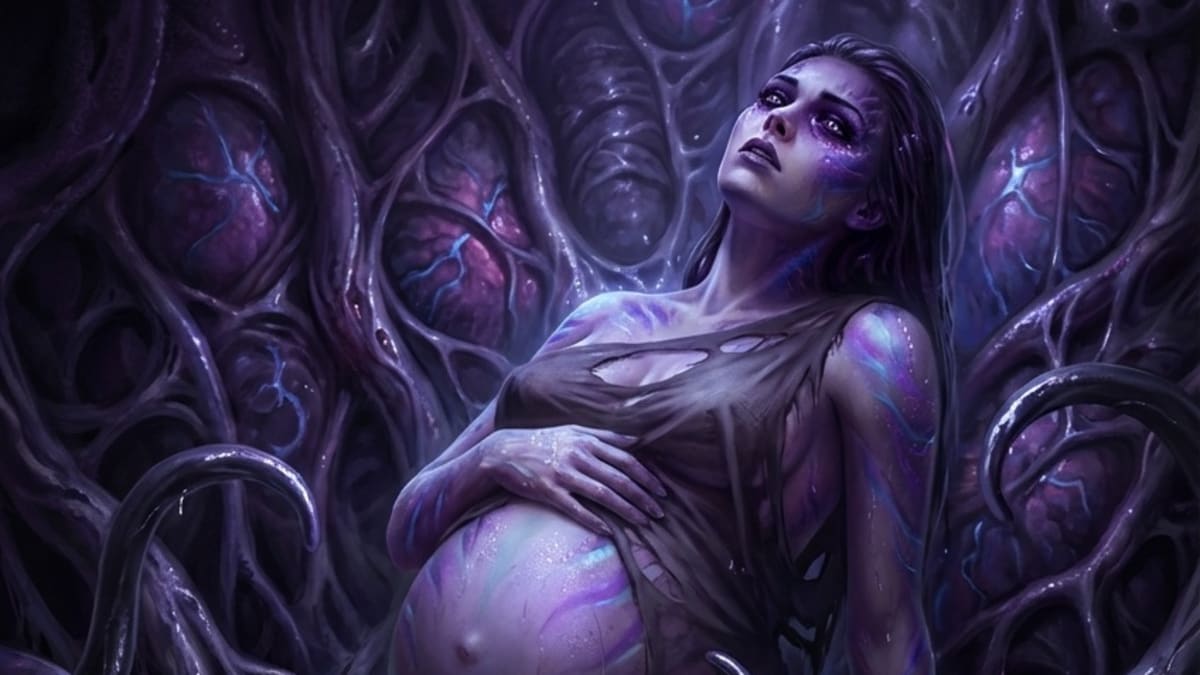
Dark romance is a love story built on morally gray actions, obsession, coercion, or real danger, where at least one lead operates well outside ethical lines and still earns a passionate, hard-won happy ending. The hero might kidnap, stalk, blackmail, or kill for the heroine. The heroine might lie, manipulate, or hand herself over to someone she knows is bad for her.
What separates dark romance from a thriller with a love interest is the guarantee: the relationship ends in love, and the reader knows it going in. The danger is the point of the ride, not a warning label.
It is one of the fastest-growing corners of self-publishing and one of the most argued-about. Readers devour it by the hundred. Critics walk in expecting abuse apologetics and walk out confused about why they finished the whole series.
Both reactions miss what the genre is doing. This guide covers what the term actually means, where it came from as a publishing category, and what a scene on the page actually does with all that menace.
What Dark Romance Actually Means
The label describes the emotional contract between book and reader, and that contract has three parts. First, the central relationship is compromised by something serious: force, deceit, criminality, possession, or psychological harm. Second, the story does not look away from that harm. Third, love and a hopeful ending arrive anyway, and the reader is meant to believe they were earned rather than handed over.
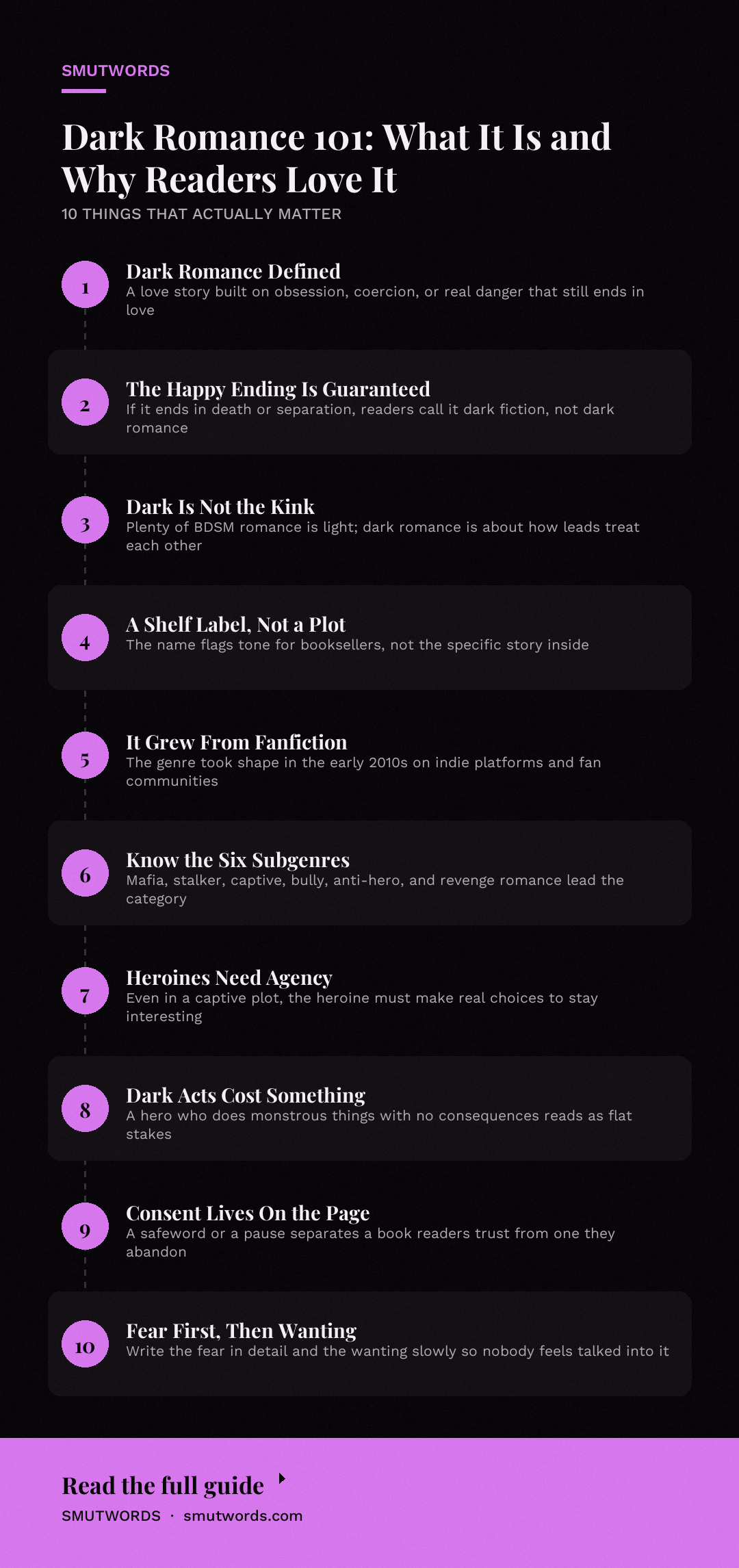
The name is a shelf label, and it grew up mostly in online retail categories. Publishers and booksellers needed a way to flag books too rough for the standard contemporary romance reader and too romantic for the crime aisle. "Dark" was the shorthand everything landed under. The genre name tells you what to expect from the tone, not the specific plot.
A few clarifications sit underneath almost every argument about the term.
- Dark romance is not the same as erotica. A dark romance can be explicit, and often is, but the relationship arc drives the book. Erotica can be dark and still center on a scene rather than a courtship.
- The "dark" is not the kink. Plenty of BDSM romance is light and consensual and sweet. Plenty of dark romance has hardly any kink. What makes a book dark is how the leads treat each other and what the story is willing to do to them.
- The happy ending is not optional. If it ends in death, separation, or a permanent break, readers will call it dark fiction or a tragedy, not dark romance. The genre promises the ending; the darkness is the price of getting there.
- Consent on the page is not the same as consent in the fantasy. Readers are not endorsing kidnapping by reading a captive romance. The book is a controlled space for a feeling, not a manual.
Where Dark Romance Comes From
The lineage is older than the label. Gothic fiction in the 1700s built its plots on menacing aristocrats, trapped heroines, and castles with locked doors, and the sexual charge was never far from the surface. The Brontës turned that machinery toward love. Wuthering Heights is a novel about obsession so complete that it damages everyone in its path, and romance readers have argued about whether Heathcliff deserved Cathy for almost two centuries.
Twentieth-century category romance carried the gothic mood forward with a gentler hand. Harlequin's historicals ran on brooding, dangerous men, forced marriages, and captives who fell in love with their captors. The covers promised danger and the endings promised safety, which is the same bargain dark romance makes today with less restraint.
The genre as readers know it now took shape in the early 2010s, in self-publishing and online fan communities. Writers influenced by fanfiction's appetite for morally compromised characters, possessive dynamics, and explicit sex started publishing full-length novels on indie platforms. Readers found them on Goodreads, TikTok, and Amazon's algorithmic shelves, and word of mouth carried them faster than traditional publishing could follow.
Three shifts changed how the genre looked and how it marketed itself. Writers became more explicit about consent and aftercare as a craft element, so readers could trust the book to hold them through the rough parts. The "morally gray hero" became a marketing identity, complete with character art and aesthetic playlists. And content warnings moved from a niche courtesy to a standard front-matter page, which made the darkest subgenres easier to find and easier to choose deliberately.
Today the genre has its own awards, its own influencer economy, and its own arguments about where the line sits between dark romance, dark erotica, and horror with kissing. The line moves, and there is no governing body to fix it.
How It Shows Up in Erotica
On the page, dark romance runs on tension that is physical and psychological at the same time. The leads are usually isolated: a remote house, a criminal compound, a locked suite, a small town where everyone answers to the same family. The isolation concentrates the pressure. Hero and heroine are forced into proximity, and the book spends its middle stretch watching the power balance move, break, and rebuild.
Sex scenes in dark romance carry weight that a lighter romance would use for celebration. The first time the leads touch, the reader should feel the risk alongside the heat. That might mean coerced seduction played as a power game, or a first kiss that reads as a threat, or a moment of surprising tenderness that lands harder because the reader expected cruelty. A good dark romance knows that restraint is its own form of heat and uses it deliberately.
Several common arrangements of the trope are worth knowing if you're trying to find what you like or write one that lands.
Enjoyed this? Get a free book.
Join the list and we will send a complete free story straight to your inbox, plus new releases every week after that. No credit card, no catch.
- Mafia romance. The hero is a crime boss or an enforcer, usually in a family that runs on loyalty and violence. Marriage-of-convenience plots and arranged unions are standard. The threat comes from inside the family as much as outside it.
- Stalker romance. The hero watches, follows, and studies the heroine before any meeting. The heat sits in his attention, which reads to the heroine (and the reader) as both terrifying and total. The redemption has to be earned carefully, and the best versions make the heroine part of the decision rather than the prey.
- Captive romance. Kidnapping, imprisonment, or forced proximity under someone's control. This is the subgenre that draws the most objections and the most readers. Strong versions foreground the heroine's perspective and show her gaining power, even if slowly, over the course of the book.
- Bully romance. A peer or rival, often in school or a professional setting, uses cruelty and humiliation as a way of keeping the heroine close. The dark energy lives in the social wreckage, not in physical confinement.
- Anti-hero romance. The hero is morally compromised but not the villain of the story. Assassins, con artists, and disgraced soldiers fit here. He might be bad at his job or bad at being good, and the heroine's love is what pulls him toward something worth having. It overlaps heavily with redemption arc romance, which is worth reading up on if this is what draws you.
- Revenge romance. A lead builds the relationship as part of a plan, usually to punish someone else, and then falls for the target. The heat is deception with real feelings underneath. Compare it to revenge romance more broadly, which pulls in more crime-thriller plot and less romantic compromise.
Beyond those, the trope crosses into other genres with small adjustments. A cyberpunk romance can go dark when the corporate enforcer is the love interest and the heroine is the property he's supposed to break. A soldier romance turns dark when the hero comes back from war with a capacity for violence the heroine can't look away from.
A celebrity romance goes dark when the power imbalance becomes the plot, with a handler, a contract, or a stalker fan who is closer than the heroine thinks. A childhood friends to lovers arc can flip dark if the reunion turns into manipulation.
What makes a dark romance strong versus flat comes down to a few craft choices that separate the books readers defend from the ones they leave unfinished.
- The heroine has agency. Even in a captive plot, the strongest heroines make choices: to stay, to fight, to bargain, to lie back. A heroine who is purely acted upon gets boring by chapter five.
- The dark acts have consequences. A hero who does something monstrous and faces no cost reads as a power fantasy with no stakes. Books that last make the hero pay, even if the price is losing the heroine for a while.
- Consent gets handled on the page. The best dark romance writers find ways to make consent visible in the middle of a scene that would otherwise be coercion. A safeword, a pause, a question the heroine answers. That detail is what separates a book readers trust from one they abandon.
- The ending feels earned. A last-minute declaration doesn't fix a hundred pages of cruelty. The heroine has to have reasons, and the hero has to show change through action rather than speech.
- The book knows what it is. Pretending a dark romance is a lighthearted comedy, or the reverse, confuses readers and invites bad reviews. Confidence in the tone is half the experience.
If you like to think about how restraint and control play out between two people, our piece on understanding switch dynamics is a useful companion, since many dark romances build their central tension around who's really in charge at any moment.
Some readers also borrow the fantasy for real life. Our roundup of roleplay scenarios for couples covers how to do that without awkwardness or crossed lines, and our guide to caning is there for the specific impact-play element that shows up in some power-exchange scenes.
One more point of craft worth naming: dark romance is where the heroine's interior world matters most. The genre lives and dies on how the author renders that contradiction, of being afraid of someone and wanting them anyway. Novels that pull this off write the fear in detail and the wanting slowly, so the reader never feels talked into something. Novels that don't get it right write the wanting first and skip the fear, which reads as bland.
Frequently Asked Questions
Is dark romance the same as BDSM romance?
No, though they overlap. BDSM romance centers on consensual power exchange as the relationship. Dark romance centers on harm, coercion, or moral compromise; kink lives inside it when the plot calls for it. A BDSM romance can be entirely light and sweet, and a dark romance can have almost no kink at all.
Do dark romances always have happy endings?
Yes, if they're marketed as dark romance. The happy ending is part of the definition readers rely on. Books that end in death, permanent separation, or unresolved grief get shelved as dark fiction or tragedy instead. Some authors write both; the labels tell you which is which.
Is it okay to enjoy dark romance?
Yes. Reading about harm is not the same as wanting it. The genre gives readers a controlled space to explore fear, power, and surrender with the safety of a foreseeable ending. Plenty of readers love dark romance and have no interest in anything like it in real life.
What's the difference between dark romance and erotica?
The relationship arc. Dark romance develops a couple over a full book and resolves their story. Erotica can be dark and can center on a couple, but its primary driver is the scene rather than the courtship. Many books sit in both categories, which is why shelves get fuzzy.
How do I know if a dark romance is too much for me?
Look for content notes at the front of the book or in the online listing. Most modern dark romance includes them, and they usually name the specific acts involved. If a book doesn't have them, the subgenre tags on the retailer page and reader reviews will point to what you're getting into.
Why do dark romance heroes get called morally gray when they do terrible things?
Because "morally gray" is the shelf word for a character whose actions are wrong but whose motivation makes sense. Readers want the complication of understanding a man's reasons without excusing them. The label signals the book will let you feel both at once.
Final Thoughts
Dark romance is bigger than any one trope now, and it keeps growing because readers keep finding something true in it: desire and danger can live in the same person, and love can be worth the mess of earning. If you want a place to start, pick a book that leads with content notes and takes its heroine's choices seriously. The dark will take care of itself.






Loading comments…