
Mutual masturbation is a sexual scene in which two or more people stimulate themselves in front of each other, usually while watching, narrating, or directing what the other person does. Nobody's hands are on anybody else's body, and that is the entire point. It is one of the most flexible heat-building scenes a writer has, and one of the most reliably searched for.
In erotica and romance the term covers a wide spread of situations. A charged first encounter where clothes stay on. A long-distance video call. A deliberate tease where one character is told to perform while the other watches and says nothing.
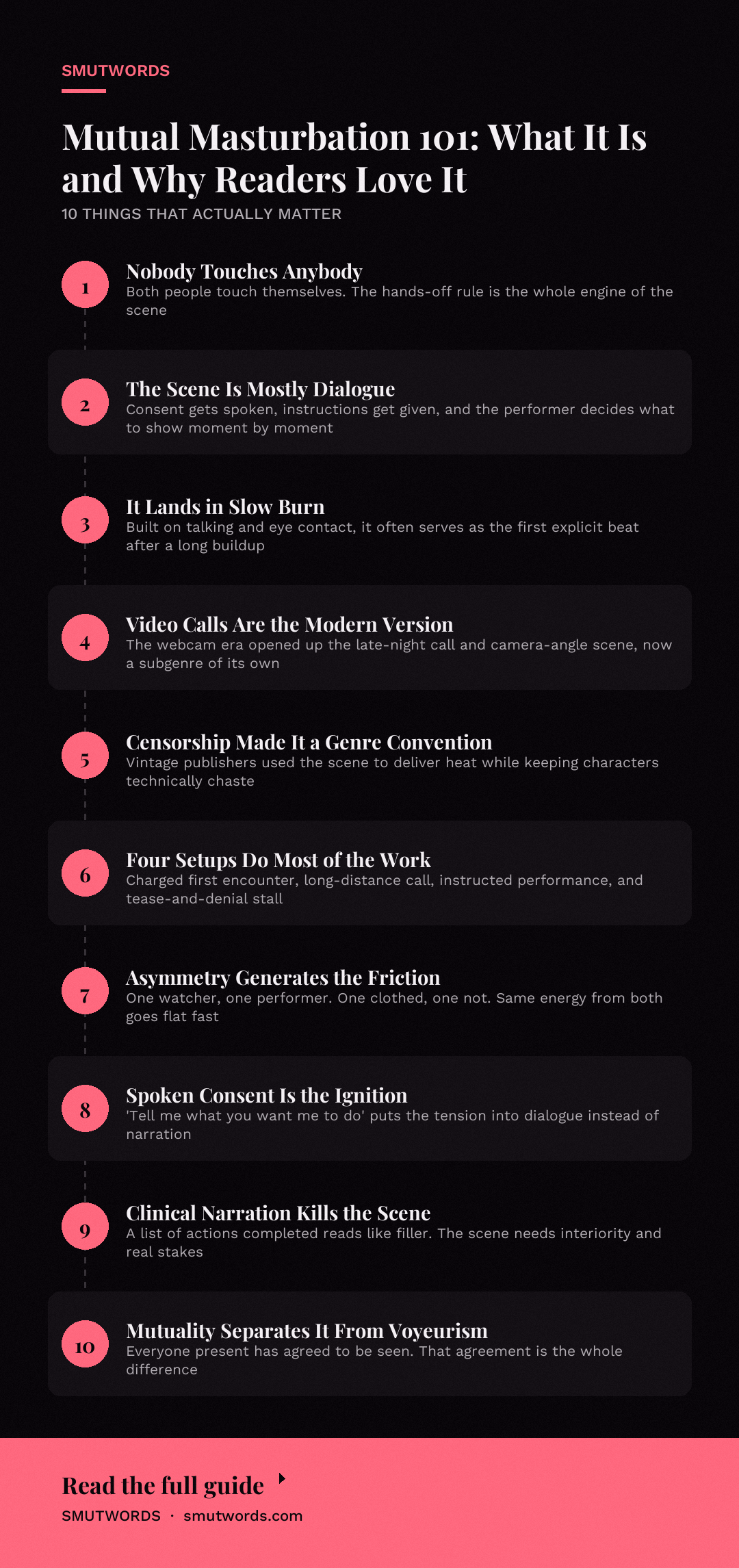
What makes the practice work on the page is the sheer amount of talking it requires. Consent has to be spoken out loud, instructions have to be given, and the person performing has to decide, moment by moment, how much to show.
That makes mutual masturbation a scene built almost entirely out of dialogue and eye contact. Which is why it lands so hard in slow-burn romance, and why it so often serves as the first genuinely explicit beat in a book that has been circling for two hundred pages.
What Mutual Masturbation Actually Means
The phrase is close to literal. Two people, both touching themselves, both present for it. The name has been in common sexual vocabulary for decades, longer than most internet-era kink terminology, and it has always carried the same core meaning: shared self-pleasure rather than partnered touch.
The definition gets slippery at the edges, though, and that slipperiness is where most of the confusion lives.
What counts
- Two or more people in the same room, each touching themselves, with or without watching each other directly.
- Video or phone calls where partners perform for each other across a distance. This is the most common modern variation and the one driving a lot of search traffic.
- Instructed or guided self-touch, where one partner gives directions and the other follows them, hands on their own body the whole time.
- One-sided performance with an audience of one, sometimes called a hand show, where the watcher stays clothed and the performer does not.
- Group variations, from a partnered couple being watched to a room of people all touching themselves. Less common in romance, more common in erotica.
What usually doesn't count
A scene where one person touches the other while that person also happens to be touching themselves is partnered sex with a self-touch element, and most readers would file it under a different tag. Mutual masturbation as a category refers to the self-touch being the main event, not an accessory.
Likewise, a solo scene with a partner watching through a window or a camera without the performer's knowledge is voyeurism, a different kink with a completely different charge. The mutuality is the whole engine here. Both people have agreed to be seen, and that agreement is what separates this practice from anything adjacent to it.
Common misconceptions
Readers sometimes assume mutual masturbation is a beginner move, a lesser version of "real" sex that characters do when they aren't ready for more. That reading flattens what the scene actually does. Plenty of written scenes use it as a deliberate endpoint, chosen over partnered touch because the watcher wants the show, or because one character's control kink runs through being the one who directs.
Another misconception: that it's inherently low-intensity. A scene where two people are forbidden to touch each other can carry more tension than almost anything else on the page. The prohibition is the heat.
Where Mutual Masturbation Comes From
As a real sexual practice, mutual masturbation has been documented across cultures for as long as anyone has been writing about sex. It shows up in sexological literature from the mid-twentieth century onward as a common activity for couples at every stage of a relationship. That's the boring part of the history.
The interesting part is how the term became a fixture of published erotic writing. Mutual masturbation has been a recognized scene type in erotic fiction since at least the mid-twentieth-century paperback boom, when publishers like Olympia Press and Grove Press were printing explicit novels that circulated widely despite censorship. Those books used the scene constantly, often as a way to deliver explicit content while keeping characters technically chaste. Censorship regimes accidentally turned a workaround into a genre convention.
That workaround shaped the trope for decades. Writers learned to build heat through watching and narrating rather than touching, and readers learned to find that specific configuration intensely erotic. When the internet arrived and explicit writing moved online, the scene migrated with it and expanded fast.
How it changed with the internet
The webcam era is the single biggest shift in how mutual masturbation appears in fiction. Before video calls were ordinary, a long-distance scene required letters, phone sex, or a physical reunion.
Once characters could see each other in real time from separate bedrooms, an entire subgenre opened up: the late-night call, the camera angle negotiation, the moment one character realizes they are being recorded. Contemporary romance and erotic romance now use the video call variation so often that it has its own reader expectations.
Instructed self-touch also grew enormously as the JOI (jerk-off instruction) format spread through audio erotica and adult content, and that format's conventions bled back into written fiction. You can see it in how modern authors write the dialogue: short directives, anatomical specificity, a lot of second-person phrasing even in third-person narration.
Where it sits in the genre now
Today mutual masturbation functions as a bridge scene. It lets authors deliver explicit heat before a relationship has fully consummated, keeps slow burns slow for another chapter, and gives characters a way to be intensely vulnerable without the logistics of full sex. It has also become a favorite in reverse harem and why-choose romance, where a scene with several people watching and performing can establish group chemistry before any pairing is settled.
The consent-forward version is standard now, which is a real change from older erotica. Modern published romance almost always has one character ask, however tersely, and the other answer. Readers expect that beat and notice when it's missing. If you want a sense of how that negotiation plays out in a relationship with mismatched appetites, the piece on when one partner is kinky and the other is vanilla covers the same conversational territory in more depth.
How It Shows Up in Erotica
Reading hundreds of these scenes teaches you quickly what separates a scene that works from one that just reports body parts in sequence. The strong ones are almost always about the negotiation. The weak ones skip straight to mechanics and read like an instruction manual nobody asked for.
The four setups you'll see most
- The charged first encounter. Two characters who haven't touched yet end up in a room together and one of them proposes it. The tension comes from the novelty of being seen by this specific person for the first time. This version lives or dies on the dialogue before anything happens.
- The long-distance call. Video or phone, usually late at night, usually with an established couple or a couple separated by circumstance. The scene has to handle the technology honestly: bad lighting, camera angles, the awkwardness of holding a phone. The best versions let the awkwardness be part of the heat.
- The instructed performance. One character directs, the other follows. This is the version closest to dominance and submission dynamics, and it's where the dialogue does the heaviest lifting. The director's voice is the scene's engine.
- The tease and denial build. Mutual masturbation as a chapter-long stall, usually with one character not allowed to finish, or allowed to finish only on instruction. This overlaps heavily with anticipation play, and the two are often written together.
What makes it work on the page
Specificity of attention. A strong scene picks one or two details and stays on them: the sound of a hand, the exact place a character is looking, the way one person's voice goes flat when they're trying to stay in control. A flat scene tries to cover everything and ends up covering nothing in enough depth to matter.
Spoken consent as heat rather than paperwork. The moment where one character says "show me" and the other says "okay" is not a legal formality in good writing, it's the ignition. The line "tell me what you want me to do" is one of the most reliable heat lines in the genre because it puts the tension directly into the dialogue instead of the narration.
Asymmetry. The best versions give the two characters different roles and let that difference generate friction. One watcher, one performer. One clothed, one not. One in control of the pace, one following it. If both characters are doing the exact same thing with the exact same energy, the scene goes flat fast.
Real physical detail about the awkwardness. Bodies make noise, get tired, lose the angle, need to shift position. A scene that admits this reads as hotter than one where everyone is effortlessly graceful for twenty straight minutes. The small fumbles are what make it feel like two actual people in a room.
Enjoyed this? Get a free book.
Join the list and we will send a complete free story straight to your inbox, plus new releases every week after that. No credit card, no catch.
What flattens it
Clinical narration is the biggest killer. If the prose reads like a list of actions completed, the reader checks out. The scene needs interiority, which means at least one character's running commentary on what they're seeing and how it's affecting them.
Missing the mutuality is the second. If the scene reads as pure performance with no sense that the watcher is also affected, the whole premise collapses. The watcher has to be visibly wrecked by what they're seeing, or the scene loses half its charge.
Third: no stakes. A mutual masturbation scene with nothing riding on it, no relationship consequence, no vulnerability risked, no line being crossed, reads like filler. Give it a reason to matter beyond the physical.
Where it fits with other kinks
Instructed self-touch overlaps naturally with breath play JOI, the audio-erotica format built around guided self-pleasure and controlled breathing. The two share a structural DNA: someone else's voice telling you what to do with your own hands, with the tension coming from obedience rather than touch.
It also pairs well with denial and teasing structures, with orgasm control, and with power exchange dynamics where the dominant character never touches the submissive at all. A scene where a dom sits back and watches their sub perform is one of the clearest illustrations of how control can operate without physical contact.
When a scene escalates in intensity, a check-in afterward matters as much here as it does after heavier play. The same instincts that make aftercare essential after impact scenes apply to any scene where someone has been intensely exposed, and a lot of writers now build that beat into the chapter itself. If you're writing or reading a scene that goes heavier than expected, the guide to impact play aftercare covers the general shape of what comes next.
The real-world detail worth getting right
For video or recorded play, clear agreement about what will be watched, who will see it, and what happens to any recording is the baseline in real life, and it's worth reflecting in fiction too. A character who asks "are you recording this" before the scene begins is not a mood killer; they're a signal that both people are fully present.
Privacy is the other piece. Shared devices, cloud backups, and screenshots are all real risks that characters in contemporary settings would plausibly think about. A line of dialogue acknowledging that before things get hot reads as attentive rather than preachy.
Mutual Masturbation vs Voyeurism and Cuckold Dynamics
Mutual masturbation brushes up against several other practices and gets confused with them constantly. The clearest distinction is consent and participation.
Voyeurism involves watching someone who hasn't agreed to be watched, or watching for the thrill of the forbidden. Mutual masturbation is built on the opposite premise: everyone present has explicitly agreed to be seen, and the being-seen is the shared activity rather than something happening to one person.
The overlap with cuckold dynamics is more layered. A cuckold scene where one partner watches another with a third person is a completely different structure from two partners performing for each other, even though both involve watching.
The heat in cuckold writing comes from the third party, the exclusion, and the public-flirtation geometry. If that's what you're after, the article on planning the cuckold pickup scene covers it properly. Mutual masturbation keeps the watching inside the primary couple.
The other distinction worth drawing is between mutual masturbation and partner touch. A scene where one person guides another's hand onto themselves is hot, but it's a different tag. The moment hands get swapped, you've crossed into partnered sex, and the specific tension of "nobody is allowed to touch anybody" evaporates.
Frequently Asked Questions
Is mutual masturbation actually sex?
By most definitions of sexual activity, yes. It involves sexual arousal and orgasm between partners, whether or not penetration or direct touch occurs. The framing as "less than" sex is a cultural hangover rather than an accurate description of what's happening.
What is a "hand show" in romance?
A hand show is a variation where one partner performs for the other while the watcher stays fully clothed and hands-off. It's often a teasing beat in a longer scene, and it's frequently used as a first explicit encounter between characters who aren't ready for more.
How do writers handle consent in these scenes without killing the mood?
By putting the asking inside the heat. A short line like "Can I watch?" or "Tell me what you want" does the work of consent and builds tension simultaneously. Clunky consent beats happen when authors write them like waivers; smooth ones read like dirty talk that happens to be clear.
Is mutual masturbation common in real relationships?
Yes, and it's one of the most commonly reported sexual activities for couples at every stage. It shows up frequently in long-distance relationships, in couples with mismatched libidos, and as a low-pressure option during recovery from illness or injury.
What's the difference between mutual masturbation and phone sex?
Phone sex is the audio-only version, and mutual masturbation is the broader category. A phone call where both partners touch themselves is one form of it; a video call or in-person scene is another. The term covers all of them.
How do I write one of these scenes without it feeling clinical?
Anchor it in one character's point of view and stay there. Give them a specific detail to obsess over. Let the dialogue carry the tension. Keep the physical description sparse and the interior reaction dense.
Final Thoughts
Mutual masturbation earns its place in the genre because it makes intimacy conversational. It forces characters to say what they want out loud, to watch each other do something vulnerable, and to decide in real time how much to give. That's a lot of heat from two people who aren't even touching.
If you want to see the scene done at full strength, look for a book that treats the video call as a genuine relationship event rather than a quick scene. One where the distance matters and the line "show me" lands like a promise. The books listed below this piece are a good place to start.





Loading comments…