A nanny romance is a story where the heroine gets hired to care for a hero's children, and the love that grows between the adults is inseparable from the daily rhythm of bedtime battles, packed lunches, and sticky fingers. The job puts her inside his house, inside his routine, and eventually inside his emotional defenses. That's exactly why the trope hits so hard.
The domestic setup does the heavy lifting: proximity, vulnerability, and a ready-made family unit that turns a flirtation into something with stakes. The best nanny romance novels make you believe the children are the real architects of the couple's connection, not just plot furniture standing in the way of a kiss.
What Nanny Romance Actually Means
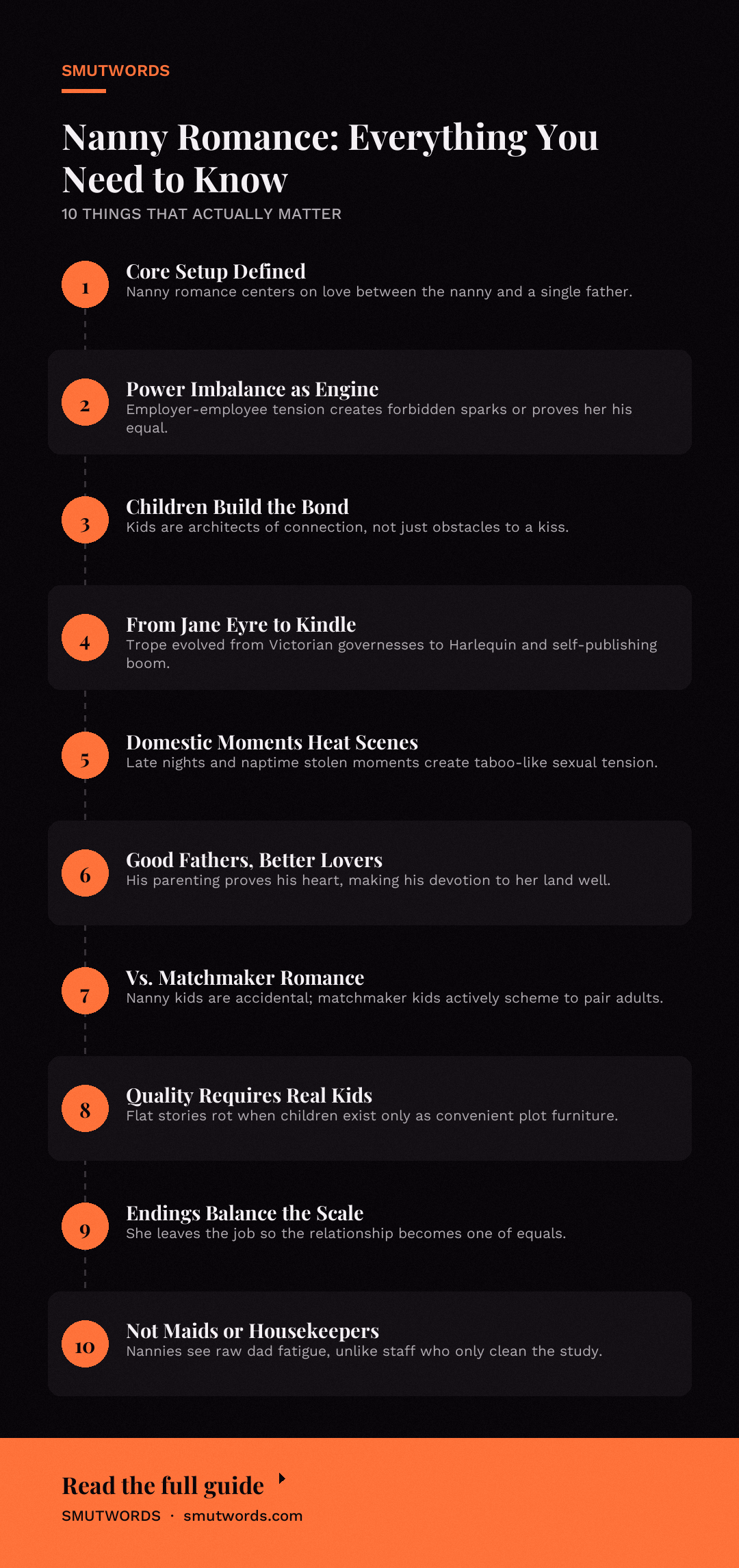
A nanny romance centers on the romantic relationship between a nanny and her employer, almost always a single father. The hero is typically wealthy, emotionally closed off, and overwhelmed by the demands of raising kids alone. The heroine is warm, capable, and often at a professional or financial disadvantage.
That employer-employee structure creates a power imbalance the story can either lean into as forbidden tension or subvert as the heroine proves herself his equal in every way that matters.
The term covers a range of setups. A live-in nanny romance puts the heroine under the hero's roof, shifting the dynamic into constant proximity. A forbidden nanny romance emphasizes the taboo of the relationship, sometimes with an explicit rule against fraternizing with staff. An older man nanny romance plays up the age gap alongside the professional divide.
All of them run on the same core engine: a man who needs help he didn't want to ask for meets a woman who gives it so completely that he can't imagine life without her.
What doesn't count is a story where the nanny exists only as a secondary figure, or where the romance happens between the children's other parent and a new partner while the nanny stays firmly in the background. The heroine has to be the nanny, and the job has to be a central part of the plot machinery. If she quits in chapter two and never looks back, you have a different book.
Common misconceptions include the idea that the children are always toddlers or that the hero is always a billionaire. Nannies in these stories care for kids of every age, from infants to teenagers, and the hero can be a carpenter or a small business owner as easily as a CEO.
The defining element is the family structure, not the father's net worth, though the trope does overlap heavily with Billionaire Romance in the current market.
Where Nanny Romance Comes From
The nanny as a romantic figure has roots that go back well before the modern publishing boom. The Victorian era produced governess narratives where a woman of reduced circumstances enters a wealthy household to educate children and ends up capturing the master's heart. Jane Eyre is the ur-example, though the heroine there is a governess rather than a nanny in the modern sense.
Those stories carried a specific charge because the governess occupied a strange middle class: too refined for the servants, too dependent for the family. That made her a figure of both sympathy and desire.
The twentieth century shifted the archetype. Films like The Sound of Music and Mary Poppins softened the governess into a magical or musical presence who heals a broken family, and that template carried into romance fiction.
By the 1980s and 1990s, category romances from publishers like Harlequin had made the single dad and nanny pairing a staple of their lineup. The hero was frequently a widower or divorcee, gruff in the boardroom but helpless in the nursery, and the heroine arrived to restore order and warmth.
The real genre shift came with the rise of self-publishing and the dominance of the billionaire hero prototype in the 2010s. The nanny romance got absorbed into the larger single dad trend and became a favorite vehicle for exploring a man whose emotional unavailability is tangled up with grief or career obsession.
Online communities of readers drove demand for specific beats: the accidental witnessing of vulnerability, the jealousy when another woman enters the picture, the children's instant attachment to the nanny that forces the father to confront his own feelings.
What was once a quiet category staple became a massively popular standalone trope in Kindle Unlimited, with entire author brands built around it. The same dynamics also pair naturally with the free use household framework, where domestic service and sexual availability blur into one arrangement, though that's a darker flavor than most traditional nanny fare.
How It Shows Up in Erotica
In erotic romance, the nanny setup is a machine for generating intimate access. The heroine is in the hero's space constantly, often at night, often in states of casual undress because she lives there or stays late.
The writing leans into those small domestic moments: him coming home to find her asleep on the couch with a book on her chest, her walking in on him shirtless after a shower, the two of them sharing a quiet drink after the kids finally go down. Each beat is an opportunity to raise the temperature.
The power imbalance is the erotic engine. She works for him, which makes every stolen glance and accidental touch carry a charge of transgression. Strong versions of the trope play with that tension rather than ignoring it.
The hero might be aware that acting on his attraction is inappropriate and try to hold the line, only to break it in a moment of need. The heroine might wrestle with the fear that she is risking her job and her reputation, which makes her eventual surrender feel earned.
The best authors let that conflict simmer for a long time before the first kiss. The anticipation is part of the payoff, and rushing it deflates the whole setup.
Children are a complicating factor in how explicit the story can get. Many nanny romance novels keep the sex scenes behind closed doors or fade to black when the kids are in the house, but erotic versions find ways to work around the logistics.
Enjoyed this? Get a free book.
Join the list and we will send a complete free story straight to your inbox, plus new releases every week after that. No credit card, no catch.
Late-night encounters after the children are asleep, stolen moments in the pantry during naptime, or a weekend away where the grandparents take the kids all give the couple room to be loud. The taboo of nearly getting caught is a recurring spice in these scenes, and some authors play it for comedy while others use it for pure tension.
Common variations on the page include:
- The widow or divorcee who has sworn off love and treats the nanny as hired help until she breaks through his walls.
- The nanny who has a secret that makes her vulnerable, which the hero discovers and uses as a reason to protect her.
- The matchmaking children who engineer situations where their father and nanny are forced together, often with comedic results.
- The reverse setup where the nanny is older and more experienced than the younger father who needs help with his chaotic life.
- The nanny who has her own ambitions and refuses to be treated as a doormat, creating an enemies-to-lovers friction within the household.
What makes a nanny romance work versus a flat one is the plausibility of the family. If the children exist only as obstacles who conveniently disappear whenever the plot needs a sex scene, the book starts to rot from the inside.
The genre's appeal is the fantasy of a ready-made family, so the children need texture: tantrums, insecurities, favorite stuffed animals. The hero's love for his kids is what makes his eventual devotion to the heroine land. When he treats her like a servant and the kids like accessories, the romance reads as hollow.
The structure of the nanny romance also makes it a natural fit for the Forced Proximity trope, since live-in arrangements give the couple no escape from each other. Some of the best books in the subgenre lean fully into that locked-together feeling, letting the shared bathroom and the midnight kitchen runs build an intimacy that would take months of dating in another story.
Nanny Romance vs Matchmaker Romance
The two tropes share DNA and are often recommended to the same readers, but the engines are different. In a nanny romance, the children are incidental to the pairing. They are the reason the heroine is present, but they are not actively trying to get their father and the nanny together.
In a matchmaker romance, the children, or a friend, or a meddling relative are consciously scheming to pair up the leads, and the plot revolves around their machinations.
The distinction matters for reader expectations. Someone picking up a nanny romance is likely there for the domestic intimacy and the slow dismantling of the hero's walls. Someone picking up a matchmaker romance wants the comedy of errors that comes from third parties trying to control the romance.
There can be overlap, a nanny romance where the kids actively push their father toward the heroine, but the primary label usually signals which element is the main event.
Frequently Asked Questions
What makes a nanny romance different from a single dad romance?
A single dad romance only requires that the hero has children. A nanny romance specifically requires that the heroine is hired to care for them.
A single dad story might involve the heroine meeting the father at work or through friends, while a nanny romance always starts with the professional arrangement. The job itself drives the proximity and the power dynamic.
Is a nanny romance always an age gap story?
No, but the trope often features an older hero. The age gap is a frequent addition because it reinforces the power imbalance between the established father and the younger woman he employs.
Plenty of books pair a nanny with a hero her own age or even younger, especially in the reversed dynamic where the father is the overwhelmed newbie and the nanny is the experienced professional.
Why are the children important in a nanny romance?
The children are the reason the couple meets and the obstacle they must navigate together. They also demonstrate the hero's capacity for love and commitment, which makes his eventual feelings for the heroine feel credible.
Readers want to see him be a good father, because it suggests he will be a good partner once he lets go of his defenses.
Can the nanny and the boss stay together without scandal?
The best books usually resolve the professional conflict by having the heroine leave the nanny job, either to pursue her own career or because the relationship has evolved past employer-employee boundaries.
Some endings keep her in a modified role as stepmother or have the couple decide she will stay home with future children. The key is that the relationship has to become one of equals by the final page.
Is this the same as a live-in maid or housekeeper romance?
The roles are adjacent but distinct. A housekeeper or maid romance centers on domestic labor and household order, while a nanny romance centers on childcare and emotional nurturing.
The nanny's work is with the children, which gives her a different kind of access to the father's vulnerabilities. A housekeeper might clean his study, but a nanny sees him at his most raw and tired with the kids.
Final Thoughts
The nanny romance works because it asks a simple question: what happens when the person who sees you at your worst moments also becomes the person you cannot live without? The fantasy of being chosen by a man who already has a family, and of becoming the missing piece that makes that family whole, is a powerful draw that shows no sign of fading.
For the strongest version of the setup, look for the books where the children feel real, the hero earns his redemption through acts of care rather than expensive gestures, and the heroine's competence is never mistaken for weakness. That combination is rarer than it should be, but when it lands, it lands hard.






Loading comments…