
Every six months or so, someone in a writers' group announces that erotica is dead. Killed off by whatever the platforms did this quarter. Eaten whole by AI, finally, for real this time.
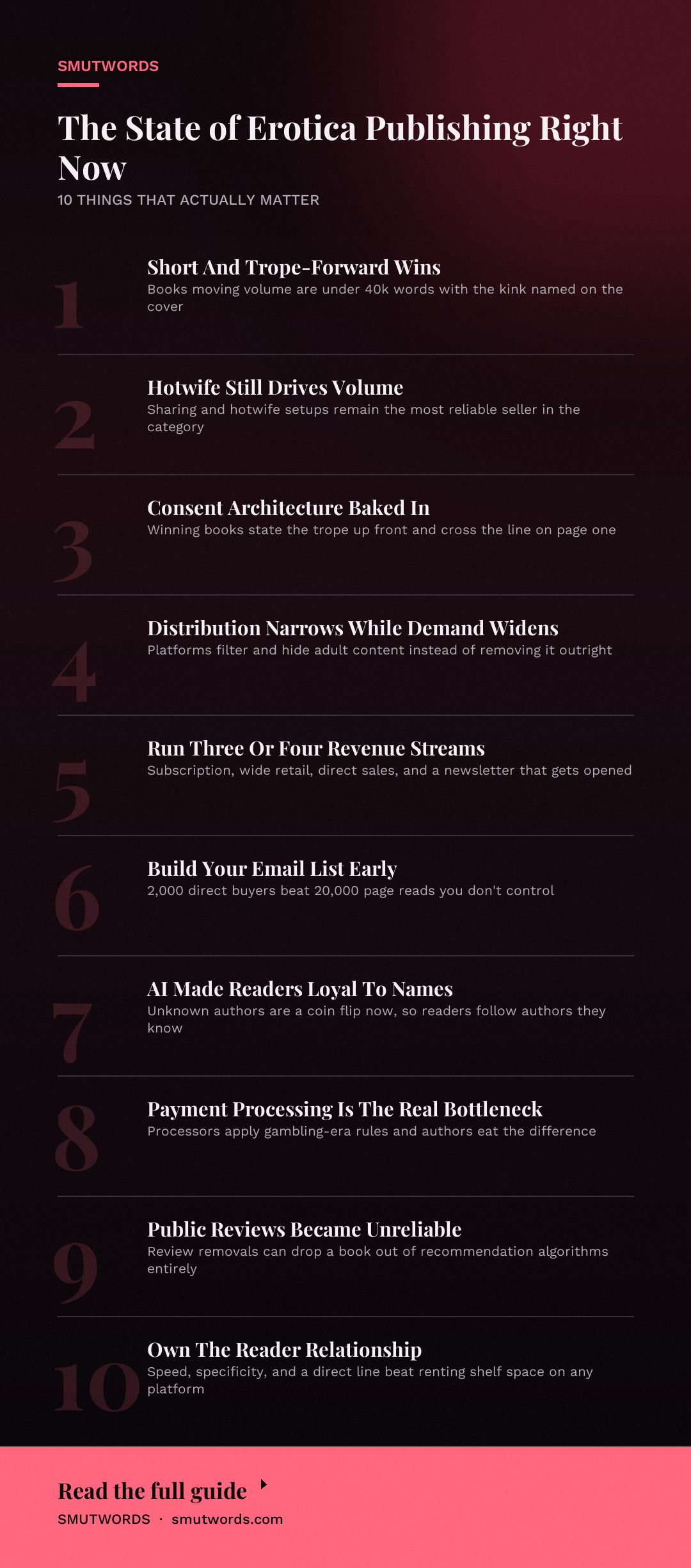
And every six months, the erotica publishing trends data comes back showing the same thing it's shown for years: the money is still there, the readers are still there, and the authors who got wiped out were the ones who built their whole business on one distribution channel and then acted surprised.
What actually shifts is smaller and more specific than the panic suggests. Certain tropes cool off. Certain categories get re-shelved, de-ranked, or quietly locked behind a new filter. Certain pricing experiments work, and most of them don't.
So here's where things actually stand, written to be torn up and rewritten in six months, because half of it will be outdated by then.
The short version: erotica is selling. The ways authors are allowed to sell it keep narrowing. The ways readers are finding it keep widening. Those two facts are fighting each other constantly, and that fight is the entire story.
What's actually selling in erotica right now
Short. Specific. Trope-forward.
The books moving volume right now are almost all under 40,000 words, sometimes under 15,000, and the covers and blurbs tell you the exact kink before you've read a full sentence. A reader scanning a row of thumbnails on her phone at 11pm is looking for one specific thing. The authors winning that scan name that thing right where it can be seen.
Long literary-adjacent erotica still has an audience. It just doesn't have a growth curve. The growth is in straightforward trope execution, and specifically in the subgenres where the reader knows within three words what she's getting.
The tropes carrying the most weight right now
- Hotwife and sharing. Still the most reliable volume driver in the category. Shared Without Shame: A Hotwife Exhibition & Sharing Fantasy is a clean example of the shape that works: a wife put on display, a husband watching, and the tension sitting entirely in how the husband handles what he asked for.
- Cuckold with an actual power dynamic. Not just the humiliation angle. The books getting passed around in reader groups have a real negotiation underneath the scene, like Permission Slip: A Cuckold Erotic Short Story, where the permission itself is the erotic object.
- Monster and nonhuman romance. Going strong and getting weirder in a good way. Lured by the Lizard Beast sits right on the overlap between monster breeding romance and plain old monster-fucks-a-human, which is a bigger overlap than people admit.
- Free use and exhibition setups. A casino, a club, a party, a resort. The setting does the consent work so the scene can just run. Free Use Casino is the template a lot of newer releases are copying, some well and some badly.
- Arrangement and transactional kink. One person paid to do the thing, and the money is part of the heat rather than an obstacle to it. He Paid Him to Fuck Me does this with three people and a very short word count, and it works because nobody apologizes for the setup.
The pattern across all five: the trope is stated up front, the consent architecture is baked into the premise, and the reader never has to guess where the line is because the line has already been drawn and crossed. Books that make readers wait four chapters to figure out what kind of book they're holding lose to books that tell them on the cover.
Distribution is where the real erotica publishing trends story lives
Nothing about what readers want has changed as fast as where they're allowed to buy it. Every platform decision in the last year has been about filtering, ranking, or hiding adult content rather than removing it outright. That creates a specific kind of problem: your book exists, the page loads, and no one browsing the category will ever see it.
Most working erotica authors now run three or four revenue streams minimum. Subscription programs, wide retail, direct sales from their own site, and a newsletter that actually gets opened. The going wide vs Kindle Unlimited question comes up less as a strategic choice and more as risk management at this point.
Exclusivity buys you visibility. It also hands one company the power to end your income overnight, and a few high-profile de-listings this year reminded everyone of that in about 48 hours.
What authors are doing differently this year
- Building the direct-sales list before they need it, not after a platform purge. An email list of 2,000 readers who bought from you once is worth more than 20,000 page reads you don't control.
- Writing shorter and faster, because the return on a 90,000-word slow burn has dropped while the return on four 20,000-word trope hits has gone up.
- Treating each trope as its own funnel. A monster book and a hotwife book may share readers, but the author who writes both under separate pen names is catching two different search behaviors instead of one blended mess.
- Testing price points in public. $2.99 and $4.99 still move; $9.99 shorts don't, and the authors who tried it this year mostly walked it back.
Audience size is up. Discoverability is down. Those two things are both true at once, and almost every author complaint you'll read online traces back to trying to solve the second problem by getting a bigger audience, which doesn't work.
AI, again, but with actual specifics
This section will be the most stale one in six months, so treat it as a snapshot. Right now the flood of AI-generated erotica has done three concrete things to the category. It's made covers harder to trust at a glance. It's made the first two pages of a lot of tropes a wasteland of near-identical blurbs.
And it's made readers noticeably more loyal to authors they already know, because the unknown author is now a coin flip and the known one isn't.
That last effect is the one worth paying attention to. The readers who stuck around are the ones who follow a name, join a newsletter, and buy the next release on day one.
Serialization helps. A recognizable voice helps. Anything that makes you look like a person who wrote a book rather than a title that appeared on a search results page helps.
Enjoyed this? Get a free book.
Join the list and we will send a complete free story straight to your inbox, plus new releases every week after that. No credit card, no catch.
Most platforms have some disclosure policy now, and enforcement is inconsistent enough that authors are gaming it in both directions, which is exactly how enforcement always goes. Don't plan around it. Plan around the newsletter.
What readers are actually searching for
The search behavior changed less than the publishing behavior. Readers still come in through a specific kink, a specific pairing, or a specific setup, and they still want it delivered without a lot of preamble. What's shifted is where they search. Reader forums and group chats have taken over some of the recommendation function that category browsing used to do, which means word of mouth matters more than the browse page now.
A few things visibly on the rise in reader requests this cycle, and some of these are getting close to saturation:
- Nonhuman love interests with real interiority, not just a monster-shaped obstacle. This is where monster breeding romance and cosmic horror romance have started to bleed into each other.
- Tutor/student romance with the age gap read as a real problem the characters work through, rather than a label on the cover.
- Secret baby plots, oddly, and in a harder-edged form than the old category-romance version.
- Stalker romance readers getting much more specific about what they want, which usually means they want obsession with a light hand on the actual menace.
- Explicit, negotiated kink where the Safe, Sane, Consensual framework is part of the scene rather than a note at the top.
Secret relationship setups are quietly one of the most requested frameworks for anything involving an age gap or a power imbalance, because the secrecy is what keeps the pairing forbidden after the first sex scene.
The uncomfortable parts nobody writes listicles about
Payment processing is the actual bottleneck and always has been. Retailers blame processors, processors apply rules that were written for gambling and pharmaceuticals, and authors eat the difference. Any author who's had a payout frozen knows this is the real crisis in the category, not any single platform's content policy.
Chargebacks are up on shorter works. So is piracy of the cheapest titles, which sounds ridiculous until you notice that piracy is mostly an onboarding funnel for readers who then buy the sequel. Fighting it is a losing game. Racing it with faster releases mostly works.
The review ecosystem has gotten hostile in a way that's specific to adult content. Reviews get removed for the text inside them, not just for the cover, and a book that collects three of those removals can drop out of recommendation algorithms entirely. Authors are moving to reader communities and newsletter replies to collect honest feedback, because public reviews have become unreliable as a signal.
And the pay floor has dropped. Short erotica is a volume game now in a way it wasn't five years ago. The people making real money at it run a release schedule that would have looked insane in 2019, with shorter books, faster turnarounds, and a direct-sales list they own outright.
Where this is probably going in the next six months
Some guesses, offered with the full awareness that this post exists to be corrected later:
- More authors leaving subscription exclusivity, not fewer, and the ones who stay getting better placement deals as a result.
- Direct sales growing faster than any retailer category, because it's the only channel where the author isn't renting shelf space.
- Audio for short erotica getting a real push, especially for the trope-heavy titles that already read like they're meant to be listened to.
- AI disclosure norms settling into something boring and consistent, the way they did for stock photography.
- The revenge romance and dark-obsession side of the category cooling slightly, while negotiated-kink and monster-romance titles keep climbing.
- At least one platform doing something that makes everyone furious for two weeks and then gets absorbed into the background noise.
None of this is apocalyptic. The category has survived worse filters, worse payment rules, and worse panics. What it rewards right now is speed, specificity, and owning your reader relationship instead of renting it.
Anyone publishing erotica who hasn't built a direct line to their readers is the one who should be worried. Everyone else can keep writing.
One more thing worth saying out loud: the trope that everyone says is oversaturated is usually the one readers still search for every night. Saturation applies to the generic versions. A specific, well-executed take on a crowded trope still finds its audience.
The reverse is just as true. The market's pickier than it used to be. It isn't smaller.
Final Thoughts
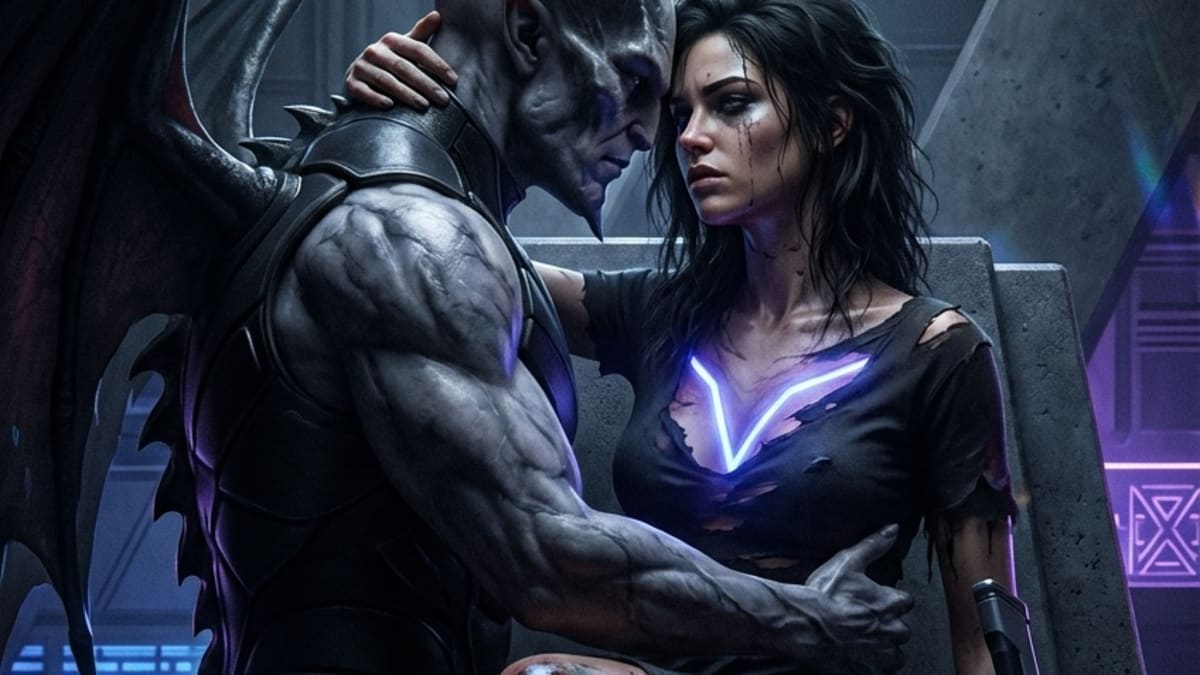
If you want a single book to read as a snapshot of everything working right now, grab Zorgon's Pet. It's a nonhuman romance, it commits to the premise on page one, it's short enough to read in a sitting, and it's exactly the kind of release that's climbing right now while longer, safer books sit flat.
Read it, then check back in six months when half of this post is wrong and the other half has only gotten more true.





Loading comments…