
A secret relationship is a romantic or sexual involvement that at least one of the people inside it works to keep hidden from the outside world. The couple knows. Everyone else does not.
That gap between private truth and public ignorance is the whole engine of the trope, and it's one of the most durable fantasies in erotic romance because it turns every ordinary moment into something loaded. A text. A glance across a meeting. A hand on a lower back.
If you searched "secret relationship" because you keep finishing books built on it and want to understand why they work, this is the long answer: what the term means, where it came from, how authors actually build these scenes, and where the version you're reading goes flat.
What Secret Relationship Actually Means
The straightforward definition is in the name: a couple conceals their romantic or sexual connection from friends, family, coworkers, or the public. But the term covers a wide range of situations, and not all of them are interchangeable. The reason for the secrecy shapes everything downstream.
What does count as a secret relationship:
- Professional secrecy. Boss and employee, coworkers, coach and athlete, agent and client. Exposure costs a job, a reputation, or a promotion, so the couple compartmentalizes.
- Social or familial secrecy. The best friend's sibling, the ex's roommate, the person your mother already hates. The relationship would detonate a social circle, so it stays underground.
- Public-figure secrecy. Two celebrities, or a celebrity and a civilian, hiding from fans and paparazzi. This overlaps heavily with celebrity romance, where the public eye is a permanent antagonist.
- Contractual or transactional secrecy. An arrangement (fake dating, a paid companion, a marriage of convenience) that started as a pretense and turned real, so admitting it means admitting the whole thing was a lie.
- Double life. One person has an entire second existence: a hidden identity, a hidden marriage, a hidden apartment. The secrecy is structural, not situational.
What does not count, at least not in the useful sense:
- A relationship nobody has asked about yet. If there's no active concealment and no cost to exposure, there's no secret, just privacy.
- A one-night stand that both parties never mention again. No ongoing relationship, no ongoing concealment.
- A pairing that's merely unspoken but obvious to everyone around them. The friends already know. The tension is gone.
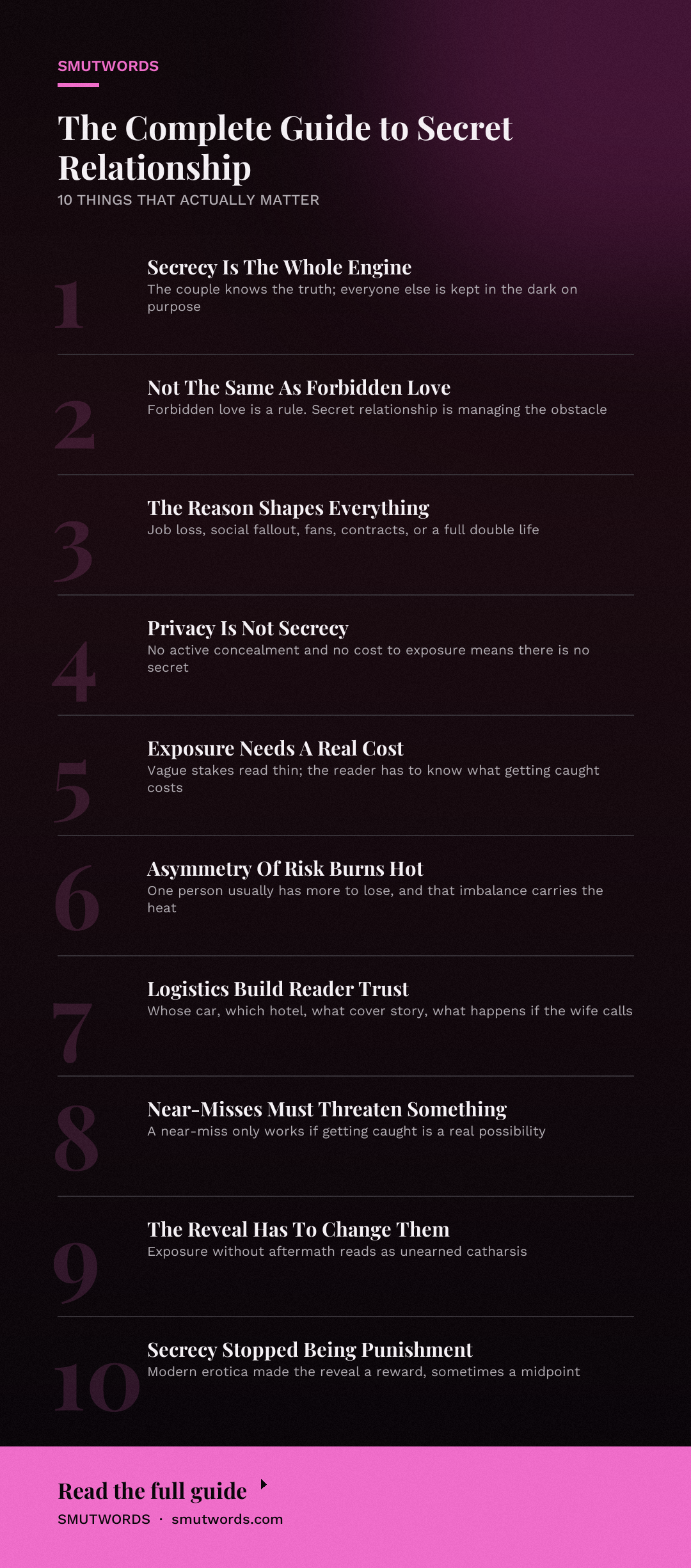
The most common misconception is that secret relationship is a synonym for forbidden love. It isn't. Forbidden love is about a rule or a taboo standing in the way. Secret relationship is about the management of that obstacle: the logistics, the lies, the near-misses.
A forbidden couple can be completely public and daring about it. A secret couple is defined by the work of not being seen.
Another misconception: readers assume secrecy equals shame. In the best versions, it doesn't. The couple isn't hiding because they're embarrassed. They're hiding because exposure has a specific, named cost, and the story has to make that cost feel real or the secrecy reads as arbitrary.
Where Secret Relationship Comes From
This is one of the oldest structures in love stories, period. The trope has existed in some form since humans started writing romance down, and its ancestry runs through three distinct veins that merged into what modern erotica readers recognize.
The first is the courtly and epistolary tradition. Letters, coded messages, midnight meetings, and the constant threat of discovery have driven romance plots for centuries. The structure is simple: love exists, the world forbids it, the lovers must become experts in concealment. That's the DNA.
The second vein is the midcentury mass-market romance. From the 1950s through the 1970s, secret affairs and hidden pregnancies were staples of the paperback romance industry, often with a moralistic frame attached. The couple got caught, and the catching was the punishment. The pleasure for the reader was the transgression, and the story always had to reckon with it.
The third vein, and the one that most directly shaped what's on shelves today, is the contemporary romance boom of the 1980s onward, and then the indie erotica explosion of the 2010s. As publishing moved online, authors could write secret relationship stories without a moralistic frame, and readers responded. The trope stopped being a cautionary tale and became a pure pleasure engine. The reveal scene, once a punishment, became a reward.
Where the trope has shifted is in what stays secret and why. Older versions overwhelmingly concerned infidelity or an illegitimate pregnancy. Modern versions have widened the aperture: an office romance nobody can know about, a relationship with someone the protagonist's family would disown them for, a prince or princess romance where the royal courtship can't go public. The mechanisms of hiding (borrowed phones, code names, separate hotel rooms, staged photo ops) have multiplied alongside the reasons.
There's also been a shift in the reveal. Older versions treated exposure as the climax, with the fallout resolving the plot. A lot of current erotica instead treats exposure as the midpoint and uses the second half to explore what a public relationship even looks like when the couple has never been public. That's a substantial structural change, and it's worth noticing if you read across decades of the subgenre.
How It Shows Up in Erotica
The trope lives or dies on the texture of concealment. A scene where two characters are alone and nothing is at stake is just a scene. A scene where two characters are alone because they've engineered fifteen minutes of being unaccounted for, and a coworker could walk in at any second? That's the trope working.
What makes secret relationship scenes land:
- A specific, credible reason for the secrecy. The reader needs to understand exactly what happens if the couple is found out. Vague "it would be bad" secrecy reads thin.
- Asymmetry of risk. The two people rarely have equal skin in the game. One has a marriage, a job, a public profile, a family reputation. The other might have less to lose, or more. That imbalance is where a lot of the heat actually lives.
- Good logistics. The best authors are specific and practical. Which hotel, whose car, what time, what does the couple tell their boss, what's the cover story, what happens if the wife calls. Readers trust stories that sweat the details.
- Near-misses that actually threaten something. A near-miss only works if the reader believes discovery is a real possibility, not a plot device the author will always yank back.
- A reveal that changes the couple. What happens after the secret comes out has to matter. The couple should not simply return to exactly who they were before, but public.
What makes them go flat:
- Secrecy with no cost. If the only thing the couple loses by being seen is a mild inconvenience, the reader stops caring about the hiding.
- A protagonist who's only secret from people who deserve to be lied to. The stakes should pressure the couple morally, not just practically.
- The reveal as pure catharsis with no aftermath. Exposure without consequence reads as unearned.
- Nobody finds out for no reason. If the couple wasn't actually at risk, the entire book was just two people being weird about a normal relationship.
A note on craft useful to anyone reading or writing: the trope plays well with several adjacent structures. Enemies to lovers is a natural fit, since the couple has an audience of witnesses who already believe they hate each other.
The protective hero trope works well in secret relationship stories because concealment is itself a form of protection, and the hero's instinct to shield the heroine often cashes out as keeping her off the radar. Marriage in trouble overlaps when the couple's secrecy is from their own spouse or from the family they live with, though the emotional engine inside is different, since the reader expects either repair or dissolution rather than discovery.
Enjoyed this? Get a free book.
Join the list and we will send a complete free story straight to your inbox, plus new releases every week after that. No credit card, no catch.
Where the trope intersects cleanly with siblings and friendship dynamics, you'll see it a lot near the best friend's sister territory, where the concealment is specifically to protect an existing relationship from the truth. That story only works if the concealer actually loves the person they're lying to, and that's a common test of whether the writer understands the trope.
Reader habits matter here too. If you're the kind of reader who burns through secret relationship books and can't find enough on one store, the choice between Kindle Unlimited and going wide directly affects how many of these you can find on any single platform. A lot of the darker, more explicit versions of the trope live outside the mainstream exclusivity programs because of the content rules those programs enforce.
If you've ever wondered why a favorite secret relationship book disappeared from your recommendations, what Amazon actually allows for erotica is usually the answer.
On the page, the strongest versions also use physical texture that the concealment theme exaggerates. A phone that has to be silenced, a shirt that has to be buttoned back up before anyone notices the wrong number of buttons, a hallway that turns into a strait of near-total darkness.
Some writers extend this into sensory kinks, and there's an underrated crossover with temperature and sensation play. If you like the way secret relationship scenes squeeze every second for meaning, the closely-related craft of ice play uses the same principle of hyper-specific sensation in a moment, and many of the same writers blend both.
Secret Relationship vs Forbidden Love
These two get used interchangeably, and they genuinely do overlap, but they're distinct enough to be worth separating.
Forbidden love is defined by a rule. Something or someone has declared the pairing off-limits: a religious doctrine, a family prohibition, a professional ethics code, a legal barrier, a power imbalance the world has named. The tension comes from the existence of the rule and the couple's choice to violate it.
Secret relationship is defined by concealment. The tension comes from the management of secrecy: the logistics, the lies, the possibility of exposure. You can have a forbidden couple with no secrecy at all (they're flouting the rule openly and daring the world to stop them). You can have a secret couple whose relationship isn't forbidden by anyone except circumstance (two adults hiding an office romance because it's simply awkward, not because anyone has banned it).
Most books in this territory use both. The rule creates the secrecy and the secrecy is what the reader is actually here for. If you had to pick one term for what the reader is buying, it's usually the secret relationship. The forbidden element is what makes the secret necessary.
A third term worth distinguishing: hidden romance is often used by publishers as a softer marketing label for the same trope, especially in young adult or less explicit categories. If you're searching across stores and see "hidden romance" as a category label, it's the same structure with a lighter tone tag attached.
Frequently Asked Questions
What is the point of a secret relationship in a romance novel?
The secrecy converts ordinary scenes into high-stakes scenes. A kiss nobody can see lands harder than a kiss the whole town is watching, because the reader knows what discovery would cost. The trope exists to make intimacy feel loaded, chosen, and fragile at the same time.
Is a secret relationship the same as cheating?
No. Cheating requires a betrayal of an existing committed relationship. A secret relationship usually means one or both people are hiding the relationship from people outside it, not cheating on a partner. The two can overlap in books where a married protagonist is hiding an affair, but the presence of a spouse isn't part of the trope's core definition.
Why do so many secret relationship books end right after the reveal?
Historically, because the reveal was the climax and the story was complete once the truth was out. Modern books increasingly extend past the reveal to show what a public version of the relationship looks like, though many older or shorter works still resolve at the moment of exposure.
What is a double life in romance?
A stronger, more structural version of secret relationship where one character maintains an entire second existence that their partner, their family, or their public doesn't know about: a hidden marriage, a hidden job, a hidden identity. The relationship may be only one piece of a much larger concealment.
Why do readers love the near-miss scenes so much?
Near-misses prove the stakes are real. Every near-miss is a test of whether the story will actually let the couple get caught, and readers keep turning pages because they don't yet know. Writers who never let the couple come close to exposure are denying the reader the exact pleasure they came for.
Are secret relationship books usually darker than other romance tropes?
They trend that way, because concealment involves sustained dishonesty and often a power imbalance. But the range is wide. Some versions are tense and angsty, some are playful and light, and the trope is flexible enough to carry both. The through-line is always the cost of being seen.
Final Thoughts
Secret relationship works because it makes intimacy scarce and expensive, and scarcity is what makes anything feel like it matters. Read it for the near-misses, the lies that get progressively harder to keep straight, and the moment the couple finally has to decide whether the relationship is worth being known.
If you only pick up one book in this lane next, look for one where the secret is expensive enough that you genuinely can't see how the story lets the characters get away with it. That's the version that stays with you.








Loading comments…