The first thing Astra Quinn will tell you about her process is that she writes the sex scene first. Not the ending, not the meet-cute, not the emotional beat where the hero realizes he's in over his head. The scene where two people are actually in bed together, or in a corridor, or on the hood of a car in a parking garage at 2 a.m.
Everything else gets built around that center. She starts there because the sex in a short story is the plot, and if you don't know what the bodies are doing, you don't know what the story is about.
That's the kind of thing you only learn by asking, which is why this astra quinn author interview turned into something closer to a confession than a Q and A. She talks fast, swears casually, and has strong opinions about people who describe erotica as "spicy."
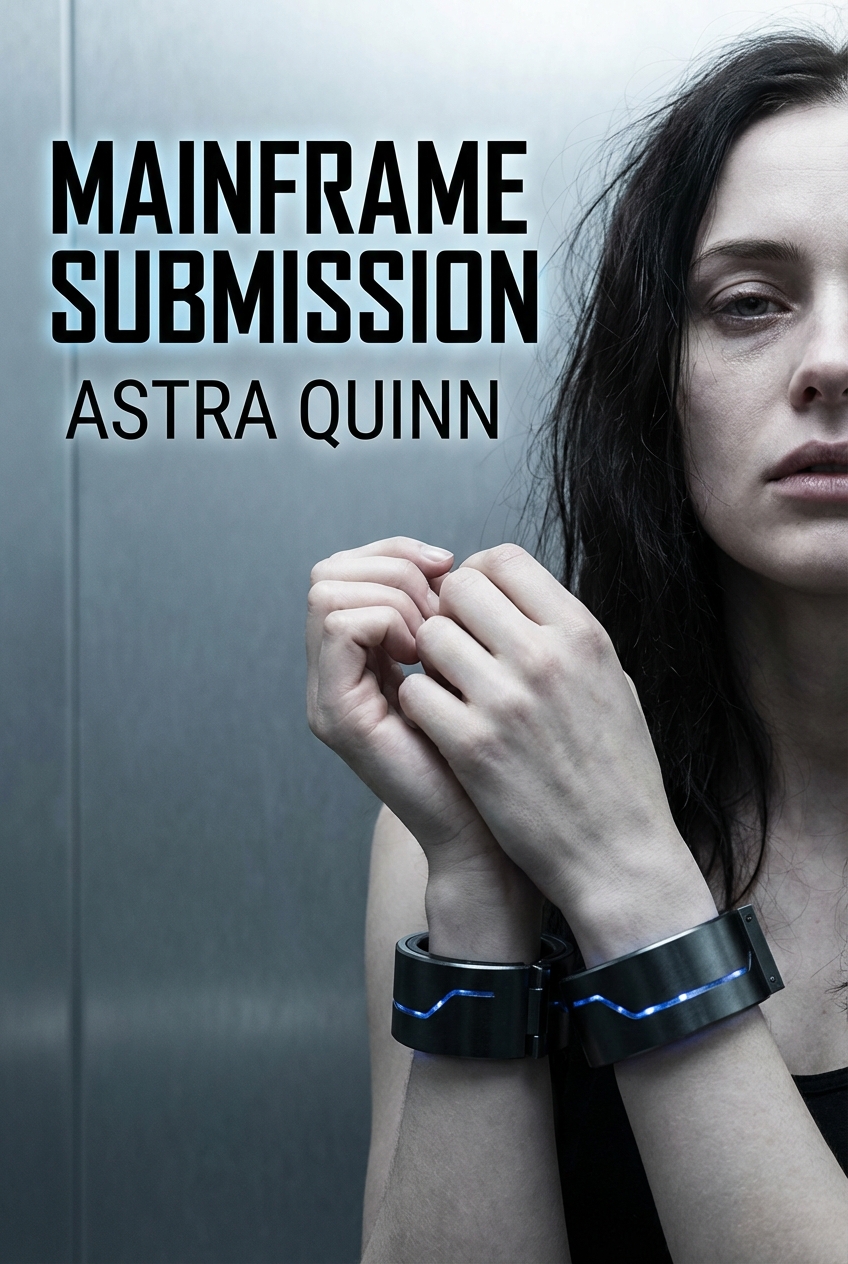
She's written alien abduction, cuckold, hotwife sharing, monster, and a cyberpunk novella that reads like someone poured a nightclub into a novel. Underneath all of it is a working method, and she's happy to explain it.
Astra Quinn on Writing Out of Order
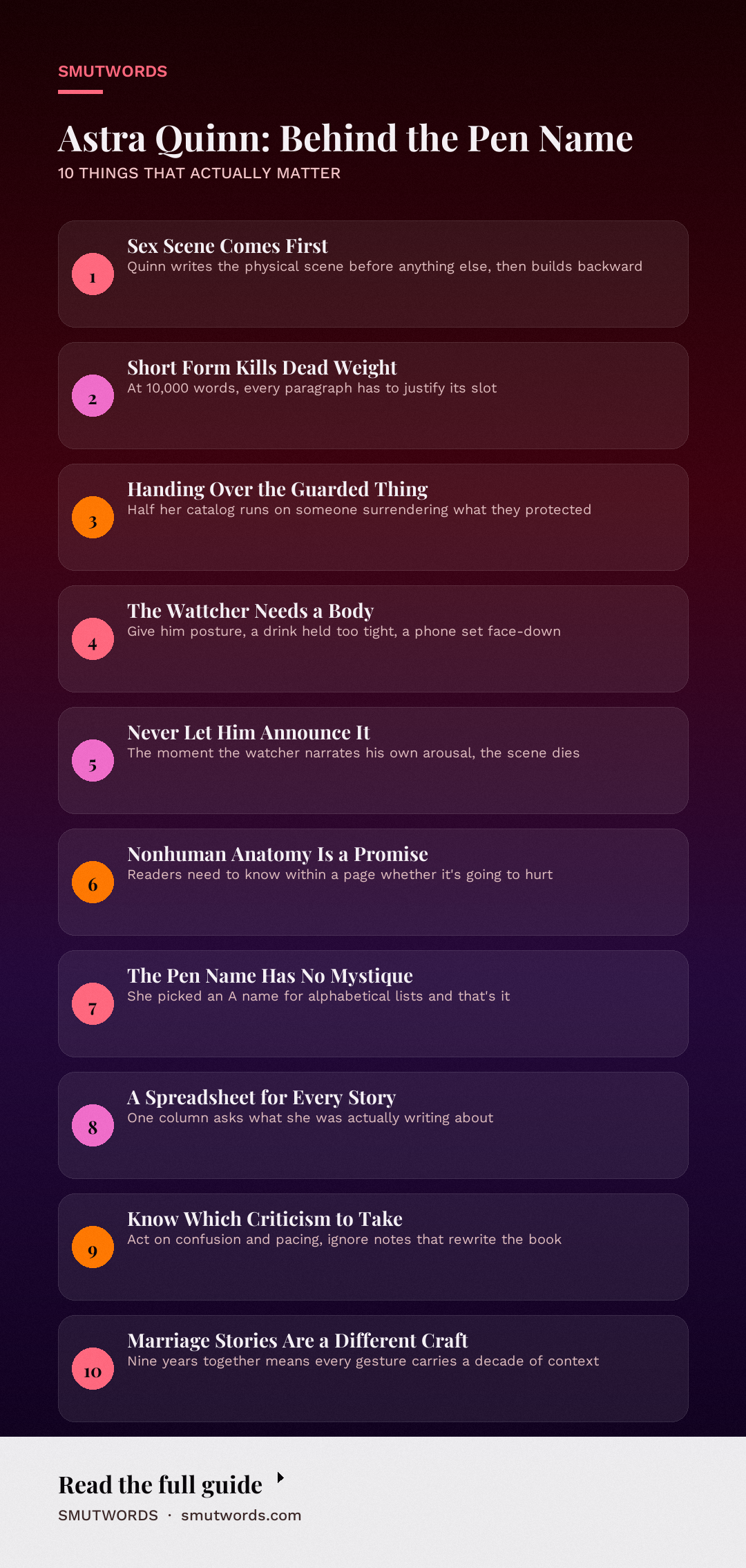
"The sex scene is the argument," she says. "If a character is going to lie about what they want, that lie shows up in what they do with their hands. So I write the physical scene first, and then I figure out what had to be true in their life for them to end up there."
Then she writes backward. The opening paragraphs are the last thing she touches. Quinn keeps a file called "the before," where she drops one or two lines about each character's week leading up to the scene: what they ate, who they lied to, what they were wearing when they left the house.
Almost none of it makes it onto the page. Some of it does, and it's the detail that makes the whole thing feel lived-in.
She says this habit comes from writing short. With 8,000 to 15,000 words, you don't get a slow-burn chapter where nothing happens. Every paragraph has to justify its slot, and the fastest way to know which paragraphs matter is to know where you're landing.
Why short-form erotica changes the math
Quinn wrote two full-length manuscripts before she sold anything. Both sit in a folder she calls "the basement," and she doesn't seem sad about it. Novels let you hide. Short stories don't, and she learned more from two years of writing 10,000-word stories than she did from either of those drafts.
When the escalation has to land in three scenes, you find out fast which beats are dead weight. You also find out exactly which tropes you can't stop returning to, which is how she figured out what her actual voice was.
A revenge romance plot she drafted twice became a story about a woman who shows up at her ex's engagement party with a date she paid for. Same bones. Shorter, meaner, better.
The Trope She Keeps Coming Back To
Quinn writes across the map, but if you squint, half her catalog is one idea. Someone hands over the thing they've been guarding, and it costs them something.
It shows up in Permission Slip: A Cuckold Erotic Short Story, where a husband signs off on something he thought he wanted. It's there again in Shared Without Shame: A Hotwife Exhibition & Sharing Fantasy, which Quinn describes as "the version where she's already made up her mind and the husband is just catching up."
And it's the engine of He Paid Him to Fuck Me, a story that takes roughly four paragraphs before the money is on the table and then spends the rest of its length on the part everyone skips. "The transaction is never the interesting part," she says. "The interesting part is the ten minutes before, when there's still a way out and nobody takes it."
Watching as its own kink
She's written a lot of scenes where one person is in the room and not participating, and she argues this is one of the hardest dynamics to write well. The watcher needs a body, not just a reaction. He needs a posture, a drink he's holding too tight, a decision about whether to look away and the fact that he doesn't.
Readers who like this strand should spend an afternoon with A Comprehensive Guide to Watching Kink, which covers the psychology better than most of what's out there. Quinn read it and had notes. They were mostly complimentary, with one disagreement she refused to specify.
Her rule for these scenes: no commentary from the watcher. The moment a character in the corner starts narrating his own arousal, the scene dies. You show the tightened jaw, the second drink, the phone he puts face-down on the table and then picks back up. Readers fill in the rest without being told.
- Write the watcher's body before writing the watcher's thoughts
- Give him something to hold, so his hands have a job
- Let him almost leave, then not leave
- Never let him announce what he's feeling
Aliens, Monsters, and the Logistics Problem
Quinn writes nonhuman love interests, and she takes the anatomy seriously in a way that made me put down my coffee. She has a notebook. She sketches. She once spent an afternoon researching how many hearts a creature could plausibly have and how that changes what stress looks like on the page.
"If you're writing a lizard that's seven feet tall, the reader needs to know within a page whether this is going to hurt," she says. "That's a promise you're making. If you fudge it, they can tell, and they stop trusting you."
Enjoyed this? Get a free book.
Join the list and we will send a complete free story straight to your inbox, plus new releases every week after that. No credit card, no catch.
That attention is why Lured by the Lizard Beast works as well as it does. The creature has weight. He has texture, temperature, a way of moving that doesn't map onto a human body, and the story keeps that constraint running through every scene instead of forgetting about it once clothes come off.
Zorgon's Pet does the same thing with a colder, more controlled monster, and Quinn says Zorgon was the hardest character she's ever written because he had to be genuinely dangerous and genuinely tender, and never once in the same paragraph.
For anyone who wants the wider map of this subgenre, A Comprehensive Guide to Human/Alien Romance Relationships is a good place to start, especially the section on consent mechanics, which Quinn calls "the only part of alien romance anybody actually argues about."
The cyberpunk detour
Her cyberpunk romance work came from a bet with a friend about whether she could write something where the setting did the emotional labor. No rain, no neon, no city. The result is a novella set almost entirely indoors, in a rented apartment with bad wiring, where two people negotiate a contract that keeps getting longer. She says it's the least explicit thing she's published and the one that gets the most email.
On Pen Names and Being a Person Online
Quinn is a pen name. She's not cagey about it, and she doesn't do the thing where an author pretends the name is just a brand.
"I picked a first name that starts with A so I'd show up early on alphabetical lists," she says. "That's the whole story. There's no mystique."
What she won't do is build a persona. No photos, no elaborate backstory, no heavy-handed teasing about who she "really" is. She thinks the mystique thing gets old fast and mostly serves the writer's ego rather than the reader's experience.
There's a related piece, Penny London: Behind the Pen Name, that takes a different angle on the same question, and Quinn says she read it and felt seen.
What she does keep is a spreadsheet. Every story gets a row: title, trope, word count, the one sentence she'd use to sell it, and a column she calls "the thing I was actually writing about." That last column is the one she checks when she's stuck. If the current draft doesn't have a real answer there, it isn't ready.
Readers she trusts and readers she doesn't
She reads her reviews. Not all of them, but enough to notice patterns, and she has a policy about which criticism she'll act on.
- Act on: "I didn't understand why she did that"
- Act on: "This scene felt rushed"
- Ignore: "I wanted them to end up together"
- Ignore: Any note that comes with a rewrite of her prose attached
The first two mean the motivation didn't land on the page, which is her problem. The last two are about a different book than the one she wrote. She says she learned this the hard way after rewriting an ending to satisfy a complaint and making the story worse in the process.
What She's Working On
There's a longer project in progress, around 60,000 words, that she describes as a marriage in trouble story with a second act she's still fighting with. She's also got a batch of short pieces in the same vein as Free Use Casino, which she calls "the most fun I've had writing dialogue in two years."
The marriage book is giving her trouble because the couple has to be genuinely good together at the start. Most of her work starts with people who barely know each other, and she says writing two characters who've been married nine years and still like each other is a completely different craft. The sex has history in it. Every gesture carries a decade of context, and she can't lean on novelty to carry a scene.
She's also interested in a redemption arc romance, which she's never tried, and a tutor/student romance that she keeps starting and abandoning because the power dynamic is too easy and she wants to find the version that isn't.
A quick word on brats
Asked what she'd write if she had a free month, she said a brat novella, immediately. Then she talked for ten minutes about how most brat characters are only brats in dialogue.
If you want to know what she means, What Is Brat? A Reader's Complete Guide lays out the dynamic in plain terms. Quinn's version would push harder on the part where the brat is the one running the scene the entire time and both people know it.
Final Thoughts
If you want the fastest introduction to how Quinn thinks, read Permission Slip. It's short, it starts mid-fight, and the last paragraph does the thing she's best at, which is landing on a detail instead of a conclusion. Then go read Lured by the Lizard Beast and notice how much of the tension comes from the creature's physical reality rather than anything he says. That contrast is the whole writer, and both are worth your evening.






Loading comments…