
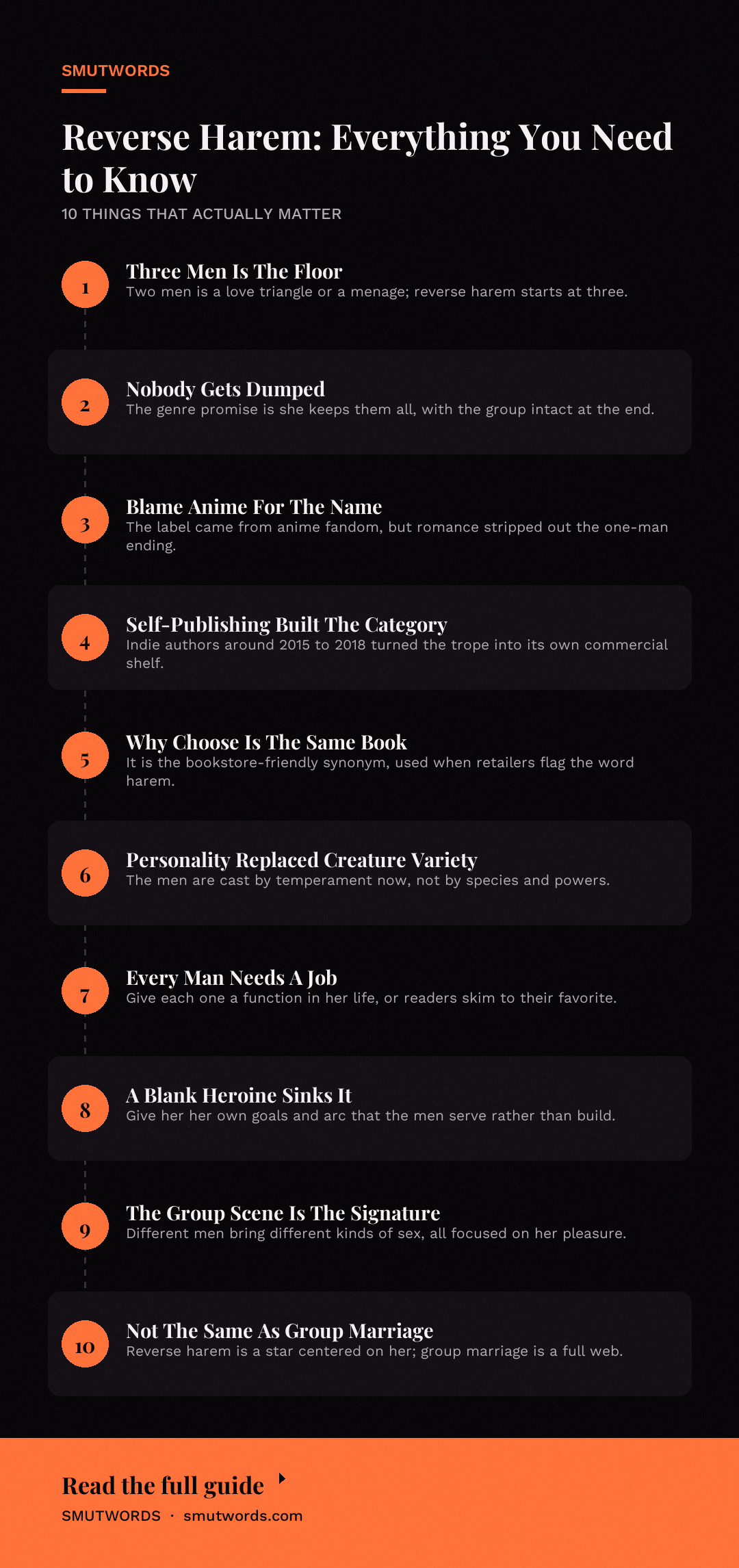
A reverse harem is a romance or erotica storyline in which the female protagonist ends up with three or more male love interests at once, all of them committed to her and to each other as a group, with no rivalry that ends in anyone getting dumped. She is the sun; they orbit. The men share her romantically and sexually, and the story treats that arrangement as the happy ending rather than a scandal to be resolved.
If you have typed "reverse harem" into a search bar and gotten a wall of listicles that never quite explain the rules, this is the long answer: where the term came from, how the books actually work on the page, and what separates a reverse harem romance that earns its devotion from one that just stacks men around a blank heroine.
What Reverse Harem Actually Means
The name is borrowed from a real-world term, and the borrowing is imperfect. In common usage, a harem is one man with multiple women. The "reverse" flips the genders: one woman, multiple men. The label entered English-language romance publishing through anime and manga fandom, where "reverse harem" described series like Ouran High School Host Club and Fushigi Yûgi, stories built around a heroine surrounded by attractive male characters.
Romance publishing then stripped out the ambiguity. In anime, a reverse harem often ends with the heroine choosing one man. In romance and erotica, the genre promise is that she keeps them all. That is the definition that matters for readers browsing SmutWords and every other catalog.
The genre rules, stated plainly
- Three or more love interests minimum. Two men is a love triangle or a menage. The harem threshold starts at three.
- The heroine is the center. Each relationship is with her. The men may be bonded to each other, but she is the shared point of devotion.
- No permanent jealousy among the men. Friction is allowed, even useful. Grudges that never resolve, or one man sabotaging another, break the genre contract.
- A committed ending. Everyone stays. The story closes with the group intact, usually with some ceremony of permanence.
- Her pleasure is the priority. Emotional and sexual fulfillment for the heroine is the plot's engine, and every man's arc points at her satisfaction.
What doesn't count
A love triangle does not count. A story where the heroine is torn between three men and chooses one at the end is a soap opera with extra suitors, and readers will say so in reviews. A story where the men compete and one "wins" has failed the label.
Ordinary polyamory doesn't automatically count either. A book about a woman with several independent partners, each relationship separate and unsynchronized, is female-led polyamory. The reverse harem expects the men to know each other well, often live together, and commit to the group as a unit.
The most common misconception: that a reverse harem is just a lot of one night stands in a trench coat. The emotional architecture is the opposite. These are long arcs of building trust, not a string of encounters.
The other misconception, heard mostly from people who have never read one: it's porn without plot. Wrong again. Reverse harem is arguably the most plot-dense subgenre in romance, because every added man has to be introduced, characterized, won, and integrated before the final chapter.
Where Reverse Harem Comes From
The trope's publishing history starts with Japanese media. Anime and manga built the visual grammar: a heroine flanked by a cast of distinct male archetypes, each designed to appeal to a different reader. The English-speaking romance market absorbed that grammar piece by piece through the 2000s and 2010s, at first in fan fiction, where tags like "harem ending" organized stories by exactly how many men would end up with the protagonist.
The Kindle self-publishing boom is where reverse harem became a commercial category of its own. Between roughly 2015 and 2018, indie authors realized that a series with five or six love interests could carry six or eight books, one per man, with a group finale. Readers who liked the trope bought every installment. Amazon's algorithms rewarded series with high read-through, and the category snowballed.
The label "why choose" emerged around the same time as a bookstore-friendly synonym, letting the trope appear on covers and in ads without the word harem, which some retailers and ad platforms flagged. The two now function as the same tag: why choose romance is the marketing-friendly name for the same architecture.
How the trope has shifted on the page
Early reverse harem books, especially the fantasy and paranormal ones that dominated the first wave, leaned hard on the men as species and abilities: the vampire, the wolf shifter, the fae prince, the human. Diversity of men meant diversity of creature. The heroine often had a hidden power of her own that justified the attention.
The contemporary wave replaced creature variety with personality variety. The current bestsellers cast the men by temperament: the steady one, the feral one, the golden retriever, the quiet one who notices everything, the one who talks too much. The shift moved the trope from monster math into character work, and the books got better for it.
A second shift: the men are now written as bonded to each other, not just respectful of each other. Earlier books had the men tolerating the arrangement for her sake. Recent books show them choosing one another too, sometimes with their own romantic thread between the men, sometimes as a found family that functions whether or not she's in the room.
One more honest note on the history. The trope has always been honest pulp. Its earliest English iterations were consumed quickly, reviewed harshly by readers outside the target audience, and loved fiercely by the readers inside it. That pattern hasn't changed, which is about as reliable a sign as publishing offers that a trope has staying power.
How It Shows Up in Erotica
Craft matters more in reverse harem than in almost any other trope, because the math is unforgiving. Six men in a cast of seven means every man needs a distinct function, a distinct voice, and a distinct way of showing up in bed, or the reader starts skimming to the chapters about her favorite. Editors who work in this space talk about man-economy constantly: who does what, who gets which chapter, who carries which kind of scene.
Building the men so they don't blur
Strong reverse harem books give each man a specific job in her life, not just a physical type. One is the protector, one the challenger, one the caretaker, one the comic relief who turns ferocious at the right moment. The reader should be able to identify the speaker from dialogue alone, without a tag.
A flat version gives the men one adjective each and no contradiction. A strong version gives every man at least one moment where he breaks his own pattern: the stoic one admits fear, the feral one shows tenderness, the caretaker asks to be taken care of once. Those breaks are where readers choose favorites, and choosing a favorite is part of the fun.
Play across the group
The bedroom scenes follow from the casting. A reverse harem group is a chance to stage completely different kinds of sex with different partners, so good books spread the range across the men. One man's scenes run long and slow. Another's run rough, hands pinning, commands given in a low voice.
A third might bring the rope: shibari reads especially well in these books because a group of men around one woman's body bound in a harness makes a specific, shareable image. Others bring public-facing scenes, the kind where a voyeur husband trope dynamic gets stretched into a group of watchers who are all lovers. Some men bring an edge, the kind of degradation kink that functions as intensity between people who trust each other.
The physical contrast is a staple for a reason. Books love setting a monster cock next to the ordinary man, or the giant next to the wiry one, letting her have both experiences in the same night. The group scene is the trope's signature for exactly this: all kinds of bodies, all kinds of pressure, one relentless focus on her.
Enjoyed this? Get a free book.
Join the list and we will send a complete free story straight to your inbox, plus new releases every week after that. No credit card, no catch.
Kink aside, the emotional scenes carry the books. The men understanding each other without words. Her coming apart in one man's arms while another holds her hand. The trope's tenderest register is a group that functions like a family, because for many readers that's the real fantasy underneath the sex.
The heroine question
The single hardest thing to get right. A passive heroine at the center of six devoted men reads as wish fulfillment without a character, and readers punish it in reviews. The best-sellers give her her own goals, her own competence, and her own arc that the men serve rather than build.
Watch for the "inexplicably adored" failure: every man falls for her by page thirty with no reason anyone can name. The fix is usually specificity of attention. Her life changes, her choices matter, and the men respond to who she actually is on the page, not to a slot she fills.
The trope's appeal runs on her being the sole focus of multiple partners; a book that makes her a nice blank page fails the appeal. For another example of a trope that lives or dies on instant, undeniable pull, the piece on why readers love insta love romance makes a good companion read.
Archetypes readers actually shop by
Readers sort the trope by setting first, then by flavor. The most common configurations in the romance catalog:
- Paranormal and monster: shifters, vampires, fae, the men exotic and dominant, the heroine often structurally special (the last of a bloodline, a mate, a magic-wielder).
- Mafia and billionaires: the men powerful in different ways, the heroine crossing into their world, often the sister or daughter of a rival.
- Rom-com: men as one big friendly circle, low stakes, a lot of jokes, the sex playful.
- Dark: men with real scars and real moral failure, the heroine changing all of them, the content warning list long.
- Contemporary small-town: the log cabin school of the genre, men as the town itself, warm and corn-fed.
Pacing and structure
A strong reverse harem works like a series of reveals. Each man arrives with a distinct reason to be around her, gets his own chapter of undivided attention, and joins the group before the next one arrives. Books that add all the men in the first hundred pages exhaust the reader's ability to care, and the middle sags.
The final chapters almost always stage a group ceremony: a ritual, a vow, a scene that binds everyone on the record. The ceremony isn't compulsory, but readers expect it. Skipping it reads as an unfinished book.
Editor's note on one recurring question: pregnancy is a popular reverse harem ending. A book that ends with a harem and a baby taps the trope's deepest register, the group as family. Books that end differently, with power or travel or a restaurant open, work just as well when the group is intact.
Reverse Harem vs Group Marriage
These two get used interchangeably, and they aren't. Use the right term and the right reader arrives.
Reverse harem is the romance-genre label. The men exist mostly as partners to the heroine. Each relationship's content is with her, and she's the shared center even when the men care about each other. The structure is a star with six points all meeting at one node.
Group marriage is the larger word, and it covers arrangements where all parties are married to each other, with a full web of relationships between the men and between the women. A group marriage can be a reverse harem if there's one woman and several men. It can also be one man and several women, or three of each. The relationships between the non-central members matter as much as the central ones.
Practical difference: a book shelved under reverse harem is centered on the heroine's fulfillment, and the men are her harem. A book centered on the group's internal politics and shared life sits under group marriage or group relationship. Readers looking for one and finding the other leave reviews; that's a solved problem when the labels are used cleanly.
Frequently Asked Questions
What does reverse harem mean in romance books?
A romance where the female lead ends up with three or more male love interests in a committed group, no one dropped. The men usually know and like each other; the story closes with the group intact. It's often tagged "why choose" so retailers don't hide the listing.
How many men does a book need to be a reverse harem?
Three is the floor. Two is a love triangle or a ménage à trois, which is a different genre. In practice most books run between three and six, each man written so the reader can tell them apart from dialogue alone.
Is reverse harem the same as polyamory?
It's the fictional romance genre version. Real-world polyamory comes in many shapes, most of them with the relationships between partners independent of any single person. A reverse harem is centered on the heroine: the men's devotion to her and to the group is the point, and the story treats it as the ideal ending rather than a documented lifestyle.
Do the men in a reverse harem sleep with each other?
Sometimes. Many books show the men as emotionally close and physically affectionate, with optional romantic or sexual threads between them. Others keep the men as devoted to her without that. Readers should check content notes or reviews to find their preference.
Are reverse harem books always explicit?
No, but they run hot more often than not. The trope's reader base is comfortable being on the page for the sex, and authors deliver the group scenes rather than cutting away. Plenty of "why choose" romances today run steamy but not graphic, which is why some readers browse by content tag rather than label.
Why is it called "reverse" harem if the men aren't all hers alone?
Because it's a reverse of real-world gender norms: a harem's traditional shape is one man with many women. The label flips the genders. The strictness of the original meaning isn't the point; the picture of a woman surrounded by partners is.
Final Thoughts
Reverse harem sells because it puts one woman's pleasure and worth at the center of a whole world of devoted men.
It only works when the writing earns that devotion. Read one good one and the mechanics become obvious: the men distinct, the heroine real, the group scene delivered. For a next step, pick up a book from our ranked list below and check whether the author gets the man-economy right. The day you close the last page and can name every man's smile, that's the book to measure the rest against.






Loading comments…