What Post-Apocalyptic Romance Actually Means
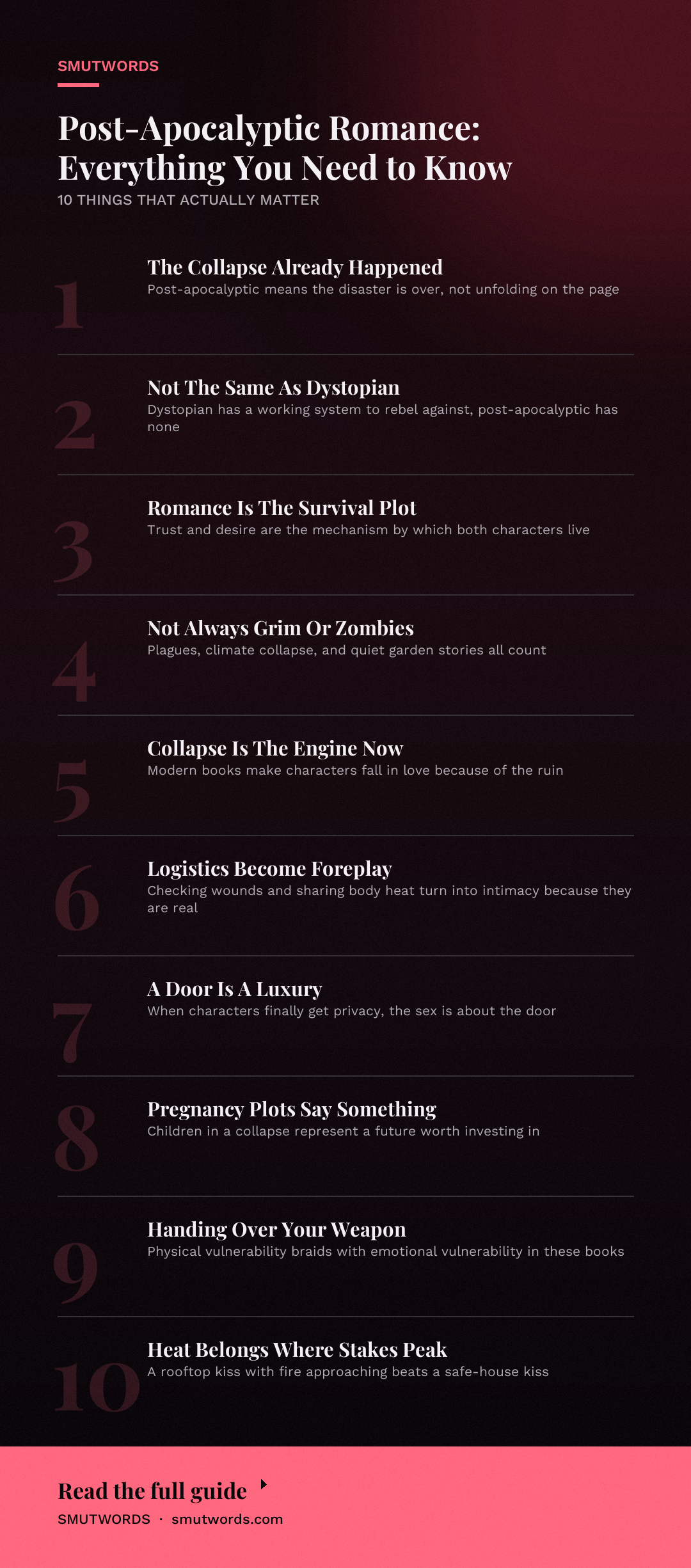
The term breaks into two halves that need each other. "Post-apocalyptic" specifies the setting: the catastrophe has already happened. This distinguishes it from apocalyptic fiction, where the disaster unfolds on the page, and from dystopian romance, where a repressive system is still functioning and still has rules to break.
That second distinction trips up a lot of readers. A rebellion story set inside a functioning oppressive regime is dystopian, not post-apocalyptic. The post-apocalyptic romance moves past infrastructure entirely.
No trains, no courts, no addresses. Characters barter, travel by foot, and sleep with a weapon within reach.
It also differs from survival romance, which can happen in a contemporary world (a plane crash, a shipwreck, a blizzard). Post-apocalyptic romance implies the collapse is global or near-global. The characters are not waiting to be rescued. There is no rescue coming.
The genre has a few common misconceptions worth clearing up:
- It is not all grimdark. Many post-apocalyptic romances are warm, hopeful, even funny. The small pleasures (a functioning radio, a jar of peaches, a bath) land harder because of the scarcity around them.
- It is not always about zombies. Zombie apocalypse romance is one variant among several. Plagues, nuclear war, climate collapse, solar flares, and alien invasion all appear.
- It is not required to be violent. Violence is common because the stakes demand it, but a book can be entirely quiet. One of the most effective post-apocalyptic romances in recent memory is about two people planting a garden.
- The romance is not a subplot to the survival plot. In a well-built post-apocalyptic romance, trust and desire are the survival plot. The relationship is the mechanism by which both characters live.
If you want a quick comparison point, think of lumberjack romance: it also isolates a character in a harsh environment where competence matters. The difference is that the lumberjack still has a truck, a town, and a grocery store. The post-apocalyptic love interest has whatever he carried out of the wreckage.
Where Post-Apocalyptic Romance Comes From
The trope has two parents: the survival novel and the gothic romance. The survival novel gave us the collapse scenario and the logistics of staying alive. The gothic romance gave us two people isolated from society, bound together by circumstance, working out desire under pressure.
Patricia Matthews and other paperback authors wrote post-disaster romances through the 1970s and 1980s, often as category series. These were usually published as science fiction or general fiction rather than romance, because the romance genre's structural requirement (a guaranteed happy ending) sat awkwardly against the collapse backdrop. The woman was often a survivor of nuclear war, and the relationship was a footnote to the devastation.
The real shift happened after 2001 and accelerated after 2008. Two things converged. First, the young adult dystopian boom (The Hunger Games, Divergent, and their hundreds of imitators) taught publishers that readers would follow romantic stakes into a ruin. Second, independent publishing gave romance authors a way to write love stories with explicit sex and a collapse setting without pitching them to a traditional imprint that would want the apocalypse sanded down.
By 2012, zombie apocalypse romance was a recognizable subgenre with its own conventions and its own audience. Readers knew the beats: the herd, the scavenging run, the bite reveal, the safe house that becomes a home. Then came the writers who pushed past zombies into quieter collapse scenarios, and the trope broadened considerably.
The last ten years have produced the biggest change of all. Earlier post-apocalyptic romance treated the collapse as backdrop. Contemporary post-apocalyptic romance treats the collapse as the relationship's engine.
The characters do not fall in love despite the ruin; they fall in love because of what the ruin makes visible. A man's willingness to share his last water is a more serious marriage proposal than anything a ring could communicate.
The genre has also diversified in who gets to survive. Early post-apocalyptic romance was overwhelmingly white, heterosexual, and male-protector centric. The current one is not. Books now center women who shoot first, gay couples running a trading post, and families formed out of strangers rather than blood.
How It Shows Up in Erotica
Here is the part that authors get right or wrong depending on whether they understand what collapse actually does to a person.
In a functioning society, desire has to compete with noise: work, phones, social obligation, the pressure to seem normal. In a collapse scenario, that noise is gone. What remains is the body, the weather, and the other person.
The erotics of post-apocalyptic romance come from that simplification. Every touch is chosen, because there is no ambient social pressure to touch anyone at all.
A strong post-apocalyptic romance scene usually does three things at once:
- Fuses logistics and intimacy. Undressing each other to check for wounds becomes foreplay because the touching is real and necessary before it is sexual. Cold nights make shared body heat a survival strategy. The scene where they huddle for warmth and then do something about it is a genre cliché because it works.
- Marks the scarcity of privacy. A locked door is a luxury. When characters finally get one, the sex becomes about the door as much as the bodies. Write the door, and the reader feels the relief.
- Uses the moment after. In a post-apocalyptic romance, the afterglow carries the question: what does this mean when we might die tomorrow, and what does it mean if we do not? The most effective post-coital scene in these books is a conversation about whether they stay or move on.
On the craft side, the elements that distinguish a flat version from a strong one are consistent.
A flat post-apocalyptic romance treats the collapse as set dressing. Characters ride dirt bikes, shoot a few zombies between chapters, and then have sex that could have happened in a contemporary apartment with the lights off. Nothing about the world has entered the bedroom.
A strong post-apocalyptic romance lets the world run through everything. The heroine's hands are calloused from dismantling shelving for firewood. She smells like smoke and cheap soap. She has not worn clean clothes in three weeks and neither has he.
The scene acknowledges that, because the acknowledgment is the sexiness. Bodies in the collapse are specific and used.
Another indicator of quality is how the book handles vulnerability. In contemporary romance, vulnerability is emotional. In post-apocalyptic romance, vulnerability is often physical.
The two braid together. A character who lets another person hold his weapon while he sleeps is giving something more intimate than a confession. The best authors know this and write the moment with the weight it deserves.
Sex in this trope also carries a particular charge around the body's aliveness. Breeding kink and impregnation kink both show up frequently in post-apocalyptic romance, and the reason is structural rather than incidental: in a world where children are rare and lineages have ended, sex becomes a statement about a future.
Authors who handle this well do not just toss it in. They let the characters argue about it, and those arguments are frequently hotter than the sex scenes around them.
Common variations in the subgenre include:
Enjoyed this? Get a free book.
Join the list and we will send a complete free story straight to your inbox, plus new releases every week after that. No credit card, no catch.
- Zombie apocalypse romance. Threat is continuous, mobile, and relentless. The relationship is a refuge and a liability.
- Plague or pandemic collapse. Slower pace, more interiority, more emphasis on the homes people build after the fever passes.
- Nuclear or climate collapse. Often the quietest variant. Focuses on agriculture, seasons, and the tiny rituals that make a life worth living.
- Settlement romance. The love story happens inside a functioning post-collapse town. The conflict is political or economic as much as physical.
- Road romance. The couple travels, and the journey is the arc. Each chapter is a new location and a new test of what they are to each other.
- Enemies-to-lovers in the ruins. Two people on opposite sides of the collapse (a raider and a survivor, a soldier and a deserter) forced to cooperate. If the hero is military, this variant frequently overlaps with soldier romance, because the discipline and violence of the old world make a specific kind of partner.
Series are common for a reason. A post-apocalyptic romance novel has to build the world, prove the world, and then deliver the couple's arc. Sequels let the author keep the world and swap the pairing. Readers of the trope are often more loyal than the median romance reader, because the labor of learning a collapse world is real and they want to be paid back for it.
Writers often ask where the heat belongs in a post-apocalyptic romance. As an editor who has read a great many of these, my answer is: it belongs wherever the stakes are highest. The first kiss in a safe house is often less interesting than the first kiss on a rooftop with an approaching fire.
Position scenes against the most urgent thing happening in the plot repeatedly, and the trope does the work of making the intimacy feel earned without the writer having to announce it.
Post-Apocalyptic Romance vs Dystopian Romance
These two get filed together constantly, and the confusion costs readers a lot of time when they are looking for a specific kind of book.
Dystopian romance is set inside a functioning oppressive system. There are rules, ranks, districts, weaponized surveillance, and usually a state with a leader. The central conflict is generally about resisting or infiltrating the system. The world is bad on purpose, and there is somebody to blame.
Post-apocalyptic romance is set after the system has failed. There is no leader to rebel against. The world is bad because the world broke.
The central conflict is about rebuilding, foraging, and whom to trust with your back. If the book has a resistance army with uniforms, it is probably dystopian. If that army ran out of bullets two years ago and now trades scrap, it is post-apocalyptic.
A few books blend the two, and they usually get marketed as dystopian because the label sells. But if you are looking specifically for the post-apocalyptic reading experience, look for a story where the old world is gone, not governing. If you like the way a failing system forces a couple to negotiate trust under pressure, the dynamics in ghostwriter romance run on a similar tension.
Frequently Asked Questions
Is post-apocalyptic romance a kink or a trope?
It is a trope. A trope is a setting or story pattern, like enemies-to-lovers or forbidden romance. A kink is a specific sexual interest, like breeding kink or restraint.
Post-apocalyptic romance is the container. The kinks inside it vary by book. You will find some post-apocalyptic romances with explicit breeding themes, some with power exchange, some with nothing kinkier than a hand on a thigh.
What makes post-apocalyptic romance different from regular survival romance?
Stakes and scale. Survival romance can be a weekend in the woods or a plane crash in the Rockies. Post-apocalyptic romance assumes the collapse is widespread, with no return to normal in the character's lifetime.
That changes how the couple makes decisions. In a survival romance, the relationship often has to survive until rescue. In a post-apocalyptic romance, the relationship is what they build instead of a rescue.
Are post-apocalyptic romances always dark?
No. Tone varies enormously. There are cozy post-apocalyptic romances about a woman who inherits a general store in a small surviving town and a man who trades firewood. There are brutal ones with cannibal raiders.
The trope promises high stakes and hard-won intimacy, not a specific level of grimness. If you want a warm version, you can find one.
Do post-apocalyptic romances always have a happy ending?
The romance genre's core promise is a happily ever after or happy for now, and the post-apocalyptic subgenre keeps it. The ending may be smaller than in other subgenres (a cabin, a garden, a settlement that will hold), but the couple is together and reasonably safe.
Books that end in loss are usually published as literary fiction or horror, not romance.
Why do so many post-apocalyptic romances involve a baby or pregnancy plot?
Children in a collapse scenario represent a specific hope: that there is a future worth investing in. A pregnancy plot lets the author say something about the world without a speech.
It also raises the stakes around safety, food, and medical care in ways that force the couple to act. Authors who handle it well treat the pregnancy as a plot engine rather than an epilogue. For a closer look at how pregnancy-related kinks differ, see the breeding kink versus impregnation kink guide, since collapsing the two is a common mistake.
What is the difference between zombie apocalypse romance and post-apocalyptic romance?
Zombie apocalypse romance is one variation within the larger post-apocalyptic romance trope. Zombie fiction brings specific monster rules (bite transmission, herd behavior, decay logic) that the plot must respect.
A post-apocalyptic romance without zombies can focus entirely on human threat, environmental threat, and the slow work of rebuilding. Both are post-apocalyptic. Only one has the undead.
Final Thoughts
Post-apocalyptic romance works because it takes away everything a love story usually hides behind. No jobs, no family expectations, no scrolling. What is left is a person choosing another person on purpose, every day, while the world is still ending around them.
The trope does not require firepower to hit hard. It requires a couple the reader believes would actually survive together.
Find a book where the collapse is quiet and the intimacy is specific. Let the couple build something. That is where the genre finds its pulse.
And if you like the way a collapse scenario forces two people into raw, unguarded devotion, try no strings attached romance, which runs the opposite experiment: what happens when two people swear they will not need each other, and then do anyway.





Loading comments…