
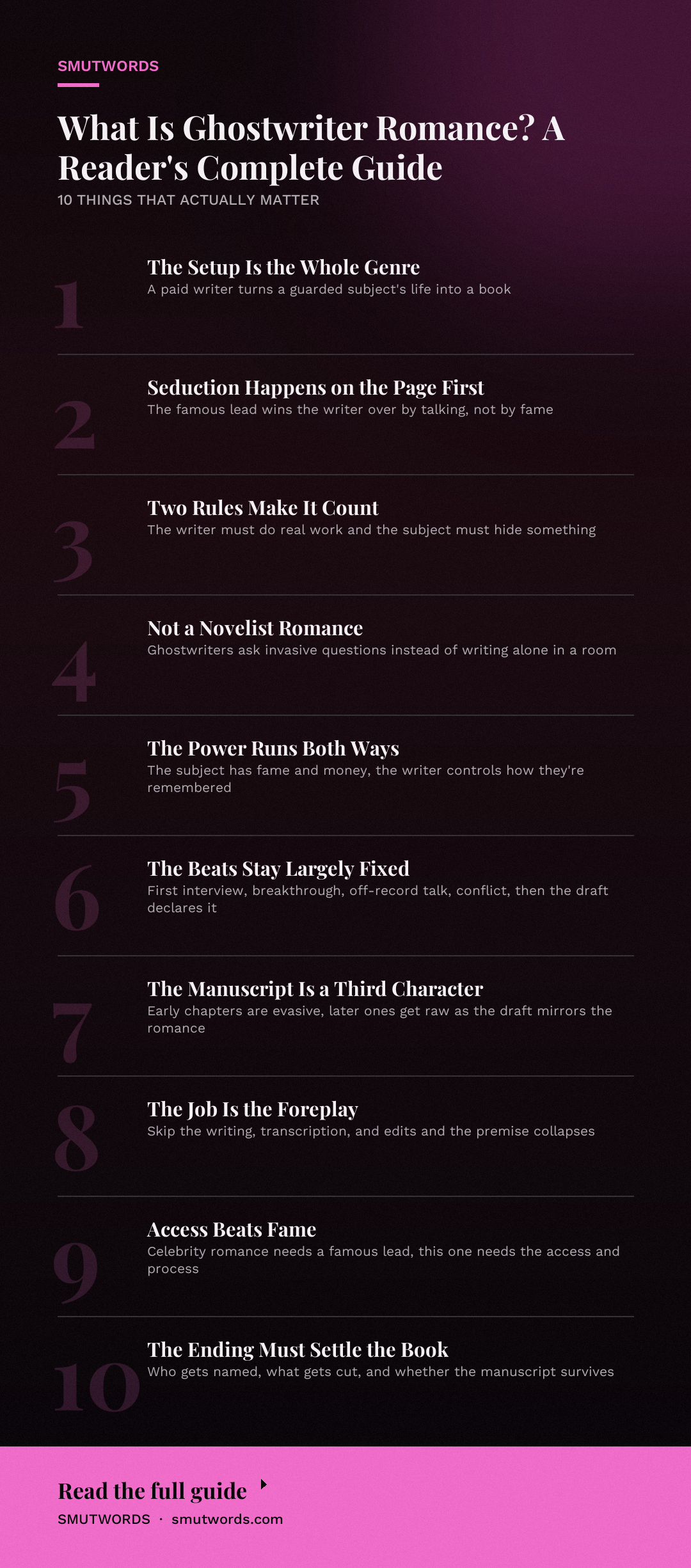
A ghostwriter romance is a love story built on a very specific triangle: the writer, the subject, and the truth. One character gets paid to turn another person's life into a readable book. The subject is usually famous, guarded, or sitting on something they can't say out loud.
Somewhere between the first interview and the final draft, the professional arrangement becomes the most intimate relationship either of them has. The genre's central promise is that the real seduction happens on the page before it ever happens in bed.
What separates ghostwriter romance from a standard celebrity or rockstar romance is where the heat lives. The famous love interest doesn't win the protagonist over with a stage, a spotlight, or a red carpet. They win them over by talking. By admitting things to a recorder that they've never admitted to a partner, a publicist, or themselves.
The protagonist has a job, a deadline, and a signed contract that says they will not sleep with the client. Those three things are the engine of the entire subgenre.
What Ghostwriter Romance Actually Means
The term describes a plot pattern rather than a formal literary category. There's no single founding text, no codified set of rules the way some tropes have. What defines it is the setup: a professional writer is contracted to produce a memoir, an autobiography, or an authorized biography for someone else, and the act of extracting that story becomes an act of emotional intimacy.
Two things have to be true for a book to actually count. First, the writer character has to be doing real work. They conduct interviews, they push back, they edit, they get blocked, they argue about what stays in the manuscript.
Second, the subject has to be hiding something the writing process will eventually surface. Strip either one out and you're left with a generic celebrity romance where one character happens to own a laptop.
Common misconceptions are worth clearing up. A ghostwriter romance is not the same as a romance about a novelist. Novelists in romance write fiction alone in a room and the love interest usually shows up as a rival or a muse.
Ghostwriters sit across from their subject and ask invasive questions for a living. That's the whole difference.
It also isn't automatically a power-imbalance story, though it often flirts with one. The subject has money, fame, and the ability to end the writer's career with one phone call. The writer has something the subject needs more: control over how the story gets told. The tension runs both directions.
Where Ghostwriter Romance Comes From
The subgenre's history is mostly a publishing phenomenon, not a kink lineage. Memoir and celebrity autobiography have been a mass-market business since the mid-twentieth century, and the ghostwriter has always been the invisible hand behind a huge share of those books. The reading public has known this for decades. That shared knowledge is what makes the romance premise land: everyone understands that behind the famous name on the cover, there's usually someone else who did the listening.
Romance publishing started using that figure as a love interest in earnest during the 2000s, when celebrity culture and confessional memoir culture collided. Writers figured out fast that the ghostwriter makes a nearly perfect romance protagonist. They're an outsider by job description, they're observant by necessity, and they have a legitimate, contractually sanctioned reason to spend hours alone with someone everyone else only gets to admire from a distance.
The shift over the last fifteen years has been in who gets to be the subject. Earlier versions leaned heavily on aging movie stars, politicians, and musicians. Recent books have expanded to athletes, tech founders, chefs, disgraced public figures clawing their way back, and fictional royals. The prince/princess romance corner of the genre picked up the ghostwriter setup enthusiastically, since a royal with a memoir deal and a family that vets every word is a natural fit for the trope.
The other evolution is honesty about the job itself. Older versions romanticized the writing process into something vaguely glamorous. Contemporary books show the ugly parts: transcription spirals, brutal rewrites, subjects who lie in interviews and then get angry when the writer notices, publishers demanding a scandal that the subject refuses to give them.
That realism is a large part of why the subgenre reads as more grown-up than its premise suggests. It's part of a broader drift toward more professionally grounded intimacy across erotica and romance, a shift covered in The State of Erotica Publishing Right Now.
How It Shows Up in Erotica
On the page, this trope runs on a structural engine that's almost absurdly effective. The writer and the subject have to be alone together, repeatedly, in a room with the door shut, asking and answering questions that go deeper than most married couples ever manage. The setup manufactures intimacy without either character having to be reckless or impulsive. That's the craft appeal for authors.
A strong ghostwriter romance usually runs the same beats, though the order and the emphasis vary:
- The first interview. The subject is charming, deflecting, and giving nothing real. The writer notices exactly which topics get a rehearsed answer. This is the hook.
- The breakthrough session. Something slips. A name, a date, a story that contradicts the official version. The writer now holds information that changes the book and the relationship.
- The off-record moment. Recorder off, drinks poured, the conversation that isn't for the manuscript. This is usually where the first real physical tension appears.
- The conflict of interest. Either the subject discovers the writer has been digging into something off-limits, or the writer realizes the book they're being asked to write is a lie.
- The draft as a declaration. A chapter, a passage, or a single sentence in the manuscript that says the quiet part out loud. The subject reads it. Everything changes.
Authors get creative with the physical contact problem. The writer and subject can't just tumble into bed early without killing the tension, so good versions delay with structure. Recording sessions that run past midnight. A research trip to the subject's hometown.
A hotel bar after a publisher meeting. A power outage that traps them in the archive. Each device buys another chapter of wanting.
The strongest versions treat the manuscript itself as the third main character. The book gets written on the page alongside the romance, and the reader watches the draft change as the relationship changes. Early chapters are polished and evasive. Later chapters get raw, and the rawness is the confession.
When the subject reads the final draft and sees themselves honestly described for the first time, that scene frequently hits harder than any sex scene in the book.
Common Variations
The hidden-identity version has the writer not knowing who they've been hired to write for until they walk into the room. This overlaps neatly with blind date romance energy, where the meeting itself is the reveal and both parties are already off balance.
The expose version gives the writer a second motive. They took the job to get close to someone, either for the story or for payback, and the assignment is a cover. That's a natural crossover with revenge romance, and it also feeds easily into enemies to lovers, since the writer is essentially lying to the subject from page one.
Enjoyed this? Get a free book.
Join the list and we will send a complete free story straight to your inbox, plus new releases every week after that. No credit card, no catch.
The damaged-subject version makes the love interest someone in genuine crisis: an athlete after a career-ending injury, a musician out of rehab, a politician after a scandal. The writer becomes the first person in years who treats them as a person instead of a headline. This is where the trope brushes against redemption arc romance.
The forbidden-contract version puts an explicit no-fraternization clause in the deal. Every kiss becomes a breach, every night together a fireable offense. The threat is never physical. It's professional, and for a freelance writer with rent due, that's plenty.
The mutual-anonymity version hires two writers, or has the subject hiding behind a pen name, so both people are standing in for something. That variant is rare and hard to pull off, but when it works, the reveal scenes are devastating.
What Makes It Work vs. What Makes It Flat
The flat versions skip the work. If the ghostwriter character never actually writes, never transcribes, never fights with their subject over a paragraph, the whole premise collapses into a famous person and a hot stranger in a nice house. Readers who came for the trope will feel the absence immediately. The job is the foreplay.
Good versions also keep the secrecy honest. In most setups, the relationship has to stay hidden from publishers, publicists, family, and the subject's existing partner if there is one. That's textbook secret relationship territory.
The trope adds one twist of its own: the manuscript is a paper trail. Every tender, undisclosed detail the writer typed into a draft is evidence. Editors read drafts. So do lawyers.
The vulnerability has to be mutual. If only the subject cracks open and the writer stays a blank professional, the romance feels like a service being performed. The best books flip it, so the writer ends up confessing something too, usually in the same chapter or the same document that broke the subject open.
Finally, the ending has to deal with the artifact. The book exists. It will be published, or it won't. Who gets to be named, who stays anonymous, what gets cut to protect the relationship, what gets left in because the truth matters more than the secret.
A ghostwriter romance that ends without resolving the fate of the manuscript has left the best scene unwritten.
Ghostwriter Romance vs Celebrity Romance
These two get used interchangeably, and they shouldn't be. A celebrity romance only requires that one lead is famous. The other can be a bodyguard, a rival actor, a bartender, a fan, a childhood friend. The fame is the obstacle and the scenery.
Ghostwriter romance is a narrower, more specific machine. The non-famous lead has a job that grants unusual access plus a professional obligation to translate the famous lead's life into words. That's a different kind of intimacy, and it produces different scenes: interviews, drafts, negotiations over what's on the record, a manuscript that both people have a stake in. The fame matters less than the process.
If you're picking between them as a reader, the question is simple. Do you want the fantasy of dating someone famous, or the fantasy of being the one person a famous person tells the truth to? The first is celebrity romance.
If you want the version where a famous musician's chaos, touring, and band drama drives the plot, that's closer to rockstar romance, where the ghostwriter setup sometimes appears as a subplot but rarely as the spine of the story.
Frequently Asked Questions
Is ghostwriter romance a real romance subgenre?
It's a recognized trope rather than a formal subgenre with its own shelf. Books using it are typically shelved as contemporary romance, celebrity romance, or romantic suspense, depending on how much of the plot involves the secret being uncovered.
Does the ghostwriter usually get credited?
In real publishing, usually not, or only as "with." In romance, the credit becomes a plot point. Whether the writer's name ends up on the cover is often the final negotiation of the book, and it doubles as a statement about how the relationship will work.
What's the appeal of the power imbalance?
The subject has fame, money, and the ability to end the writer's career. The writer controls how the subject will be remembered. Both people hold something the other can't get anywhere else, which keeps the dynamic from reading as simple exploitation.
Can the ghostwriter be the famous one?
It happens, and it's a fun inversion: a well-known author hired to write a memoir for a private, non-famous subject. The access problem flips, since now the writer is the one with handlers and a public image to manage while trying to get someone ordinary to open up.
Why is the manuscript always a problem in these books?
Because it's physical evidence. Every honest paragraph is a recording of something private, and drafts move through editors, lawyers, and publishers. That gives the trope its built-in ticking clock, and it also gives the couple something concrete to fight about besides feelings.
Does it work outside contemporary settings?
It can, though it takes adjustment. Historical versions usually swap the ghostwriter for a secretary, an amanuensis, or a family historian. The pirate romance and soldier romance corners of the genre have both used the "hired to write down someone's life story" setup to good effect, since a memoir about a war or a voyage carries its own built-in stakes.
Final Thoughts
The ghostwriter romance earns its keep because it makes intimacy a job. Two people in a room, a recorder running, a deadline, and a subject who has spent years deciding which version of themselves is safe to show. The books that handle it well understand that the hottest thing a character can do is tell the truth to one specific person and let them write it down.
If you want to see the trope at full strength, start with a title where the manuscript itself is in danger. That's the version that understands what the subgenre is actually about.





Loading comments…